
Charleston's historic peninsula rewards the traveller who arrives without a car. The Charleston Area Convention and Visitors Bureau describes the district as "highly walkable," with many sights, restaurants and shops only a few blocks apart, and CARTA's free DASH shuttle closes the longer gaps between the major sights. For a visitor based downtown, the car becomes optional for most of the stay.
The practical case is straightforward. The Battery, Rainbow Row, Waterfront Park, the City Market, King Street and the French Quarter all sit within the peninsula, and the free DASH network links them to the aquarium, the Charleston Museum and the Visitors Center. Where a car earns its keep is beyond the peninsula: the plantations along Ashley River Road and the beaches at Folly Beach, Sullivan's Island and the Isle of Palms. This guide covers the car-free core, the surfaces underfoot, and the moments when four wheels make sense.
Do you need a car in Charleston?
No, not for the historic peninsula. Charleston's historic district is described as highly walkable, with many attractions, restaurants and shops only a few blocks apart, and the free DASH shuttle is presented by CARTA as a way to reduce longer walks across the peninsula. A car becomes useful only for plantations, beaches and outlying sites.
CARTA, the regional transit authority, publishes three free DASH routes: Orange 210, Green 211 and Purple 213. Between them they connect the South Carolina Aquarium, College of Charleston, the Visitors Center, King Street, the Medical Complex, the Citadel and stadiums, Waterfront Park, City Market and the Charleston Museum. No ticket and no fare are required, for residents or visitors alike.
For anything beyond the DASH area, CARTA's regular fixed-route buses run across Charleston and surrounding communities. Riders aged 55 and over pay a discounted fare of $1 during all hours of service, according to CARTA, and a Medicare card or identification showing a date of birth will serve as proof. The authority also advertises one day per quarter when riders aged 55 and over travel all routes free; the published example is Monday, February 17th, tied to Presidents Day and National Senior Independence Month.
 AI-edited
How do the free DASH trolleys work?
DASH is CARTA's free downtown shuttle, running three routes across the historic peninsula with no fare and no booking. Vehicles have low floors with no steps, cushioned seats and panoramic windows, according to CARTA. The authority does not publish step-free access at every individual stop, so boarding conditions at a specific stop should be confirmed with CARTA before you rely on it.
The routes are worth knowing by name. Orange Line 210 covers College of Charleston, the Charleston Museum area and the South Carolina Aquarium. Green Line 211 runs along Meeting Street and King Street. Purple Line 213 takes in Lockwood Drive and Calhoun Street, and serves Waterfront Park, City Market and the Charleston Museum.
Two practical points from CARTA's own material. First, the authority directs passengers to the Transit app for vehicle tracking, and lists 843-724-7420 for questions. Second, DASH does not operate on Thanksgiving, Christmas Day or New Year's Day. CARTA publishes no further closure calendar or annual maintenance shutdown in the material reviewed here. Service alerts and route information appear on CARTA's website, and are worth checking before departure, particularly during disruptions.
Is the historic district easy to walk?
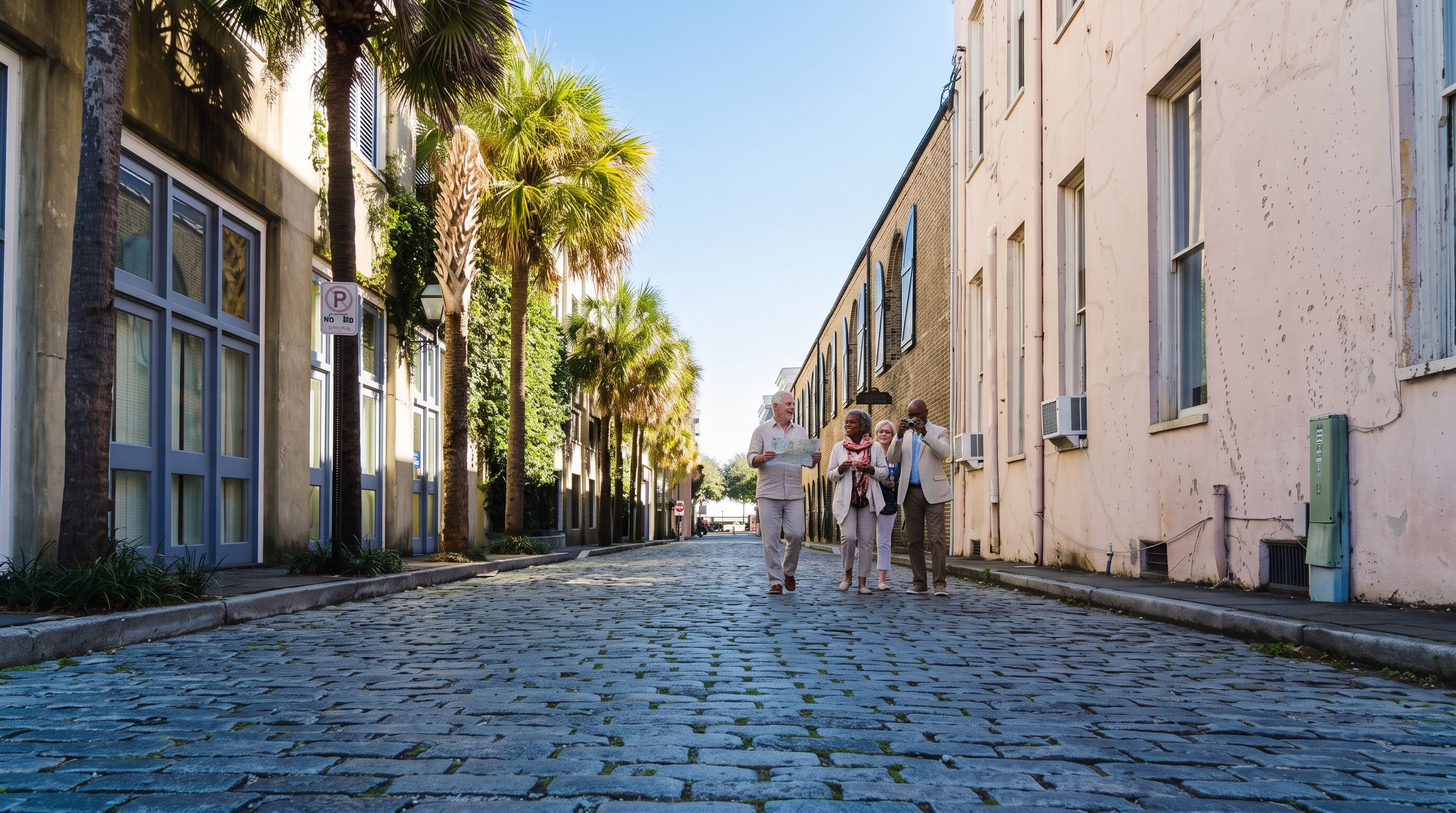
Broadly yes, with a caveat. The convention and visitors bureau calls the district highly walkable, with sights a few blocks apart. But Charleston's historic streets include older, narrow lanes and uneven walking surfaces, and no official source publishes a complete accessibility inventory for every pavement, crossing or block. The district is not documented as uniformly level, smooth or step-free.
That matters for travellers in their fifties and sixties planning a day on foot. The available official material provides no single authoritative citywide walking-distance figure, and no reliable walking time between named downtown attractions. Distances and surface conditions should be checked attraction by attraction rather than assumed from a map.
The Charleston Museum offers free wheelchairs, an entrance ramp and elevators to the second floor. The Historical Society Museum has a wheelchair entrance on Meeting Street and elevator access to both floors, with admission stated at $1, tickets bought on site, and a self-guided visit.
What about pedicabs and rideshare?
Licensed pedicabs operate in Charleston's Old and Historic District under a city ordinance requiring an operating decal, a cap on fares and a fare schedule available to passengers on request. Charleston Pedicab says it serves the downtown peninsula, including King Street, Upper King, the Historic District and the City Market. Rideshare (Uber and Lyft) covers the rest.
Charleston Pedicab publishes an operating schedule of Sunday to Thursday, 9 a.m. to midnight, and Friday to Saturday until 1 a.m., weather permitting. The operator accepts cash, credit cards and Venmo, and says passengers can reserve in advance or call for same-day pickup, with dispatch typically taking about 5 to 10 minutes. That is an operator statement, not a guaranteed response time. The published page does not give a standard per-trip fare; pricing depends on trip length and group size.
For rideshare, a Charleston visitor guide identifies Uber and Lyft as practical for restaurants and for returning from evening tours, and useful for beaches, plantations and Angel Oak. No official source publishes a citywide rideshare fare schedule. Costs vary with time, demand, vehicle category and destination, so no price should be assumed in advance.
Pedicabs suit the short hop when heat, distance, evening fatigue or uneven historic paving makes walking uncomfortable. The city's pedicab ordinance sets out the decal and fare rules that licensed operators work under.
When does a car actually help?
A car helps for the plantations west of downtown and for the beaches. Magnolia Plantation and Gardens and Middleton Place sit on or near Ashley River Road, South Carolina Highway 61, outside the historic peninsula. Folly Beach, Sullivan's Island and the Isle of Palms are also outside it. No practical walking route from downtown to the plantations is documented.
For the plantations, travel guidance recommends a car, taxi, rideshare or organised tour, and notes that a rental car or organised excursion is generally more dependable than relying on a return rideshare pickup. A 2025 Fodor's discussion reports that public transport from downtown to Drayton Hall, Magnolia Plantation and Middleton Place was no longer available, and describes a pre-arranged chauffeur service covering two plantations as a "godsend." That discussion advises arranging such transport at least a day ahead.
For beaches, the same guidance says rideshare can work but may become expensive, and that a rental car is unnecessary for a single beach outing if a tour or rideshare is suitable. A car is more helpful when carrying beach equipment, travelling at peak times, or combining several locations in one day. CARTA's visitor information confirms regular routes serve destinations beyond the DASH area, but publishes no universal rule for choosing transit over a car for plantations or beaches.
Organised excursions remove the driving question entirely. Our guide to small-group and guided tours of Charleston sets out what is available for travellers who prefer a fixed itinerary.
What does car-free travel in Charleston cost?
The DASH shuttle is free, so the core of a car-free visit costs nothing in fares. Paid options are CARTA's regular buses, with a $1 fare for riders aged 55 and over at all hours, and passes for longer stays. Rideshare and pedicab prices are not published as fixed schedules.
CARTA's published fare information gives the following figures. Passes are available at the Visitor Center, the CARTA station and selected grocery stores, according to the authority's visitor information.
| Option | Fare | Condition |
|---|---|---|
| DASH shuttle | Free | All riders, residents and visitors |
| CARTA regular bus, senior | $1 | Riders aged 55 and over, all hours; proof of age may be requested |
| CARTA regular bus, disabled | $0.75 | With a valid CARTA Card |
| One-day pass | $7 | CARTA regular routes |
| Three-day pass | $14 | CARTA regular routes |
| Seven-day pass | $15 | CARTA regular routes |
| 31-day pass | $57 | CARTA regular routes |
Two further notes from CARTA's route material: drivers cannot provide change, and passengers should arrive at the stop at least five minutes before the scheduled time. Children aged 6 and under ride free.
How accessible is public transport for older riders?
CARTA states that all its vehicles are wheelchair accessible. Fixed-route buses have wheelchair lifts, kneel to the curb, provide priority seating, secure wheelchairs and scooters, and permit service animals. The front seats behind the driver are designated courtesy seats for older and disabled passengers. DASH vehicles have low floors with no steps.
For riders unable to use fixed-route buses, CARTA offers Tel-A-Ride paratransit for eligible passengers, and operates CARTA OnDemand, described by the authority as a service for seniors aged 60 and over and Tel-A-Ride customers in its designated service area. Eligibility rules and booking procedures for both should be confirmed directly with CARTA.
CARTA's customer-information number is (843) 724-7420, and the authority lists (843) 747-1499 for TTY/TTD assistance. Its ADA coordinator can be reached at (843) 529-0400, extension 202, with requests for event accommodations recommended at least three business days in advance. CARTA also invites passengers to call (843) 724-7420 to be paired with a CARTA Ambassador.
What the authority does not publish is step-free access at every individual DASH stop, or a stop-by-stop accessibility survey. Boarding conditions at a specific stop should be confirmed with CARTA before you rely on them.
Is it safe to walk Charleston at night?
The available transport sources do not provide a current Charleston-specific solo-female or nighttime walking assessment, and no citywide safety advisory appears in the material reviewed here. Visitors should check official local advisories immediately before travel. For a life-threatening emergency in Charleston, call 911.
the City of Charleston states that no street parking is permitted on King Street between Spring and John streets from Thursday through Saturday, 6 p.m. to 3 a.m. That is useful for anyone driving into the evening, and it says nothing about pedestrian conditions.
For evening movement without a car, the documented options are rideshare, which a Charleston visitor guide specifically recommends for returning from evening tours, and pedicabs, which Charleston Pedicab runs until midnight Sunday to Thursday and until 1 a.m. Friday and Saturday, weather permitting. A local resident's Reddit account from March 2025 warns that several bridges and overpasses lack suitable walking or cycling lanes and describes crossing them on foot or by bicycle as unsafe. That is a resident's account, not an official assessment, but it is a sensible reason to keep to the peninsula on foot.
How should a car-free stay be planned?
Stay downtown, group the peninsula sights by DASH route, and book outlying trips in advance. The downtown historic district remains the easiest base for combining Fort Sumter with walking sightseeing, since the fort is on an island and reachable only by boat. A ferry ticket is required; the fort entrance itself carries no additional charge.
Fort Sumter repays a little planning. The supplied sources disagree on pricing: one reports an adult price of $43 and a senior or active-military price of $39, another reports online adult and senior prices of $28 and $25. Because the information is inconsistent, the applicable current fare is not established here; confirm with the ferry operator when booking. The Post and Courier has also reported that private funding kept Fort Sumter ferry tours operating during a federal government shutdown, so check the current operating status before relying on the ferry.
Charles Towne Landing, a South Carolina state historic site, is documented with a senior admission price of $7.50 for South Carolina seniors, compared with $12 for an adult. The source does not describe steps, lifts, walking distances or terrain there.
For a structured plan across several days, our four-day Charleston itinerary for the over-50s sequences the peninsula sights. Travellers timing a visit around events should consult Charleston through the year: festivals and quiet seasons, and those considering a historic inn can read a closer look at the Wentworth Mansion.
What else should car-free visitors know?
Confirm the details that operators do not publish, and carry the phone numbers you may need. CARTA does not document step-free access at every DASH stop, the pedicab fare schedule is available on request rather than published as a standard rate, and no official source gives fixed rideshare prices. A short call or check before you travel resolves each of these.
Recent construction is worth a glance before any trip that crosses the peninsula by road. The City of Charleston and SCDOT reported overnight lane closures on northbound U.S. 17 between Albemarle Road and the Lockwood Boulevard exit in August and October 2026, which may affect taxi, rideshare, shuttle and bus travel between downtown and West Ashley. Charleston County reported a new traffic circle opening in July 2026 at Fort Johnson Road and Camp Road on James Island, with a pedestrian detour remaining in place. Charleston Business reported in November 2026 that the nearly $200 million Crosstown drainage project had been completed, intended to make flooding shorter and shallower rather than to eliminate it.
One final piece of practical arithmetic from a local resident's Reddit account in March 2025: a journey taking roughly 20 minutes by car could require two buses and about two hours, and CARTA coverage and reliability were criticised outside the central area. That is one resident's experience rather than a visitor review, but it points the same way as everything else here. Keep the car-free plan to the peninsula, and arrange transport deliberately for everything beyond it.


