
Ubud rewards the traveller who plans around short distances, a car and a handful of well-chosen stops. It frustrates the traveller who expects to step out of a hotel and stroll. The town's central sights sit close together, and the Sacred Monkey Forest's main circuit is paved, wide and mostly level. Between those sights, however, the pedestrian environment is uneven, interrupted and at times genuinely hazardous. For visitors aged 50 to 70 who tire easily or use a stick, walker or wheelchair, the honest reading is this: Ubud is workable with strategy and difficult without it.
The town has no railway station and no direct airport rail link. Arrival from Ngurah Rai International Airport is by road, and the airport-to-Ubud route measures 42 km on the road network, about 35 minutes with clear roads and no stops. In practice the journey is commonly reported at 60 to 90 minutes depending on traffic. That gap between the measured route and the lived journey sets the tone for everything that follows: in Ubud, distance on a map tells you very little.
Can you walk around central Ubud with limited mobility?
Partly, and only in short stretches. Central Ubud's pavements are documented as narrow, uneven and broken, with slopes, open drains and missing slabs. The most usable section is roughly 200 metres of Jalan Raya Ubud between Ubud Palace and the Jalan Monkey Forest intersection, described in one recorded accessibility account as passable in a manual wheelchair with assistance, though curb cuts are inconsistent and often blocked by parked motorcycles.
The Bali Sun reported in April 2026 that Ubud's pavements had broken slabs and holes, with injuries ranging from sprains to serious falls, and described navigating the area with wheelchairs, pushchairs or mobility aids as "something of a nightmare." The same reporting said impassable pavements often push pedestrians into the road, alongside congestion and illegal parking.
Other documented hazards recur across accounts. Kerbs are reported as high as about 40 cm in places. Concrete slabs around storm drains are sometimes missing. Utility poles interrupt narrow stretches. Scooters and vendors occupy what pavement exists. After heavy rain, surfaces flood and become slippery.
There is one piece of forward-looking news. The Bali Sun reported that approximately 7 km of pavement was scheduled for major improvement in 2026, extending roughly from the Teges intersection to Kedewatan, with the Gianyar Regency section covering the pavement from Ubud Palace to the entrance to Campuhan Ridge Walk. That is a planned works programme. The available reporting does not establish that the work has been completed or that the redesigned routes will be step-free, and construction itself can create temporary diversions and uneven surfaces.
 AI-edited
Which Ubud sights are step-light?
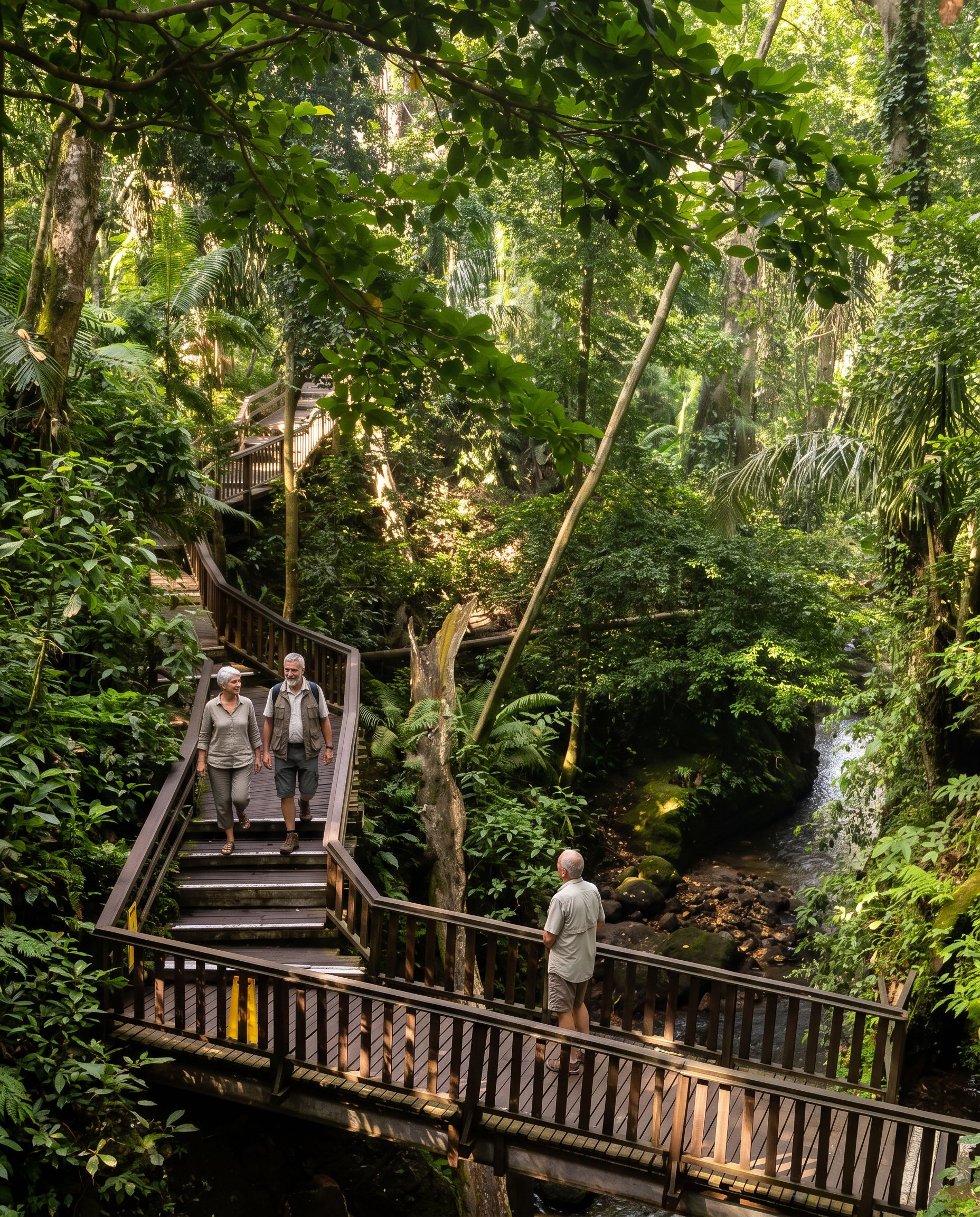
The Sacred Monkey Forest's main visitor circuit is the easiest substantial walk among the named sites: paved, wide, mostly level, shaded and equipped with benches. Ubud Palace's courtyards are described as more manageable than the outlying sites. Pura Taman Saraswati has a short, central approach. Beyond these three, step counts and step-free routes are not published for any named attraction.
The central cluster of Ubud Palace, Pura Taman Saraswati and the Sacred Monkey Forest can be visited in one unhurried day. The Palace sits at the junction of Jalan Raya Ubud and Jalan Monkey Forest, and the walk from Palace to Monkey Forest is approximately 1.5 km, or about 20 minutes along Jalan Monkey Forest.
Practical detail for the Forest: it opens daily from 09:00 to 18:00, with last admission at 17:00. Admission is IDR 130,000 for adults and IDR 100,000 for children. No senior rate is published. The official information does not publish a step-free circuit, route distances, wheelchair hire or an escort service, and a sanctuary-specific pharmacy or medical post is not documented. Macaques around the Forest are identified in Ubud safety material as a practical concern, and they may approach bags or wheelchair components.
Ubud Palace is reported as free or subject to a modest gate fee, but no single confirmed current tariff is established. Steps, lifts, accessible toilets, a step-free route and an assistance service are not documented for the Palace. Pura Taman Saraswati is a living temple rather than solely a historic monument, and ceremonies can restrict visitor access. A specific current tariff for Saraswati is not clearly established.
What about the rice terraces and ridge walks?
Rice-terrace paths and ridge walks are not reliable accessible routes. They may include dirt, stairs, narrow edges and no turning space, and forum contributors caution that terrace and waterfall outings involve elevation changes even when the walking distance is not long. Campuhan Ridge is a changing-gradient ridge walk, not a level promenade, and is unsuitable for visitors who cannot manage slopes, loose surfaces or steps.
This is the section where honesty matters most. The photographs of Tegallalang and the Campuhan Ridge sell a version of Ubud that involves descents into valleys and climbs back out. The steps are irregular stone, handrails are limited, and wet-season surfaces turn slick. Standard sightseeing circuits of this kind are unsuitable for many wheelchair users or anyone unable to manage stairs.
One workaround documented in traveller discussions is to view the rice terraces from a café rather than walk through them; Tis Café is named as one such vantage point. For Tegenungan Waterfall, reports warn of many stairs and a steep approach, with viewing from Omma day club suggested as an alternative if access to the club can be confirmed in advance. Gunung Kawi, discussed in a March 2026 forum thread, requires many steps and is described as unsuitable for some visitors with mobility problems.
If you want the scenery without the gradient, ask a driver to build a route of roadside viewpoints. The choice between a central town base and the rice valleys shapes how much of this you can do, since valley properties sit on slopes and their approaches are not documented as level.
Are the outlying temples worth the trip for someone who tires easily?
They are worth it if you go by car and accept that the approaches involve steps and uneven ground. Goa Gajah lies 6.5 km from Ubud, about 10 minutes with clear roads, and Tirta Empul 17 km, about 20 minutes with clear roads. Neither publishes step counts, and neither documents a fully step-free route, lifts, seating provision or an assistance service.
Goa Gajah is described as rewarding for its living ritual but less suitable for visitors seeking a consistently level route. Cave and temple approaches may include steps, narrow paths and wet or slippery surfaces. Tirta Empul is a spring-temple complex offering active ritual bathing rather than a museum-style visit, and movement between the water spouts involves additional walking and standing. It is among the less suitable named sites for visitors seeking consistently level access.
No senior concession is documented at any of the named attractions, and no Ubud-wide senior, accessibility or multi-attraction pass is documented either.
Two practical notes apply to all temple visits. Access may be restricted during ceremonies, so check at the entrance on the day. And Nyepi, Bali's Day of Silence, stops normal activity across Ubud for 24 hours, including sightseeing, transport and evening performances. The exact Nyepi date changes according to the Balinese calendar and should be confirmed locally. International visitors also pay a Bali tourist levy of IDR 150,000 through the official Love Bali system, separate from attraction admission.
Where can I stop and cool down?
Air-conditioned rest stops are a planning category rather than a documented list. The practical approach is to identify a handful of indoor venues on your route before setting out and confirm their facilities directly.
Ubud's reported climate normals show mean daily temperatures between 24.2°C in July and 25.9°C in November, with mean highs reaching 30.5°C in April and November. Humidity adds to the load, and the practical consequence for anyone with limited stamina is a short walking window followed by a cool pause.
Two named indoor options are documented for their access rather than their air conditioning. ARMA Museum in Pengosekan has a ramp entrance to the main gallery, and its ground-floor galleries reportedly have smooth floors and wide doorways; the upper floor requires stairs. Satyanara, a newer Ubud cultural centre, is reported as wheelchair-accessible throughout and open Tuesday to Sunday, 10:00 to 18:00, according to NOW! Bali's report on Satyanara. That fact applies to Satyanara, not to Ubud generally.
For the heat itself, our guide to coping with heat and humidity in Ubud sets out timing and hydration in more detail. And if a slow morning is the goal, a gentle yoga and spa day is a low-walking way to fill it.
How do I get around without walking far?
By private car and driver, arranged in advance. Public transport around Bali is generally not wheelchair-accessible, particularly in rural areas, and ordinary taxis and ride-hailing vehicles are not established as wheelchair-accessible in the available information. Kura-Kura buses are reported not to offer wheelchair facilities.
One published Ubud guide gives approximately IDR 600,000 per day for a private driver, an indicative travel-guide figure rather than an official tariff. Trans Metro Dewata has a disabled-passenger fare-registration category, but step-free boarding at the airport, Ubud stops or nearby terminals was not verified. Perama bus services between Ubud and Kuta/airport are reported, but accessible boarding or wheelchair provision is not documented.
For airport arrival, the airport's Special Needs Service covers wheelchair support, accompaniment and a special waiting area. Request it through your airline before departure and specify the assistance required. Confirm in advance whether the booked vehicle can carry an unfolded wheelchair, since airport accessibility does not imply that the road journey or Ubud's pavements are accessible. Pre-booked private airport transfers to Ubud are reported by Traveloka at approximately IDR 300,000 to 450,000 for a sedan or minivan, with the airport-counter taxi reported at approximately IDR 360,000 to 430,000 and queues of 20 to 30 minutes possible during busy periods. Rates are indicative and vary by season and booking channel.
Traffic arrangements can change the picture. A DOMA News report said that from 8 September 2026, Jalan Raya Ubud and Jalan Raya Pengosekan would operate one-way, with tour buses barred from central Ubud and passenger drop-offs designated at Dalem Puri. The report said launch-day congestion produced delays in the centre. For older visitors this could mean fewer large coaches in the centre but longer or less convenient transfers from the drop-off point, so allow extra time for short central journeys.
What happens when it rains?
Paths, steps and stone surfaces become slippery, and the wet season runs from November to March with more frequent heavy showers. January, February and December are the wettest months in the reported Ubud figures, at 325 mm, 292 mm and 292 mm respectively. Operators may modify or cancel waterfall visits during particularly heavy rain.
Rain changes the risk profile rather than just the view. Forest, cave and spring surfaces may be wet or slippery. A traveller with a slight limp reported nearly falling into pavement holes during a rainy first evening, and the same discussion warns that humidity and mud can make paths slippery, including the route around Tjampuhan Temple, and that some alleys are dimly lit.
For mobility-conscious itineraries, June to September generally offers the most dependable conditions, although July and August are busier. Shoulder periods of April to May and September to October are presented by Discover Ubud as more manageable, combining fewer visitors with relatively favourable weather. If you travel in the wet season, plan indoor or covered stops as the anchor of each day and treat outdoor paths as optional.
What medical help is nearby if something goes wrong?
Ubud has 24-hour clinic cover. UbudCare Clinic in Peliatan runs 24-hour emergency services with doctors, laboratory services, a pharmacy and an ambulance service, at Jalan Raya Teges No. 8, telephone 0811 3977 911. BIMC Ubud Medical Centre in Kedewatan runs 24-hour medical and emergency services with a pharmacy, at Jalan Raya Sanggingan No. 21, telephone +62 361 2091 030.
Two further points are worth knowing. UbudCare states that its pharmacy is an on-site service for patients receiving treatment and is not documented as an ordinary over-the-counter retail pharmacy. And RSUD Gianyar is reported as Ubud's closest 24-hour hospital, approximately 13 km east of Ubud. Kenak Medika Hospital Ubud in Mas is also reported as operating 24 hours.
Ubud Royal Medical is reported as a 24-hour clinic with English-speaking doctors and an on-site pharmacy, but the material does not provide a precise distance from each attraction. A pharmacy or medical post at Ubud Palace, Saraswati, Monkey Forest, Goa Gajah or Tirta Empul is not documented, so carry what you need for the day.
Reported Bali emergency numbers are 112 for general emergencies, 110 for police, 113 for fire, 118 or 119 for ambulance and medical emergencies, and 115 for search and rescue.
When should I go, and how should I plan the days?
Go in the drier months if you can, stay central, and build each day around one or two stops with a car between them. Ubud is feasible for many older travellers with limited mobility when organised around a suitable hotel, private transport, assistance and a small number of vetted venues. It is not well suited to independent wheelchair touring or long, spontaneous walks.
The pattern that recurs in traveller accounts is a central base, a driver on call and a short list of confirmed venues. Do not assume a resort described as "near Ubud" is walkable: travellers report walks of about 30 minutes from river or valley-ridge resorts into town, and around 45 minutes from some outlying hotels, on routes that may lack pavements, lighting and safe shoulders. One discussion recommends accommodation within roughly 10 minutes' walking distance of central Ubud or a property with a regular shuttle.
Hotel access is a separate subject with its own dedicated guide, where to stay in Ubud with comfort first, and it deserves the attention. What matters at town level is narrower: ask the exact property to confirm the number of steps from the entrance to reception, the bedroom and the restaurant, whether a lift serves the reserved room rather than just the main building, and whether the shower is genuinely level-entry. A short map distance is not an easy walk.
Finally, the town's cultural life is the reason most people come, and much of it is reachable without a long walk. Our guide to Ubud's temples, palaces and sacred sites sets out what each site involves, and the Balinese food guide covers where to eat between stops. Ubud lies within the cultural landscape associated with Bali's subak irrigation system, included in the UNESCO World Heritage listing "Cultural Landscape of Bali Province". That listing applies to the designated landscape and its component areas, not to every street, and it is not evidence that Ubud's pavements or temples are step-free.
The bottom line for a traveller who tires easily
Ubud suits older visitors who can tolerate uneven ground and use transport strategically. It is a poor choice for anyone who needs continuous, level, well-lit pavements. The town's central sights are close, the Monkey Forest circuit is the easiest substantial walk, and a car solves most of the rest.
Plan for short daylight walking sections, preferably on back streets or within the compact centre. Avoid dark walks, heavy rain and wet paths. Wear shoes with firm grip, leave both hands free, and expect to stop frequently. Do not assume a pavement will continue around the next corner.
For severe arthritis or major balance limitations, consider using Ubud as a car-based destination rather than a walking base. A discussion involving mobile parents in their 80s reports that they enjoyed flatter Sanur but struggled in Ubud, a comparison that applies to Sanur while the warning about difficulty applies to Ubud. That is the useful framing: Ubud is not inaccessible, but it is not forgiving either. Go with a driver, a central room, a short list and realistic expectations, and the town gives you its temples, its forest and its ritual life without demanding that you walk to them.


