
Ubud sits inland and a little above sea level, which makes it cooler and greener than Bali's coastal resorts. It also makes its weather its own subject. The town has a wet season and a dry season like the rest of the island, but the local pattern matters more than the island-wide averages, and the difference between a well-timed visit and a poorly timed one is measured in mud, humidity and how far you can walk before the sky opens. For travellers aged 50 to 70 planning around firm footing and manageable crowds, the month you choose does most of the work.
The good news is that Ubud stays visitable all year. The better news is that the window between May and September combines the driest conditions with the most predictable days, and the margins of that window, May, June and September, add fewer visitors than the July and August peak. What follows is a month-by-month reading of the year, with the honest caveats the climate data supports.
What is the best time to visit Ubud for dry days and fewer crowds?
May, June and September offer the strongest documented balance: they fall inside the drier April to October period while avoiding the July and August peak. Bali.com identifies May, June and September as the best balance of good weather and fewer tourists. Tripadvisor's Ubud planning data names June as the best compromise, with September another reasonable option.
The sources do not agree on a single perfect month, and that disagreement is worth stating plainly rather than smoothing over. Bali.com points to May, June and September as a group; Tripadvisor's planning data leans toward June first and September second. Both readings sit inside the same window, so the practical answer for most readers is to pick whichever of those three months suits the diary and accept that the difference between them is small.
What all the guidance agrees on is the shape of the year. April to October is the drier half, and the paths, rice terraces and road-based excursions are more likely to stay firm. July and August are drier still but are Ubud's busiest months, with higher demand, prices and crowd levels. Travel + Leisure Asia reports that Ubud sees a surge of visitors in those two months, while April, May and September provide a more relaxed pace.
What does each month actually feel like?
The year divides cleanly: rainfall climbs through November, December and January, falls away from April, and bottoms out in August. A 1991 to 2020 climate series for Ubud gives roughly 396 mm in January and about 12 mm in August, with sunshine hours rising from about 6.1 in December to around 9.1 in August.
Those figures come from a cited Ubud series, and they matter because Ubud's rainfall is not the same as the coast's. One published Ubud table gives September as approximately 22 to 29°C, around 110 mm of rain and about 80 per cent humidity, which sits oddly against the lower September figure in the longer series. The asiavela.com guide warns specifically that reliable separate rainfall figures for Ubud are limited, and that coastal Denpasar data should not be treated as an exact Ubud forecast. Treat the numbers below as a shape, not a promise.
| Month | Rainfall | Sunshine | What to expect |
|---|---|---|---|
| January | ~396 mm | ~6.5 hrs | Peak wet season; humid air and potentially disruptive downpours |
| February | ~289 mm | ~6.7 hrs | Very wet |
| March | ~222 mm | ~7 hrs | Still wet |
| April | ~125 mm | ~7.9 hrs | Transition; not as consistently dry as May to September |
| May | ~76 mm | ~8.4 hrs | Strong shoulder-season choice; lower humidity, fewer visitors than the peak |
| June | ~38 mm | ~8 hrs | Dry, sunny and relatively quiet; good for walking and excursions |
| July | ~27 mm | ~8.5 hrs | Dry but peak tourist season |
| August | ~12 mm | ~9.1 hrs | Driest month in the cited series; busiest |
| September | ~30 mm | ~8.9 hrs | Dry with fewer crowds than July and August |
| October | ~74 mm | Not given | Rainfall rises and humidity begins increasing |
| November | ~132 mm | Not given | Wet season begins in many travel-climate guides |
| December | ~295 mm | ~6.1 hrs | Wet, with Christmas and New Year crowds despite the rain |
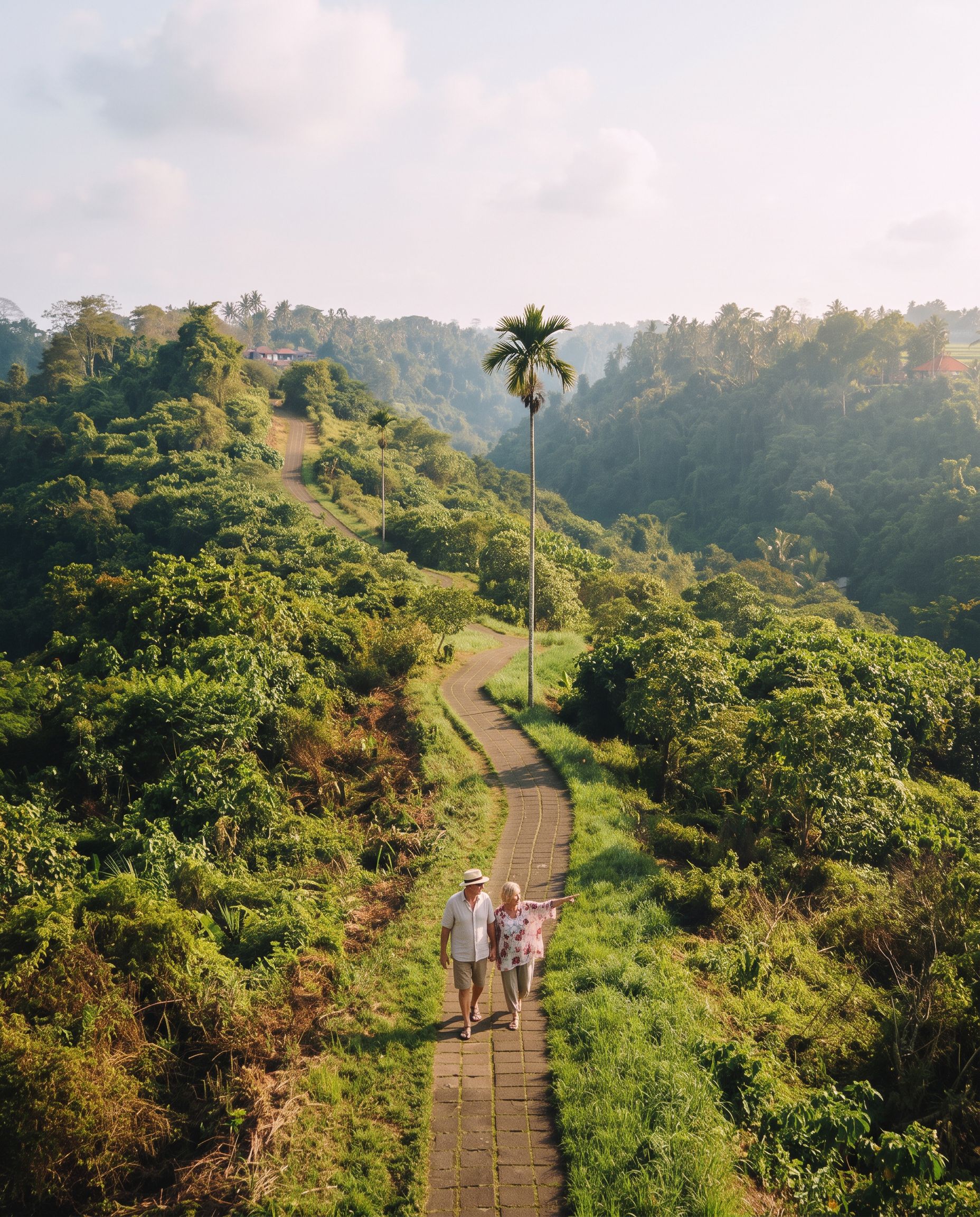
Two months deserve a closer word. May is a strong shoulder-season choice: relatively dry, with fewer visitors than the July and August peak, and lower humidity than the wetter months. June is dry, generally sunny and relatively quiet compared with the high season, which makes it a particularly good month for walking and excursions. October is viable, but afternoon showers become more likely as rainfall rises to about 74 mm and humidity begins increasing.
 AI-edited
How wet is the wet season, honestly?
Wetter than the reassuring "afternoon shower" line suggests. Bali.com describes afternoon showers as commonly lasting one or two hours rather than producing uninterrupted rain, but Ubud-specific reporting records intense showers and far greater monthly rainfall in January, February and December. A short-shower assumption is risky for important outdoor plans.
January is the month to think about hardest. The Bali Guide Line describes wet-season conditions in January as typically among the wettest, with humid air and potentially disruptive downpours. The monthly figures back that up: roughly 396 mm in the cited Ubud series, against about 12 mm in August.
First-hand accounts from the wet season vary widely, and the variation is the point. Reports from January 2024 describe rainy-season days that were mostly dry, with some showers lasting about an hour, but stress that humidity and heat remained intense. A January 2026 Ubud account reports several brief showers of about 20 minutes amid otherwise sunny, hot or overcast weather. A January 2025 Reddit discussion warns that Ubud's mountain location and rainforest environment can bring heavier rain, slippery paths and occasional flooding, and includes an account of rain continuing for almost 72 hours, although that visitor still enjoyed the Campuhan Ridge walk and the local markets.
There is a small consolation for crowd-averse travellers: rain can reduce crowds because visitors take shelter indoors. It is not a reason to book January for a walking holiday, but it is a reason not to write the wet season off entirely if the dates are fixed.
Is Ubud humid even in the dry season?
Yes. WeatherSpark's long-term analysis finds the share of time classed as muggy, oppressive or miserable stays within roughly two percentage points of 98 per cent throughout the year. "Dry season" in Ubud means less rain, not cool air or low humidity.
This is the single most useful correction to make before packing. Temperatures hold at roughly 20 to 30°C year-round, with daytime highs around 29 to 30°C and nights near 21°C. The dry months bring more sunshine and firmer ground, not relief from the warmth.
For older travellers the practical consequences are straightforward. Early morning is consistently recommended for the main sights, because paths are cooler and major attractions are quieter before mid-morning. Carrying water is advised on the Campuhan Ridge Walk, and wet conditions can make that path slippery. Anyone managing heat sensitivity should treat the middle of the day as indoor time regardless of the month.
What do the crowds actually look like, month by month?
July and August are the peak, with higher demand, prices and crowd levels. Late January to March is among the quieter periods outside Christmas and New Year, but wet-season rain is more likely. Shoulder periods in April to May and September to October are described as calmer and potentially less expensive.
Recent visitor reports add texture the seasonal averages miss. A July 2025 Reddit discussion says the dry high season attracts visitors expecting ideal weather, which can make Ubud's restaurants, spas and roads crowded; another contributor identifies July and August and Christmas and New Year as the peak periods. A discussion updated in January 2026 says the central area is "as busy as ever" and reports that after about 10 a.m. it can become particularly crowded.
Traffic is part of the crowd picture. Reddit reports from July 2025 repeatedly say central Ubud traffic is often so slow that walking is faster, with one account of a vehicle remaining stationary for roughly 20 minutes. The same discussion reports that high-season traffic is worst approximately 11 a.m. to 8 p.m., and recommends visiting popular areas early in the morning or in the evening after day-tour crowds have departed.
Early October is a special case. It can offer good shoulder-season weather, but Australian school holidays and public holidays can increase family travel in early October, so the calm depends on which week you pick.
Which months suit walking and the outdoor sights?
April to October is the best walking period, especially May, June and September. Paths and roads are more likely to remain firm, which matters for the Campuhan Ridge Walk, the rice terraces and road-based excursions. Central Ubud's pavements are another matter and are narrow, broken in places and often obstructed.
The distinction between walkable and easy is worth holding onto. Central Ubud is compact enough that the palace, market, Saraswati Temple, Monkey Forest and many cafés sit within roughly 1.5 km of one another. But published guidance describes narrow, uneven or broken pavements, parked scooters and open drains. A February 2025 Reddit thread describes uneven paving, sloping surfaces, abrupt level changes and poorly maintained kerbs, and warns that paths can be challenging for limited mobility, particularly near Tjampuhan Temple where humidity and mud may make surfaces slippery.
For the outdoor set pieces, season changes the experience directly. The Sacred Monkey Forest's main circuit is described as paved, wide, mostly level, shaded and equipped with benches, and it is open daily with reported hours of 09:00 to 18:00 and last admission at 17:00. Adult admission is reported as IDR 130,000 and child admission as IDR 100,000; no senior rate is documented. The rice terraces at Tegallalang involve dirt paths, stairs, narrow edges and uneven terrain, and wet-season paths may become muddy and slippery. The fuller picture of steps, gradients and transport is covered in our guide to how accessible Ubud is for older travellers.
How many days should you allow?
A practical first visit is three full days for central Ubud, a cultural or museum day and a rice-terrace or countryside excursion. Four nights is not excessive for a slower-paced trip, particularly when allowing for weather, rest and travel time.
The weather argues for slack in the itinerary. A wet-season downpour can wipe out an afternoon, and a dry-season day can still bring a shower, since Ubud's inland, elevated setting is described as cooler and wetter than Bali's coast. Building in one flexible day costs little and protects the rest.
Ubud's appeal lies in the combination of inland Balinese culture, temples, crafts, rice landscapes, wellness activities and greener valley scenery rather than beaches. That mix rewards a slower pace than a checklist allows. A sensible structure is one or two principal stops per day, with transport between them rather than attempting a long sequence of walks.
Getting there shapes the calculation too. Central Ubud is reported at roughly 35 to 38 km from Ngurah Rai International Airport, with a typical road journey of about 60 to 120 minutes depending heavily on traffic. A day trip is possible for a tightly selected itinerary, but the airport journey and traffic can make it tiring; staying several nights is more comfortable for older travellers and permits early starts.
What should you pack for the season you choose?
Pack for heat and humidity whatever the month, add rain protection even in the dry season, and bring footwear that grips. Temple visits require covered legs, and women are advised to cover their shoulders. A flashlight is worth having for dimly lit alleys.
- Rain layer: showers are possible in the dry season, and afternoon showers in the wetter months commonly last one or two hours.
- Grippy shoes: wet stone and mud are reported on ridge, terrace and waterfall routes.
- Temple clothing: visitors entering the active temple area at the Monkey Forest are advised to cover their legs, and women to cover their shoulders.
- Water: carrying water is advised on the Campuhan Ridge Walk.
- A small torch: recommended in a February 2025 discussion for dimly lit alleys.
Food and drink deserve their own planning note, particularly in the heat; our guide to food and water safety in Ubud for the over-50s covers what to check. For the evenings, the town's dining rooms are a topic in themselves, and Ubud's restaurants and jungle-view dining sets out the options.
Where should you stay, given the season?
Central Ubud is the most practical base for the palace, market, Saraswati Temple, Monkey Forest and cafés. Penestanan, Nyuh Kuning and the Campuhan area provide quieter settings but may require more walking or transport. A Reddit thread from April 2024 also recommends looking beyond the centre to Kedewatan, Sayan, Pejeng, Tegallalang, Peliatan and Nyuh Kuning.
Season changes what you want from a room. In the wet months, a central base shortens the dash between showers. In the dry peak, a property set back from the main road buys quiet when the town is loud. Properties set back from Ubud's main roads are often quiet, but rooms beside bars, clubs or neighbouring buildings can be very noisy; at Cendana Resort, several Tripadvisor reports mention live music from a neighbouring venue, with some rooms affected until midnight or as late as 1 to 2 a.m., and one review specifically recommended earplugs. Ask for a room away from the bar.
Traffic noise is a separate issue from town noise. A May 2026 Tripadvisor review of The Westin Resort & Spa Ubud described constant traffic and horns from a busy road as early as 5 a.m., and another review reported motorcycle noise on the first night before being moved to a quieter room. By contrast, Tripadvisor guests at Green Field Hotel and Restaurant repeatedly praised its quiet position near rice terraces and reported that traffic was inaudible, and The Artini Dijiwa was described as peaceful, with birds and water sounds rather than road noise. Our guide to the quietest retreats around Ubud goes further into room choice.
What else should you sort out before booking?
Check passport validity of at least six months, confirm whether your nationality needs a Visa on Arrival or e-Visa, and budget for Bali's tourist levy of IDR 150,000 per foreign visitor per arrival, separate from the visa fee. The levy can be paid through the Love Bali platform before arrival, generating a QR code that may be checked at the airport or popular sites.
The travel-advisory source does not provide nationality-specific visa eligibility, permitted stay lengths or passport-page requirements; these should be checked against the Indonesian immigration authority for your nationality. Attraction charges are separate from the levy, and no verified Ubud-wide pass or senior discount is documented for any named attraction.
For medical planning, published local guidance lists UbudCare Clinic in Peliatan, with emergency services, doctors, laboratory, pharmacy and ambulance on 0811 3977 911, and BIMC Ubud Medical Centre in Kedewatan, with 24-hour medical and emergency services and a pharmacy on +62 361 2091 030. These are operator-specific services, not a guarantee of universal 24-hour medical coverage throughout every Ubud neighbourhood. The national emergency number is 112, and the Ubud Tourist Police can be reached on (0361) 755 316; the advisory does not specify whether 112 reliably connects to every emergency service in all circumstances, so hotel staff or a clinic should place the call and give the exact accommodation name, road and nearest landmark.
One local development is worth knowing if you are booking accommodation in the centre. The Bali Sun reported in June 2025 that the former PARQ Ubud site had been acquired and was intended to become a tourism-accommodation complex, with further details pending; the timing, branding and exact facilities of any reopening were not documented. Separately, the town's ceremony calendar is a subject in its own right and has its own dedicated guide.
Ubud rewards the traveller who chooses the month deliberately. Pick the shoulder of the dry season, plan one or two stops a day, arrange a car for anything outside the centre, and the town's temples, terraces and valley walks are yours at a pace that suits.


