
Tuscany rewards travellers who plan their moves as carefully as their sightseeing. The region's beauty sits in its hill towns, vineyards and medieval walls, but those same qualities make transport a genuine question. For travellers aged 50 to 70, the choice between rail, bus and rental car shapes the entire trip, from daily fatigue levels to how many towns you can realistically see. The good news is that a car-free visit works well for the main cities, while a car opens up the countryside for those prepared to handle narrow roads and strict parking rules.
This guide focuses purely on moving within Tuscany. Arriving from abroad, whether by air or long-distance rail, is a separate topic with its own dedicated guide. Here we cover the practical realities of the Florence to Siena and Arezzo rail lines, the regional buses that reach smaller hill towns, and an honest assessment of whether hiring a car makes sense for your itinerary.
Can you see Tuscany without a car?
Yes, for the main cities and several hill towns, but public transport demands planning and some walking at each end. Trains serve Florence, Siena, Arezzo, Lucca and Pisa well, while buses fill the gaps to smaller settlements. The schedules, not the geography, are the real limitation.
Tuscany can be visited without a car for major city-to-city travel, according to the region's official tourism guidance. Regional trains reach many of Tuscany's cities and towns, and the places that cannot be reached by train can be reached by bus, which almost always leaves from the closest stations, as Visit Tuscany's getting around page explains. This pattern, train to a hub then bus to the town, is the backbone of car-free travel here.
For travellers over 50, trains are often the better choice for intercity travel, while buses prove more useful for smaller towns. Florence's Santa Maria Novella station functions as the region's main rail hub, with regional connections radiating toward Prato, Pistoia, Arezzo, Siena, Grosseto and many other destinations, according to Italo's Tuscany rail page. The practical consequence is that a base in Florence or Siena with good rail links can remove the need for a car entirely, provided you accept that some days will include a bus connection and a walk at the far end.
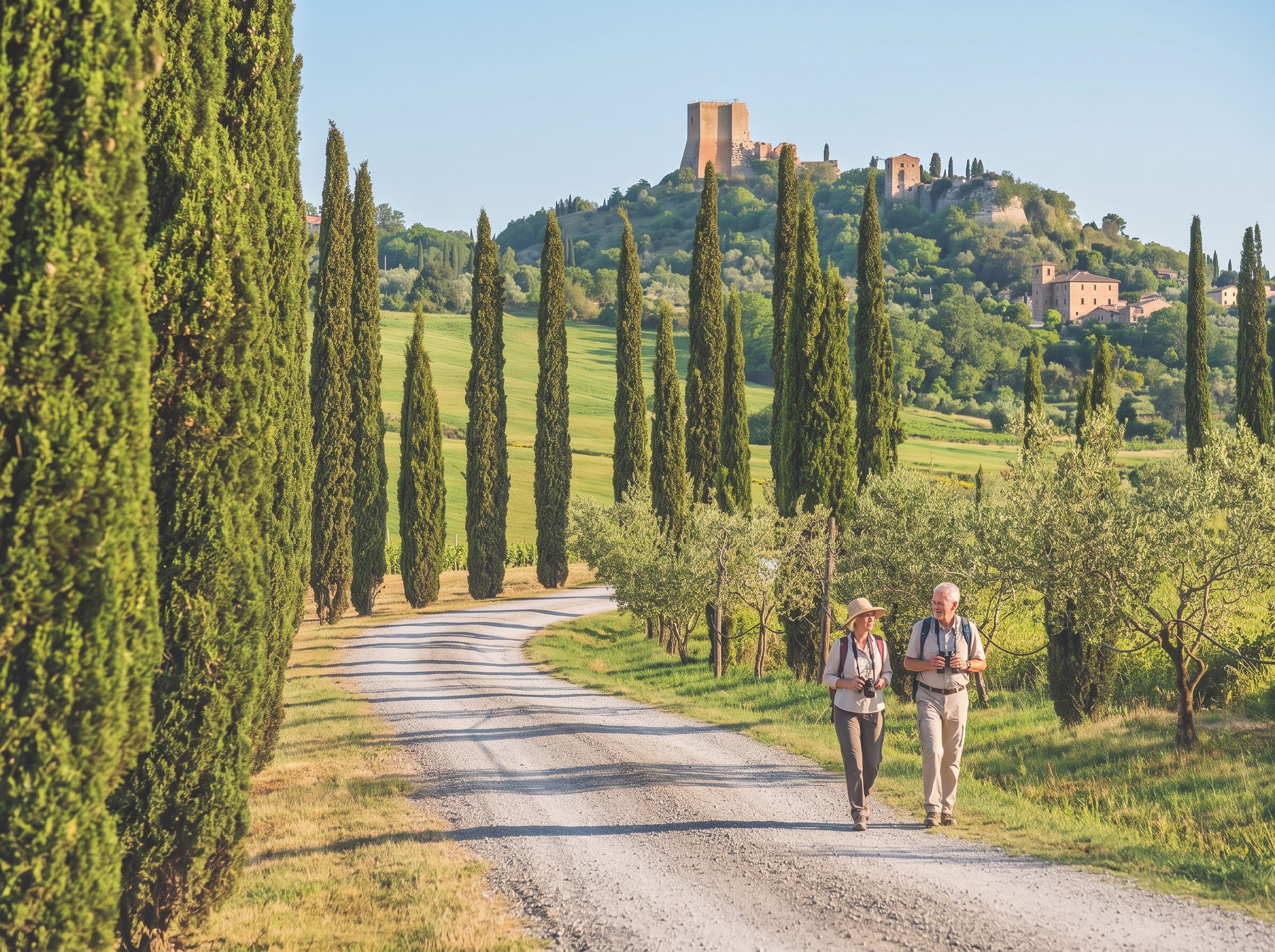 AI-edited
How good are the trains between Florence, Siena and Arezzo?
The Florence to Arezzo line is direct and efficient, while Florence to Siena is indirect and often slower than the bus. Journey times vary by service type, so check whether you are booking a regional or faster train before you commit to a schedule.
The Florence to Arezzo corridor is the region's strongest rail link. Published timetables show regional travel between the two cities takes roughly 50 to 100 minutes depending on the service, while an intercity service can complete the journey in about 40 minutes. Discover Tuscany's rail guide describes Arezzo station as an important hub on the Florence to Rome line, with high-speed Florence to Arezzo journeys of about 35 to 40 minutes and regional-fast journeys of about 55 to 60 minutes. Measured from the published weekday timetable for September 2026, the journey spans about 65 to 95 minutes with no change required.
The Florence to Siena rail route is less straightforward. The line runs indirectly, often via Empoli, and published guides advise that the journey can take up to about 100 minutes by train and is often not the best choice. Measured public transport connections for the same September 2026 weekday show about 85 to 105 minutes with zero or one change, using either bus or train. Many experienced travellers recommend the direct bus from Florence to Siena instead, with one forum post quoting a journey of about 1 hour 15 minutes. The bus departs from Florence's bus station near Santa Maria Novella and arrives at Siena's Piazza Gramsci, which sits closer to the historic centre than Siena's railway station.
What are the regional bus options for hill towns?
Buses are the practical link for many places not served by rail, including San Gimignano, Montalcino and parts of the Val d'Orcia. Services are timed more for commuters and students than tourists, so check schedules carefully, especially on Sundays.
Regional bus operators cover the gaps in the rail network. Tiemme and other operators serve Siena, San Gimignano, Grosseto and Arezzo areas, while bus networks also reach Val d'Elsa, Chianti and other inland districts. From Poggibonsi, a town on the Siena to Empoli rail line, buses reach San Gimignano in about 30 minutes, Siena in about 45 minutes, Colle Val d'Elsa in about 15 minutes, and Florence in about 1 hour 30 minutes with a change, according to a published guide for the area. The same guide notes that regional trains on the Siena to Empoli to Florence line run roughly hourly in both directions from the Poggibonsi-San Gimignano station.
For the classic hill towns, the pattern is usually train to a valley station, then bus up into the town. Cortona is reached by train to Camucia station, then a local bus up into the town, with one forum post advising travellers to make sure they take the correct bus. Montepulciano's station sits outside town, and Montalcino has no train station at all, so a bus, taxi or car is needed for the final leg. A Fodors forum post warns that buses are fine for smaller towns but are more timed for commuters and students than tourists, and that schedules can be difficult, especially on Sunday.
Should you hire a car for the countryside?
A car is the most flexible way to explore rural Tuscany, particularly the Chianti vineyards and Val d'Orcia landscapes, but it comes with real costs: ZTL restrictions, scarce parking and narrow medieval streets. Many travellers split their trip, using public transport for cities and a car only for a countryside block.
Published guidance is consistent on this point. Renting a car is the best way to get around Tuscany except in historic centres, according to one Tuscany guide, while another notes that a car becomes useful once you leave Florence for the rural part of the trip. The same sources warn that narrow medieval streets and limited parking are major downsides. A Rick Steves forum post calls a car the best way to see Tuscan towns and cities but notes that parking is a serious problem.
For travellers over 50, the honest assessment depends on your itinerary and your comfort with driving. Driving is portrayed as not difficult on secondary roads but less appealing in city centres because of ZTL restrictions and parking stress. Several forum contributors recommend splitting the trip into two modes: train or bus for Florence, Siena, Pisa and Lucca, then a car for a short countryside block south of Florence or around Siena. If wine touring is a priority, a guided wine-focused tour may be better than managing everything on public transport, and for a short countryside visit, hiring a driver can be more relaxing than driving yourself, especially when parking and navigation are part of the workload.
Car hire is available at Florence and Pisa airports and at major rail stations, including Florence Santa Maria Novella. A published guide recommends booking in advance, especially in high season, and choosing a medium-sized or smaller car because mountain roads and gravel roads are easier to manage in smaller vehicles. Automatic transmissions are available from major hire companies but are less common than manuals in Italy, so specify your preference when booking.
What are the ZTL rules and parking realities?
Historic centres across Tuscany are limited traffic zones, or ZTLs, where entry is restricted and camera-enforced. Rental cars have no special right to enter, and unauthorised entry can trigger fines by camera. Park outside the walls and walk in.
The ZTL system is the single biggest source of driving anxiety in Tuscany, and for good reason. Historic centres are usually ZTLs where entry is restricted and camera-enforced, according to multiple published sources. One guide states that rental cars have no special right to enter a ZTL and that unauthorised entry can trigger fines by camera. Another describes the historic centre of Florence as a major ZTL cost risk and advises never driving into central Florence with a rental car.
Florence's ZTL hours are Monday to Friday 7:30 a.m. to 8:00 p.m. and Saturday 7:30 a.m. to 4:00 p.m., according to the city's official visitor material. From the first Thursday in April to the first Sunday in October, night ZTL hours apply on Thursday, Friday and Saturday. Sunday and public holidays are ZTL-free during the daytime schedule. Private traffic is prohibited 24 hours a day in pedestrian areas and preferential lanes, parking inside the ZTL is not allowed, and parking on the street is only permitted in blue-bay paid spaces.
Outside Florence, the pattern repeats. Tuscan villages commonly have car parks outside the historic centre, rules vary by village, and high season fills up early, according to a 2026 guidance page. San Gimignano's historic centre is a ZTL, so visitors should park in official lots on the outskirts and walk in. The guidance advises arriving before 9 a.m. in high season because parking fills quickly. Check ZTL signs carefully because unauthorised entry triggers automatic fines by camera.
One important exception exists for travellers with disabilities. Visitors with limited mobility, who must be in possession of documentation, can access the ZTLs without restrictions, according to Visit Tuscany. Anyone with a disability and supporting documentation is free to access the restricted-traffic zones, which are very common in Tuscany, especially in the historic town centres, as Visit Chianti confirms. In Florence, vehicles with the proper disability badge may enter the ZTL if the required notice is given promptly to SAS Servizi alla Strada, with the toll-free number 800 339891 published for this purpose. In Arezzo, access to the city's ZTL is allowed for vehicles with a European Disabled Parking Permit after registering the vehicle, and transit is still permitted if reported within 48 hours.
What are the road distances and driving times?
Distances between Tuscan cities are modest, but driving times stretch beyond what the map suggests because of winding roads and town crossings. With clear roads, Florence to Siena takes about 65 minutes for 69 kilometres, while Florence to Arezzo is about 55 minutes for 78 kilometres.
For travellers weighing the driving option, here are the measured road distances between the main centres, calculated from the railway stations where town centres are closed to through traffic:
| Route | Distance | Driving time (clear roads) |
|---|---|---|
| Florence to Siena | 69 km | About 65 minutes |
| Florence to Arezzo | 78 km | About 55 minutes |
| Florence to Pisa | 99 km | About 65 minutes |
| Florence to Lucca | 75 km | About 45 minutes |
| Siena to San Gimignano | 40 km | About 40 minutes |
| Arezzo to Cortona (Camucia station) | 56 km | About 45 minutes |
These driving times assume free-flowing roads at the speed limit with no traffic, no stops and no town crossings in rush hour. Real-world journeys will take longer, particularly on summer weekends when Italian holiday traffic fills the secondary roads. The Val d'Orcia, with its winding roads between Pienza, Montalcino and San Quirico, rewards slower driving but demands more time than the map suggests.
How do trains and buses compare on time?
For most city pairs, public transport times are competitive with driving once you factor in parking. Trains are fastest on the Florence to Arezzo and Florence to Pisa corridors, while buses win on Florence to Siena. The bus is the only practical public option for San Gimignano.
Measured from the published weekday timetable for September 2026, the public transport connections between the main centres are as follows:
| Route | Public transport time | Changes | Mode |
|---|---|---|---|
| Florence to Arezzo | About 65-95 minutes | None | Train |
| Florence to Pisa | About 60-85 minutes | None | Train |
| Florence to Siena | About 85-105 minutes | 0-1 | Bus or train |
| Florence to Lucca | About 80-110 minutes | 0-1 | Train |
| Siena to San Gimignano | About 70-80 minutes | 0-1 | Bus or train |
| Arezzo to Cortona (Camucia station) | About 20-75 minutes | 0-1 | Train |
Timetables change with the day and the service, so check the operator before travelling. The wide span on some routes reflects the difference between direct services and those requiring a change. The Florence to Lucca route, for example, can be a direct regional train or may require a change depending on the service you choose.
For travellers comparing modes, the key insight is that public transport times are often comparable to driving once you add parking time at the destination. Driving from Florence to Siena takes about 65 minutes with clear roads, but you then face the challenge of parking outside the ZTL and walking or taking a bus into the centre. The direct bus drops you at Piazza Gramsci, a short walk from the old town.
What assistance is available for travellers with mobility concerns?
Both rail and bus operators provide free assistance for passengers with disabilities or reduced mobility, but you must book in advance. Trenitalia's Sala Blu service handles station assistance, while regional bus operators offer support at equipped terminals.
Passengers with a disability or reduced mobility are entitled to free assistance on board the train and in the stations that are part of Rete Ferroviaria Italiana's Sala Blu network, according to RFI's passenger-rights page. Trenitalia explicitly includes elderly people among the passengers covered by this assistance. Requests can be made through SalaBlu online, the Sala Blu+ app, by email or by phone, with assistance free of charge and requested in line with the stated timetable.
For regional trains, Trenitalia states that rolling stock such as Vivalto, Jazz, Swing, Minuetto, Flirt Stadler, Caf, Taf and Media Distanza has accessible toilets, wheelchair restraints, reserved spaces, a boarding ramp and low floor access. However, some Taf, Media Distanza and Caf trains do not have platform, low floors or accessible toilets, so check the specific service when booking. Wheelchair spaces on Frecciarossa, Frecciargento, Frecciabianca and FrecciaLink trains can be booked with at least 24 hours' notice.
On the bus network, the Tuscany regional accessibility rules require the concessionaire to provide free assistance to people with disabilities or reduced mobility at equipped bus stations and termini in the provincial capitals of Arezzo, Florence, Grosseto, Siena and Lucca. New buses must be equipped with dedicated spaces for disabled passengers, and urban and suburban buses will also have ramps. Autolinee Toscane, the main regional operator, provides a reduced-mobility toll-free number, 800 14 24 25, available daily from 8:00 to 20:00, according to the company's contact page.
What about senior fares and discounts?
Over-60 travellers have several discount options on Italian rail, but the landscape changed in 2026. Trenitalia's Carta d'Argento was withdrawn on 1 April 2026, replaced by the free X-GO programme offering 20% off selected regional tickets.
The senior-travel guide documents that Trenitalia's Carta d'Argento was withdrawn on 1 April 2026 and that over-60s can instead use the free X-GO programme for 20% off selected regional single tickets up to 30 November 2026. Trenitalia's Senior Offer also gives discounts of up to 50% for customers over 60 who are CartaFreccia or X-GO members, on Frecciabianca, Intercity and Intercity Notte trains. Italo, the private operator, offers its own Italo Senior programme for older travellers.
For bus travel, no senior discount is documented in the gathered material. Standard single tickets are purchased from the driver, at tobacco shops or through the At Bus app, which Visit Tuscany recommends for planning trips, checking service status and buying tickets.
What are the current disruptions and works?
Several Tuscan rail lines have scheduled engineering works through 2025 and 2026, with replacement buses operating during closures. Check the regional transport authority's updates before finalising your itinerary.
Regional press has reported a series of rail works affecting Tuscany. Train circulation between Pistoia and Montecatini Terme was suspended through 31 August 2024 for double-tracking works, with replacement buses via the A11 and no stop at Serravalle Pistoiese. The same route was again listed for summer works in 2025, with suspension from 8 June to 7 September 2025 to complete the double-tracking project. Service between Empoli and Granaiolo was suspended from 1 July to 31 August 2025, with bus replacement service during the works.
Two phases of works affected the Firenze to Faenza line via Borgo San Lorenzo in 2025, including a suspension between Borgo San Lorenzo and Faenza from 11 June to 7 September, and a further stop between Firenze and Borgo San Lorenzo via Vaglia from 2 August to 7 September, with the main works involving installation of the ERTMS signalling system. Trains between Castelnuovo Garfagnana and Aulla Lunigiana were suspended from 9 June to 31 August 2025 for major maintenance, including tunnel, bridge and hydrological works.
National reporting with Tuscany relevance noted that works to replace the Ponte al Pino overpass in Florence forced two periods of disruption in July 2026, with suspensions affecting routes between Florence Campo di Marte, Florence Rifredi and Florence Santa Maria Novella, and some trains diverted or replaced by buses. In summer 2024, the line between Pontassieve and Figline was interrupted from 5 to 19 August for viaduct maintenance near Rignano sull'Arno.
The practical takeaway is to check the regional transport authority's updates before travelling, particularly in the summer months when most engineering works are scheduled. Replacement buses operate during closures, but they add journey time and require finding the bus stop at each station.
What is the bottom line for travellers over 50?
Match your transport to your itinerary. For a city-based trip centred on Florence, Siena, Lucca and Pisa, public transport works well with pre-booked assistance where needed. For a countryside trip through Chianti or the Val d'Orcia, a car or hired driver gives you freedom that buses cannot match.
Tuscany can work without a car if the plan focuses on Florence and other rail-linked towns, with buses for smaller places and pre-booked assistance where needed. The best-documented accessible choices in the gathered material are Florence, Chianti's adapted routes and Colle di Val d'Elsa's lift connection. For those who prefer driving, the Val d'Orcia is better suited to visitors who enjoy driving or hiring a driver, according to the senior-travel guide.
For travellers with mobility concerns, the repeated advice is to favour bases with good rail and bus links and short final walks, rather than assuming every Tuscan hill town will be walkable from the station. Check the distance from the station to the town centre before booking, because some destinations require an onward bus or taxi after the train. A repeated caution across forums is that bus and train timings shape the day, which can feel constraining for travellers who prefer an unhurried pace.
If you are planning a longer stay, consider our week in Tuscany itinerary for the over-50s, which balances city days with countryside exploration. For those who prefer not to drive at all, our guide to small-group and guided tours covers options that handle transport for you. And if you are weighing a luxury countryside base, our closer look at Rosewood Castiglion del Bosco shows what a car-dependent estate offers in exchange for the driving effort.
One final note on taxis: in Tuscany, as in the rest of Italy, taxis are always white and cannot be hailed in the street. You can get into a taxi only in specifically designated areas or when you have called one, according to Visit Tuscany and Visit Chianti. In Florence, disabled passengers using cab services receive a 15% reduction on common fares.
Whatever mode you choose, build in flexibility. Tuscany rewards the traveller who can pause for a longer lunch, linger in a piazza or accept that the afternoon bus runs only every two hours. The transport is a means to an end, and the end, here, is very much worth the planning.


