
Tuscany rewards those who resist the urge to see everything. For travellers aged 50 to 70, the difference between a memorable week and an exhausting one comes down to two decisions: where you sleep and how often you change beds. This itinerary proposes two bases—Florence for culture, then a countryside stay for slow mornings—with unhurried day trips that respect your energy and your curiosity.
The plan is straightforward: four nights in Florence, three nights in the countryside between Siena and the Val d'Orcia. You unpack twice, never fight a suitcase through a medieval doorway, and build in a rest afternoon on day three. The rhythm suits the region's heat, its hills, and its habit of long lunches.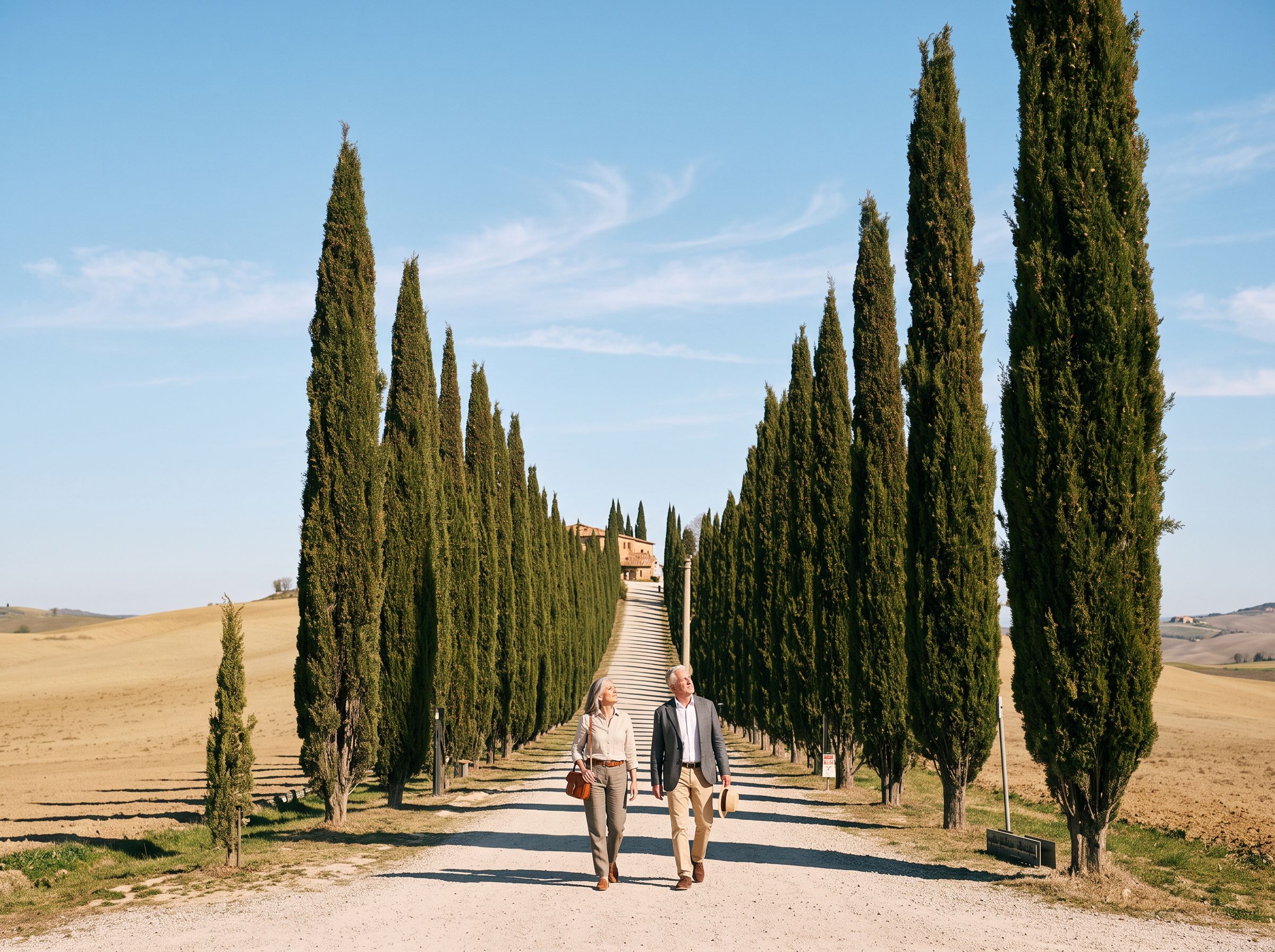 AI-edited
Why settle for two bases instead of moving daily?
Two bases—Florence and a countryside agriturismo—let you unpack once, keep laundry manageable, and turn day trips into relaxed outings rather than logistical puzzles. This is the single most effective way to reduce fatigue on a Tuscan holiday.
Travellers over 50 consistently report that the best Tuscany trips are slower, with fewer bases and more time in one or two towns. Forum regulars describe eight-night trips split between Florence and the Val d'Orcia as the arrangement that converted them to the slower approach. The same threads recommend keeping each day trip to roughly an hour each way when you are travelling with an older companion. The practical benefits extend beyond comfort. Staying in one countryside base means you learn the local rhythms: which bakery opens early, which trattoria fills at 1pm, which walking path suits your knees. You also avoid the mid-trip packing day that can consume a full morning.How should the seven days be structured?
Days one to four belong to Florence; days five to seven move to a countryside base near Siena, with day trips into Chianti and the Val d'Orcia. This gives you four museum mornings, three slow countryside days, and one deliberate rest afternoon.
The itinerary below assumes you arrive with energy to spare. If your flight lands mid-afternoon, treat day one as a gentle orientation rather than a museum day.- Day 1: Arrive in Florence, settle in, walk the Arno at sunset
- Day 2: Morning at the Uffizi, long lunch, Ponte Vecchio
- Day 3: Morning at the Accademia, Duomo, afternoon rest
- Day 4: Day trip to Lucca—flat, walkable, easy
- Day 5: Transfer to countryside base, settle in, pool afternoon
- Day 6: Siena day trip, morning focus, early return
- Day 7: Val d'Orcia loop: Pienza, Montalcino, optional vineyard walk
Is Florence manageable for a 50-plus traveller?
Florence is one of Tuscany's most senior-friendly cities if you stay central, book museums in advance, and limit each day to one major sight plus a long lunch. The historic core is compact and largely flat, with frequent taxi ranks for the "last mile."
The city rewards a slow approach. Senior-focused itineraries recommend museum time in the morning, when crowds are thinner and your energy is freshest, followed by a long lunch and a gentle afternoon. Neither gallery makes booking compulsory. The Accademia states that reservations are highly recommended and that without one the wait for access may be long; the Uffizi sells named same-day tickets at its own ticket offices under the loggia. Reserving still spares you the queue, so do it as soon as your dates are firm—and note that both galleries close every Monday. Recent guests consistently praise the organisation of Florence-based day trips, noting that guides kept everyone on time and that pickups and drop-offs were smooth. One reviewer on Google in March 2026 wrote that the experience "did not disappoint" after being highly recommended by friends. For mobility, the key is choosing accommodation near the Duomo or Santa Croce, where most sights sit within a 20-minute stroll. If stairs are a concern, confirm elevator access between the street and your room—many historic palazzi have steps at the entrance that a lift does not bypass.What makes Lucca worth a day trip?
Lucca is a flat, relaxed walled city, with a compact historic centre that is easy to manage on foot. Its medieval walls run 4.2 kilometres around the old town and can be walked in sections, with benches, tables, drinking fountains and café stops along the way.
The direct regional train from Florence Santa Maria Novella takes 1 hour 20 minutes, making it an ideal day trip that does not require a car; connections with a change take up to 1 hour 50, so it pays to pick a direct departure. In the September 2026 timetable, direct trains ran back from Lucca roughly hourly until 22:31, so an unhurried afternoon puts your return at no risk. Once inside the walls, the city is notably level—a relief after Florence's bridges and Siena's slopes. The walls themselves are the main attraction: a tree-lined promenade that circles the old city. Getting up onto them is the part to plan—the city's own accessibility project states that the ascents are of varying ease and always require assistance, so count on a companion for the climb rather than assuming a step-free route. The historic centre is compact enough to explore in a few hours, with the cathedral, the oval Piazza dell'Anfiteatro, and the Guinigi Tower (with its famous rooftop trees) as the highlights. If you prefer not to climb the tower, the view from the walls is equally rewarding. Plan to arrive by mid-morning, have a long lunch in a piazza-side trattoria, and return to Florence by late afternoon. This keeps the day gentle and leaves evening energy for a quiet dinner near your hotel.How does Siena compare in difficulty?
Siena is walkable but hillier than Florence or Lucca, with uneven streets and more vertical change. It is manageable if you use taxis for the "last mile," focus on Piazza del Campo and the cathedral, and keep your visit to three or four hours.
The city's medieval centre has been a UNESCO World Heritage Site since 1995, and its beauty comes with a price: slopes, steps, and cobblestones. Siena has answered that with machinery: a system of mechanised escalators, the risalite, links the multi-storey car parks around the old town to the centre on the northern, eastern and western approaches. Arriving by train you can use the Risalita Stazione, open 24 hours a day, which climbs 62 metres over a 283-metre route from the station up to the Antiporto di Camollia, a few hundred metres from Porta Camollia. Wheelchair users cannot ride the escalators, but the operator provides a free substitute taxi between the two ends of every risalita on request, by telephone on 0577 228799 or through the intercoms inside. If you would rather take an ordinary taxi, the fare from the station rank to Piazza del Campo is a fixed €10.00. Recent guests on Siena day trips consistently praise the organisation and punctuality of guided visits, noting that guides kept everyone on time and that bus drivers dropped off and picked up groups as close as possible to each site. The air-conditioned buses were specifically mentioned as a relief during hot weather. For a relaxed visit, arrive by mid-morning, walk slowly downhill to Piazza del Campo, rest at a café (you can sit as long as you like, even if the coffee costs a bit more), then visit the cathedral before returning. Skip the climb to the top of the Mangia Tower. The Musei Civici put the ascent at about 400 steps from the level of the Campo and strongly advise against it for anyone with a pacemaker, a heart or respiratory condition, claustrophobia, vertigo, diabetes or reduced mobility. Tower tickets cannot be reserved in any case: they are sold only at the Palazzo Pubblico ticket office on the day, for timed ascents of 25 people every 45 minutes.What should you know about Chianti wine country?
Chianti is best enjoyed from a seated position: a scenic drive, a lunch at an estate, and a guided tasting. Senior travel guides recommend hiring a driver so you can enjoy the vineyards without worrying about rural roads or parking.
The region between Florence and Siena is a patchwork of vineyards, olive groves, and hilltop villages. The driving is beautiful but winding, and parking in villages like Greve or Castellina can be tight. A private driver or small-group tour removes the stress and lets you taste without concern. Recent guests on Chianti tours describe the wine tasting at a vineyard as a recurring highlight, with reviewers describing it as excellent quality, fun, and exceeding expectations. The tours are described as good value for money, covering multiple locations in one day, and a practical alternative to renting a car. For a gentle active option, many estates offer short vineyard walks on relatively flat terrain, followed by a seated tasting. An e-bike ride is another possibility—the electric assist makes the hills manageable—but book through a reputable operator who provides well-maintained bikes and a support vehicle.Is the Val d'Orcia worth the journey?
The Val d'Orcia is one of Tuscany's most scenic areas, with compact hill towns, Renaissance streets in Pienza, and wine tastings in Montalcino. It is best handled as a short-excursion region, with one or two towns per day rather than a full-day marathon.
The landscape—rolling hills, cypress-lined roads, and medieval villages—is the region's main attraction. Pienza, a Renaissance town with harmonious urban design and UNESCO recognition, is the most walkable, with a flat main street and views over the valley. Montalcino, home to Brunello wine, is hillier but rewards visitors with seated tastings and panoramic terraces. Hill-town terrain is less forgiving for mobility-limited travellers, so plan for short, focused visits of one to two hours per town. Use a private driver or taxi between towns, and build in a long lunch at an agriturismo with a view. The thermal baths at Bagno Vignoni are a gentle add-on if you want to soak tired muscles—see our guide to the thermal baths of Saturnia and Bagno Vignoni for what to expect.How should you get around without a car?
Trains work well for Florence–Lucca and Florence–Siena, while hill towns in Chianti and the Val d'Orcia are easier with a private driver, taxi, or guided transfer. Pre-planned transport removes the stress of rural roads, parking, and ZTL restricted zones.
Tuscany's train network connects the major cities efficiently, and station assistance can be arranged in advance if you need help with luggage. For the countryside, a private driver for specific days is often more cost-effective than renting a car when you factor in parking fees, fuel, and the risk of fines in restricted traffic zones. A useful rule of thumb: assume that anywhere inside a city wall is a restricted zone. The comune of Siena sells temporary ZTL permits by the half-hour for exactly this reason, and San Gimignano operates a camera-controlled ZTL in its historic centre; driving in without authorisation means a fine. This is a strong argument for relying on drivers and taxis in Siena, Montepulciano, and San Gimignano. For a relaxed week, consider this transport plan:- Florence: walk everywhere, taxi for the "last mile"
- Lucca: regional train from Florence Santa Maria Novella
- Siena: train or private driver, taxi from station to centre
- Chianti and Val d'Orcia: private driver or small-group tour
When is the best time for this itinerary?
Late spring (May–June) and early autumn (September–October) offer warm days, smaller crowds, and more comfortable walking conditions. Mid-June through mid-September is peak season, with queues at museums and longer waits at restaurants.
According to Visit Tuscany, the official tourism site, mid-June, July, August, and mid-September are the region's peak season, with crowds in squares, queues at museums, and longer waits at restaurants. For travellers over 50, the shoulder seasons are kinder: cooler mornings for walking, shorter queues, and a more relaxed pace. The best months for warm days and small crowds are typically May and September, when the landscape is green (May) or golden (September) and the heat is manageable. July and August can be intense, especially in hill towns with little shade. If you travel in the shoulder season, check that your countryside accommodation is open—many seasonal properties open in late March or early April and close in late October. For festivals and quieter periods, see our guide to Tuscany through the year: festivals, sagre and quiet seasons.What should you pack for comfort?
Pack light, bring good walking shoes, and include a folding walking stick if balance is an issue. Air conditioning in all rooms—especially bedrooms—is essential for summer travel, and medications should stay in your carry-on.
In threads about older parents travelling in Tuscany, two points come up before all others: accommodation must have air conditioning in all rooms, especially bedrooms, and good shoes are essential. The same discussion recommended carry-on only, elevator access, and keeping medications, prescriptions, and ID copies handy. Walking poles or canes can be vital if balance is an issue, especially on cobblestones and slopes. Contributors also suggest using local buses to save steps, and resting at sidewalk cafés, where you can sit as long as you need even if coffee or gelato costs a little more at a table. For the countryside, pack layers—mornings can be cool even in summer, and evenings on a terrace can turn chilly. A light scarf serves as sun protection, a shawl for cool evenings, and a cover for church visits.How should you book to avoid disappointment?
Book major museums in advance—especially the Uffizi and Accademia—and confirm accessibility details with your accommodation before paying. For hill towns, plan parking and drop-off logistics before you arrive.
Reservations at the Uffizi and Accademia are recommended rather than compulsory, but they spare you a long wait at the door, so book as soon as your dates are firm. The cathedral in Florence needs neither ticket nor booking—entry is free, Monday to Saturday from 10:15 to 15:45. For Siena and the hill towns, check where parking is located before choosing your route — where you can leave the car effectively decides how much climbing a visit involves. When booking countryside accommodation, confirm elevator access, the number of steps between the elevator and your room, and whether the pool has steps or a ladder. Travellers who have split eight nights between Florence and the Val d'Orcia consistently report the same conclusion: the slower arrangement is the one they would repeat. For guided tours, recent guests consistently praise the punctuality and organisation of day trips, with guides described as knowledgeable and attentive. The meeting point for some Florence-based tours is located somewhat far from the centre, so check the logistics before booking."An absolutely brilliant use of the city wall by having a multipurpose recreational trail on top of the wall. Paved for walking and wheeling, the many ramps give ready access for users. The bulwarks of the wall have parks, playgrounds, and picnic areas." — a Google review of Lucca's walls, April 2024


