
Tuscany rewards those who let someone else handle the logistics. For travellers aged 50 to 70 who prefer organised travel, a small-group or private guided tour transforms this famously hilly, cobblestoned region from a logistical puzzle into a relaxed sequence of art, wine, and landscape. The key is choosing the right format and asking the right questions before you book.
This guide focuses exclusively on small-group, private, and escorted tour options across Florence, Siena, Chianti, and the surrounding hill towns. If you prefer to plan everything yourself, we have a separate guide for self-guided itineraries elsewhere on this site. Here, we concentrate on what to look for, what to ask, and how to match a tour to your comfort level and walking ability.
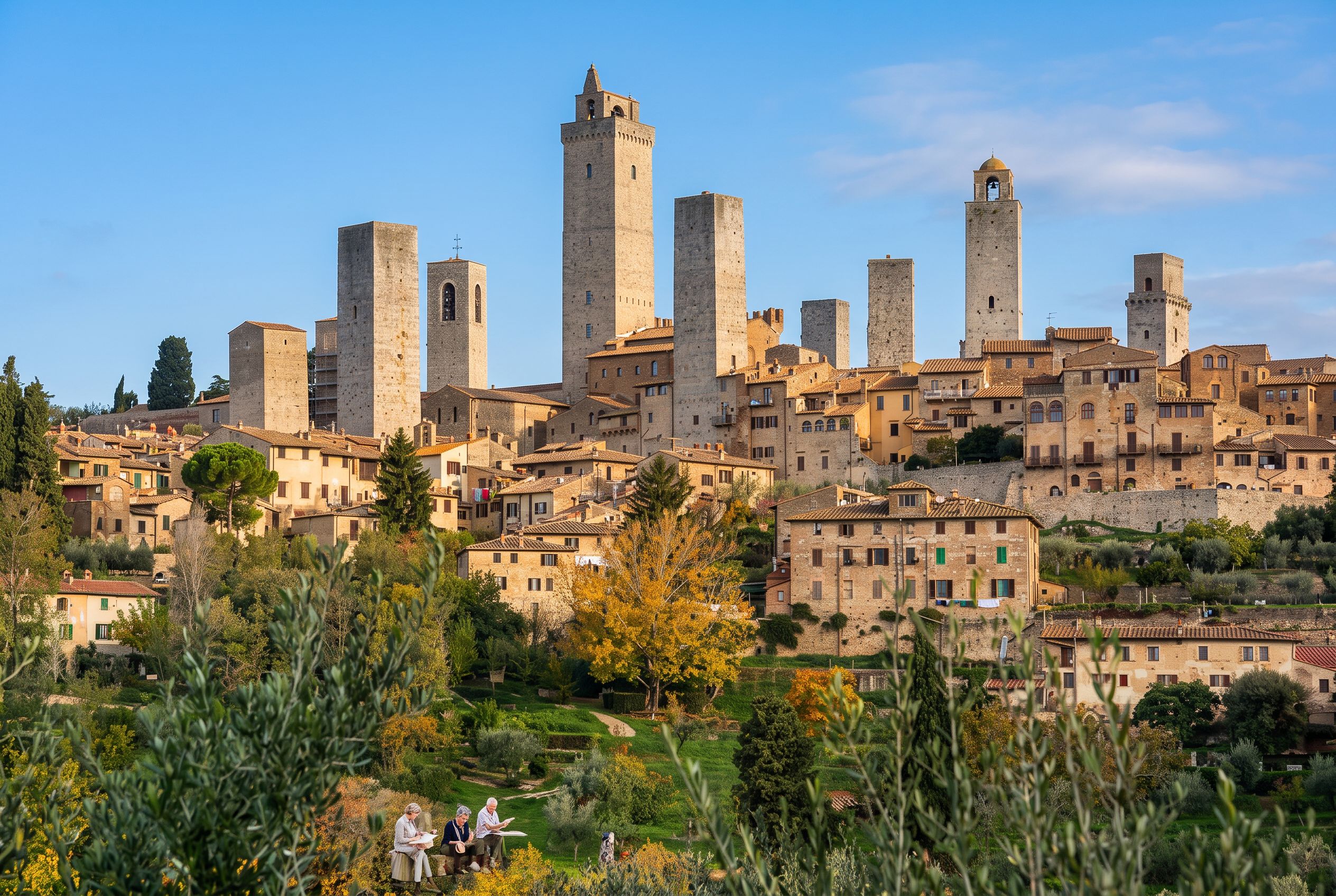 AI-edited
Which tour formats suit travellers over 50 best?
Private tours with a licensed guide offer the most flexibility for pacing and exertion, while semi-private day tours — some capped at eight guests — provide a sociable middle ground. Escorted coach tours work well for those wanting everything arranged, but published group sizes run to 24–28 people, so verify the maximum before booking.
Group size is the first thing to check, because the word "small" is used very loosely. Rick Steves describes its Best of Tuscany in 11 Days departures as "a small, friendly group of 24–28 people — half the size of most tour groups", which is small for an escorted coach tour but not for a day out. At the other end, Tours of Tuscany states that its semi-private wine days are "guaranteed, with a maximum of 8 guests". Both are honestly described; they are simply different products, so the number matters far more than the label.
Private and semi-private touring gives you control over pace, distance, and how much exertion the day involves. That matters in Tuscany, where historic centres combine cobblestones, slopes, and limited vehicle access. A private guide can adjust the itinerary on the spot if you need a longer rest or want to skip a climb.
How much walking is actually involved?
Escorted itineraries publish real numbers: Rick Steves grades the days of its Tuscany tour from "light walking: 2–4 miles" to "strenuous walking: 2–8 miles throughout the day with lots of hills, stairs, and uneven terrain". Cobblestones and inclines are the norm in Florence, Siena, San Gimignano, and Lucca, so plan for walking as much as for sightseeing.
A guided day in Tuscany still involves a great deal of walking, and hiring a driver does not remove it. Florence's limited traffic zone is enforced by camera-controlled gates that, according to Servizi alla Strada, the city's mobility operator, run Monday to Friday from 07:30 to 20:00 and on Saturday from 07:30 to 16:00, with an additional night-time zone from the first Thursday in April to the first Sunday in October. As of August 2026 those are the hours in force, and in practice they mean your vehicle stops at the edge of the centre and the rest of the day is on foot.
Operators are explicit about the terrain once you read past the itinerary highlights. Rick Steves tells travellers on its Tuscany tour they will need to "carry/roll your luggage over uneven pavement (possibly several blocks) and up stairways to reach your hotel, then up several flights of stairs to reach your room", and to "be on your feet, walking and standing for up to three hours". Older buildings frequently have no lift, and rest benches are not consistently available in historic centres, so plan breaks in cafés, churches, or piazzas instead.
If mobility is a concern, ask about drop-off points, walking distances, and restroom access before booking. Some hill towns provide mechanised help: in Siena, the company that runs the city's garages states that the main car parks at San Francesco, Santa Caterina and La Stazione are connected to the historic centre by escalators, and that a free dedicated taxi service is available for visitors with disabilities. Florence, on flat ground, makes for easier travel days than the hill towns.
What questions should I ask before booking?
Ask about maximum group size, exact drop-off and pickup points, walking distances, restroom stops, and whether your guide is entered in Italy's national register of tourist guides. Also confirm what is included in the price — meals, tastings, and entry tickets — and what requires cash on the day.
Since Law 190 of 13 December 2023, guiding is a regulated profession registered nationally rather than region by region. The Ministry of Tourism maintains the Elenco Nazionale delle Guide Turistiche and describes the platform behind it as a tool whose purpose is "la facilitazione del collegamento tra le guide abilitate e il pubblico" — connecting qualified guides with the public. Registered guides carry a digital badge with a QR code that confirms their entry in the register when it is scanned. Illustrating and interpreting heritage during a guided visit is reserved to that profession; a hire-car driver (noleggio con conducente, or Ncc) is licensed to transport you, not to guide you.
Guest reviews across operators return to the same practical themes, and they are worth turning into questions: how much contact you get before departure, which payments are expected in cash on the day, and how much of the schedule is genuinely filled. Ask about payment methods, about what happens if the itinerary has to change, and for an hour-by-hour outline of the day rather than a list of place names.
Group size expectations can also differ from reality, because "small group" is a marketing phrase rather than a defined number. Ask for the maximum in writing, and ask whether it is a hard cap or a target the operator aims for.
How do small-group wine tours compare to coach excursions?
Semi-private wine days in Chianti and Montalcino are built around a relaxed pace, a proper lunch, and more personal attention than a large coach excursion allows. A typical published format is two wineries with a wine-paired lunch at one of them, a cap of eight guests, and pick-up at your accommodation.
The appeal of a semi-private day is the pacing: two stops rather than five, a sit-down lunch rather than a queue, and a vehicle small enough to park close. A guest wrote on Google in March 2024 about a Montalcino and Montepulciano day with Tours of Tuscany that the "driver was very friendly and lots of history and stories to tell" and that it was "very easy and accommodating to book".
For a concrete benchmark, Tours of Tuscany lists its semi-private Brunello day at about seven hours from €220 per person as of August 2026, with two wineries, a three-course lunch paired with the estate's own Brunello, and pick-up and drop-off at your accommodation in Siena, Florence, or nearby. The meal is the detail most worth confirming: ask whether lunch is inside the headline price or an optional extra, and what it consists of.
For those who enjoy regional cuisine, our guide to what to eat around Tuscany offers a deeper look at the dishes you are likely to encounter on these tours.
What transport options work best for organised touring?
Private drivers and small-group minivans are the most accessible options for older travellers because they reduce transfers, parking, and luggage handling. Trains work well for point-to-point city connections, but most hill towns still require a bus, taxi, or private transfer from the station.
Tuscany operators market small-group and fully escorted travel using minivans and coaches, and the published caps vary enormously — from eight guests on a semi-private wine day to the 24–28 travellers Rick Steves lists for its 11-day escorted Tuscany tour. Hotel pick-up and drop-off is common on the smaller formats and is worth asking about by name, because it removes the walk to and from a central meeting point at each end of a long day.
Trains are best for connecting major cities such as Florence, Pisa, Lucca, and Siena-area hubs. However, most hill towns require onward transport. Buses reach smaller villages more affordably but are less convenient for travellers who want minimal walking, and schedules can be slower and less frequent than in major cities.
Senior rail fares in Italy sit on the long-distance network rather than on regional trains. Trenitalia withdrew its Carta Argento from sale on 1 April 2026 — cards issued before that date stay valid until they expire — and now points travellers over 60 to its FrecciaSENIOR fare, which starts at €29 on Frecciarossa and Frecciargento services for CartaFreccia members aged 60 and over. Regional trains to the hill towns carry no equivalent age-based discount, so budget those at the standard fare. For a broader view of when to travel, see our guide to when to visit Tuscany for warm days and small crowds.
How do I choose between a private guide and a small group?
Choose a private guide if you want complete control over pace, distance, and exertion. Choose a small group if you enjoy shared experiences and want to keep costs lower. Both formats work well for travellers over 50; the decision comes down to budget and social preference.
Private tours cost more but offer the greatest flexibility, and many are priced per group rather than per person, which narrows the gap once two couples travel together. Florence Connection, for example, publishes its Siena and Chianti private day at €700 per group for one or two people, €800 for three or four, and €900 for five to seven, as of August 2026. This format suits travellers with a specific interest — Renaissance sculpture, Brunello, Etruscan sites — who want the itinerary built around it.
Semi-private tours offer a middle ground: a shared vehicle and a shared guide, but a cap low enough that the group still fits around one table at lunch. Tours of Tuscany states that its small-group experiences are "guaranteed, with a maximum of 8 guests". Other operators use the same wording with very different numbers behind it, which is exactly why the figure matters more than the phrase.
Escorted coach tours handle everything — hotels, transport, guides, and most meals — but the groups are larger and the day is planned around the coach. The better operators publish an activity level for every day: Rick Steves labels each day of its Tuscany itinerary "light", "moderate", or "strenuous" walking with a mileage band attached, and marks which days involve a bus and how long. Read those lines before you read the highlights.
What should I pack for a guided Tuscany tour?
Pack supportive walking shoes with grip for cobblestones, light layers for changing temperatures, sun protection, a compact rain layer, and a refillable water bottle. A walking stick can help on slopes, and a small day bag should hold medication, tissues, and a light snack.
Comfortable footwear is the single most important item. Cobblestones and uneven streets are everywhere in historic centres, and grip matters more than style. Light layers work well for the temperature shifts between sunny afternoons and cooler evenings, especially when touring churches, hill towns, or wineries.
Sun protection — a hat, sunglasses, and sunscreen — is essential for open countryside and summer city walking. A compact rain layer or small umbrella handles variable weather. A refillable water bottle keeps you hydrated during long sightseeing days and uphill walks.
If you prefer extra stability on slopes or stone paving, bring a walking stick or trekking pole. For small-group wine or countryside tours, smart-casual attire is usually sufficient; several operators include tastings, lunches, and village free time rather than formal activities.
What about health, pharmacies, and emergencies?
Tuscany's major tourist bases such as Florence and Siena have pharmacies, clinics, and hospitals. Keep your hotel's address and the nearest farmacia on hand — pharmacies are the fastest source for minor issues, prescriptions, and basic medical advice. For emergencies, call 112.
Pharmacies in Italian towns are usually the first stop for minor health concerns. They can provide basic advice, over-the-counter medications, and guidance on whether you need a doctor. For more serious issues, hospitals are available in Florence, Siena, and other major centres.
The unified emergency number in Italy is 112, which connects you to police, ambulance, or fire services. Save this number before you travel. For a detailed look at healthcare options, see our guide to health, pharmacies, and peace of mind in Tuscany.
When booking a senior-oriented itinerary, choose operators that include transport back to accommodation or have easy access to Florence-based support. Several private and escorted tours already offer hotel pickup and drop-off or fixed transfer times, which adds a layer of security if you need assistance.
When is the best time to book a guided Tuscany tour?
Spring (April–May) and early autumn (September–October) are the best seasons for guided Tuscany tours, with mild weather, smaller crowds, and more comfortable walking conditions. Summer is hotter and busier, while winter offers quieter streets but cooler weather and earlier closing times.
Operator calendars show the same pattern. Every remaining 2026 departure of Rick Steves' Best of Tuscany falls between 7 September and 28 October, and as of August 2026 five of those seven dates are already waitlisted — a useful signal both of when the season is considered comfortable and of how early those dates go.
Summer brings heat and crowds, which can make walking more strenuous and queues longer. Winter is quieter, but with cooler weather, shorter opening hours, and fewer daylight hours for sightseeing. If you prefer a slower pace, the shoulder seasons are the compromise. For a month-by-month breakdown, see our guide to Tuscany through the year.
How do I verify tour quality before booking?
Check the operator's licensing, read recent reviews on multiple platforms, and ask for references if needed. Look for consistent praise of guiding quality, organisation, and pacing, and be wary of recurring complaints about communication or group size.
Reviews are most useful when they say something about the day rather than the mood. A review left on Google in October 2017 describes two days in the wine country around Siena in exactly those terms: the writer had "excellent service and felt that we would not have had nearly such a great experience had we done the touring by ourselves". That is the clearest argument there is for handing over the logistics.
Check ratings on the platform itself rather than on an aggregator's summary, and check that the listing belongs to the business you are actually booking. Tours of Tuscany, the Siena-province operator linked below, holds 4.8 out of 5 from 41 Google reviews as of August 2026. Across operators, reviews return to the same three things worth probing before you pay: contact before departure, whether any payment is expected in cash on the day, and whether the group size matches the one advertised.
You can also check the guide yourself before you pay. The Italian Ministry of Tourism publishes the national register of tourist guides, and every registered guide carries a QR-coded badge that links back to it. For a sense of what a well-paced wine day looks like, Tours of Tuscany's small-group wine tours publish their group cap, itinerary, and price.
Rates vary by format, group size, and what is included, and the unit differs too: private days are usually quoted per group, shared days per person. As of August 2026, Florence Connection lists a private Siena and Chianti day from €700 per group for one or two people up to €900 for five to seven, while Tours of Tuscany lists its semi-private Brunello day from €220 per person. Both are published high-season starting prices before any seasonal or booking-channel variation.
What are the common pitfalls to avoid?
Over-scheduling is the most common mistake. Build in breaks, book timed entries for major museums in advance, and choose small-group wine tours over generic coach excursions if you want time for lunch and tastings.
Build breaks into the plan rather than hoping the day provides them. Timed entry helps: the Uffizi sells a named ticket at €25 bought on the day of entry and €29 bought in advance, and the reserved slot moves you past the ticket queue but not past security. The gallery also joins Italy's free-admission scheme on the first Sunday of each month, when reservations are not possible at all — a date to plan around rather than towards if standing in line is hard on you.
One assumption worth correcting early: Italy's state museums give no discount for older visitors. The Uffizi's reduced €2 ticket is limited to European Union citizens "over 18 and until the day of the twenty-fifth year of age", while free priority admission goes to visitors with a certified disability and one accompanying person. Budget full price, and if a certificate applies, carry it — it also buys you the shorter queue.
Finally, remember that even the best-organised tour involves walking. No driver can pull up at the door of every sight inside Florence's limited traffic zone, and the stretch between the nearest permitted set-down point and the entrance is often the tiring part of the day. Plan for it, and choose the format that matches your comfort level.


