
Salzburg is a city that rewards a measured pace. Its compact, largely flat historic core—a UNESCO World Heritage site—makes it one of Europe's most manageable destinations for travellers aged 50 to 70. This guide focuses on the five essential experiences that balance cultural richness with comfort: the fortress by funicular, the Mirabell gardens, the cathedral and Residenz, a river stroll, and an evening concert. Each entry includes its effort level, seating and rest options, and practical advice for avoiding the worst crowds.
 AI-edited
Why is Salzburg particularly suited to travellers over 50?
Salzburg's historic centre is unusually compact and mostly flat, with many of its signature sights clustered within a 20-minute walk of each other along the Salzach River. The city's official barrier-free pages confirm that many attractions, churches, and restaurants can be reached via level paths or accessible entrances, making it a natural fit for both active and leisurely visitors.
The city's topography works in your favour. The Old Town sits on a flat river terrace, while the hills—the Mönchsberg and the fortress hill—are easily bypassed using lifts and funiculars. Salzburg's official top-ten list places eight of its ten entries in or immediately beside the historic centre; the other two, Hellbrunn Palace and Trick Fountains and Salzburg Zoo Hellbrunn, lie several kilometres to the south. This concentration means you can see a great deal without covering much ground, and you can break the day into short walking segments punctuated by café stops.
The city's tourism statistics show a strong summer season from May to October. For the 2025 calendar year the City of Salzburg recorded 1,836,515 arrivals and 3,288,513 overnight stays, four and 4.8 per cent above 2024. The practical takeaway: plan your visit for shoulder months (May-June or September-October) when crowds are thinner and temperatures are mild.
How do I visit Hohensalzburg Fortress without the climb?
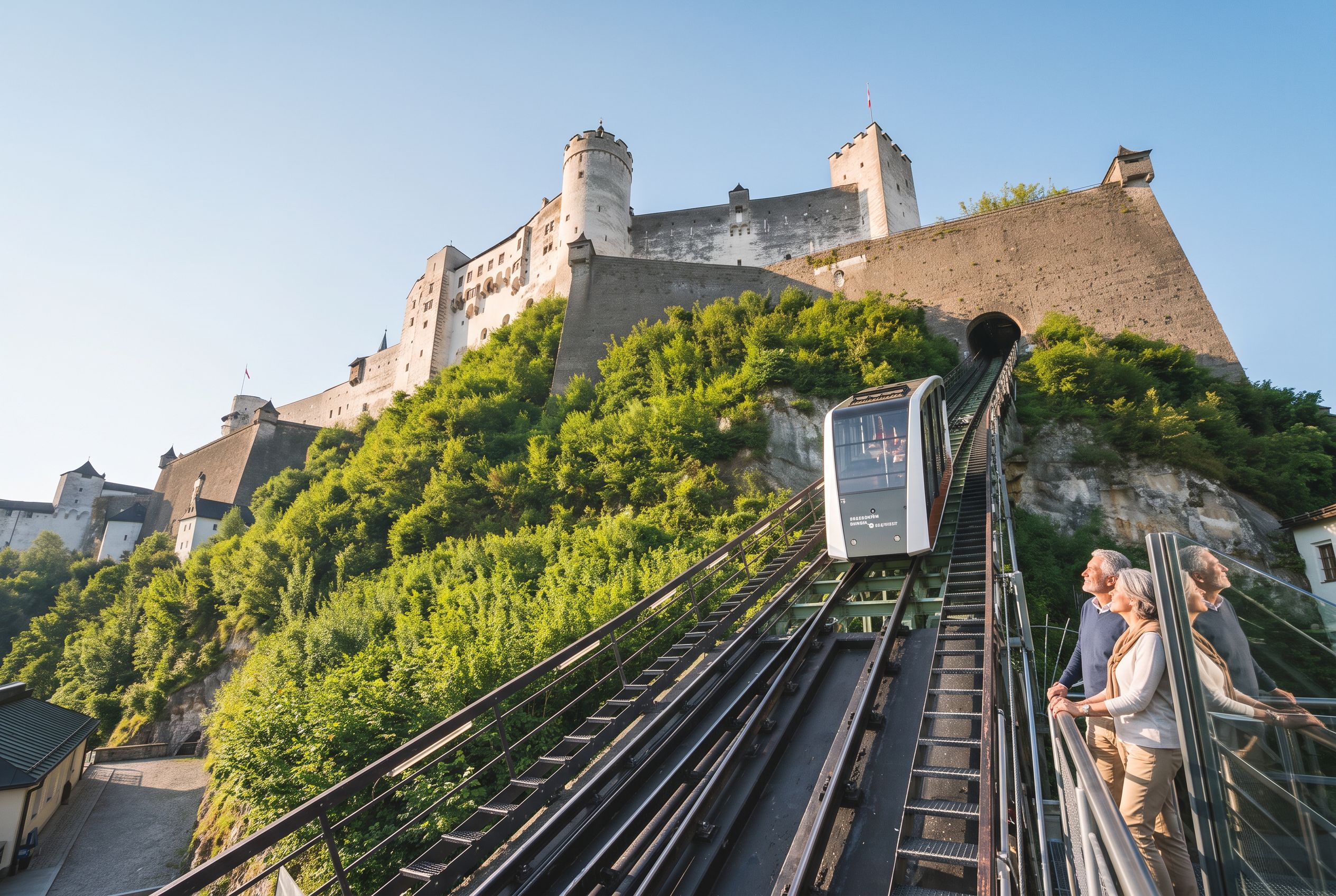
The Festungsbahn funicular provides a smooth, seated ride from Festungsgasse 4 to the fortress summit in under a minute. It is the recommended approach for anyone with mobility concerns, as the walking path is steep, uneven, and includes many steps. The funicular is included with the Salzburg Card and with the two fortress tickets sold "with funicular"; the cheaper footpath tickets do not cover it.
Once at the top, the fortress offers panoramic views over the city and the Alps. The interior museums—including the state rooms, the Rainer Regiment Museum, and the Marionette Museum—are well-maintained with clear signage in multiple languages. The operator is candid about what the building allows: there are many steps and inclines, and the interior of the fortress is not barrier-free. Fully accessible are the panorama terrace and the bastion by the mountain station, and a lift in the bell tower reaches the castle courtyard, the armoury exhibition, the tavern, the Kuenburg bastion and the marionette museum. Barrier-free toilets are next to the Info Point and inside the fortress restaurant.
Google reviewers of the FestungsBahn keep returning to the same point: the ride is what spares you the climb, and it is short enough that it barely eats into the visit.
"The FestungsBahn funicular is a convenient and enjoyable way to reach Fortress Hohensalzburg. The ride is smooth and offers fantastic views as you ascend, making it a great start to your visit. It's quick, efficient, and the perfect way to save time and energy while still enjoying the scenic experience." — a Google reviewer wrote in March 2025
The fortress is open 365 days a year: 9:30 AM to 5:00 PM from January to April and from October to December, and 8:30 AM to 8:00 PM from May to September, when the museums and state rooms run 9:00 AM to 7:00 PM. The funicular runs every ten minutes and the ride itself takes 54 seconds. As of August 2026 the Basic Ticket including the funicular up and down costs €15.50 for adults and the All-inclusive Ticket €19.20; those combined tickets carry no senior rate. A reduced senior fare does exist on the funicular alone — €2.70 one way, €4.20 return — but only after the fortress has closed for the day, and only for holders of an SVV Edelweiß ticket, a trolleybus pensioner card or an ÖBB Vorteilscard Senior. Two funicular maintenance windows are already announced: 9 to 13 November 2026 and, for accessibility works, 11 January to 14 March 2027, when the fortress can only be reached on foot.
What makes Mirabell Gardens so easy and enjoyable?
Mirabell Palace and its formal gardens are among the easiest major sights in Salzburg: the city's tourism office records barrier-free access for both palace and gardens. The grounds are level, well-laid-out with paved paths, and dotted with benches and shaded spots. The gardens connect directly to the riverbank and are a short, flat walk from the Old Town across the Staatsbrücke bridge.
The gardens are famous for their geometric flower beds, the Pegasus Fountain, and the "Do-Re-Mi" steps from The Sound of Music. The palace itself houses the Marble Hall — the city's wedding hall — and the Angel Staircase; the rest of the building is the mayor's office and the city administration. Palace and staircase are open Monday to Saturday from roughly 8 AM to 6 PM, the Marble Hall only on Monday, Wednesday and Thursday from 8 AM to 4 PM and on Tuesday and Friday from 1 PM to 4 PM. The real draw for a relaxed visit is the garden itself. It is a perfect opening stop—gentle, scenic, and requiring no advance booking.
What visitors single out about the gardens is how little they ask of you — the planting, the layout, and the number of places to sit down along the way.
"Garden is beautifully sculptured with trees and flowers. So spacious and relaxing. Plenty of benches around the garden. Everything was well kept and the flowers were blooming in multi colors" — from a review of Mirabell Gardens left on Google in June 2026
The gardens are free to enter and open daily from around 6 AM until dusk, with parts closed in winter. The best months are late spring and summer when the flowers are in full bloom. Allow 30–45 minutes for a relaxed stroll with photo stops.
How do I explore the Cathedral and Residenz comfortably?
Salzburg Cathedral and the adjacent Residenzplatz form a single, low-effort cultural block. The cathedral offers barrier-free access with the single exception of its crypt, and there are pews throughout for resting. The DomQuartier—which connects the cathedral, the Residenz, and the museum—was modified to be barrier-free as far as possible within monument-protection limits, but for insurance reasons both of its lifts may only be used with a member of staff accompanying you.
The cathedral itself is a masterpiece of Baroque architecture. The interior is vast and cool, with plenty of seating. It is barrier-free apart from the crypt, which keeps its own hours — Monday to Saturday 10 AM to 5 PM, Sundays and church holidays 1 PM to 5 PM. Entry is not free: a preservation fee of €7.00 applies for adults, reduced to €5.50 with the Salzburg Card. The DomQuartier ticket covers the Residenz state rooms, the Cathedral Museum and the Museum of St Peter's Archabbey; the Residenzgalerie is closed until autumn 2027 and reduced rates apply while it is. The operator suggests one and a half to two hours for the nine-stop circuit, and the ticket is valid all day, so you can leave and come back. Visitors aged 65 and over pay the reduced rate.
Residenzplatz, with the Residenz on one side and the cathedral arcades on the other, is an ideal spot for a mid-morning coffee before tackling the cathedral. The DomQuartier lends out wheelchairs and lightweight folding stools that double as walking sticks, both from the porter's lodge and both worth reserving by phone.
The cathedral opens Monday to Saturday at 9:00 AM and on Sundays and holidays at 1:00 PM; it closes at 5:00 PM in January, February and November, at 6:00 PM from March to July and from September to December, and at 7:00 PM in August. There is no visiting during services or during "Music at Noon", which runs daily except Sundays and public holidays from 12:00 to 12:30. The DomQuartier is open daily except Tuesday from 10:00 AM to 5:00 PM, and to 6:00 PM in July and August, with last admission an hour before closing.
What is the best way to enjoy a river stroll?
The Salzach River promenades on both banks offer flat, paved walking paths with frequent benches and views of the fortress and Old Town skyline. The most scenic stretch runs from the Staatsbrücke to the Müllner Steg footbridge, roughly 900 metres along the water and about a quarter of an hour at an unhurried pace.
The left bank (Old Town side) is more historic, while the right bank (Mirabell side) offers wider paths and more greenery. The river is particularly lovely in the late afternoon when the sun catches the fortress and the cathedral spires. The path itself runs level along the water. Salzburg's official barrier-free pages document accessibility sight by sight rather than for the riverside route, so if steps are a concern it is worth planning where you join and leave it.
For a longer walk, continue past the Mülln district to the Augustiner Bräustübl, where beer has been brewed since 1621 and which is half-owned by the Benedictine Abbey of Michaelbeuern. It is a relaxed spot for lunch or an early dinner, roughly 1.2 kilometres from the Getreidegasse along the riverbank. If you would rather not walk back, bus lines 4, 7, 9, 20, 21, 24, 27 and 28 stop close by at Landeskrankenhaus, and the S-Bahn stops at Mülln-Altstadt.
As of July 2026, the river promenade is well-maintained and lit in the evenings. It is a popular spot for locals and visitors alike, but never feels crowded outside of peak summer weekends.
How do I choose a concert that suits my comfort level?
Salzburg offers a wide range of concert experiences, from formal evening performances at the Festspielhaus to intimate chamber concerts at the Mozarteum. For a relaxed evening, choose a concert that starts at 7:00 PM or 7:30 PM, with seating in the main hall (not balcony) and a duration of 90 minutes or less.
The Mozarteum Foundation's concerts at the Great Hall are a safe bet: they are well-paced, with comfortable seating and good acoustics. The Salzburg Marionette Theatre also offers evening performances of Mozart operas, which are a unique and less formal alternative. For a truly casual experience, the Augustiner Bräustübl runs live music evenings with the band Second Hand Brothers — hits and oldies rather than folk — starting at 6:30 PM in Hall 3, with doors at 6:00 PM.
For a deeper dive into Mozart's life and music, see our dedicated guide: Mozart's Salzburg: A Practical Guide to His Houses, Museums and Music.
Book tickets in advance for popular venues, especially during the Salzburg Festival, which runs from 17 July to 30 August in 2026 and has a separate Whitsun festival from 22 to 25 May. Ask about reduced rates and accessible seating when you book rather than assuming they are listed online. Avoid balcony seats if you have mobility concerns, as they often require climbing stairs.
How can I avoid the worst crowds at these sights?
Crowds in Salzburg peak between 10:00 AM and 2:00 PM, especially in July and August. The best strategy is to visit major sights early (before 9:30 AM) or late (after 3:00 PM), and to eat lunch at off-peak times (11:30 AM or 1:30 PM).
Specific timing tips:
- Hohensalzburg Fortress: Arrive at opening — 9:30 AM from October to April, 8:30 AM from May to September — or after 2:00 PM. The funicular queue is longest between 10:30 AM and 12:30 PM.
- Mirabell Gardens: Visit at 8:00 AM or 5:00 PM. The gardens are quietest in the early morning and late afternoon.
- Cathedral and DomQuartier: Visit at 10:00 AM (after the early rush) or 2:00 PM. The DomQuartier is quieter on weekday afternoons.
- Getreidegasse: Walk it at 8:30 AM or 6:00 PM. The street is packed with tour groups between 10:00 AM and 4:00 PM.
Consider purchasing the Salzburg Card, which includes entry to the fortress (with funicular), the DomQuartier, and public transport. It also allows you to skip some ticket queues. The card is available for 24, 48 or 72 hours — €35, €41 and €44 from November to March, €38, €45 and €49 from April to October — and starts to pay for itself at about three paid sights: the fortress with the funicular (€15.50), the DomQuartier (€15.00) and the cathedral preservation fee (€7.00) already come to €37.50.
For accommodation recommendations that prioritise comfort and quiet, see our guide: Where to Stay in Salzburg When Comfort Comes First.
What are the effort levels and rest options for each sight?
Four of the five ask very little: the Mirabell gardens, the river promenade and an evening concert are level and seated, and the fortress turns low-effort the moment you take the funicular. The cathedral and DomQuartier block is the one to pace — the DomQuartier runs over three floors and its lifts need a staff escort.
Here is a quick-reference table for the five core experiences:
| Sight | Effort Level | Seating/Rest Options | Best Time to Visit |
|---|---|---|---|
| Hohensalzburg Fortress (via funicular) | Low | Multiple cafés, beer garden, benches on ramparts | 9:00 AM or 2:00 PM |
| Mirabell Gardens | Very Low | Numerous benches, shaded areas, café nearby | 8:00 AM or 5:00 PM |
| Salzburg Cathedral & DomQuartier | Low to Moderate | Pews in cathedral, benches on Residenzplatz, seating and loan folding stools in the DomQuartier | 10:00 AM or 2:00 PM |
| River Promenade | Very Low | Frequent benches along both banks | Late afternoon |
| Evening Concert | Very Low | Comfortable seating, pre-concert lounge | 7:00 PM |
All sights are within a 20-minute walk of each other. Use the river promenade as a connecting route between Mirabell Gardens and the Old Town. For a truly relaxed day, limit yourself to three sights and include a long lunch or coffee break.
What practical tips should I know before I go?
Austrian law lets shops open Monday to Friday until 9 PM but on Saturdays only until 6 PM, and Sundays and public holidays are closed apart from a narrow Salzburg city-centre exception for souvenir shops. Salzburg has no trams but trolleybuses, the vast majority of them low-entry with a fold-out ramp, and the ÖBB rate the main station at accessibility level 1.
For health and safety, Salzburg has several central pharmacies, including the Pharmacy "Zum Goldenen Biber" at Getreidegasse 4. Emergency pharmacies operate at night and on public holidays. The main hospital is Landeskrankenhaus Salzburg at Müllner Hauptstrasse 48.
For wellness and relaxation after a day of sightseeing, see our guide: The Best Spa Hotels In and Around Salzburg for Rest and Wellness.
Finally, consider a guided city tour for your first day. The Free Walking Tour Salzburg (Schwarzstraße 1) holds 4.9 out of 5 on Google from 1,974 reviews as of August 2026 and offers a paced introduction to the city. It is a low-effort way to orient yourself before exploring independently.


