
Santa Fe rewards the traveller who plans around stamina rather than against it. The historic core is compact: the Plaza, the Palace of the Governors and several state museums sit within a short radius of one another, and the New Mexico History Museum itself describes self-guided visits as the best way to control your own pace. What the city does not offer is a uniform surface. The strongest documented support is public transport: Santa Fe Trails buses carry wheelchair ramps and priority seating, and Santa Fe Ride provides accessible shared-ride transport for eligible residents aged 60 and over.
This guide reads the city for people who tire easily or use a stick, walker or wheelchair. It covers the Plaza and Canyon Road, the step-free question at the museums, the churches with stairs, what 7,000 feet of altitude does to a walking day, and where to park and sit. Hotel-by-hotel access has its own dedicated guide, and the medical side of altitude is treated separately; neither is covered in depth here.
Is downtown Santa Fe walkable with limited mobility?
Downtown Santa Fe is compact enough that the Plaza, the Palace of the Governors and the New Mexico History Museum sit within a short walk of each other, but the walking itself is not uniform. The city publishes no measured walking map, slope grades or pavement assessment, and traveller reports describe cracked and buckled sidewalks.
The official visitors' guide says much of Santa Fe is accessible on foot and that many experiences lie within walking distance of lodging. That is a statement about proximity, not about surfaces. The city does not publish a street-by-street pavement assessment, and no source gives slope grades or a senior-specific terrain rating for the historic core.
What travellers report is more granular. A Reddit thread from February 2025 about visiting with elderly in-laws described cracks, uneven stones, buckled sidewalks, narrow passages and curb cuts that lead to obstructed or damaged pavement. A separate Santa Fe walking-safety discussion called the sidewalks "buckled all over" and a serious tripping hazard. Those are traveller accounts, not an official audit, but they point in the same direction: expect brick and stone underfoot, and watch the transitions at curbs.
The practical reading is that the Plaza area works as a series of short hops with rests between them, not as a continuous promenade. Forum advice for older visitors recommends choosing accommodation close to the Plaza and building in frequent coffee, meal and shopping breaks. The same discussion described Santa Fe as navigable on foot between individual destinations but too dispersed for comfortable walking across the whole city.
What should I expect at the Plaza and the Palace of the Governors?
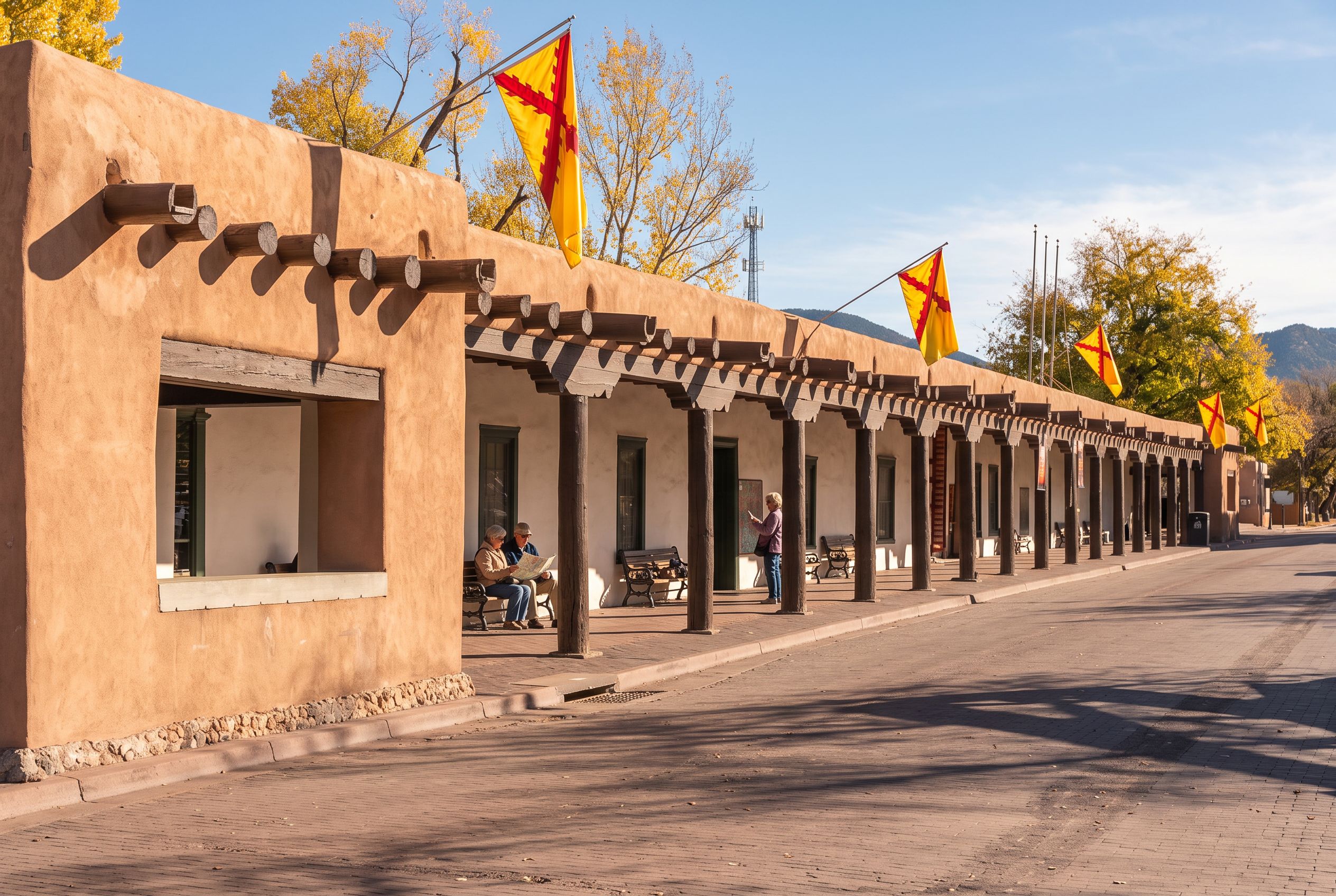
The Plaza is the practical base for a limited-mobility visit, with the New Mexico History Museum at 113 Lincoln Avenue immediately north of the Palace of the Governors. One ticket covers the History Museum, the Palace and the Palace Print Shop. The museum documents self-guided visits as the best way to control pace; it does not document step counts, lifts or an accessible route between the three sites.
The New Mexico History Museum publishes its own guidance for visitors. Self-guided visits are described as the best option for controlling the pace. Guided group tours require booking at least one month in advance, and self-guided groups should book at least two weeks ahead. The museum does not publish cancellation terms for group bookings.
Opening hours carry a seasonal condition. In summer the History Museum is open daily from 10 a.m. to 5 p.m., with Friday hours until 8 p.m.; in winter it closes on Mondays. The museum does not publish a complete holiday or maintenance-closure list, so confirm the date you plan to visit.
Admission is $6 for New Mexico residents and $9 for others. New Mexico residents enter free on Sundays, and senior citizens enter free on Wednesdays; the museum does not define "senior" by age. Identification is required for resident rates at state museums generally.
The Palace of the Governors stands beside the History Museum on the Plaza and is covered by the same ticket. Traveller reports recommend it with a warning to be prepared for a few steps. The museum does not publish a step count for the Palace, so ask at the desk if stairs are a concern.
 AI-edited
Is Canyon Road manageable, and what about the historic churches?
Canyon Road is the hardest part of the historic core for limited mobility. Traveller reports describe it as not ADA-compliant, with stairs at the entrances of galleries and restaurants and further steps inside some buildings. Parking there can be difficult, and one practical suggestion is to look for parking along East Alameda instead.
the access difficulty is at the thresholds, not along the road itself. The city does not publish an access survey for Canyon Road, and individual galleries do not publish step counts. If a particular gallery matters to you, call ahead and ask about the entrance.
Historic churches in Santa Fe follow the same pattern. The honest position is that this detail is not documented and should be confirmed with each parish before you go.
For the wider city, forum advice recommends driving to more dispersed destinations, including the Railyard and Museum Hill, rather than walking between districts. The Railyard was specifically mentioned as a place where driving and parking nearby may be preferable. Outside the central area, contributors report that sidewalks may stop and become dirt, gravel or street walking.
Which Santa Fe museums document step-free access?
None of the state museums publishes a step-free access statement. The New Mexico Museum of Art, its Vladem Contemporary location and the History Museum all leave steps, lifts and internal distances undocumented. What is documented is pace control, seating reports and ticketing that lets you spread a visit across two sites.
The New Mexico Museum of Art's Plaza Building is at 107 West Palace Avenue, just off the Plaza, and its ticket also covers same-day admission to the Vladem Contemporary in the Railyard Arts District. That same-day arrangement is useful for anyone managing stamina: you are not obliged to see both in one push.
Hours carry a seasonal condition. From November through April, both locations are generally open Tuesday through Sunday, 10 a.m. to 5 p.m., and closed Mondays. From May through October, they are open Saturday through Thursday, 10 a.m. to 5 p.m., with Friday hours to 7 p.m. The museum closes on January 1, Thanksgiving Day and Christmas Day, and winter weather may require additional closure.
Admission is $12 general, $7 for New Mexico residents, and $8 per person for groups of 10 or more. New Mexico residents aged 60 and older enter free on Wednesdays with identification. The museum offers docent-led tours, in person and virtually.
One traveller report is worth carrying: the Georgia O'Keeffe Museum was described as relatively comfortable because it is small and has plenty of seating. That is a visitor account, not an official accessibility assessment, and the museum's own access details are not documented. Meow Wolf was advised against for someone unsteady on their feet because carpeted floors can be uneven; confirm current conditions directly with the venue.
| Museum | Season | Days and hours | Closure |
|---|---|---|---|
| New Mexico History Museum | Summer | Daily 10 a.m.–5 p.m.; Fridays until 8 p.m. | Winter: closed Mondays |
| New Mexico History Museum | Winter | Not fully published | Mondays |
| Museum of Art (both sites) | November–April | Tue–Sun 10 a.m.–5 p.m. | Mondays |
| Museum of Art (both sites) | May–October | Sat–Thu 10 a.m.–5 p.m.; Fridays until 7 p.m. | Not stated for this season |
How do I get around without a long walk?
Santa Fe Trails buses carry wheelchair ramps, priority seating and stop announcements, and operators are trained to deploy ramps and secure wheelchairs. Santa Fe Ride provides accessible shared-ride transport for eligible residents aged 60 and over, with a flat $5 fare per trip. Both are documented; neither removes the need to plan the pavement at each end.
The city states that Santa Fe Trails is accessible to people with disabilities, with ramps, priority seating and operators trained to assist. The transit and ADA information line is (505) 955-2001 or (866) 551-7433, as published on the city's ADA transit page.
Santa Fe Ride is the senior and paratransit option, and its rules matter for planning. Rides must be booked the day before the trip, and there is no scheduling of rides on Sundays. Trips must be completed by 8:00 p.m. Passengers must be ready at the curb, and drivers will not assist passengers up or down steps, so the path from door to vehicle must be accessible. All passengers using a wheelchair or scooter must use the restraint system to secure. Five no-shows within any 30-day period will result in temporary suspension. The senior fare is $5 per one-way trip, and senior veterans ride free under the current guide, according to the city's Senior Rider Guide.
Eligibility is the catch for visitors. Santa Fe Ride is available to Santa Fe residents aged 60 or older who complete an application and obtain a Santa Fe Ride identification card. The published material does not establish that visitors can use the service without eligibility or advance arrangements. Ask the city before you build a trip around it.
Santa Fe Pick-Up returned on September 3, 2024, providing free transport around the greater downtown area. The announcement does not specify vehicle or stop-by-stop wheelchair-access information, so confirm with the operator.
How much does the altitude affect a walking day?
Santa Fe sits at roughly 7,000 feet, and the effect on stamina is real. Forum participants advise waiting at least a day before strenuous activity, choosing flat walks first, hydrating and using sunscreen. A contributor travelling with older parents recommended stopping frequently to rest and avoiding ambitious hikes immediately after arrival.
Heat behaves differently at this elevation. The same discussion noted that 75°F can feel hotter at roughly 7,000 feet than at sea level. Lower trails may be sunny and hot, while higher trails can be cooler but still demanding because of elevation.
Santa Fe Canyon Preserve and the La Tierra Trails were described as relatively flat. Arroyo Hondo Open Space was described as close to town with limited elevation change. Grasshopper Canyon was described as largely flat but outside town. The Dale Ball and Sun Mountain trails were specifically characterized as steep and therefore less suitable for many visitors with mobility limitations.
Big Tesuque was recommended for a short, flexible outing: described as mellow, with the option to turn around and bathrooms at the trailhead. Little Tesuque was described as a shorter creekside trail, while Chamisa was said to become easier after a more challenging first half. These are trail descriptions from traveller discussion, not a maintained accessibility rating; confirm surfaces with the Santa Fe National Forest before setting out.
Where can I park, and where can I sit down?
Parking near the historic centre can be difficult, and several hotels run shuttles to the Plaza for that reason. The History Museum notes that visitors using free parking at the PERA Building or Santa Fe Trail "will have to walk," without giving a distance or estimated time. Seating is documented at the Georgia O'Keeffe Museum in traveller reports; elsewhere it is not.
The History Museum's own FAQ is the most specific parking document. It names the PERA Building and Santa Fe Trail as free parking options and states plainly that visitors will have to walk from them. It gives no distance and no estimated time. If the walk from the car is the part that worries you, call the museum and ask before you commit.
Rest spots are harder to pin down. A Reddit discussion from November 2025 said the area around the Plaza has many galleries, restaurants, shops and places to sit within a compact area. That is a traveller observation rather than a published inventory, and the city does not publish a bench or rest-stop map. The practical approach is to plan a seated break roughly every hour and to treat cafes and museum lobbies as your rest infrastructure.
Traffic is the other thing to plan around. Forum contributors repeatedly warned that drivers may fail to yield, turn quickly or run yellow and red lights, and one discussion advised extra care at crosswalks because older pedestrians may have slower response times. The city does not publish a pedestrian-safety assessment for the historic core.
What do the museums cost, and are there senior concessions?
State museum admission is modest, and the senior concessions are specific. New Mexico residents aged 60 and older enter the Museum of Art free on Wednesdays with identification, and senior citizens enter the History Museum free on Wednesdays, though that museum does not define "senior" by age. The $30 New Mexico CulturePass covers one visit to each participating state museum and historic site over 12 months.
The CulturePass can be purchased online or at any participating state museum or historic site, can be used immediately, and remains valid for 12 months. Films and certain special events or programmes may cost extra. The state says many museums and historic sites offer reduced admission to seniors, but the cited material does not establish additional senior concessions at the Museum of Art beyond the Wednesday arrangement.
There is also a library route. The New Mexico FamilyPass provides free admission for up to six people to 16 state museums and historic sites, and FamilyPasses are available for checkout at public libraries throughout the state. Patrons may borrow a pass, which circulates like other library materials, for up to one week. For a visiting grandparent group, that is worth asking about at the front desk of a local library.
For the wider cost picture, including meals and transport, see our guide to what a comfortable Santa Fe trip costs.
When is the easiest time of year to visit?
Winter is the quieter period, when restaurant reservations may be easier and museums less crowded, but it brings cold and changeable conditions at elevation. Late June and the summer months are described as very busy, and summer is monsoon season, with the city potentially receiving up to six inches of rain.
The official visitors' material describes four distinct seasons, more than 320 days of sunshine annually and a semiarid climate. It recommends water, sun protection and rainwear for summer visits, and warns that late spring snowstorms can still occur despite generally springlike conditions.
January can suit visitors who prefer quieter conditions, easier restaurant bookings and less crowding. It is less suitable for anyone seeking reliably mild weather, since Santa Fe is high-elevation and winter conditions can be cold and changeable. The official guide highlights the city's 20-plus museums as particularly attractive during quieter winter travel.
The material also does not provide a month-by-month visitor-volume table. Santa Fe is not a seasonal destination with a single annual closing period; individual attractions keep their own schedules.
How many days should I allow, and how should I structure them?
Three full days is a sensible starting point: two days for the Plaza, museums, galleries and historic neighbourhoods, plus one day for a slower excursion. Visitors using mobility aids should allow four days, which leaves room for rests and for the altitude adjustment at the start of the trip.
That structure comes from the official visitors' guide, which confirms many central experiences are walkable but does not prescribe an official stay length. The four-day allowance for mobility aids is a planning suggestion rather than a published standard.
Where you base yourself shapes the walking. The official guide highlights the Santa Fe Plaza and historic centre as the most practical base for a compact cultural visit. Our neighbourhood guide to choosing your Santa Fe base sets out the trade-offs between the Plaza, the Railyard and the wider city.
Two recent infrastructure notes affect routing. Guadalupe Street reconstruction was completed in September 2025, intended to improve safety, accessibility and roadway conditions along the corridor. The Agua Fria/South Meadows intersection work was completed in December 2025, and the reconstructed intersection includes pedestrian lanes designed under NMDOT, PROWAG and AASHTO standards; the city's description does not say whether every nearby route is now fully step-free. Separately, the city scheduled the first phase of Airport Road improvements between Cerrillos Road and NM-599 from February 11 through the end of June 2026, subject to weather and site conditions, so expect possible construction-related delays or changed pedestrian conditions in that area during the works.
For a gentler outdoor day outside the city, the Santa Fe New Mexican reported on December 15, 2025 that the half-mile Dovetail Accessible Trail in the Galisteo Basin was complete and scheduled to open after its December dedication, at 268 Thornton Ranch Road, Lamy. It is described as a wide, gently graded, stabilized surface with rest and shade structures, detector strips for visually impaired users, and two accessible parking spaces. It sits in the immediate area of Santa Fe rather than within the city proper.
If you want to build a rest day into the itinerary, our guide to a spa day at Ten Thousand Waves covers what that outing involves, and our piece on what to eat in Santa Fe explains the local cooking that fills the lunch breaks.
What should I confirm before I travel?
Confirm four things directly with each venue: the entrance and any steps, the internal walking distance, the nearest rest point, and the cancellation terms. None of the state museums publishes step counts or lift details, and the city publishes no complete accessibility audit for its monuments, streets or public buildings.
That is not a warning about Santa Fe specifically; it is the state of the published record. The venue is the only reliable source. A short phone call to the museum or gallery you most want to see will settle more than any general guide can.
Two further details are undocumented and worth a direct question. The nearest pharmacy or medical facility to the historic core is not documented in the cited sources, and no local emergency number is stated beyond the standard U.S. number, 911. The city's Behavioral Health Crisis Line is 988. For transit enquiries, Santa Fe Ride can be reached on (505) 473-4444 and city senior transportation on (505) 955-4700.
The overall reading is a city that works well for older travellers who treat it as a series of short, planned movements rather than a continuous walk. The Plaza cluster is close, the museums are inexpensive and pace-friendly, and the accessible bus and paratransit systems are documented in detail. The surfaces and the altitude are the two variables to plan around, and both are manageable with a little forethought.


