
Venice rewards a slower pace. The city's historic centre is threaded with roughly 14 kilometres of pedestrian routes that the municipality promotes as accessible for visitors with reduced mobility, and the main sights sit close enough together that a well-planned day needs only a handful of vaporetto hops. What matters for travellers in their fifties and sixties is not distance but the bridges, the boarding points and the narrow lanes between them. This guide walks through the headline experiences one by one, with the effort each demands, the rest stops nearby, and how to time a visit around the worst of the crowds.
Two practical points frame everything below. First, Venice's official tourism pages publish downloadable accessible itineraries and support contacts for both the historic centre and Mestre, though they do not publish step counts or bridge-by-bridge difficulty for individual sights. Second, the city records its busiest arrivals in July, when overnight stays peak across the municipality. Planning around those two facts does most of the work.
When is the worst time to visit Venice?
July is the busiest month, according to Venice's municipal tourism yearbook, which recorded 5,664,611 arrivals and 12,628,079 overnight stays across 2023, with July showing the highest arrivals. The Venice Access Fee also applies on selected peak days, generally between 8:30 a.m. and 4:00 p.m., and must be paid by all visitors aged 14 and older on active days.
That combination, peak heat plus peak arrivals plus a timed entry fee, makes midsummer the period to avoid if quiet matters more than weather. The shoulder months either side carry the same sights with far more breathing room.
The Access Fee is worth understanding before booking. In 2025 the fee was required on 54 days, generally between 8:30 a.m. and 4:00 p.m., when the historic centre experiences peak visitor numbers, according to the city's tourism portal. The amount is €5 if booked by the fourth-last day and €10 later, with no reductions, and the official exemption page lists people with disabilities and their companions among those exempt. The 2026 trial period had ended by 27 July 2026, so the fee does not apply for the rest of that year. Booking and exemption requests are handled through the official portal.
How demanding is St Mark's Basilica and Square?
St Mark's Square is the flattest and most rest-friendly of Venice's headline sights, with benches, cafés and a first-aid point in the Procuratie Nuove nearby. The Basilica itself involves a queue and interior time of roughly 30 minutes on a guided visit. On Sundays the Basilica opens at 2:00 p.m.
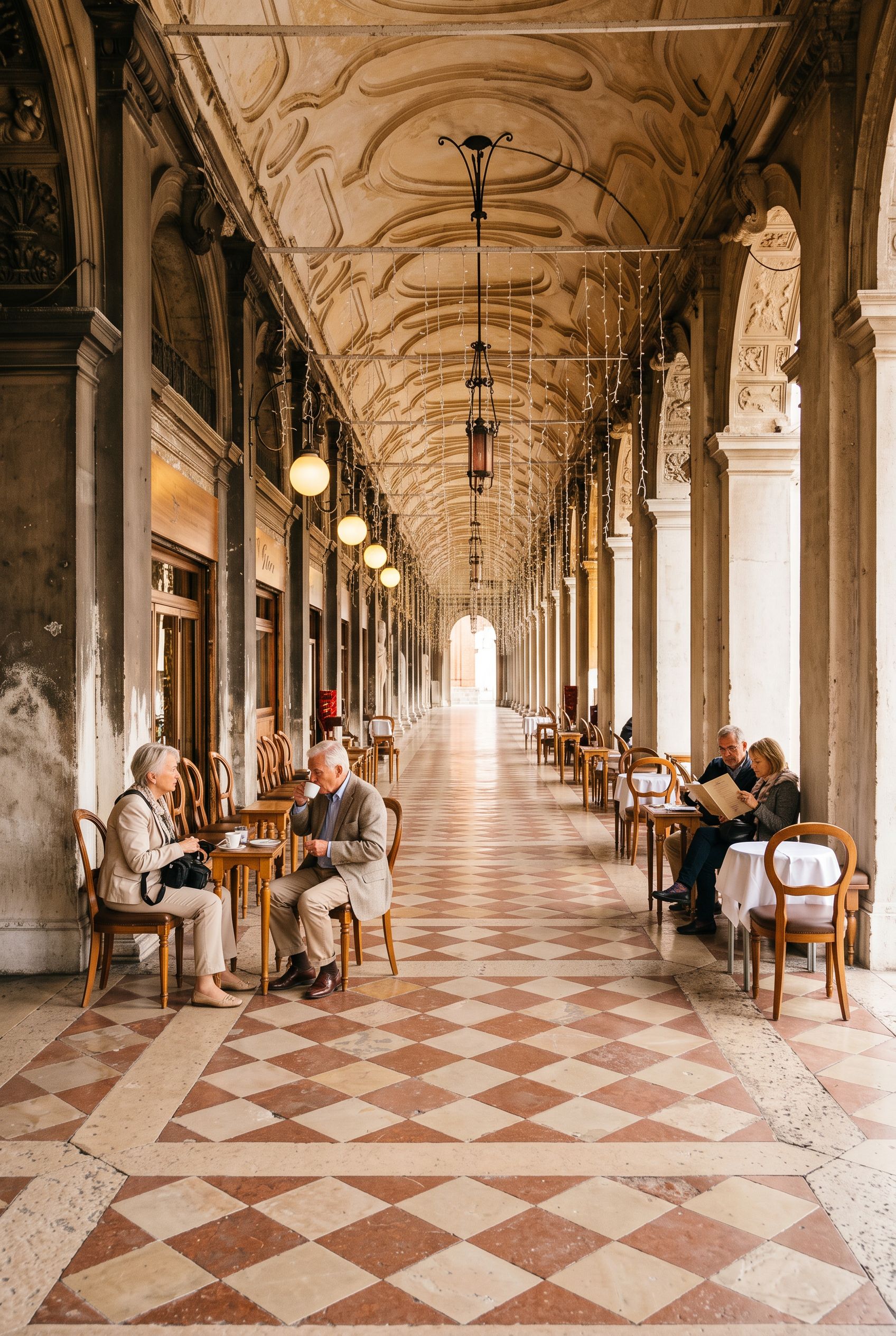
The Piazza is the natural starting point for a first morning. It is open, level and lined with seating, and the surrounding arcades offer shade and coffee within a few steps of the Basilica doors. A tourist medical service operates in the Procuratie Nuove, described as nearby Caffè Florian, every day from 9:00 to 19:00, with a published phone number for contact. That service runs only from 28 May to 11 September, so outside those months the nearest help is the Ospedale Civile in Castello.
Inside the Basilica, a guided visit typically allows about 30 minutes. The city's official accessibility pages do not publish step counts or lift details for the Basilica, so anyone with mobility concerns should confirm access arrangements directly before travelling. The same applies to seating inside: it is not documented.
 AI-edited
For the square itself, the practical rhythm is straightforward. Arrive early, sit when you need to, and treat the arcades as a series of staging posts rather than a single open space to cross. The Piazza San Marco first-aid point has no documented step or lift details, so if you rely on a wheelchair or walking aid, ask on arrival rather than assuming.
What does the Doge's Palace ask of you?
The Doge's Palace is the most accessible of the major interiors: the first and second floors are reachable by lift, according to the operator's own tour information. A guided visit spends about 1 hour 30 minutes inside. The internal passage connecting the palace to the prisons is not accessible by wheelchair because of a tight passage.
That lift detail matters more than any other single fact in this guide. Venice's historic buildings rarely publish this information, and the Doge's Palace is one of the few where the operator states it plainly. The palace's own accessible tour description confirms that the first and second floors are accessible by lift, while the internal connection between the palace and the prisons is not equipped for wheelchairs because of the narrow passage.
Timing is worth planning. A wheelchair-accessible guided tour covering the Doge's Palace, St Mark's Basilica and the Rialto area runs about four hours in total, with time set aside at each stop rather than rushing. It starts at Calle Vallaresso, 30124 Venezia, at 9:30 a.m., and includes a daily steamboat ticket, with one key transfer being a ride on steamboat line 1 to reach the Rialto area. The Rialto stop runs about one hour, and the Basilica portion about 30 minutes. At $436.87 per person, the tour costs more than big-group highlights, and food and drinks are not included.
For a fuller picture of the city's palaces and churches at a gentler pace, see our guide to the palaces, basilicas and museums of Venice.
Is a Grand Canal vaporetto ride worth it?
A vaporetto ride along the Grand Canal is the single best-value sightseeing in Venice, and it doubles as transport. Rick Steves forum reports describe the long rides on the vaporetto along the Grand Canal and out to the islands as great sightseeing opportunities. Boarding is the main physical challenge, not the ride itself.
The waterbus network is the city's accessible public transport backbone. Venice's official accessible-transport page confirms that wheelchair users can travel on ACTV waterbuses, buses and trams, with specially equipped spaces provided. AVM states that accessible waterbus boarding is available, and that special boarding arrangements and separate stop procedures apply for wheelchair users at certain locations and times.
Fares are published and straightforward. A 24-hour tourist ticket costs €30.00, a 48-hour ticket €50.00 and a 72-hour ticket €65.00 per person, according to the airport's waterbus information page. A 4.5-hour tour ticket costs €20.00 per person. Airport-to-Lido, Venice or the Cruise Terminal costs €15.00 one way when bought at ticket offices or machines, or €27.00 for a round trip. From San Marco to Lido or Murano, tickets are €10.00 one way or €18.00 per person round trip.
Luggage is the harder problem, not the walking. A Reddit report notes there are no porters inside Venice and that navigating luggage on a vaporetto can be difficult for anyone with mobility issues, recommending a private water taxi for hotel transfers. A Rick Steves report adds that porters with wheeled carts are usually found right outside Santa Lucia station, which can reduce strain at arrival. For the full picture of arriving by air, rail or water, see getting to Venice by airport, train and water.
Gondola or traghetto: which suits you?
The official gondola tariff is €90 for 30 minutes by day and €110 after 7:00 p.m., with up to five passengers per boat, so a full gondola works out at €18 per person by day. The traghetto, a shared crossing, costs €2 for non-residents and €0.70 for residents, paid in cash to the gondolier as you board.
These are two very different experiences. The gondola is a private, seated, slow glide through the smaller canals, and the daytime rate applies from 9:00 a.m. to 7:00 p.m., with the evening rate applying after 7:00 p.m. One official Venice information page states the evening tariff runs until 3:00 a.m. Tipping is not required but is appreciated for a particularly good experience.
The traghetto is a short standing crossing, traditionally used by locals to get from one bank to the other without walking to a bridge. There is no ticket, machine, app or pass for the service; payment is cash only, handed to the gondolier as you board. Service is shorter on Sundays and shorter again in winter, with some crossings operating on weekdays only and some closing seasonally. It also stops in bad weather or when not enough gondoliers are rostered. There is no service on 15 August, 25 December, 26 December or 1 January, and boats stop at 13:00 on 24 and 31 December.
| Detail | Gondola | Traghetto |
|---|---|---|
| Cost | €90 for 30 minutes by day; €110 after 7:00 p.m. | €2 for non-residents; €0.70 for residents |
| Capacity | Up to 5 passengers per boat | Shared crossing |
| Payment | Card payment not documented | Cash only, to the gondolier as you board |
| Timing | Day rate 9:00 a.m. to 7:00 p.m.; evening rate after 7:00 p.m. | Shorter on Sundays and in winter; some crossings weekdays only |
| Closures | Not documented | No service 15 Aug, 25 Dec, 26 Dec, 1 Jan; boats stop 13:00 on 24 and 31 Dec |
Neither service has a documented senior or over-65 fare in the gathered official material.
What should you know about the Rialto market?
The Rialto markets are active most mornings of the week, according to the operator's own tour description, and a Rialto stop on a guided route runs about one hour. The area is reached most easily by steamboat line 1. The market is the liveliest and most crowded part of the morning.
The market sits at the heart of the Rialto district, and the surrounding lanes are narrow, busy and uneven in places. The gathered official sources do not document step counts, bridge difficulty or seating for the Rialto area specifically, so anyone with mobility concerns should treat the approach as the uncertain part rather than the market itself.
The practical approach is to arrive early in the morning, when the market is at its most active and the surrounding streets are at their least congested, and to use the vaporetto rather than walking the full distance from San Marco. Steamboat line 1 is the documented transfer for reaching the Rialto area on the accessible guided route, and a daily steamboat ticket is included in that tour.
For travellers who prefer a slower cultural morning, the city's museums offer a gentler alternative. The Peggy Guggenheim Collection states free admission for visitors with limited mobility and care partners, with wheelchairs available free at the ticket office, staff assistance and access via platform lifts rather than direct Grand Canal entry. It opens daily 10 a.m. to 6 p.m., closed Tuesdays and 25 December. The National Archaeological Museum of Venice offers a tactile itinerary open to everyone for free, with booking requested, plus Braille guidebooks on demand and a multimedia guide.
Where can you sit down and rest?
Venice's cafés and benches are the practical rest infrastructure, and a Rick Steves forum post aimed at first-time seniors recommends exactly that: benches and coffee shops for frequent rest stops, plus asking museums about elevators where available. The city's official pages do not publish a seating map.
The accessible Venice map published by the Comune di Venezia does mark public toilets and waterborne public transport stops, along with bridges that have facilities such as a platform lift, lift or low step. That map was last updated in October 2017, so treat it as a starting point rather than a current inventory. The city's accessible-mobility guidance also notes that stops marked "BUS FACILE" are intended for safe boarding.
For medical needs, the documented numbers are 118 for medical emergencies and 112 as the unified European emergency number. The tourist medical service in Piazza San Marco operates every day from 9:00 to 19:00, with a published phone number for booking and contact, but only from 28 May to 11 September. A doctors-on-call service covers nights, Sundays, public holidays and pre-public holidays, with district-specific numbers listed for the Venice historic centre and nearby islands. The Ospedale Civile di Venezia, the city's civil hospital, sits in the Castello sestiere with access from the Ospedale vaporetto stop. A 24/7 first-aid station is documented at Piazzale Ravà 1 on the Lido.
How should you plan the day around effort?
The simplest sightseeing cluster for older visitors is St Mark's area, the Doge's Palace and the Grand Canal by vaporetto, because they sit close together and the city's official transport page directs travellers to ACTV and the Hello Venice service for public-transport information. The €1.50 wheelchair-user fare includes an accompanying person's fare.
That fare is documented on the municipal transport page, which sets disability-card and wheelchair-user fares at €1.50 for eligible travel, inclusive of the accompanying person's fare. It does not document a general tourist senior fare, and the gathered official material does not document any senior or over-65 fare, reduced tariff or senior pass for the named Venice sights.
Infrastructure work is the most common practical disruption. In January 2025 the People Mover linking Piazzale Roma and Tronchetto was shut for 20 days for urgent maintenance, with ACTV advising vaporetto lines 2 and N as alternatives. Cannaregio has been especially affected by repeated infrastructure work, so visitors who want a gentler pace may want to check access there before going. The Arsenale and Lido side can be busier or differently routed during big events such as the Boat Show and Biennale-related traffic.
For accommodation chosen around comfort rather than style, see where to stay in Venice when comfort comes first. For travellers who want to build rest and recovery into the trip, our guide to spa hotels in Venice and on the Lido covers the options.
What about luggage and getting around?
Luggage is the harder issue than the walking once inside the city, according to a Rick Steves trip report. The most concrete advice across traveller threads is to use a private water taxi if carrying luggage, especially on arrival and departure. Porters with wheeled carts are usually found right outside Santa Lucia station.
The airport connections are well documented. Venice Airport is linked to Piazzale Roma by ACTV urban line 5 and the ATVO express line, and to Venezia Mestre station by ACTV urban line 15 and the ATVO express line. ATVO states its Venice Airport Bus Express buses are accessible to people with reduced mobility and have luggage space. The airport bus stop sits about 50 metres from the terminal exit, in the area dedicated to bus services, with self-service ticket machines available 24 hours a day. From Marco Polo Airport, the official airport transport page lists the Alilaguna water bus and private water taxi as options to reach Venice.
Once in the city, the vaporetto network is the practical way to cover distance without walking. A Rick Steves report notes that other passengers may give up seats and help the infirm and elderly on the vaporetto, which is worth knowing if standing is difficult. The city's bridges, boarding points and narrow lanes make mobility more of a planning factor than the distance alone.
The gathered official sources do not document a citywide safety rating for Venice, and the exact nearest pharmacy to any given point is not documented either. A dated accessibility guide lists individual pharmacies in the municipality, including Farmacia Morelli, San Marco 5310, but does not identify it as the nearest to any specific sight.
What else should you confirm before you go?
Several details that matter to older travellers are simply not published. Step counts, lift counts and bridge-by-bridge difficulty for the named Venice sights are not documented in the gathered official material, and neither are senior discounts or reduced-tariff passes. Confirm these directly with the operator or the city's accessibility office before travelling.
The city's official accessibility page states that Venice and Mestre both have public information services for disability access and urban accessibility projects, with downloadable itineraries and support contacts. That is the right first stop for anyone who needs to plan around specific access requirements, because it is the authority that would publish the detail if it existed.
For the Doge's Palace, the operator's own tour information states that a Covid-19 Vaccination Card or Green Pass is mandatory to enter museums and churches. That requirement is stated on a page last updated in the period covered by the source, so check current entry rules before travelling.
Finally, a note on the accessible guided route. The 4.5-hour wheelchair-accessible tour covering the Doge's Palace, St Mark's Basilica and the Rialto area starts at Calle Vallaresso at 9:30 a.m. and costs $436.87 per person, with food and drinks not included. It includes a daily steamboat ticket. For travellers who want the reassurance of a guided route with documented lift access at the palace, it is the clearest published option.


