
The Dolomites are not quiet by default. In February and in the first half of August, the villages below the passes fill with ski boots, shuttle buses and dinner service that runs late, and the difference between a restful week and a restless one usually comes down to which side of the building your room faces. For travellers aged 50 to 70 who sleep lightly, the useful question is not which hotel is the most luxurious but which properties document calm, and which room to ask for once you have chosen one.
Italy's own tourism boards describe the Dolomites as two seasons rather than one: a summer period from June to September for hiking and panoramic viewpoints, and a winter season from December to March for skiing (Dolomites official travel guide). Both peak seasons are loud in the resorts. The quieter stays documented cluster around a handful of properties with published quiet-room categories, gardens or edge-of-village settings, and around valleys that empty out in the shoulder months.
Which Dolomites hotels actually document quiet rooms?
Only one property carries an explicit quiet-room category: DOLOMEET BOUTIQUE HOTEL in Pinzolo, listed as wheelchair accessible with a lift, restaurant, room service and both a quiet room/apartment and a low-noise room/apartment.
That absence matters. A hotel can sit in a silent hamlet and still put you above the kitchen extractor, and a hotel on a village square can be perfectly still by 10pm. which properties stand away from lift stations, which have gardens or terraces, and which sit on the edge of a village rather than in its middle.
Guest feedback across the Dolomites points the same way. Reviews of hotels in the region repeatedly flag lift machinery, road noise and warm rooms as the main sleep disruptors, and several guests note that their room was quiet specifically because it was at the back of the building, away from the lift, or booked as a quiet room. Acoustics are not uniform across a property, which is why the request you make at booking does more work than the star rating.
 AI-edited
Where are the calmest settings in the Dolomites?
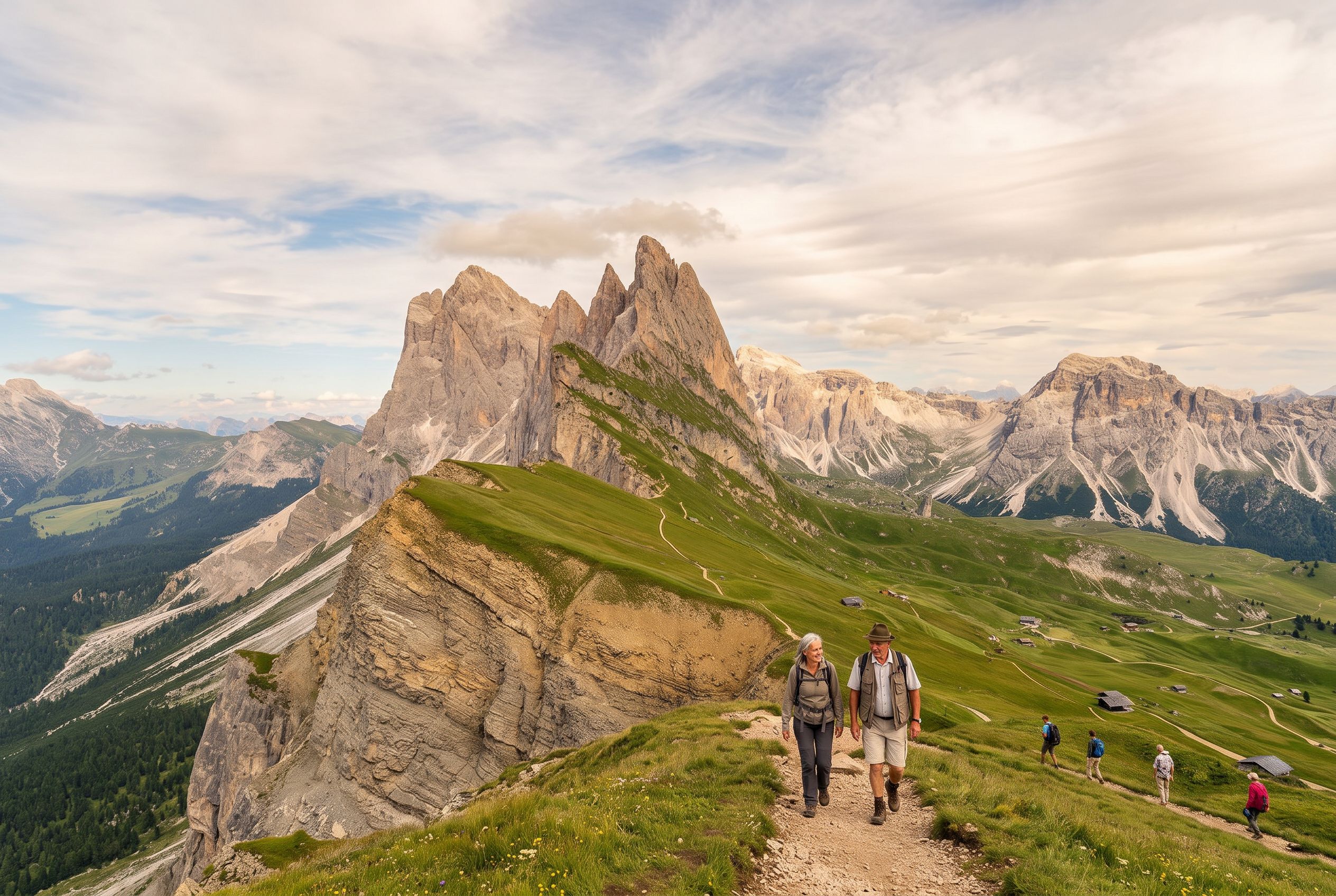
Alpe di Siusi and the smaller South Tyrol villages produce the strongest documented quiet-stay pattern. Several highly rated hotels on Alpe di Siusi are described in guest listings as away from the main road and therefore quiet, and as offering peace and quiet in the heart of the Dolomites. Val Gardena's villages and the Val di Fassa settlements offer more services but more evening activity.
Alpe di Siusi sits above Castelrotto and is reached by cable car, with the road up closed to cars from 9:00 to 17:00 during the season. That restriction shapes the day: no through traffic during the middle hours, and a plateau that empties as the last gondola descends. The Seiser Alm cable car runs 22 May to 2 November 2026, open 8:00 to 18:00, with high-season hours from 7 June to 6 September 2026 extended to 19:00 (Seiser Alm cable car summer timetable).
Val Gardena is the busier alternative. Ortisei, Santa Cristina and Selva di Val Gardena all have pharmacies and lift access, and the valley's official pages list Hospital Bressanone about 30 to 35 km away and Hospital Bolzano about 35 to 40 km away. Bressanone railway station to Selva di Val Gardena is 37 km by road, about 35 minutes with clear roads.
For a fuller comparison of the valleys as bases, our resort-by-resort guide to choosing a base in the Dolomites covers the trade-offs between services and calm.
Which properties suit light sleepers best?
The best-documented quiet-leaning properties are DOLOMEET BOUTIQUE HOTEL in Pinzolo for its quiet-room category, Hotel Hartmann in Ortisei for its edge-of-village forest setting, and the Alpe di Siusi hotels described by guests as away from the main road. Tirler, Hotel Villa Stefania, Renè Dolomites Boutique Hotel and Dolomit Boutique Hotel are documented for access and location rather than for noise.
DOLOMEET BOUTIQUE HOTEL in Pinzolo is documented as wheelchair accessible, with a lift, restaurant, room service, disabled washroom and quiet and low-noise room categories. The property does not publish noise measurements; ask which rooms fall under the quiet category when booking.
Hotel Hartmann in Ortisei appears in a Fodors trip report from September 2025 as a small place, very quiet, overlooking forest and on the edge of Ortisei. That is a first-hand forum account rather than an operator statement, and the hotel publishes no quietness rating; treat it as a lead to check rather than a guarantee.
On Alpe di Siusi, guest listings describe several highly rated hotels as away from the main road so quiet, and as calm and quiet. One Tripadvisor review notes that children were present but that the setting still felt calm and quiet, which is worth knowing if you sleep lightly and are booking in school holidays.
What about accessibility in these quieter hotels?
Accessibility details are documented for several properties but not for all, and they vary by hotel. Tirler documents a ground-floor room with a terrace and level-access shower plus two lifts from the underground car park. Hotel Villa Stefania documents high accessibility with two special-needs rooms. The detail is not documented and should be confirmed with the property.
Tirler - Dolomites Living Hotel documents ground-floor room 200 with a terrace, a level-access shower, two lifts from the underground car park, and stepless access to the pool, fitness, beauty and relaxation areas. It is the only property with a documented walk-in or level-access shower.
Hotel Villa Stefania in San Candido/Innichen documents high accessibility, with access in almost all areas, two special-needs rooms, a lift serving the main hotel areas, an accessible sauna and beauty area, and an indoor pool reached via steps. The special-needs rooms have a bathroom with a 65 cm shower cubicle door width, but the source does not state that the shower is walk-in. The property stands 348 m from the Innichen/San Candido centre.
Renè Dolomites Boutique Hotel in San Giovanni di Fassa is documented as barrier-free, with a lift, shuttle service, ski and hiking bus, underground garage or covered parking, and grocery stores and a restaurant close by. One source places it 0.3 miles from the centre of Pozza di Fassa.
Hotel COSMEA Dolomites documents a step-free entrance path and lift access, with a lift door width of 120 cm. The shower type is not documented. Santre dolomythic home in Bressanone and Mirabell Dolomites Hotel in Valdaora both have extensive wheelchair-access inventories, but neither publishes shower layout. Dolomit Boutique Hotel in La Villa does not document lift, step-free access or shower type at all.
For a wider picture of step-free routes, station assistance and accessible transport across the region, see our guide to how accessible the Dolomites are for older travellers.
How do you reach a quiet hotel without a car?
South Tyrol has a documented public transport chain for arriving guests. DB and ÖBB train travellers can use the Anschlussticket Südtirol to continue by public transport from the station to their accommodation on arrival and departure days, and Südtirol Transfer runs shared or private transfers from the station to the accommodation, bookable online.
Several other services are documented on the Odles Dolomites mobility page. Alpine Pearls hosts often offer extras such as station pick-up. Insam Express ships luggage and bikes from home to a South Tyrol stay. The Südtirol Guest Pass Slow Dolomites Card gives free, unlimited use of all public transport. An e-car-sharing scheme from AlpsGo operates in the municipality of Lüsen.
Two practical limits are documented. Bike carriage on public transport around the Dolomite passes is not possible. At Zans, paid parking is limited and often full in summer, with a limited quota of spaces bookable online for cars only, and roadside parking is forbidden and fined.
For train travel in South Tyrol, assistance must be requested at least 24 hours before departure via Sala Blu Verona, by email, app or the toll-free number 800 90 60 60. Winter tyres or snow chains are required from 15 November to 15 April.
When should light sleepers travel?
Late spring to early summer and autumn are consistently described as less crowded than peak summer and winter, with some sources calling May, June and September the thinner-crowd months. Mid-July to late August carries the heaviest pressure. Shoulder months bring their own trade-off: May, October and November have limited lift operations and some accommodation closures.
The Dolomites' official travel guide states that shoulder months such as May, October and November deliver beautiful scenery but have limited lift operations and some accommodation closures, which matters at the planning stage. Most lifts open from mid-June to late September, and many hotels, mountain huts and lifts remain closed until early summer.
Spring is described as the quietest shoulder season, with snow melting in the valleys, high routes still under snow and many huts shut. For hiking and calmer stays, several guides put the most reliable window at late June through September, while peak pressure falls in mid-July to late August.
Construction is the other seasonal noise risk. Regional hotel-news coverage for 2026/27 reports that the Dolomiti lift at Kronplatz is being rebuilt as a modern 8-seater chairlift with a capacity of 3,000 passengers per hour, and ski-industry reporting lists further 2026 lift projects including Ruacia-Sochers-Bruno, Costabella, Val d'Arei and Apollonio-Mortisa-Socrepes. Areas around active lift projects can be noisy during the build period.
What does a quiet stay in the Dolomites cost?
The one documented figure in the material is for a different property: Hotel Dolomitenblick in Terento lists high-season prices from €82 to €108. Rates across the Dolomites are indicative and vary by season and booking channel.
Senior reductions are documented for some mountain services rather than for hotels. The Seiser Alm Aerial Cableway publishes a reduced fare for people born in 1960 or earlier: €18 one-way and €26 return in summer 2026, and the same senior fare appears on the winter page. Reduced-rate tickets can only be bought at the cable car ticket offices, and summer tickets are also available online. Proof of identity is required at the ticket office.
Dolomiti Superski gives a 10% reduction on some ski passes for that age group. The Geological Museum of the Dolomites offers a reduced €4 ticket for over-65s, and DoloMythos Museum charges €12 for seniors aged 60 and over against €14 for adults.
No senior or over-65 fares, reduced tariffs, closing days or maintenance closures are documented for the hotels named in this article. For a wider breakdown of what a comfortable trip costs, see our guide to what a comfortable Dolomites trip costs.
What should you check before booking a quiet room?
Ask three things: which side of the building the room faces, how far it is from the lift and any bar or terrace, and whether the property has a quiet-room category. Only DOLOMEET BOUTIQUE HOTEL documents such a category. For every other property, the detail is not documented and should be confirmed directly.
Reviews of Dolomites hotels repeatedly identify lift machinery, road noise and warm rooms as the main sleep disruptors. Several guests report that their room was quiet because it was at the back of the hotel or away from the lift, which shows that the same property can produce very different nights depending on where you are placed.
Air conditioning is a recurring theme rather than a universal feature. At MY ARBOR – Dolomites in Bressanone, guest feedback notes that many rooms have no air conditioning and that portable units are reported as noisy or ineffective in hot weather, with upper-category rooms that have air conditioning available at extra cost. For a light sleeper in a warm month, that is worth asking about before arrival rather than after.
"We stayed for 5 nights and it was the most perfect way to unwind after some morning adventures. The facilities, pools, saunas were fab! Would highly recommend." (Google, July 2026)
Evening space is another point to check. One Tripadvisor review of a Dolomites property notes that the guest would have expected a quiet area or snug in addition to the main bar, but that there was not one. If you want a calm place to sit after dinner, ask whether the hotel has one.
Finally, check the booking terms. Cancellation policies, health provisions and safety notes are not documented for the properties named in this article, so confirm them with the hotel directly. The single European emergency number 112 covers mountain rescue across the Dolomites, and in the Veneto Dolomites the medical emergency number is 118, with an operations centre active 24 hours a day, seven days a week, and helicopter rescue activated when needed. Helicopter rescue is not free.
If your priority is broader comfort rather than quiet alone, that is a separate subject with its own dedicated guide, which you can find in our base-by-base comparison of Dolomites resorts.


