
The Dolomites reward a decision made early: where to sleep. The range spreads across three provinces and nine mountain systems, and the drive between its western and eastern valleys can swallow half a day. Travellers aged 50-70 who pick a base that matches their walking range, their tolerance for steps and their appetite for town life tend to spend their holiday on the mountain rather than in the car. This guide compares Ortisei, Cortina d'Ampezzo, Alta Badia (Corvara), Selva di Val Gardena, Castelrotto and Bolzano on atmosphere, transport, walkability, terrain, lift access and the kind of traveller each one suits.
It is a comparison of places, not properties. Individual hotel reviews have their own dedicated guide, and the mountains themselves are covered in our round-up of the finest Dolomites experiences for the over-50s.
Which Dolomites base suits you best?
Ortisei in Val Gardena is the most frequently recommended single base, with published barrier-free walking routes and easy lift access. Cortina d'Ampezzo suits travellers who want a full service town and the eastern peaks. Corvara, Selva, Castelrotto and Bolzano each answer a narrower brief.
The clearest pattern in the material is a west-versus-east split. A Rick Steves forum post advises that it is not necessary to switch places, suggesting one base for four to five nights, naming Ortisei and Val Gardena for the west side and Cortina for the east. Another poster reports using two bases, Ortisei in Val Gardena and Valdaora in the east.
That advice holds up against the geography. Val Gardena sits close to the Seceda and Alpe di Siusi lifts. Cortina sits nearer the Tre Cime area, and a Reddit thread notes it is closer to Rifugio Auronzo. If your list is weighted to one side of the range, base there and day-trip across rather than moving hotels twice.
What makes Ortisei the most recommended base?
Ortisei combines a working Ladin town with published accessible walking routes, several bus connections and lift access to Seceda and the Alpe di Siusi. It is repeatedly named as the best base on travel forums, and it is the best-documented choice for travellers who prioritise walking without barriers.
Val Gardena publishes a Small Village Tour of Ortisei described as completely barrier-free and easily undertaken by those with reduced mobility. It runs about 600 metres with a 40-metre elevation difference and takes roughly 20 minutes on foot. A separate accessible route around the town is published as wheelchair-accessible all year round, with an escalator from St. Antonius square to the starting point.
Bus access is documented too. The accessible Ortisei pages name line 350 from Bolzano, 360 from Bressanone, 172 from Castelrotto and 351 from Chiusa, Laion and San Pietro, all reaching St. Antonius square. The same pages say the town is reachable by train, car, bike or on foot, but they do not document a specific nearest station or airport transfer service for Ortisei itself. For the wider journey, see our guide to airports, trains and transfers in the Dolomites.
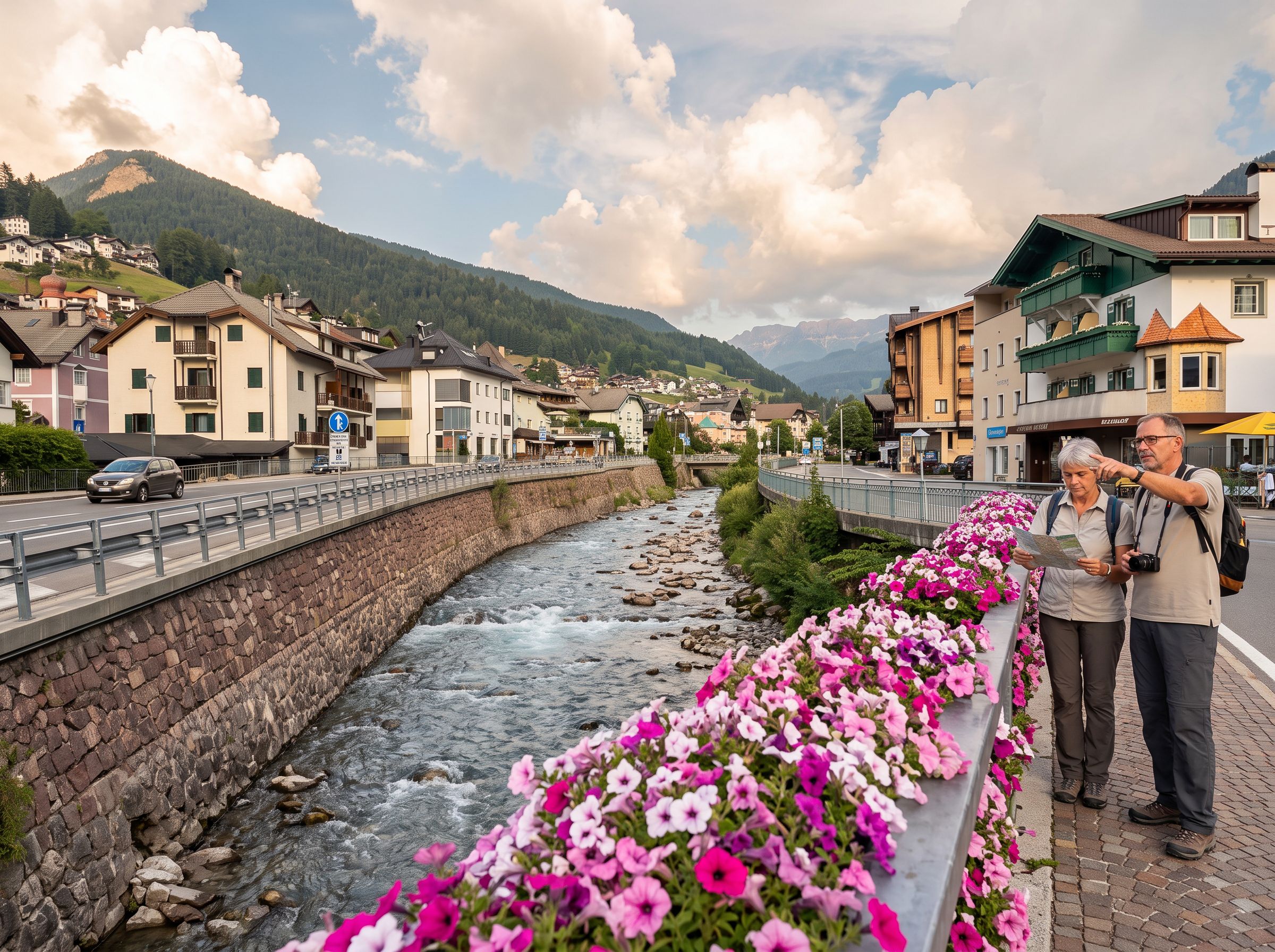 AI-edited
One caveat belongs here rather than in the closing. The Ortisei accessibility pages warn that the path can be slippery in winter and advise extra care on snow-covered ground. Ask at the tourist office about current surface conditions before committing to a route in the cold months.
Guest feedback supports the town's reputation for rest. Across the reviews reviewed, guests consistently describe Ortisei as the quieter, more sleep-friendly Dolomites base, while central Cortina draws stronger warnings about nightlife and street noise. Forum posters on Rick Steves describe Ortisei as convenient and the base for several cable cars, with easy access to hiking trails.
Is Cortina d'Ampezzo the right base for you?
Cortina suits travellers who want a classic resort town with a full service network: tourist office, skipass office and bus ticket office all in the centre, a hospital on Via Codivilla, and a direct airport coach from Venice Marco Polo in about two and a half hours. It is the strongest base for the eastern Dolomites.
The town is described in published material as compact and walkable, with public toilets below the town hall reached via Via Varentin from Corso Italia. The tourist office, skipass office and bus ticket office all sit in the centre on Corso Italia and Via Marconi. The official Cortina information page lists emergency call 112, alpine rescue on 118-112, municipal police and Carabinieri contacts, and names Hospital in Cortina at Via Codivilla, 1. A cortinadampezzo.it page describes the Codivilla-Putti hospital as the main healthcare facility in town.
On transport, the published material mentions bus connections and an airport coach service but gives no rail station inside Cortina. A cortinadampezzo.it page says Cortina Express runs direct buses from Venice Marco Polo Airport to the town's bus station in about 2.5 hours. The resort guide notes the heliport of Fiames is five kilometres north of town. Reuters reported in late 2025 that organisers had to cap ticket sales for Olympic events because of transport congestion and delays on a new cable car link to the Tofane ski area, and that Cortina has no rail station and road access can be slow at peak times.
Official and tourism pages frame Cortina as a wellness destination, with spas, hot tubs and sauna experiences, and the town sits within the UNESCO World Heritage Dolomites. One official guide gives the population as 6,000. For what a spa visit actually involves, see our piece on an alpine spa day in the Dolomites.
The caveat is noise. Reviews of central Cortina properties report club noise until late and traffic noise through the night, with light sleepers specifically warned about nightlife noise from an attached nightclub at one central address. If you sleep lightly, ask for a room away from the street and away from any bar or club in the building.
What is Alta Badia and Corvara like as a base?
Alta Badia is the quieter, more dispersed option, with Corvara as its main village. It suits travellers who want a calmer setting and a recently upgraded luxury hotel stock, and who are content with a shorter lift season than Val Gardena offers.
The Dolomiti SuperSummer lift season for Alta Badia runs from 13 June to 4 October 2026, according to the published Dolomiti lift calendar. That is a shorter window than Val Gardena and Alpe di Siusi, which both run from 1 May to 2 November 2026. If your visit falls in early May or late October, Alta Badia's lifts will not be running while Val Gardena's will.
A Rick Steves forum post notes that for hiking you can also stay in Corvara or Badia or even Cortina d'Ampezzo, which places Alta Badia in the same conversation as the larger resorts for walkers. The setting is Ladin, and the villages are covered in our guide to the mountain villages and Ladin culture of the Dolomites.
One recent change is worth knowing. Rosa Alpina in San Cassiano in Badia is being transformed into Aman Rosa Alpina after a top-to-bottom refurbishment. Reporting in 2025 says it reopened in July 2025 with redesigned rooms, expanded wellness space and new dining concepts, and that the property stays under the Pizzinini family's control while joining Aman. That is a brand change rather than a sale, and it shifts the upper end of the local market.
How does Selva di Val Gardena compare with Ortisei?
Selva sits in the same valley as Ortisei, roughly six miles away according to a Rick Steves forum post, and shares its lift network. It is the better choice if you want to be higher up the valley and closer to the Sella passes, and the weaker choice if you want the flatter town walking that Ortisei documents.
The relationship between the two is simple. A Rick Steves forum post notes that Selva is only six miles from Ortisei, where the lifts to Seceda and Alpe di Siusi are located. Both sit within Val Gardena, whose summer lift season runs from 1 May to 2 November 2026 on the published Dolomiti calendar.
Val Gardena publishes a barrier-free village tour and an all-year wheelchair-accessible route for Ortisei, and no equivalent route is documented for Selva in the material reviewed. That is a gap in the record, not a statement about the ground. If step-free walking matters to you, ask the Val Gardena tourist office directly about Selva's centre before booking there.
For skiers, the two are effectively one resort area. For summer walkers who want a gentle town stroll at the end of the day, Ortisei's published routes are the ones you can plan against in advance.
Why consider Castelrotto or Bolzano?
Castelrotto sits below the Alpe di Siusi and is served by shuttle buses to the cable car, which makes it a quieter alternative to Ortisei with the same meadow above it. Bolzano is the provincial capital and the main rail arrival point, better as a first or last night than as a walking base.
The Seiser Alm operator publishes that shuttle buses run between Kastelruth (Castelrotto), Seis am Schlern, Völs am Schlern, Tiers am Rosengarten and the Seiser Alm cable car. That matters if you stay in Castelrotto without a car: the connection to the meadow is a bus ride rather than a walk.
Bolzano's role is different. Bus line 350 from Bolzano to Ortisei is named on the accessible Ortisei pages, which confirms the link between the city and the valley. The city is the provincial capital of Bolzano/Bozen, and it functions as the practical gateway for arrivals by rail. It is not a mountain base in the sense the other five are.
If your trip begins or ends with a long train journey, one night in Bolzano before moving up to a valley is a sensible arrangement.
How walkable are these bases, and what about steps and hills?
Ortisei is the only base in this comparison with a published barrier-free village route and an all-year wheelchair-accessible circuit. Cortina is described as compact and walkable. For the other four, the material reviewed does not document town-centre gradients or step counts, and those details should be confirmed with the local tourist office.
Here is what is documented, and by whom.
| Base | What the operator or authority publishes |
|---|---|
| Ortisei | Small Village Tour: barrier-free, about 600 m, 40 m elevation difference, about 20 minutes. A separate all-year wheelchair-accessible route, with an escalator from St. Antonius square to the start. Path can be slippery in winter. |
| Cortina d'Ampezzo | Described as compact and walkable; public toilets below the town hall reached via Via Varentin from Corso Italia. |
| Selva di Val Gardena | No town-centre walking or access route documented in the material reviewed. |
| Alta Badia (Corvara) | No town-centre walking or access route documented in the material reviewed. |
| Castelrotto | Shuttle buses connect the village to the Seiser Alm cable car; village gradients not documented. |
| Bolzano | Walking terrain and lift access not documented in the material reviewed. |
The wider picture is that the Dolomites UNESCO accessible pages describe an interactive map covering 36 routes of varying difficulty and 13 accessible viewpoints across the nine mountain systems, aimed specifically at visitors with limited mobility, older travellers and very young children. That is a range-wide resource rather than a village one, and it is worth opening before you choose a base.
What lift access does each base give you?
Val Gardena and Alpe di Siusi have the longest published summer lift season, running from 1 May to 2 November 2026. Cortina runs from 6 June to 18 October 2026 and Alta Badia from 13 June to 4 October 2026. Ortisei's Seiser Alm cable car runs from mid-May to early November.
The Seiser Alm operator publishes that the cable car operates from mid-May to early November, daily until 6 pm and until 7 pm in high season. Ropeways make it possible for people who cannot manage long distances on foot to explore the entire Seiser Alm, and all ropeways transport pushchairs.
On fares, the Seiser Alm cable car page gives a senior rate for people over 65, born before 31 December 1958: €18 single and €26 return. That is a specific, published reduction rather than a general assumption, and it is worth checking the equivalent at whichever lift you plan to use most.
Cortina sells a Vertical Pass giving pedestrians access to all lifts except the Col Drusciè-Ra Valles and Ra Valles-Cima Tofana lines, for 1, 3, 5 or 7 days, usable throughout the season while days last. It is not valid on the Lagazuoi, Ra Valles and Cima Tofana cable cars. The official Cortina lift page also sells a Cortina Bike Pass for mountain bike and gravel users. No senior fare was documented on the cited Cortina lift page.
One exclusion is worth flagging for Val Gardena. The published Dolomiti SuperSummer terms state that passes are not valid on the Ortisei-Furnes, Furnes-Seceda and Fermeda lifts on the Seceda ascent. If Seceda is your priority, check how you will pay for that ascent before buying a card.
Where should you base without a car?
Ortisei and Cortina are the two best-documented car-free bases. Ortisei has named bus lines from Bolzano, Bressanone, Castelrotto and Chiusa reaching St. Antonius square. Cortina has a town-centre bus ticket office and a direct airport coach from Venice Marco Polo in about two and a half hours.
For Ortisei, the documented lines are 350 from Bolzano, 360 from Bressanone, 172 from Castelrotto and 351 from Chiusa, Laion and San Pietro. The accessible pages say the town is reachable by train, car, bike or on foot, but they do not document a specific nearest station or airport transfer service for Ortisei itself. Plan the last leg with the bus operator rather than assuming a station transfer exists.
For Cortina, the tourist office, skipass office and bus ticket office are all in the centre, and the Cortina Express coach from Venice Marco Polo takes about 2.5 hours to the town's bus station. The official information page gives the local bus and ticket-office contacts.
Castelrotto has the published shuttle network to the Seiser Alm cable car, which covers the meadow but not the wider valley. Selva, Corvara and Bolzano are not documented in the material reviewed for car-free village access, so confirm connections with the local tourist office before committing.
When should you go, and when should you avoid the Dolomites?
The published seasons split cleanly: skiing is best from December to March, especially January and February, while hiking is best from June to September. The clearest caution is late September into October for Cortina, when many huts and cableways have already closed and early snow may begin.
Cortina's official guide describes long snowy winters and short, sunny, relatively fresh summers, with winter snowfall usually from November to April and the coldest temperatures from late December to early January. Summer temperatures are usually below 25°C with frequent sunshine. The Lagazuoi cable car may stay open until late October.
Lift seasons vary enough to matter when you book. Val Gardena and Alpe di Siusi run from 1 May to 2 November 2026, Cortina from 6 June to 18 October 2026 and Alta Badia from 13 June to 4 October 2026, on the published Dolomiti calendar. The Dolomiti SuperSummer Card is valid from 23 May to 9 November 2026.
For a first visit with the widest choice of open lifts and the longest walking window, late June to early September is the safest bet across all six bases. For a quieter trip with fewer crowds, early October works in Val Gardena but not in Alta Badia or Cortina.
What should you check before booking?
Check the lift season for your exact dates, the bus connection to your village, and the terrain between your accommodation and the places you plan to walk. Where the material reviewed does not document step-free access, gradients or walk-in showers for a given base or property, that detail should be confirmed directly rather than assumed.
Some properties publish clear access detail and others do not. Where a hotel does not document step-free entry, lift access or a walk-in shower, that is a gap in its published information, not a statement that the feature is absent. Ask the property directly and get the answer in writing before you book.
On health, the picture differs by base. Cortina names Hospital in Cortina at Via Codivilla, 1, and the Codivilla-Putti hospital is described as the main healthcare facility there. Val Gardena names Pharmacy Ortisei with telephone 0471 796125, and names Hospital Bressanone and Hospital Bolzano with phone numbers, but does not identify one as the nearest hospital for Ortisei. Local emergency numbers are not documented for Cortina, Ortisei or Val Gardena. Cortina's official page lists 112 for emergency calls and 118-112 for alpine rescue.
On cost, rates across the range are indicative and vary by season and booking channel. A Rick Steves forum post puts it plainly: Ortisei is expensive, Cortina is very expensive. Treat any figure you see as a starting point and confirm at the point of booking.
On booking, cancellation terms are not documented in the material reviewed for the bases covered here. Ask before you commit, particularly for peak winter weeks.


