
The Dolomites can work beautifully for travellers who tire easily or use a stick, a walker or a wheelchair, but only if the trip is built around the right lifts, the right plateau and the right expectations. The UNESCO Dolomites Foundation documents 36 accessible trails and 13 panoramic viewpoints reached by fully accessible lift systems across the nine mountain systems that make up the World Heritage Site (the foundation's accessible Dolomites programme). That is a real, structured network, not a marketing phrase. It is also a network, not a blanket. Between the accessible routes lie steep, gravel and sometimes unprotected mountain paths, and the difference between a gentle day and a punishing one is usually decided before you leave the valley floor.
This guide reads the region as a whole: which cable cars and gondolas are documented as step-free, where the level walking actually is, how altitude affects a traveller in their sixties, and where the terrain turns serious. Hotel-by-hotel access is a separate subject with its own dedicated guide, so it appears here only in passing.
Is the Dolomites region accessible for limited mobility?
Partly, and unevenly. The UNESCO Dolomites Foundation documents 36 accessible trails and 13 accessible viewpoints across the nine mountain systems of the World Heritage Site, with technical sheets in English, German and Italian. Outside that documented network, accessibility is published lift by lift and valley by valley, so the region cannot be described as uniformly barrier-free.
The practical consequence for a traveller aged 50 to 70 is that the Dolomites are not one destination with one answer. They are a collection of valleys, each with its own lift operator, its own access rules and its own level of published detail. Some operators state plainly that a cable car is barrier-free at both stations. Others say only that it is accessible for wheelchair users. Others say nothing at all, and silence is not a promise.
The documented accessible routes are the strongest starting point because each one carries a technical sheet describing the trail, its access points and its terrain, so a reader can judge suitability before committing. The programme was developed with accessibility associations, which is why the sheets exist at all. The same programme's interactive map covers routes of varying difficulty, which is a reminder that "accessible" here means documented and assessed, not necessarily flat.
Which cable cars and gondolas are documented as step-free?
Three are documented in operator-level detail: the Seiser Alm cable car, described as fully accessible with barrier-free valley and mountain stations; the Renon cable car from Bolzano, stated to be accessible for wheelchair users; and the Lagazuoi cable car above the Falzarego Pass, described as fully accessible to disabled passengers.
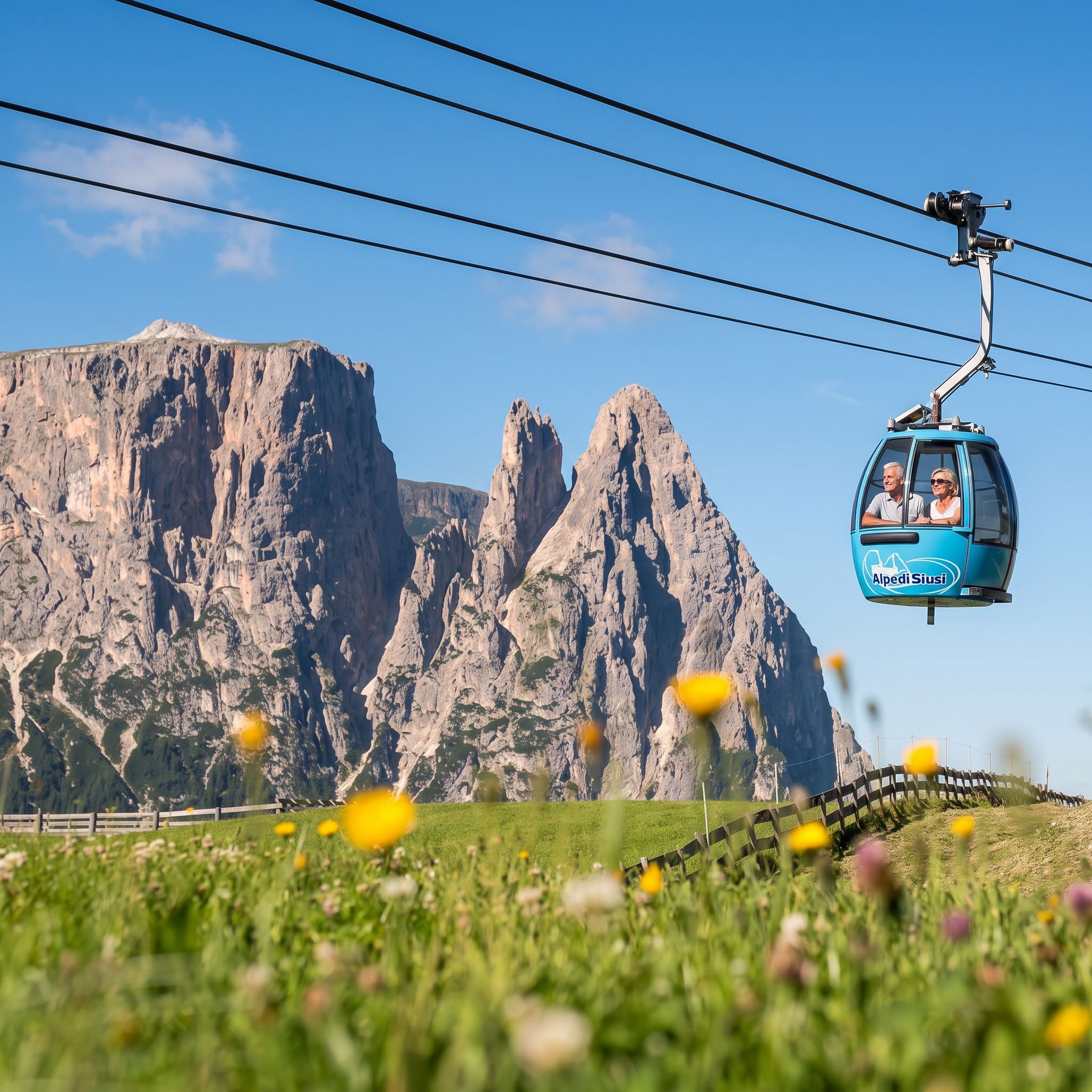
The Seiser Alm cable car carries passengers, rucksacks, pushchairs, bikes and dogs up to the plateau in about 15 minutes, and the operator describes the cabins as spacious, taking up to 16 passengers, with priority boarding for wheelchair users. The bottom station sits in Seis am Schlern at Schlernstraße 39, with free parking in the large outdoor car park and paid underground garages.
The Renon cable car starts in the centre of Bolzano and climbs roughly 1,000 metres to Soprabolzano in 12 minutes, with a cabin departing every 4 to 12 minutes from the Bolzano and Soprabolzano stations. The operator states it is accessible for wheelchair users. Tickets and seats cannot be reserved, so arrival time is the only lever a traveller has.
At Lagazuoi, the operator states there are no architectural barriers from the Falzarego Pass parking area to the panoramic terrace near the mountain station, that the cable car is fully accessible to disabled passengers, and that ramps and a lift serve the Lagazuoi EXPO Dolomiti exhibition space.
 AI-edited
Is the Alpe di Siusi the easiest place to walk?
The Seiser Alm, or Alpe di Siusi, is the clearest low-effort option in the Dolomites because the operator describes the cable car as fully accessible and the plateau as reachable comfortably by lift. It is the single best-documented combination of an accessible ascent and gentle high ground.
The plateau sits above the village of Seis am Schlern, and the road connection from the village to the Alpe is short: 3.9 km by road, about 5 minutes with clear roads. That matters if you are being driven to the bottom station rather than walking to it.
Access rules on the access road are the detail most travellers miss. When the cable car is operating, the road up to the Seiser Alm is closed to private traffic from 9:00 to 17:00. Holders of an official European Disability Card may drive up to Seiser Alm and Compatsch at any time, but only after prior registration and an access permit applied for through the municipal portal. The permit is not automatic and the operator does not publish cancellation terms for it.
For summer 2026 the operator lists the gondola as running from 22 May 2026 to 2 November 2026, and publishes a senior rate for those born in 1960 or earlier of €18 one-way and €26 return. Wheelchair users, blind passengers and people with 100% disability travel free, and other passengers with a disability and a valid certificate pay the same €18 and €26. Reduced-rate tickets can only be bought at the cable car's own ticket offices, not online.
Where are the accessible viewpoints?
The UNESCO programme lists 13 panoramic viewpoints reached by fully accessible lift systems, spread across the nine mountain systems of the World Heritage Site. The programme also notes that some of the 36 accessible routes require an off-road wheelchair, so the viewpoint list and the route list are not the same thing.
Viewpoints and trails carry different demands. A viewpoint reached by lift asks only that you can board and leave the cabin and manage the terrace. A route asks for distance, surface and stamina. The foundation's own framing is that the routes were developed with accessibility associations and that each carries a technical sheet so users can evaluate their own ability to complete it. That is an unusually honest approach, and it puts the decision in the traveller's hands rather than in a brochure.
Lagazuoi is the clearest example of a viewpoint with a cultural stop attached. The Lagazuoi EXPO Dolomiti holds temporary exhibitions in summer and winter, and the operator states that the refuge has services for disabled guests including a stairlift. The restored old path from the refuge to the summit cross follows a First World War route, which gives the walk historical weight as well as a view.
That same path carries the sharpest warning in the whole accessibility picture. The operator describes it as an unprotected mountain path, suitable for people with reduced mobility and even wheelchair users, but to be used with common sense and at one's own risk. Both statements are true at once, and a traveller should read them together rather than choosing the reassuring half.
How does altitude affect older travellers?
What is documented is that the terrain itself causes trouble: even travellers who did no hiking reported knee pain from steepness and uneven footing.
That reported experience is worth taking seriously. A traveller on a Rick Steves forum described the adjustment period in blunt terms: "My knees were in a lot of pain at the beginning of the trip as I got accustomed to the terrain." The same account is a useful warning for anyone managing joint issues, because it suggests the difficulty is cumulative and front-loaded rather than tied to one hard day.
Altitude figures for individual lifts and viewpoints are not documented in the material behind this guide, so no comparison table of heights would be honest.
Practical planning follows from that. Build the first two days around lifts and terraces rather than trails, keep the walking distances short at the start, and treat any increase in distance as something to add later in the trip rather than on arrival.
Is it easy to get around the Dolomites without a car?
In South Tyrol, public transport is described as accessible for people with limited mobility, with raised train platforms, lifts, and modern low-floor buses and trains carrying designated wheelchair spaces. The region is not uniformly easy without a car, because access rules and lift connections vary by valley.
In the Odles Slow Dolomites area of Val di Funes and Luson in the province of Bolzano, the region states that many regional trains have low-floor access, stations have lifts, and buses are barrier-free with ramps. The Südtirol Transfer shuttle covers the last kilometres from bus or train to accommodation and is described as barrier-free on request. The Südtirol Guest Pass Slow Dolomites Card gives unlimited public transport, and South Tyrol provides an assistance service at Bolzano railway station.
Bus services in the Dolomiti bus area, including the Cortina d'Ampezzo network, publish their own seasonal timetables and shuttle services, and the Tre Cime di Lavaredo shuttle returns from 30 May according to the operator's own site. The Skibus service for the 2025/2026 season is listed as active on the same operator page.
Where a car is part of the plan, the measured road connections are short. Bolzano railway station to Soprabolzano is 19 km by road, about 20 minutes with clear roads. Falzarego Pass to Lagazuoi is 1.4 km by road, about 5 minutes with clear roads. Those times assume free-flowing traffic with no stops, and summer traffic in the valleys can change them.
What does access cost, and who gets a reduction?
Reductions exist but are set valley by valley and product by product, so no single regional fare applies. The best-documented figures are the Seiser Alm cable car's senior rate for those born in 1960 or earlier, at €18 one-way and €26 return in summer 2026, and free travel for wheelchair users, blind passengers and people with 100% disability.
Dolomiti Superski states that discounts are available for seniors, with the exact reduction varying by product and area. Its official reductions page lists a 10% discount for seniors born in 1960 or earlier on daily and multi-day ski passes, and a 20% discount for people with at least 51% recognised disability on daily, multi-day and season passes. Discounted disability passes are available only at sales points, not online.
Museum reductions follow the same pattern of local variation. The Geological Museum of the Dolomites lists over-65s at €4, and the DoloMythos Museum lists seniors 60 and over at €12.
Two gaps are worth naming. The Renon cable car page does not document a senior or over-65 fare. The Lagazuoi page does not document senior or over-65 fares either. Neither silence means no reduction exists; it means the published page does not state one, and the fare should be confirmed at the ticket office. Rates across the region are indicative and vary by season and booking channel.
For a fuller picture of what a comfortable trip costs beyond lift fares, see our guide to what a comfortable Dolomites trip costs.
When should older travellers visit?
June, September and early July are the most practical compromise for travellers who want open lifts, good weather and fewer crowds. July and August are the busiest months, and May, October and November can bring limited lift operations and some accommodation closures.
Summer lift operations run from May to November across South Tyrol, Trentino and Belluno, according to Dolomiti SuperSummer, but many summer lift products operate only in peak season and some areas run limited services or close in the shoulder months. The official lift landscape is heavily seasonal, and some lifts may be closed or not open to pedestrians at all.
Dolomiti Superski states that all gondolas and cable cars can be used without skis, but that not all chairlifts are accessible to pedestrians for safety reasons. That distinction matters for anyone planning to ride a lift purely for the view: a gondola and a chairlift are not interchangeable.
The regional pattern is a dual season rather than a monthly curve. Bolzano records about 6 million overnight stays in August and 3.5 million in February, with the lowest points in April and November. The quieter windows are late September, early October, April and May.
What are the honest warnings about terrain?
The Dolomites are not a single easy-walking destination. Access ranges from barrier-free cable cars and plateau terrain to steep, gravel and unprotected mountain paths, and the documented accessible routes themselves vary in difficulty, with some requiring an off-road wheelchair.
The terrain is the main obstacle, and it does not announce itself. A path described as suitable for reduced mobility may still be an unprotected mountain path, as the Lagazuoi operator states for the route to the summit cross. The same page advises using it with common sense and at one's own risk. That is not a contradiction to be resolved; it is the actual condition of the route.
Construction is a live factor across the region. Val di Fassa saw the historic Campitello-to-Col Rodella cable car replaced by a new 3S gondola opening in December 2025, with 16 cabins and 30 seats per cabin. Cortina d'Ampezzo expanded its winter service from 24 December with five new ski-bus lines running every 15 to 30 minutes, plus dedicated links to Falzarego and Vodo. A live traffic bulletin lists trail closures in Pinzolo from 1 July 2026 to 4 December 2026 because of construction of a new ski slope, which applies to that municipality rather than the whole region.
For medical help, the emergency number across the Dolomites is 112, which covers mountain rescue, and 118 is the health emergency number in the Veneto Dolomites, with the operations centre active around the clock. Val Gardena's guidance notes that helicopter rescue is not free. The ULSS1 Dolomiti network lists hospitals at Belluno, Feltre, Agordo and Pieve di Cadore, and coordinates 76 affiliated pharmacies with 24-hour coverage through a shift system.
Two practical gaps should be named. Nor do they document a general calmest season or time-of-day rule for the region as a whole. Check each operator's own page close to travel.
If a slower day is part of the plan, our piece on what to expect from an alpine spa day in the Dolomites covers the indoor alternative, and choosing your base in the Dolomites explains how much the choice of village shapes the trip.
How should a limited-mobility trip be planned?
Build the trip around documented lifts and the plateau rather than around trails, and verify each lift's own accessibility statement before booking. The Dolomites work as a viewpoint destination for travellers who stay close to gondolas, funiculars and summit restaurants instead of assuming level ground.
Ortisei, Santa Cristina, Alpe di Siusi and the lift stations around Passo Sella and Passo Pordoi are the areas singled out as easiest for a low-walking day. Several lifts are recommended specifically for going up to enjoy the view or to have coffee or a meal with a view. The Seceda lift from Ortisei, the cable cars at Passo Sella and Passo Pordoi, the lift from Ortisei to Mont Sëuc, the funicular to Rasciesa, the Col Raiser lift from Santa Cristina and the Siusi-to-Compatsch gondolas are all described as good options for reaching major viewpoints without hiking.
Summit restaurants give a natural turning point. A traveller can ride up, eat, and ride back down rather than committing to a descent on foot, which is the pattern that protects knees and hips on steep ground.
Two documentation gaps are worth stating plainly. Where an operator publishes an accessibility statement, that statement is the reliable source. Where an operator publishes nothing, the detail is not documented and should be confirmed directly before travel.
For the wider picture of what to eat and where, our guide to eating in the Dolomites covers the table side of the trip.


