
A comfortable Dolomites trip costs roughly €200 to €400 per person per day in peak season once lodging, meals, lifts and transport are counted, and a couple travelling for five days should plan on €1,600 to €2,900 excluding international flights. Those are planning figures drawn from published rates and traveller reports, not a single official tariff. The Dolomites are not documented as one uniform destination for pricing, so costs vary by valley, season and how many cable cars you ride.
The good news for travellers aged 50 to 70 is that the region publishes some of its prices very clearly. The Seiser Alm cable car, the Gardena Card and the Dolomiti Supersummer Card all carry current figures on their own pages, which makes budgeting far less guesswork than in many Alpine areas. The harder part is accommodation, where rates swing widely between a valley town and a mountain village, and between June and September.
Is the Dolomites an expensive destination?
Yes, by most accounts. A widely published travel-planning estimate places mid-range daily spending at about €150 to €220 per person, budget travel at €80 to €120 per day, and upscale stays at €300 to €500 per day. Forum consensus among travellers over 50 is that a comfortable Dolomites trip is a mid- to high-budget trip, not a cheap one.
The Dolomites tourism site describes two main seasons: a summer period from June to September and a winter season from December to March, according to the region's own best-time-to-visit guidance. Both are peak, and both push lodging prices up. The quietest periods are late September, early October, April and May, when many hotels, huts and lifts are closed or running limited schedules.
That trade-off is the central budgeting decision. A shoulder-season trip costs less per night but removes some lifts and some dining from the equation entirely. A July trip costs more but delivers everything open.
What actually drives the cost?
Three things dominate: peak-season lodging, cable cars and lifts, and car hire or private transfers. Recent infrastructure work in Val di Fassa and Cortina d'Ampezzo signals continued high demand, and the cheapest rooms in high season are the first to sell out.
Lodging is the swing factor. A practical working range that appears repeatedly in first-hand forum discussion is about €200 to €300 or more per night in high-demand areas, with some travellers reporting €400 to €500 nights in Ortisei. Others describe €100 to €200 as challenging for a room with a view in September.
Lifts come second, and here the published numbers are firm. A single Seiser Alm return ride is €30 for adults in summer 2026, while a Dolomiti Supersummer Card day is €67 for adults. Ride three or four lifts in a day and the card pays for itself; ride one and it does not.
Transport comes third. Private airport transfers are often quoted from about €400 to €600 each way, while regional buses and trains are presented as the lower-cost alternative. For a couple, that single decision can move a week's budget by more than a thousand euros.
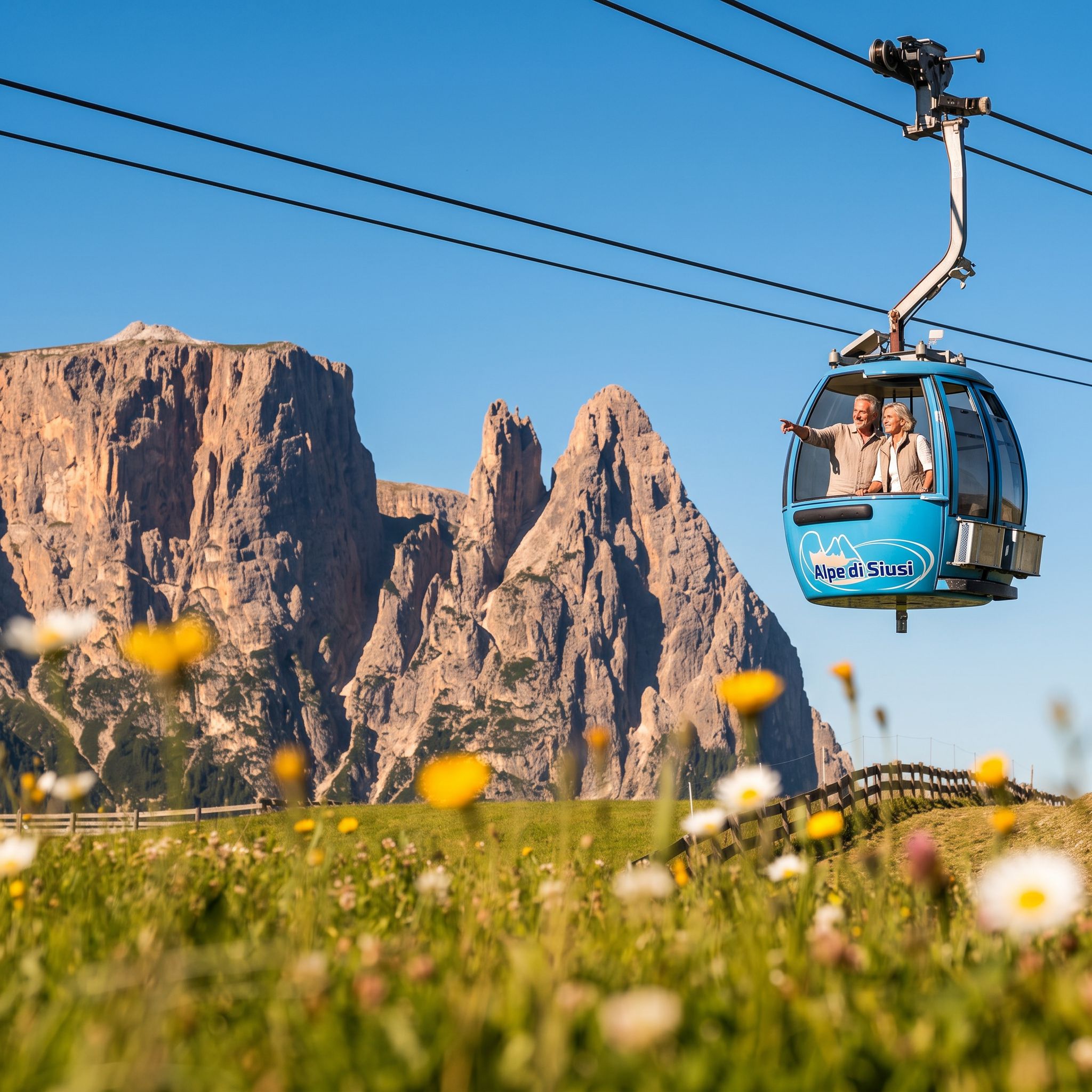 AI-edited
How much do lift passes and cable cars cost?
Published summer 2026 rates are clear at the operator level. The Seiser Alm cable car charges €21 one way and €30 return for adults, with a senior rate of €18 and €26 for those born in 1960 or earlier. The Gardena Card costs €160 for adults over six consecutive days, and the Dolomiti Supersummer Card is €67 for one adult day.
The Seiser Alm operator publishes its own summer cable car fares directly. The lift runs from 22 May to 2 November 2026, opening 8:00 to 18:00, extended to 19:00 from 7 June to 6 September 2026. A multi-ride card covering three ascents and descents during the season costs €73.
| Ticket | Adult | Senior / reduced | Validity |
|---|---|---|---|
| Seiser Alm cable car, one way | €21 | €18 (born 1960 or earlier) | Summer 2026 |
| Seiser Alm cable car, return | €30 | €26 (born 1960 or earlier) | Summer 2026 |
| Seiser Alm multi-ride card | €73 | Not documented | 3 rides, season |
| Gardena Card, 6 consecutive days | €160 | No senior rate documented | 6 June to 11 October 2026 |
| Gardena Card, 3 consecutive days | €124 | No senior rate documented | 6 June to 11 October 2026 |
| Dolomiti Supersummer Card, 1 day | €67 | No senior rate documented | Selected days |
| Dolomiti Supersummer Card, 5 of 7 days | €185 | No senior rate documented | Selected days |
The Gardena Card gives unlimited trips on 18 cable cars in Val Gardena and is valid for either 3 or 6 consecutive days. The operator notes that lift opening periods may not coincide with the card's validity window of 6 June to 11 October 2026, so check which lifts are running before you buy. Bike transport costs an extra €5.
For winter, one recent comparison put a one-day Dolomiti Superski pass at €86 and a 6-day high-season pass at €414 for 2025/26. Dolomiti Superski gives a 10% reduction on some ski passes for people born in 1960 or earlier, though rates vary by season and booking channel.
What do hotels cost by tier?
Frugal means a rifugio dorm bed with half board at roughly USD 75 or more per person per night. Mid-range valley-town hotels run about USD 250 to 300 or more per night, or €180 to €350 by another estimate. Comfortable mountain-base hotels in Ortisei or Cortina can reach €300 to €500 per night in peak season.
One current guide places a comfortable couple's trip at €1,600 to €2,900 for five days and €2,300 to €4,100 for seven days, excluding flights and international travel. Those figures assume a comfortable hotel, meals out and lift access.
Where you base yourself matters as much as which hotel you pick. A repeated warning in traveller forums is to check whether a cheap room is actually in a valley town such as Bolzano or Bressanone, because that lowers lodging cost but adds transport time to the mountains and increases weather uncertainty. The trade-off is real, and it is the single most common budgeting mistake reported.
Free cancellation in high season may be limited to 14 days before arrival, according to one forum thread on Val Gardena and Dobbiaco searches. Booking conditions vary by property, and the region publishes no standard cancellation rule. Ask when you book.
What does a sample day cost at each tier?
Frugal days land around €80 to €120 per person. Mid-range days run €150 to €220. Comfortable days reach €200 to €400 in peak season. These ranges cover accommodation, meals, lifts and local transport, and they exclude international flights and private airport transfers.
Budget-style travel is commonly described at €80 to €120 per day, while more upscale stays can reach €300 to €500 per day. The Dolomiti Bus network publishes route-by-route fare checking through its own timetable and fare portal, which is the practical way to price a car-free day.
| Style | Daily range | What it typically covers |
|---|---|---|
| Frugal | €80 to €120 | Rifugio or simple guesthouse, bus transport, one lift or none |
| Mid-range | €150 to €220 | Three-star hotel, meals out, some lifts, local transport |
| Comfortable | €200 to €400 | Four-star mountain base, daily lifts, car hire or transfers |
For a comfort-oriented traveller aged 50 to 70, a realistic planning figure is about €150 to €220 per day, with costs rising if you rely on private transfers or higher-end hotels. That is the figure most consistently repeated across planning sources.
What about ski hire and e-bike hire?
What it does document is bike carriage on lifts: the Seiser Alm cable car charges €6 for a single bike one way and €12 return, and the Gardena Card adds a €5 fee for bike transport.
Lift operators publish bike-carriage fees but not rental rates. Rental pricing sits with individual hire shops, which set their own rates by season, duration and equipment tier. No regional rate card exists.
One documented discount is worth knowing. At Punka Bikecenter Rent & Go 3 Zinnen, cardholders receive a 10% discount, according to the 3 Zinnen Dolomites ticket page. That is a shop-level offer, not a regional standard.
For ski hire, the position is the same: no published regional rate is documented in the material gathered. Ask the hire shop directly for a multi-day rate, and ask whether boots are included, since that is where quotes most often diverge.
Where is the Dolomites dear, and where is it reasonable?
Ortisei and Cortina d'Ampezzo are the most consistently reported as expensive, with forum posts citing €300 to €500 per night. Valley towns such as Bolzano and Bressanone are cheaper for lodging but add transport time. Shoulder months, late September, early October, April and May, are the most reasonable window, though many lifts and hotels close.
The pattern is consistent across sources. Rick Steves forum posters describe the whole Dolomites as expensive, with one warning that $100 to $200 per night with a view in September is challenging. Another thread reports accommodations searched in Val Gardena or Dobbiaco at €300 or more per night. A Reddit post reported being shocked by prices in Cortina and Ortisei, finding over €300 per night and even €400 to €500 in Ortisei for their dates.
Where the region is reasonable is in its published lift pricing and its public transport. A €67 Supersummer Card day across more than 100 chairlifts, gondolas and cable cars is a defined, knowable cost. Regional buses and trains are presented as the lower-cost alternative to private transfers, which are often quoted from about €400 to €600 each way.
Choosing your base is the other lever. Our guide to choosing a Dolomites base resort by resort sets out how the main valleys differ for access and convenience.
When should you go to keep costs down?
The most reasonable window is the shoulder season: late September, early October, April and May. But shoulder months bring limited lift operations and some accommodation closures, so the saving comes with reduced access. Summer runs June to September, winter December to March, and both are peak.
Spring and late autumn are repeatedly described as times when many hotels, huts and lifts remain closed or operate on a limited schedule. Summer lifts are described as opening from mid-June to late September on one source. Many mountain huts are open in summer, and many refuges are open in winter for meals and overnights.
If you want both lower prices and full lift access, the edges of the summer season, early June or late September, are the practical compromise. Confirm lift opening dates before booking, because the Gardena Card's own validity window of 6 June to 11 October 2026 does not guarantee that every participating lift is running.
For travellers aged 50 to 70, the calculation is not purely financial. A quieter month means fewer crowds on paths and easier restaurant bookings, which many readers value as much as the saving itself. Our guide to the finest Dolomites experiences for the over-50s covers what is worth prioritising when time is limited.
What else should you budget for?
Add pharmacy access, mountain rescue cover and travel insurance to the plan. Emergency help in the Dolomites uses the single European number 112 for mountain rescue. In the Veneto Dolomites the health emergency number is 118, with the operations centre active 24 hours a day, seven days a week.
Pharmacy coverage is well documented in the main bases. In Val Gardena, a published local guide names Pharmacy Dolomiti in Selva di Val Gardena on 0471 795142, and notes an outpatient clinic at Nivesstr. 2. No hospital is documented in Selva itself; the nearest listed hospitals are in Bressanone and Bolzano, roughly 30 to 40 kilometres away.
In Alta Badia, pharmacies and medical services are listed in Corvara, La Villa, Badia, Colfosco, San Cassiano and La Val, including the Brixsana Trauma Center Alta Badia in Corvara. In the Veneto Dolomites, ULSS1 Dolomiti coordinates 76 affiliated pharmacies to provide continuous pharmaceutical assistance, 24 hours a day.
The MooneyGo app is used for tickets, and Google Maps can estimate distance-based bus prices. For dining costs, our guide to what to eat in the Dolomites covers what a hut lunch or a valley dinner typically involves.
If a spa day is part of the plan, factor it separately. Our piece on what to expect from an Alpine spa day in the Dolomites explains how those bookings usually work.
How should you book to control the cost?
Book early, base yourself strategically, and treat valley towns as a deliberate trade rather than a bargain. In high season the cheapest places are in high demand, so flexible dates matter more than expecting last-minute deals. Free cancellation in high season may be limited to 14 days before arrival.
Accessibility discounts are worth asking about, though they are not uniform. In Val Gardena, blind and visually impaired people may use public transport free of charge on presentation of the appropriate ID, and adults and juniors with a disability level of 51% or more receive a 20% discount. On the Seiser Alm cable car, wheelchair users, people with 100% disability and blind people travel free, with companions paying the regular fare, and people with at least 51% disability receive 20% off.
For disability discounts on ski passes in Val Gardena, the tourism site advises contacting sales points or emailing in advance. It publishes no single universal booking or cancellation rule. The same applies across the region: no Dolomites-wide booking system is documented.
One final note on dates. The Dolomites were added to the UNESCO World Heritage List on 26 June 2009, according to the Dolomites UNESCO World Heritage site, and the property covers about 142,000 hectares across five provinces. That status underpins the region's continued draw, and continued demand, which is the reason prices hold where they do.


