
There is a particular pleasure in staying somewhere you never need to leave for dinner. In Tuscany, that pleasure reaches an art form. The region's estate hotels and agriturismi have turned in-house dining into a genuine reason to book, with kitchens that draw on vineyards, olive groves, and vegetable gardens just steps from the dining room. For travellers aged 50 to 70 who value good food without the fuss of evening drives on unfamiliar country roads, these properties offer something increasingly rare: a complete sense of place, served course by course.
The three strongest senior-friendly picks in Tuscany for combining exceptional food with easier stay logistics are COMO Castello Del Nero, Castello Banfi – Il Borgo, and Castello di Casole, A Belmond Hotel, Tuscany. Each is a destination property in its own right, set in quieter rural surroundings rather than dense city centres, which helps reduce walking stress and makes the evening meal a simple matter of crossing a courtyard or a garden path.
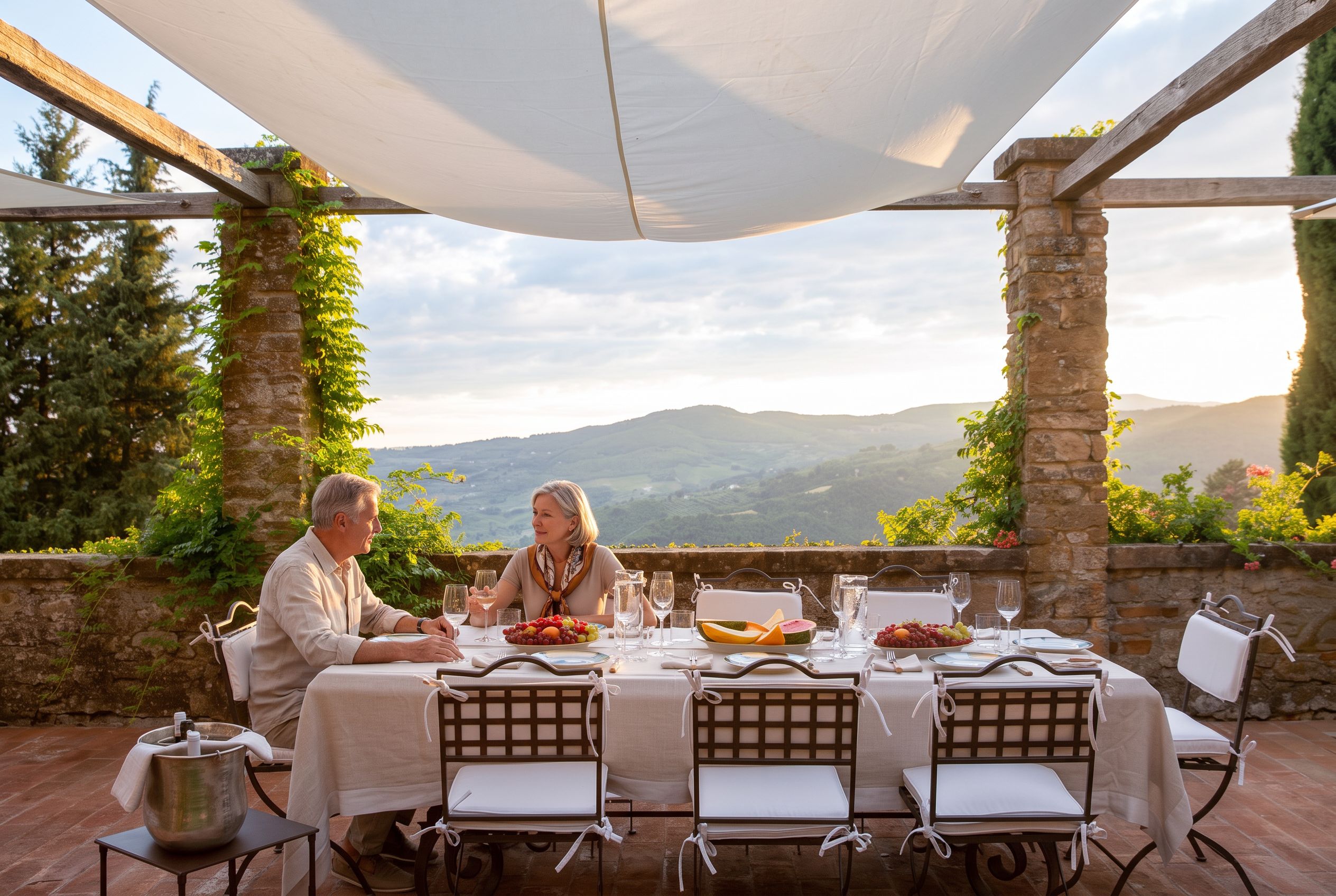 AI-edited
What follows is a practical guide to these estates, plus a look at the broader landscape of farm-to-table agriturismi that make Tuscany's hotel dining so memorable. We will cover who each property suits best, whether half-board represents good value, and what to ask before booking to ensure the stay matches your comfort needs.
What Makes Tuscan Hotel Dining Special?
Tuscan hotel dining stands apart because the kitchens cook from what surrounds them: estate-grown olives, wine-country produce, and recipes that have been refined over generations rather than invented for a menu. The result is food that tastes of its place, served in settings that range from medieval stone vaults to terrace tables overlooking vineyards.
The properties that earn their reputation on food tend to share the same three things: serious cooking, a generous breakfast, and service that comes from the family running the place. Agriturismo Il Selvatico, at Cinigiano in the Maremma hills of Grosseto province, runs a restaurant on the farm itself. Agriturismo Poggio al Tufo, an eight-room house at Pitigliano in the same province, is part of the Tommasi family's wine estate. In both cases the kitchen belongs to the farm, and guests tend to eat in rather than drive out.
This is not hotel dining as an afterthought. It is the central experience of the stay, often with the family who runs the property also running the kitchen. Breakfast is treated the same way: at Castello Banfi it is included with every room and suite, alongside a tasting of the estate's wines, and at Poggio al Tufo the bread, jam and yoghurt come from the farm itself.
COMO Castello Del Nero: The Polished Luxury Choice
COMO Castello Del Nero suits travellers who want upscale on-site dining with multiple venues and a resort-style stay. Its Michelin-starred La Torre restaurant anchors the culinary offering, supported by the al fresco Pavilion and the La Taverna bar, all focused on Tuscan cuisine in a refined estate setting.
This 12th-century castle estate, set in the hills south of Florence, has been transformed into a luxury resort that retains its historic character. The dining programme is the centrepiece: La Torre has held one Michelin star for twelve consecutive years under executive chef Giovanni Luca Di Pirro, with three tasting menus — Evoluzione Vegetali built on the estate's own vegetables, La Terra on local meat, Il Mare on seafood. It serves dinner only, Tuesday to Saturday from 7.30pm to 10.30pm, and reservations are required. The hotel itself closes for winter, from mid-November until the end of March. La Taverna is the relaxed end of the estate: COMO lists it as the hotel bar rather than a third restaurant, while the Pavilion serves lighter fare through the day.
For food-minded travellers, the advantage here is choice. You can dress up for a serious tasting menu one evening, then opt for something simpler and more rustic the next. The estate's setting, with its own vineyards and olive groves, means the kitchen has direct access to the raw materials of Tuscan cooking.
“The food is outstanding, made with fantastic ingredients and great attention to quality. We loved the setting, and the rooms were comfortable and well-appointed.” — from a Google review of COMO Castello Del Nero, June 2026
This property suits those who want a polished, controlled environment with consistent service. It is quieter than a town-centre stay, but it is also more formal. If you prefer a more intimate, family-run atmosphere, one of the agriturismi below may serve you better.
As with all historic estates, accessibility specifics need direct confirmation. The source materials confirm the dining setup but do not provide verified details on elevator count, step-free access, walk-in showers, or bed height. Ask specifically about these before booking.
Castello Banfi – Il Borgo: The Wine-Country Table
Castello Banfi – Il Borgo suits travellers who want a classic Tuscan estate with strong dining and an intimate wine-country feel. With La Taverna serving Tuscan cuisine, the Michelin-starred La Sala dei Grappoli offering fine dining, and breakfast included in every room rate, this is a strong half-board-style candidate for guests who prefer staying on property.
Set in the Brunello di Montalcino wine zone, Castello Banfi is one of Italy's most celebrated wine estates. Il Borgo, the hotel within the estate, offers a more personal experience than the larger resort properties. The dining here is deeply connected to the wine: La Sala dei Grappoli, which has carried a Michelin star for six consecutive years under chef Domenico Francone, pairs estate vintages with refined regional cooking, while La Taverna offers a more casual take on the same ingredients. La Sala dei Grappoli serves dinner only, Tuesday to Saturday, and is closed on Sundays and Mondays. It also shuts for the winter, from 8 November 2026 until 18 March 2027.
For travellers interested in wine tasting in Montalcino and the surrounding valleys, this is an ideal base. You can spend the day exploring the estate's vineyards and cellars, then settle into dinner without moving the car. The atmosphere is elegant but unhurried, suited to guests who appreciate the ritual of a long meal.
The estate's quieter rural setting means minimal street noise, though the source materials do not quantify noise levels. Banfi itself publishes nothing about access. Booking portals list a stair-free path to the entrance and a wheelchair accessible restaurant, but they also record that the building has no lift, which matters if your room is not on the ground floor. If you are booking for a traveller with limited mobility, ask for a ground-floor room with a walk-in shower and have the property confirm it before you commit.
Castello di Casole: The Quiet Countryside Resort
Castello di Casole, A Belmond Hotel, Tuscany, suits travellers whose priority is quiet ambiance and a scenic countryside resort atmosphere. Dining centres on local produce, with Tosca fine dining and other on-site outlets providing multiple options without leaving the estate.
This restored medieval castle near Siena offers one of Tuscany's most atmospheric stays. The dining programme emphasises local sourcing: Tosca for fine dining, Emporio del Castello for traditional Tuscan cooking, and Castello Grill for wood-fired dishes by the pool. Tosca serves dinner only, 7pm to 10pm, is closed on Mondays, and takes non-resident guests as well as those staying. The hotel runs a season rather than a full year: it opened on 12 March 2026 and stays open until 29 November. The estate's position, surrounded by rolling hills and cypress-lined roads, creates a sense of calm that is hard to find in busier locations.
For food-minded travellers, the appeal here is the combination of quality and convenience. You can enjoy a serious dinner at Tosca, then linger over coffee on a terrace with panoramic views. The resort's facilities, including a pool and spa, add to the sense of a complete destination rather than just a place to sleep.
This property suits those who want to feel entirely removed from the everyday, with minimal street noise and a peaceful setting. The trade-off is that it is less convenient for public transport than a central Florence or Siena hotel. Access is better documented here than at the other two estates: Belmond's published fact sheet names rooms in the main building suitable for wheelchair users, and the team offers to help arrange one. Lift access, shower type and bed height are not stated, so those still need a direct question before booking.
For help deciding between a countryside estate and a city base, see our guide to choosing your base in Tuscany.
The Agriturismi Worth Knowing
Beyond the grand estates, Tuscany's agriturismi offer some of the most memorable hotel dining in the region. These working farms and family-run properties serve dinners that guests consistently describe as the best meals of their trips, often at a fraction of the cost of the luxury estates.
Agriturismo Il Selvatico holds 4.8/5 on Google from 170 reviews as of August 2026, and the evening meals are the recurring theme in them. The farm sits at Cinigiano, in the Maremma part of Grosseto province, and keeps its own restaurant on site rather than sending guests into the village. The family-run atmosphere is what people describe most often: closer to being welcomed into someone's home than to checking into a hotel.
Agriturismo Poggio al Tufo offers a similar experience. It is a small eight-room house at Pitigliano, in the tufa country of southern Tuscany, attached to the Tommasi family's wine estate. The kitchen serves every evening: the Tavola delle Meraviglie Toscane runs daily from 7pm to 9pm by reservation, so dinner never depends on a drive after dark.
These properties suit travellers who value authenticity over formality. The dining pacing is leisurely by design: dinner at Il Selvatico is a fixed menu for everyone at the table, and a guest wrote on Google in July 2024 that it is "a set four course menu with wine." This is not fast food; it is the rhythm of a Tuscan evening, and it rewards those who are happy to settle in.
For a broader look at what a comfortable Tuscany trip costs, including agriturismo rates, see our honest 2026 budget guide.
Is Half-Board Good Value?
Half-board is generally good value at Tuscany's estate hotels and agriturismi, particularly where the evening meal is a multi-course affair with wine. At the luxury estates, it simplifies budgeting and ensures you experience the property's signature dining; at the agriturismi, it is often the only option and represents exceptional value.
The value calculation depends on your dining habits. If you enjoy a serious evening meal and would otherwise seek out a comparable restaurant, half-board typically saves money and eliminates the need to drive after dinner. At properties like Castello Banfi, where breakfast is already included, adding the evening meal creates a seamless experience.
At the agriturismi, the economics are even clearer. A four-course dinner with wine at a property like Il Selvatico would cost significantly more at a standalone restaurant of comparable quality. At Il Selvatico, reviewers describe coming back for a second dinner later in the same trip rather than looking for a restaurant elsewhere, which suggests the value is recognised by those who experience it.
One consideration is flexibility. Some travellers prefer to explore different restaurants during their stay, and half-board can feel restrictive if you are the type to wander. If you are based in a walkable town, this matters more. At the rural estates, however, the on-site dining is the point, and half-board allows you to relax into the rhythm of the property.
How Accessible Are These Hotels?
Accessibility at Tuscany's historic estates varies considerably, and only one of the three publishes anything concrete. Belmond's fact sheet for Castello di Casole states that wheelchair accessible rooms are available in the hotel building. COMO Castello Del Nero and Castello Banfi say nothing about access on their own sites, so for those two the practical rule holds: ask directly about lift availability, shower type, steps from entrance to room, bed height, and bathroom photos before booking.
Historic buildings in Tuscany often lack elevators and can have compact bathrooms, and a converted castle or farmhouse is under no obligation to say so on its website. That makes the published statements worth reading closely: what one property documents in detail, another leaves out entirely, and the silence is not the same as a step-free route.
Belmond states in its own fact sheet for Castello di Casole that wheelchair accessible rooms are available in the hotel building and that its team will help arrange suitable accommodation. Castello Banfi publishes nothing itself; booking portals list a stair-free path to the entrance and a wheelchair accessible restaurant, but also state that the property has no lift, which matters if your room is not on the ground floor. COMO Castello Del Nero is silent on access and refers enquiries to its front office.
Our dedicated guide to Tuscany accessibility for older travellers offers a broader overview of what to expect and how to prepare.
When you contact a property, ask these specific questions:
- Is there a lift to all room floors?
- Are there ground-floor rooms available?
- Do the bathrooms have walk-in showers or step-in tubs?
- How many steps are there from the entrance to the room?
- What is the bed height?
- Can you provide recent bathroom photos?
What About Noise and Sleep Quality?
Sleep quality at Tuscany's historic properties is generally good when rooms are quiet and beds are comfortable, but night-time noise and acoustics can be a problem in older buildings. Requesting a quiet room away from public spaces is a simple precaution that often makes the difference.
Guest reviews across the region highlight "quiet room" as a valued feature, suggesting that quietness is a frequent concern. At the estate properties featured here, the rural settings naturally reduce street noise, but internal acoustics in historic buildings can still be an issue. Rooms near dining areas or courtyards may pick up evening activity.
Sleep quality is worth a thought at booking. Historic estate buildings carry sound, and a room above or beside a courtyard, a bar or a restaurant terrace will pick up the evening. If sleep is a priority, ask for a room at the end of a corridor or in a quieter wing.
At the agriturismi, the family-run atmosphere can mean more personal attention to such requests. Guests at Il Selvatico and Poggio al Tufo reported warm, attentive service, which suggests the hosts are likely to accommodate reasonable requests for quieter rooms.
Location and Transport Considerations
The estate properties featured here are less convenient for public transport than central Florence, Siena, or Lucca hotels. The advantage is on-site dining and a quieter environment, which reduces the need for evening walking or taxi use. If easy transit access matters, choose a property near a rail station or base in a walkable town.
All three estates have multiple on-site dining venues, which means you rarely need to leave the property for meals. This is a significant practical advantage for travellers who prefer to avoid evening drives on unfamiliar roads. The trade-off is that exploring the surrounding area requires a car or organised transport.
For travellers who want to combine estate dining with day trips, a car is essential. The estates are spread across the region: COMO Castello Del Nero sits south of Florence, Castello Banfi is in the Montalcino zone, and Castello di Casole is near Siena. Each offers a different base for exploring, and our guide to choosing your base in Tuscany can help you decide which area suits your interests.
If you prefer not to drive, consider basing yourself in a walkable town with good rail connections and choosing a hotel with a strong restaurant. This combines the convenience of public transport with the pleasure of on-site dining, though you will miss the estate experience.
Price Bands and Booking Advice
None of the properties in this guide publishes a standing nightly rate on its own website, and there is no official Tuscan price statistic to fall back on, so the bands here are relative rather than absolute: the agriturismi sit well below the estates, and the gap widens once a starred kitchen enters the bill. Dinner is easier to price than a bed.
The agriturismi offer the best value for food-minded travellers. A four-course dinner with wine at a property like Il Selvatico is typically included in the half-board rate, making the overall cost comparable to a standard hotel room plus a restaurant meal. The luxury estates command a premium for their settings, facilities, and Michelin-starred dining, but the experience is correspondingly more polished.
When booking, consider the season. High season runs from June to September, with shoulder months of May and October offering milder weather and lower rates. None of the three estates is open all year. COMO Castello Del Nero closes from mid-November to the end of March, Castello di Casole runs from 12 March to 29 November 2026, and Castello Banfi's La Sala dei Grappoli shuts from 8 November 2026 until 18 March 2027. Check the dates before you build a trip around a particular kitchen.
For a detailed breakdown of what a comfortable Tuscany trip costs, including accommodation and dining budgets, see our honest 2026 budget guide.
How to Choose the Right Property for You
Choose COMO Castello Del Nero if your top priority is food quality and a polished luxury stay. Choose Castello Banfi – Il Borgo for a classic Tuscan estate with strong dining and an intimate wine-country feel. Choose Castello di Casole for quiet ambiance and a scenic countryside resort atmosphere.
For travellers who prefer the warmth of a family-run property and exceptional value, the agriturismi are the clear choice. Properties like Il Selvatico and Poggio al Tufo offer the most memorable meals, often described as the best of the entire trip, with service that feels personal rather than professional.
The decision ultimately comes down to what you value most. If you want multiple dining venues, spa facilities, and a polished experience, the luxury estates deliver. If you want the taste of Tuscany at its most authentic, with a family cooking for you as a guest rather than a customer, the agriturismi are unmatched.
Whichever you choose, book directly with the property where possible. This allows you to ask the accessibility questions, confirm half-board details, and request a quiet room before you commit. The extra conversation is worth the peace of mind.


