
Tuscany rewards those who slow down, and for travellers aged 50–70, the first decision—where to sleep—shapes everything. Florence offers rail connections and walkable museums. Chianti delivers vineyard views and quiet lanes. Val d'Orcia presents the postcard hills, but demands a car. This guide compares the three bases on transport, walking demands, driving requirements, and atmosphere, so you can settle in the right place before you arrive.
Travellers often ask whether one base can cover the whole region. The honest answer is no—not comfortably. Florence, Siena, Chianti, and Val d'Orcia each serve a different travel style. The advice that comes back again and again is blunt: without a car, base yourself in Florence; if the countryside towns are what you came for, hire a car and sleep outside the cities. Both Florence and Siena run restricted traffic zones in their historic centres, which is the practical reason behind it. The choice comes down to what you want your mornings and evenings to look like—crowds and cappuccinos, or cypress trees and silence.
Which base suits you best?
Florence suits travellers who want effortless logistics; Chianti suits those who want wine country calm with a car; Val d'Orcia suits those who want the most iconic scenery and are happy to drive for dinner. Siena is the compromise for a smaller city with day-trip reach.
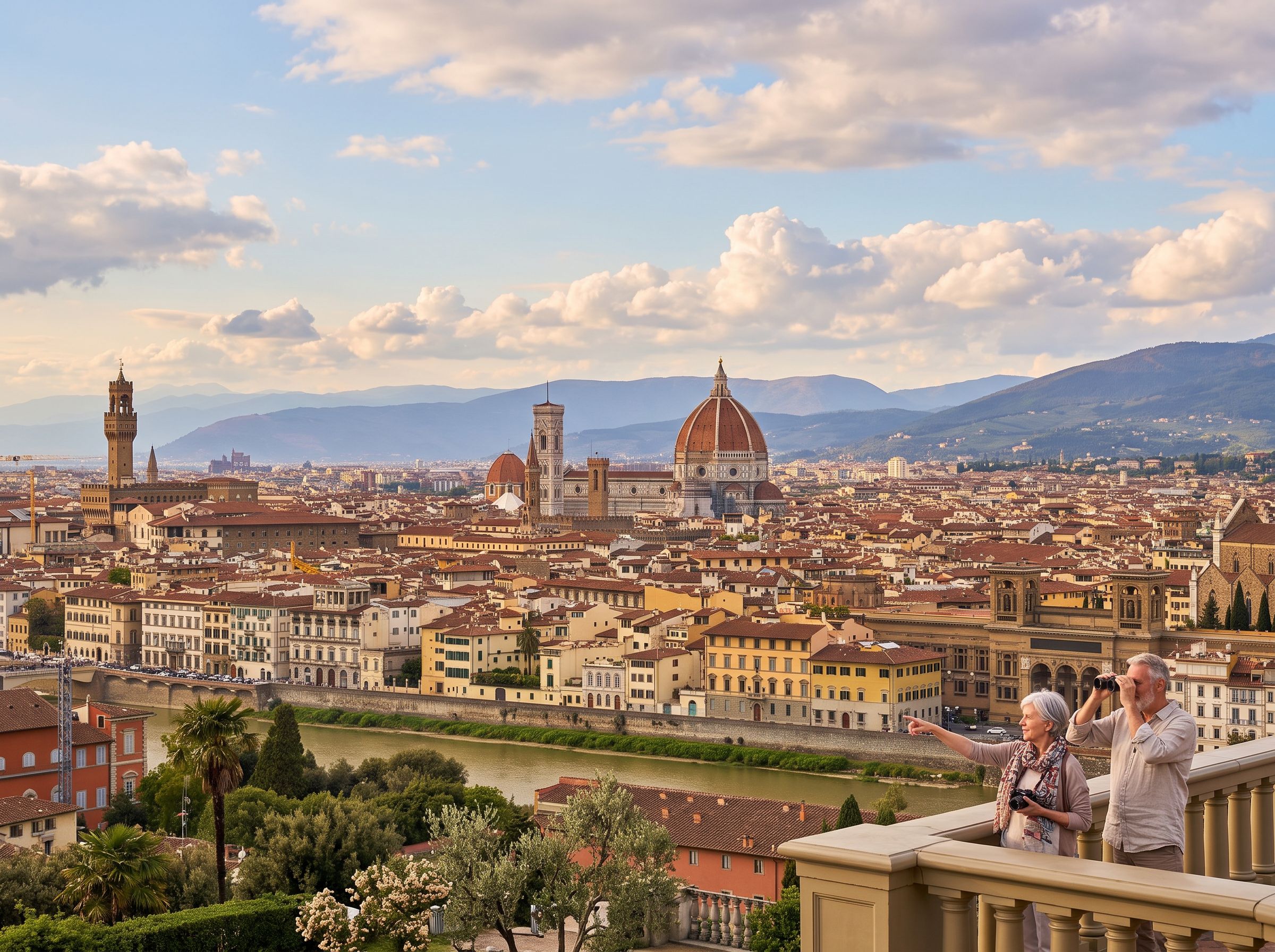
For a first visit, Florence is the safest all-round choice. The city is compact, the tram lines T1 and T2 are accessible to passengers with reduced mobility, and the train station connects you to the rest of Tuscany without a car. Chianti and Val d'Orcia are better as second bases, once you have seen the museums and want to trade them for vineyard lunches and hilltop towns. Experienced Tuscany visitors give the same advice again and again: slow it down and take it easy on a first visit.
 AI-edited
Is Florence the easiest base for seniors?
Yes. Florence has the strongest rail connections, the widest range of hotels with elevators and accessible rooms, and the most restaurants within walking distance. The city is compact—anywhere between the Duomo, Ponte Vecchio, and the train station keeps you within an easy walk of the main sights.
Drivers holding a disabled parking permit may enter Florence's ZTL (limited traffic zone), but the number plate has to be registered first: Servizi alla Strada, which runs the scheme for the city, gives unlimited ZTL access to up to two plates linked to the permit, and for any other vehicle you must call the freephone line or send an e-mail either beforehand or within 48 hours of driving in. Permits issued by another Italian municipality go through the same registration. The tram operator states that every tram in service and every platform shelter is accessible to passengers with mobility or visual impairments, that each tram carries four wheelchair bays with anchoring systems, and that acoustic announcers call the name of the coming stop, with braille markings on the door-request buttons. For travellers who prefer not to drive, this makes Florence the most practical base in Tuscany.
The trade-off is noise and crowds. During high season, the area around the Duomo and Santa Croce can be extremely crowded. Many visitors prefer the quieter Oltrarno side, on the far bank of the river, to avoid some of that hustle and bustle while staying close enough to walk in. For a deeper look at the region's highlights, see our guide to Tuscany's highlights, chosen for the over-50s.
Is Siena a good compromise?
Siena offers a smaller, calmer city experience with good access to southern Tuscany and the hill towns. It is less transport-rich than Florence, but many travellers find it a more atmospheric base for day trips into Chianti and Val d'Orcia.
Siena is often described as the sweet spot for a Tuscan base if you want a smaller city and day trips — a city worth a couple of full days in its own right, not merely a stop between Florence and the hill towns. If you are planning to visit both Florence and the countryside, a common strategy is to base in Siena after seeing Florence first.
The historic centre is walkable, though it is hillier than Florence. The main challenge is the same as Florence: restricted traffic zones and limited parking. If you arrive by car, confirm your hotel's parking arrangements before you drive in. For getting around the region, see our practical guide to getting to Tuscany: airports, trains and transfers.
What about Chianti for a countryside stay?
Chianti is ideal if you want quiet vineyard scenery and a slower pace, but it works best with a car. There are few rail links, and you will drive for most meals and activities. It is often recommended as a second base rather than your only base.
Chianti sits between Florence and Siena, making it convenient for day trips to both cities. Practical bases include Greve, Panzano, Radda, Gaiole, and Castellina in Chianti. Castellina comes up most often for a practical reason: by road it sits about 43 km from Florence and 21 km from Siena, the shortest combined run of the four. Radda is roughly 51 km from Florence and 35 km from Siena, Gaiole 69 km and 29 km. Greve is the closest of all to Florence at about 31 km, but the furthest from Siena.
If you prefer not to drive, there is one workable option: bus route 365, run by Autolinee Toscane, which has managed Tuscany's road public transport since 1 November 2021. Its branches link Florence's Montelungo hub with Greve, Panzano, Radda and Gaiole — the 365 A is timetabled as Gaiole-Radda-Greve-Florence, the 365 D as Gaiole-Panzano-Greve-Florence. Choosing a base along the 365 route is a way to skip the hassle of driving and parking in Florence altogether. However, bus service is less frequent than trains, evening returns require planning, and it is worth checking which branch serves your village on the day you travel.
For a luxurious countryside base, consider the Castello di Casole, a Belmond Hotel, which we have reviewed separately for senior travellers; Belmond's own fact sheet states that wheelchair-accessible rooms are available in the hotel building.
Chianti is also further along on accessibility than its hills suggest. The regional tourism board describes three accessible looped routes branching off the historic Via Romea Sanese, starting from Castellina in Chianti, Barberino Tavarnelle and Castelnuovo Berardenga, which can be followed independently using off-road wheelchairs; the association behind them keeps nine Joelettes and two electric Trirides that can be requested free of charge on reservation. In Castellina itself, the Archaeological Museum of Sienese Chianti has a lift up to its main exhibition floor.
| Factor | Florence | Chianti | Val d'Orcia |
|---|---|---|---|
| Rail access | Excellent (main station) | Limited (bus only) | Limited (nearest stations Chiusi-Chianciano Terme and Montepulciano) |
| Walkability | Compact, flat centre | Village-dependent, hilly | Hill towns with steep streets |
| Driving demands | Not needed; ZTL restrictions | Essential for most activities | Essential; remote roads |
| Atmosphere | Urban, lively, crowded | Rural, vineyard views, quiet | Iconic hills, UNESCO-listed, tranquil |
| Evening dining | Many restaurants walkable | Often requires driving 20–30 min | Often requires driving 20–30 min |
Is Val d'Orcia worth the drive?
Val d'Orcia is the most visually striking base, with rolling hills, cypress-lined roads, and hilltop towns like Pienza and Montepulciano. It is a UNESCO World Heritage Site, but it is also the most car-dependent and the most affected by seasonal crowds.
Val d'Orcia is a UNESCO World Heritage Site, and its scenery is the main draw. Travellers who stay there consistently praise the quiet and the views. One guest wrote on Google in May 2025: "We had a wonderful stay here and the service was outstanding. Such a beautiful setting and accommodation. I'd highly recommend it for a relaxing time away or for your honeymoon like we did."
The practical reality is that you need a car. The nearest towns are a 20–30 minute drive from most countryside properties, and evening dining usually requires driving. If you plan to arrive by train, the two nearest stations are not interchangeable: RFI lists Chiusi-Chianciano Terme, with seven platforms, as a station with an assistance service for passengers with disabilities or reduced mobility, and its lifts run from 06:00 until 22:00. The station called Montepulciano has two platforms, no assistance service at all, and stands about 9 km outside the town it is named after. If you want to stay in the landscape rather than commute to it, Val d'Orcia is the place—but plan for driving after dinner.
For thermal relaxation after a day of driving, consider the nearby thermal baths of Saturnia and Bagno Vignoni, which are within reach from Val d'Orcia bases.
What about accessibility and comfort?
Florence has the widest range of hotels with elevators, step-free entrances, and walk-in showers. Countryside properties vary significantly—always confirm lift access, step-free routes, and shower type directly with the hotel before booking.
For travellers with mobility concerns, Florence is the safest choice, and its museums are further ahead than its buildings. The regional tourism board records a barrier-free entrance and ticket office at the Accademia with the whole visitor route accessible, an accessible entrance and lifts between floors at the Uffizi, and a ramp under the loggia into Palazzo Pitti with a step-free courtyard beyond it. Wheelchairs and walkers can be borrowed free of charge at the Uffizi's accessible entrance and at the Palazzo Pitti ticket office, with no reservation and no deposit. Hotels are the more variable half: many Florence properties have step-free or ramped entrances, but some historic buildings still have entrance steps, so confirm exact room details before booking.
In the countryside, properties are more variable. Guest reviews of countryside stays regularly flag two things: upper-floor rooms reached only by stairs, and breakfast that is not included as standard. Reviewers also mention the narrow, steep village roads in places like Montalcino and Montepulciano, which matters for anyone with mobility concerns. Before booking any countryside stay, ask for written confirmation of:
- Elevator access to all guest floors
- Step-free entrance from street or drop-off point
- Walk-in or roll-in shower with grab bars and seating
- Bed height around 45–50 cm, so the mattress top sits level with a wheelchair seat, with at least 90 cm of clear floor along one long side
- Nearest transport: station, taxi stand, or transfer options
- Restaurant access nearby to avoid long walks after dark
What do guests say about countryside stays?
Guests consistently praise countryside stays for quiet nights, comfortable beds, and attentive hosts. The most repeated downside is the need to drive 20–30 minutes for dinner, which matters if you prefer not to drive after dark.
A Google review of Castello di Casole, the Belmond property near Casole d'Elsa, describes a room in April 2026 "with a stunning mountain view that looked like a painting" and staff who made the arrival feel welcoming from the first minute. Hosts are frequently described as gracious and attentive, going above and beyond to help plan trips and make restaurant reservations.
As of August 2026, Relais Val d'Orcia holds a Google rating of 4.9/5 from 203 reviews, reflecting consistent guest satisfaction. The house stands on the SP 53 at Podere Tribbioli outside Pienza, which makes it a countryside base in the literal sense. Its published list of services runs to covered parking on site, a private wellness area with Finnish sauna, steam room and sensory shower that is open from October to May, and breakfast served between 8:30 and 10:30.
The main caveat is location. Rural properties require a car, and the nearest towns are often a 20–30 minute drive away. Guests mention this as the only real negative, but it is a significant one for travellers who prefer to walk to dinner.
"We stay for 5 days Easter holiday. We love every there ! It's such a quiet and relax place. Def will come back next time to stay longer !" — Google review, April 2025
When is the best time to go?
April through June and September through October are the most comfortable months across all three bases. July and August are hotter and more crowded; Val d'Orcia is driest in July and wettest in November.
The nearest long-term weather record is Siena, 350 metres above sea level and a short drive north-west, where the regional climate service LaMMA publishes 1991–2020 normals. Average daily highs there are 22.7°C in May, 25.0°C in September and 19.8°C in October — the three easiest months for walking. August is the hottest at 30.7°C, just ahead of July at 30.5°C, while January is the coldest, with highs around 9.8°C and overnight lows averaging 3.1°C. July is also the driest month at 29 mm of rain and November the wettest at 125 mm, so late spring and early autumn are the most comfortable shoulder seasons for walking and sightseeing.
For any of the three bases, plan your visit between April and June or September and October if you want comfortable walking weather and fewer crowds. If you tolerate heat and want the driest conditions, July and August work, but expect larger crowds in Florence and Siena and more event-driven activity in Val d'Orcia.
Should you split your stay?
For travellers aged 50–70, a split stay is often the most comfortable strategy: 2–3 nights in Florence, then 3–4 nights in Chianti or Val d'Orcia if you want slower mornings, vineyard lunches, and countryside views.
Forum contributors warn that a stay concentrated entirely in Florence means missing the villages, and they suggest splitting nights between the city and a countryside property. The same threads report Florence as the more expensive half of the trip, with the countryside offering better value and more local food and wine.
A split stay lets you enjoy Florence's museums and restaurants without a car, then move to the countryside for quiet and scenery. The practical challenge is moving luggage between bases—consider hiring a private transfer or renting a car for the second leg. If you would rather not drive that leg, the rail option is better staffed than it looks: RFI classes both Florence Santa Maria Novella and Siena as stations with an assistance service for passengers with disabilities or reduced mobility, both covered by the Florence Sala Blu, and Siena's platform lifts run from 06:00 until 22:00.
How do the costs compare?
Florence is generally the most expensive base, especially in high season. Countryside properties in Chianti and Val d'Orcia often offer better value, particularly for longer stays, but require a car—factor in rental and fuel costs.
Rates vary widely by season and booking channel, so treat the following as indicative ranges. In Florence, central hotels with elevators and accessible rooms typically range from roughly EUR 200–400 per night in shoulder season, rising to EUR 300–500 or more in high season. Countryside properties in Chianti and Val d'Orcia range from roughly EUR 150–350 per night for a comfortable room in shoulder season, with premium villas costing more and high-season and holiday weeks priced well above that. One cost that is not negotiable is the tourist tax, which every Tuscan municipality sets for itself: Florence charges it per person per night, capped at seven consecutive nights, at rates it raised on 1 February 2025.
Visitors who have tried both consistently describe Florence as the pricier base, with countryside stays offering better value and more local food and wine. However, countryside stays often include breakfast, and some properties offer dinner on-site, which can offset the cost of driving to restaurants.
| Base | Typical range (EUR) | What's included |
|---|---|---|
| Florence (central hotel) | 200–400 | Breakfast, elevator, central location |
| Chianti (countryside hotel) | 150–350 | Breakfast, parking, pool, views |
| Val d'Orcia (countryside hotel) | 150–350 | Breakfast, parking, pool, views |
Rates are indicative and vary by season and booking channel. Always confirm what is included—breakfast, parking, and dinner options—before booking.
What should you verify before booking?
Before booking any Tuscan hotel, confirm elevator access, step-free entrances, walk-in showers, bed height, and the nearest transport options. In the countryside, also confirm parking and dinner arrangements.
Five details decide whether a room actually works: lift access to all guest floors; a step-free entrance from the street or drop-off point; a walk-in or roll-in shower with grab bars and a seat; a bed whose mattress top sits level with a wheelchair seat, which in accessible hotel design means 45 to 50 cm from the floor with at least 90 cm of clear space along one long side; and the nearest transport options, meaning station, taxi rank or transfer service. Tuscany's regional tourism board keeps a dedicated Accessible Tuscany section covering places of culture, accommodation and bathing facilities, which is the place to start.
For countryside properties, also ask about parking (is it on-site and level?), dinner options (is there an on-site restaurant, or will you need to drive?), and the access road (is it paved or unpaved?). Countryside properties in the Val d'Orcia are regularly reached by an unpaved final stretch, and the nearest town can be ten kilometres away or more. These details matter for planning, especially if you arrive after dark.
For a comprehensive look at what to expect across the region, see our guide to Tuscany's highlights, chosen for the over-50s.
What is the final recommendation?
Choose Florence if you want the easiest logistics and no car. Choose Chianti if you want vineyard views and are happy to drive. Choose Val d'Orcia if you want the most iconic scenery and a quieter, more wellness-oriented stay. Siena is the compromise for a smaller city with day-trip reach.
If you are choosing only one base, Florence is the safest all-round option. If you want the most atmospheric "Tuscan" stay, Val d'Orcia is the most distinctive but also the one most affected by tourism pressure and event-driven crowding. If you want the quietest, most restful base, guest reviews most strongly support Val d'Orcia countryside stays.
Whichever base you choose, slow down. Tuscany rewards those who stay put, linger over lunch, and let the hills do the talking.


