
Tuscany's great reds — Chianti Classico, Brunello di Montalcino, and Vino Nobile di Montepulciano — reward those who approach them slowly. For wine-minded travellers aged 50 to 70, the pleasure lies not in rushing between estates but in settling into a seated tasting, watching the light shift across vine-covered hills, and letting a knowledgeable host pour and explain. This guide focuses on which cellar visits work as relaxed, seated outings, how to arrange them, the effort and walking involved, and whether to hire a driver rather than drive yourself. General dining has its own dedicated guide — see our food-lover's guide to Tuscany — but we will touch on winery lunches where they are part of the tasting experience itself.
Wine tourism in Tuscany has evolved to suit mature travellers. The region's culture is built around la passeggiata — the early-evening stroll — and long, unrushed meals in farmhouse settings. Small-group and private winery visits dominate, often paired with cellar tours and lunch, which suits older travellers far better than large festival crowds. The key is to pick one area per day, book ahead, and decide early on whether you will drive or be driven.
 AI-edited
Which wine areas are most senior-friendly?
Chianti Classico offers the gentlest terrain, and Greve in Chianti's level market square is the easiest base of all; Radda and Castellina are ridge-top towns, and Montalcino and Montepulciano are hill towns requiring more effort, but their enotecas provide seated, flexible tasting options that minimise walking.
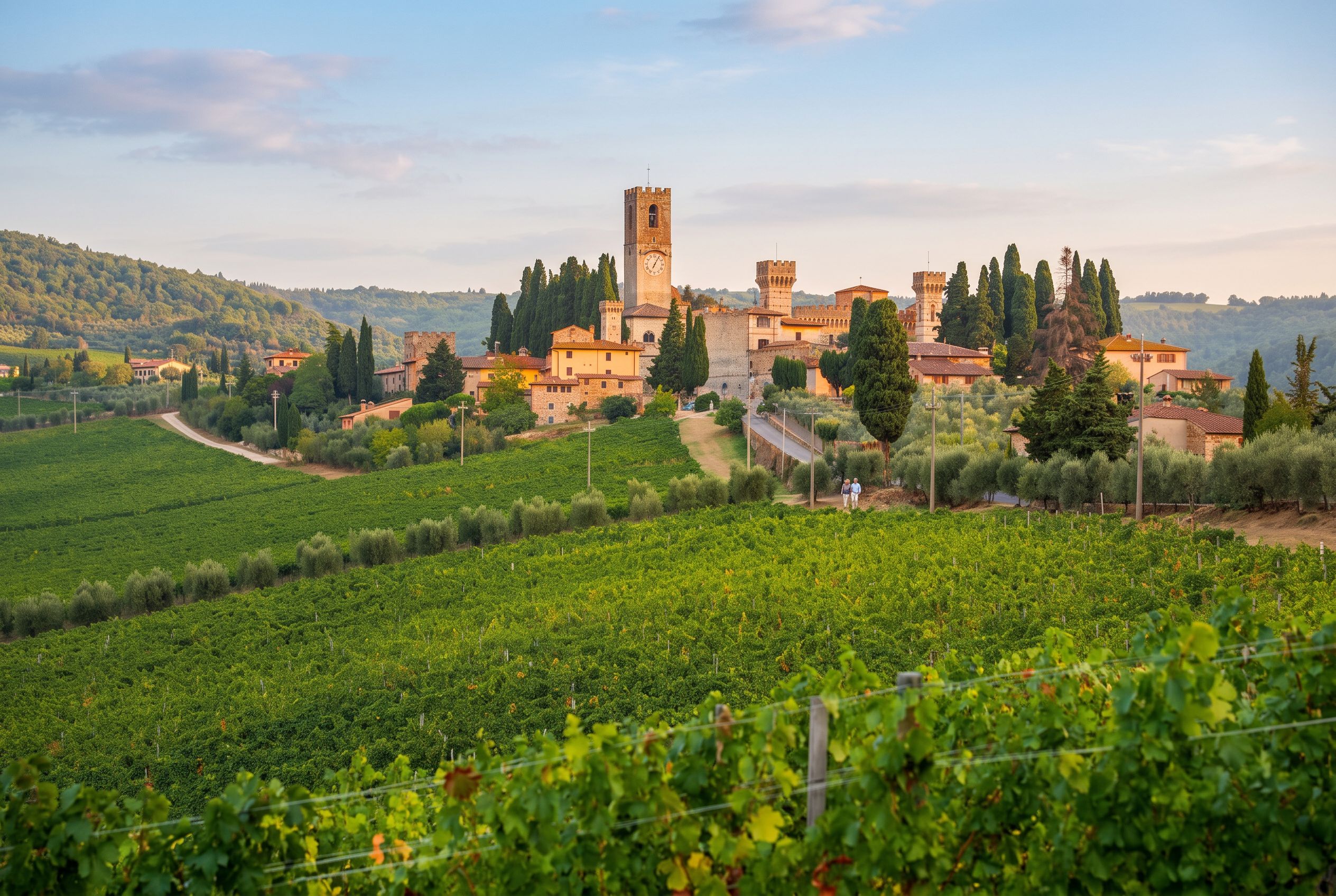
Chianti's classic villages differ more than a map suggests. Greve in Chianti lies in the valley, and its triangular Piazza Matteotti — ringed by arched loggias full of shops — is level walking. Radda and Castellina sit higher: the regional tourist board of Tuscany calls Radda "a classic Chianti hilltown" and describes Castellina as perched "on a gentle arc of hills", with the car parks below the centre in both. The historic Chiantigiana road (SR 222) from Siena to Florence is a rewarding self-drive route if you are not tasting heavily, though many prefer to leave the driving to someone else. A relaxed Siena-area loop — Siena, Castellina, Radda, lunch in Gaiole, then a winery in Monti — can feel unhurried, with a 9:00 a.m. departure and return by 3:30–4:00 p.m. If time is short, experienced travellers suggest skipping Gaiole but keeping Radda.
Montalcino and Montepulciano are different beasts. Both are hill towns where parking sits below the historic centre and streets climb steeply. For Brunello di Montalcino tasting, the best-fit experiences are private or small-group winery visits in and around Montalcino, often paired with a cellar tour, lunch, and private transport. In Montepulciano, public transportation options are virtually nonexistent for reaching countryside estates, which makes a driver or e-bike more practical. For older travellers, that means picking a base in town or using a transfer rather than expecting easy hop-on-hop-off vineyard access.
How do I arrange a seated tasting?
Book ahead — most wineries require reservations and charge a tasting fee, typically EUR 15–30 per person; walk-ins are rarely accommodated at better estates, and opening days vary widely from estate to estate, so check them before you plan the drive.
Travellers repeatedly note that the better wineries need advance booking and often charge a tasting fee. A Google review of Castello di Verrazzano from May 2026 makes the same point about the better-known estates: "This vineyard is a little busier so book ahead and expect quite a few guests." This is not a barrier — it simply means planning. Most estates accept bookings by email or through their websites, and English is widely spoken.
For flexibility, consider enotecas in town centres. The Enoteca di Piazza in Montalcino describes itself as "the first wine shop in Italy where it is possible to taste wines every day from over 100 wineries using a wine card system", and companions can sit nearby in the piazza. You insert a chipped card into the dispenser, pour what you like and settle up at the end: the house states there is no minimum spend and that "you will be charged only for what you've consumed". Buy one of the wines you have tasted and that particular pour costs nothing. Note that the business runs several premises within a few streets; the tasting room with the self-serve machines is at Via Giacomo Matteotti 43, open daily from 9.00 to 20.00 including holidays, not the Piazza Giuseppe Garibaldi 4 address that appears first in online searches.
What walking is involved at the estates?
Winery visits typically involve short walks from parking to the tasting room, plus a cellar tour that can run half an hour; cellars are not always level — Contucci's in Montepulciano spread over three floors — hill-town estates may require a short gravel-road drive and a brief uphill stroll, so ask about accessibility when booking.
Most Chianti estates are spread out along country roads, with parking close to the tasting room. The walking is minimal — from car to door, then possibly a short cellar tour. At Uccelliera in Montalcino, guests report that the final stretch of road is a short gravel road, and cellphone coverage is spotty, so downloading an offline map is advisable. The property sits near the Abbey of Sant'Antimo, making it easy to combine a visit to both.
In Montepulciano, the historic centre is compact but steep. The pattern that works best for older travellers is to use private transport or a driver for the countryside, then focus walking on the historic centres themselves. Florence's old streets are uneven and cobbled, and hill towns often require parking below town and walking uphill — a consideration for those with mobility concerns. Older buildings often have stairs, no lifts, and narrow staircases, so if you need step-free access, ask specifically when booking.
Should I hire a driver or drive myself?
Hire a driver. Italy's legal limit is 0.5 grams of alcohol per litre of blood, and the first band above it costs EUR 543 to EUR 2,170 plus a three- to six-month licence suspension; wineries are generous with their wine, and experienced travellers consistently prefer a private driver or small-group tour over self-driving after tastings.
Contributors on the Rick Steves travel forum remind visitors to arrange a designated driver, and Italian law shows why. Article 186 of the Codice della Strada makes it an offence to drive above 0.5 grams of alcohol per litre of blood: between 0.5 and 0.8 g/l the penalty is EUR 543 to EUR 2,170 plus a licence suspension of three to six months, and above 0.8 g/l it becomes a criminal fine with the possibility of arrest. Article 186-bis sets the limit at zero for drivers under 21, for anyone within three years of passing a category B test, and for professional drivers — worth knowing if a younger relative is at the wheel. The same threads recommend a private driver for a second reason: pours in Tuscan cellars are generous. The consensus across traveller forums is clear: experienced posters repeatedly prefer a private driver or a small-group tour over self-driving after tastings.
Private drivers in Tuscany charge by the vehicle, not by the head. One Tuscan operator lists a full-day, eight-hour Chianti Classico tour from Florence at from EUR 280 per car and from EUR 380 per minivan; another quotes EUR 450 for a saloon carrying up to three and EUR 500 for a van carrying seven or eight on an eight-hour Siena, San Gimignano and Chianti day. Split between four travellers, the cheaper of those day rates comes to less a head than a seat on a shared tour. Small-group tours from Florence or Siena are priced per person: a five-hour Chianti Classico tour with two wineries and lunch is listed at EUR 196 per person shared, and full-day tours with three wineries and lunch at roughly EUR 175–210. For those who prefer self-drive, the Chiantigiana SR 222 is rewarding, but limit yourself to one tasting and plan a long lunch before driving again.
If you do drive, GPS directions can be tricky for wineries. Fattoria Viticcio in Greve in Chianti says as much on its own contact page: type "Piscine Comunali Greve in Chianti, Via Montebeni" into the satnav rather than the farm's postal address in Via San Cresci, then follow the Viticcio signs uphill to the left. Download offline maps before heading into the countryside — coverage is spotty in the hills around Montalcino.
What are the best estates for a relaxed visit?
Uccelliera in Montalcino stands out for its warm, family-run welcome and generous tastings — reviewers describe barrel samples and eight or more wines — while Enoteca di Piazza, open daily from 9.00 to 20.00, offers the most flexible seated option in Montalcino town itself.
Uccelliera sits at Podere Uccelliera 45 in Castelnuovo dell'Abate, the hamlet below the Abbey of Sant'Antimo, and has earned a Google rating of 5/5 from 63 reviews as of August 2026. Reviewers are warm about the welcome but consistent about the practicalities: book first. One describes arriving unannounced and being met by the owner, who apologised that no tasting was possible that day and sent them off with two bottles instead; another notes simply that reservations are recommended. Tastings frequently include samples directly from barrels in the cellar, allowing visitors to compare wines at different stages of aging. A Google review from November 2025 describes "multiple barrel tastings and a beautiful and intimate tasting table set amongst the barrels," with "8+ wines" poured, including an older Reserve. The estate publishes no tariff, so agree the fee when you book — and note that buying does not cancel it: one reviewer took home half a case and still paid the tasting fee.
"Went here without noting them in advance. Still received warm welcome and quick tutorial on their wines etc. Worth noting them in advance if you plan to visit this place since it's small establishment." — Google review, April 2025
In Chianti, Panzano rewards a slow lunch: Sassolini Vinaria sits on the small Piazza Ricasoli and holds 4.7 out of 5 on Google from 92 reviews as of August 2026. Older guides sent visitors to the Accademia del Buon Gusto on the same square, but it has not been traceable as a working business since its founder died in January 2020. Castello di Verrazzano, at Via Castello di Verrazzano 1 in the hamlet of Greti, is worth checking for its historic setting, and its welcome desk is open daily from 10.00 to 17.00. In Radda, the Casa del Chianti Classico fills the former Franciscan convent of Santa Maria al Prato and runs guided tastings — the enoteca opens Wednesday to Sunday from 11.00 to 18.00, the restaurant from 12.30 to 15.00. A Google review from June 2026 describes "a magnificent villa and beautifully maintained gardens" on the upper level of the Verrazzano estate — a pleasant place to linger after lunch before exploring Greve on foot.
How do I pace a multi-day tasting trip?
Plan one wine area per day: Chianti from Florence or Siena, Montalcino as a full day from Siena or a stay in town, and Montepulciano as its own day — cramming Siena, San Gimignano, Pisa, and a winery into one day works against the relaxed pace most wine-minded visitors want.
Experienced travellers consistently warn against overpacking. The general advice is to pick one area per day, allow time for lunch and village stops, and expect more walking and more time than a map suggests. Buses from Florence do reach the Chianti villages, but the last stretch is usually on foot and uphill. Castello di Verrazzano spells it out on its own site: Autolinee Toscane runs from Florence's Hub Vittorio Veneto roughly once an hour, the ride takes about 50 minutes, and from the Greti Distilleria stop the wine shop is some 200 metres away — but the castle itself is "approx. 2 km uphill, please consider a walk of 30-40 minutes, we do not provide shuttle service". It is a budget-friendly way to see the hills, but not ideal for a full tasting day.
For Montalcino, a full day from Siena works well, or consider staying in town to experience the evening passeggiata. Early September is a particularly pleasant time for Montalcino visits. For Montepulciano, stay close to the historic centre and use enotecas for tastings, avoiding too many countryside stops in one day. The town's Vino Nobile is best appreciated with time to let it breathe — both it and Brunello di Montalcino change noticeably after an hour open, and a Coravin pour at a winery may not show a Riserva's full character straight away.
For those planning a longer stay, our honest 2026 budget guide for travellers 50–70 breaks down daily costs, and our accessibility guide for older travellers covers mobility considerations across the region. For accommodation, see our roundup of Tuscany hotels worth booking for the food.
What should I know about tasting etiquette?
Expect to pay for tastings, tip-free, and to buy a bottle or two if you enjoyed the experience; wineries are generous with pours, so pace yourself and always have a driver arranged before the first glass.
Italian tasting etiquette differs from what many visitors expect. Tasting fees are standard and rarely waived, even with purchases — at Uccelliera a reviewer who bought half a case still paid one. Fattoria Viticcio in Greve shows how the tiers usually work: a thirty-minute tasting of its wines from EUR 10 per person, the same tasting with olive oil, Tuscan bread, salami and cheese from EUR 15, and a full cellar visit with a guided tasting of three wines at EUR 30 — all of it, in the estate's own words, "upon reservation". The fee covers the winery's time and the wines poured, which are often generous. Most estates expect that you may purchase a bottle or two, but there is no pressure.
The self-serve system at Enoteca di Piazza means the final bill is simply the sum of what you poured; reviewers describe the per-pour prices as clearly marked at the dispenser, with a taste of roughly 40 millilitres running from about one to nine euros depending on the bottle. The tasting room can be busy at peak times, so consider visiting mid-morning or late afternoon for a more relaxed experience.
For those who want to explore beyond the three great reds, Tuscany's seasonal food traditions — truffle hunting near San Miniato, olive oil tastings, pecorino cheese — pair beautifully with wine visits. But those deserve their own guide; for now, focus on the wines.
What does a tasting day cost?
Expect to budget EUR 15–30 per person per winery tasting, roughly EUR 175–210 per person for a small-group tour including transport and lunch, or from about EUR 280 and up to EUR 500 per car for a full-day private driver — rates are indicative and vary by season and booking channel.
| Option | Cost per person | What's included |
|---|---|---|
| Self-drive, one winery tasting | EUR 15–30 | Tasting fee only; you drive |
| Small-group tour from Florence or Siena | EUR 175–210 | Transport, 2–3 wineries, usually lunch |
| Private driver, full day | EUR 280–500 per car | Pickup, drop-off, flexible itinerary |
| Enoteca tasting card (Montalcino) | EUR 1–9 per pour | No minimum spend; that pour is free if you buy the wine |
These figures are indicative and vary by season and booking channel. The enoteca option in Montalcino offers the most flexibility — you can taste as little or as much as you like, and the tasting cost of a wine you go on to buy is dropped from that bottle. Enoteca di Piazza does ship to the United States, quoting 15 to 20 working days for standard delivery and 5 to 10 for express; every alcohol delivery there needs a signature and a valid 21+ ID, so arrange to be at home.
For those weighing the cost of a driver against the safety and comfort benefits, consider that a private driver eliminates the stress of narrow gravel roads, spotty GPS coverage, and parking in hill towns — and allows everyone to taste freely. Pours in Tuscan cellars are generous, and the last thing you want is to be watching the clock while everyone else enjoys the tasting.
For a deeper look at what a comfortable Tuscany trip costs overall, our 2026 budget guide breaks down daily expenses for travellers 50–70.
What about Montepulciano specifically?
Montepulciano's Vino Nobile is best approached from the historic centre, using enotecas for seated tastings and a driver for any countryside estates; public transport to vineyards is virtually nonexistent, so plan accordingly.
While the search results are thinner on Montepulciano-specific threads from older travellers, the pattern from nearby Tuscany advice is clear: stay close to the historic centre, use enotecas, and avoid packing too many countryside stops into one day. Some visitors choose e-bikes instead, finding them more comfortable than driving themselves between vineyards — a viable option for those at ease on two wheels, though not for everyone. In the town centre itself, a Google review of the Contucci cellar from September 2025 notes that the "self guided tour was excellent" with "no reservation necessary" — and the estate itself calls the visit "a completely free experience". Be aware that its historic cellars run over three floors, so there are stairs. The guided Contucci Experience is a separate arrangement: it runs from 1 April to 6 January on Mondays, Tuesdays, Fridays and Saturdays at 11.00 and 15.30, and has to be booked at least fifteen days ahead.
The town itself is compact but steep, with parking below the centre and a climb to the main square. For wine-minded visitors, the pleasure is in the town's enotecas, where Vino Nobile can be tasted seated, with staff guiding you through the differences between vintages and producers. As with Brunello, let the wine breathe — Vino Nobile benefits from time in the glass.
If you do visit a countryside estate near Montepulciano, book ahead and arrange transport. The general warning from experienced travellers is that cramming Siena, San Gimignano, Pisa, and a winery into one day feels rushed and works against the relaxed pace most wine-minded visitors want. Choose one area, savour it, and leave the rest for another visit.
For those planning a broader Tuscany itinerary, our accessibility guide covers the region's hill towns and transport options in detail.
What are the common mistakes to avoid?
The most common mistakes are overpacking the day, self-driving after generous tastings, and expecting walk-in access at better wineries — all easily avoided with advance booking and a driver.
Experienced travellers repeatedly warn against overpacking tours. Choose a day with one or two towns plus one winery, and block out the afternoon for the full food-and-wine experience. Experienced Chianti visitors give the same advice: block out the afternoon, because rushing a tasting defeats the purpose of being there.
Self-driving after tastings is the other recurring mistake. Italian drink-driving limits are very low and penalties are high, and wineries are generous with their wine. Arrange a driver before the first glass, whether that means a private driver, a small-group tour, or a designated non-drinker in your party.
Finally, don't expect walk-in access at better wineries. The better estates are simply not set up for walk-in tastings. Book ahead, confirm opening days rather than assuming them, and ask about accessibility if you have mobility concerns. The effort of planning pays off in a far more relaxed experience.
For those who want to combine wine with food, our guide to Tuscan food culture covers the region's culinary heritage, from pecorino to pici — the perfect complement to a day of tasting.


