
Tuscany rewards the traveller who plans around its quirks rather than against them. The region is not uniformly step-free, but neither is it the obstacle course some fear. Florence, Lucca and Pisa's main square are genuinely workable for slower walkers and wheelchair users, while Siena, San Gimignano and most hill towns demand strategy: taxis, shuttles and knowing exactly where to park. The honest answer is that Tuscany offers a rich, manageable experience for travellers aged 50 to 70 — provided you choose your bases wisely and check access before you go.
The key is understanding that "accessible" here usually means "selectively accessible." A museum may have a lift while its café toilet sits in the basement. A hill town may have a shuttle that drops you at the top, saving the hardest climb. The travellers who enjoy Tuscany most are those who treat each visit as a small logistical puzzle — and the payoff is worth the planning.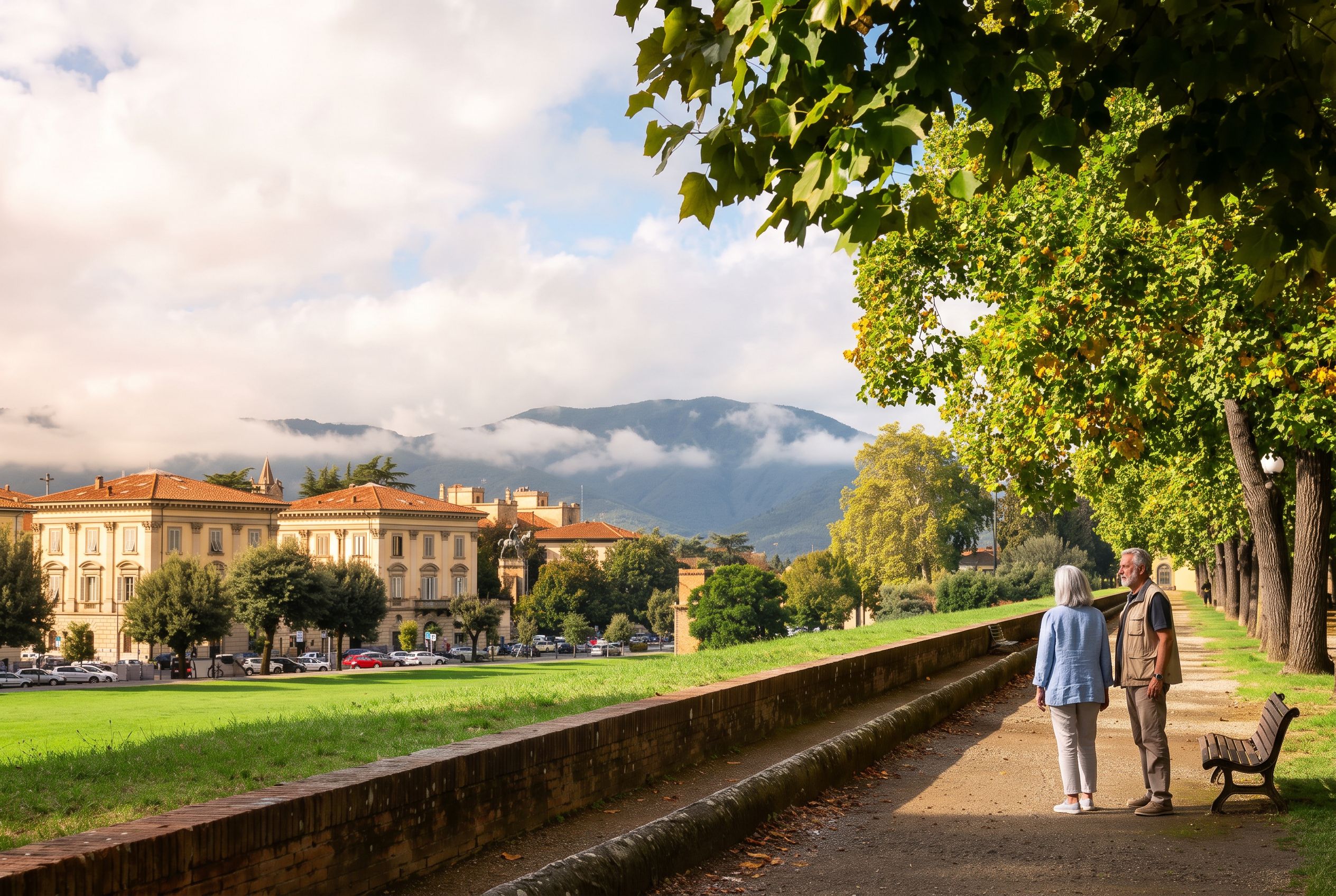 AI-edited
Which Tuscan cities are easiest for limited mobility?
Lucca is the standout choice: it sits on a plain, has a largely pedestrianised centre, and its Renaissance wall offers a smooth, car-free circuit of 4.2 kilometres — about 2.6 miles — that can be walked or cycled at your own pace. Pisa's Piazza dei Miracoli is also level and compact, while Florence's historic core is walkable with caveats.
Lucca is the flattest of Tuscany's major bases, and once you are up on the wall the path is level the whole way round — a review left on Google in January 2026 describes it as "suitable for pedestrians and casual cyclists." The city's own accessibility project is blunt about the one catch: the walls are reached by slopes of varying steepness that always require assistance. Among the museums, the Museo Nazionale di Villa Guinigi reaches its upper floors by lift and ramps, though staff have to help. The old town is compact, so you can cover a surprising amount without ever feeling rushed. Pisa is similarly manageable — but only if you focus on the Campo dei Miracoli. The square itself is level, and the cathedral complex is accessible. The Leaning Tower, however, is not: it has 251 steps and no lift. Plan your visit around the square and the museums, and you will have a full, satisfying day. The Opera della Primaziale, which runs the square, admits visitors with a registered disability to all its monuments and museums free of charge — but only if you email its accessibility office at least five days before you arrive and attach proof. Florence is more complicated. The historic centre is compact, but paving is uneven, streets are narrow, and crowds can be intense. The Uffizi, Accademia, Santa Maria Novella and Palazzo Pitti all have barrier-free entrances, lifts and ramps, and several lend wheelchairs and walkers free of charge. As of August 2026, Italy's state museums — the Uffizi and Accademia among them — admit a visitor with a certified disability free of charge, together with a family member or a companion who can show they work in social or health assistance. Bring documentation for both.How hard are Siena and San Gimignano really?
Siena is the most demanding major city in Tuscany for limited mobility: it is built on hills, with cobblestones and slanted streets throughout. San Gimignano is steeper still, but its four car parks are linked to the town by a citybus whose two minibuses carry a wheelchair platform, and from June to September that bus stops at the gates rather than the centre. Both are worth seeing, with a strategy.
The trick with Siena is arrival. As of August 2026, Radiotaxi Siena publishes a fixed fare of 10 euros from the station rank to Piazza del Campo, and the ride drops you close to the square; from there the walking is comparatively level. If you come by car instead, the city has spent the last fifteen years building three mechanised ascents — escalator systems on the northern, eastern and western approaches that link the multi-storey car parks to the historic centre precisely to take the height difference out of the walk. Once you are at the Campo, you can enjoy the square, the cathedral and a café without tackling the steepest streets. The Duomo is not an exterior-only proposition: it has a dedicated accessible entrance to the left of the main staircase, and the Piccolomini Library inside is reached by a platform. Santa Maria della Scala, opposite, has step-free access to every room. Keep your visit to one to two hours and you will leave with the essence of the city, not exhaustion. San Gimignano is a different beast. The town is perched on a hill, and most of its charm lies in climbing its medieval streets. All four car parks lie outside the walls, so the "last mile" is the hardest part — but it is a solved problem. Citybus line 1 links the car parks with the centre throughout the year, the two minibuses on the route carry a platform for wheelchair users, and a single ticket costs 1.20 euros as of August 2026, validated with your parking ticket. One condition matters for planning: from June to September line 1 stops short of the centre, at Porta San Giovanni and Porta San Matteo. Each car park also holds two to five marked disabled bays, free to badge holders. Montepulciano falls somewhere in between. It is hilly, but the small orange town bus is fitted with a ramp and stops at Piazza Grande on the summit, which removes the hardest part of the climb. As with Siena, a taxi or private driver makes the difference between a pleasant visit and a punishing one.What about the Chianti countryside and wineries?
Chianti is surprisingly workable: many wineries have adapted their tasting rooms and tours for limited mobility, and the region offers accessible loop routes and mobility aids for gradients. This is the best part of Tuscany for a scenic, low-walking experience.
The rolling hills of Chianti are easier to enjoy from a car or a winery terrace than on foot. Many estates have invested in accessibility, with level tasting rooms, adapted restrooms and staff who understand the needs of older visitors. The regional tourist board is specific about what exists. Three accessible looped routes branch off the historic Via Romea Sanese, at Castellina in Chianti, Barberino Tavarnelle and Castelnuovo Berardenga, and the association behind them lends nine Joëlettes — single-wheeled chairs built for rough ground — plus two electric Trirides, free of charge on reservation. At the Chianti Sculpture Park in Pievasciata, the mobility aids on offer have brakes rated for a 20 percent gradient. Travellers who want the countryside with less walking in it should consider the Val d'Orcia. Pienza gathers its cathedral, Palazzo Piccolomini and the Diocesan Museum around a single square, Piazza Pio II, so one arrival covers most of what there is to see. The thermal village of Bagno Vignoni nearby is a shorter proposition again, though not a smooth one. For a full picture of where to stay, our guide to choosing your base in Tuscany breaks down the trade-offs between city, Chianti and Val d'Orcia.Are the thermal baths accessible?
Saturnia's free natural pools are not set up for wheelchairs — the operator states plainly that the area has no walkways or spaces designed for disabled visitors. The seasonal Molino del Bagno relaxation area beside them is barrier-free, and at Bagno Vignoni the thermal water is enjoyed indoors, at the village's spa hotels.
The thermal baths of Tuscany are a genuine pleasure for older travellers, but the free sites and the commercial ones are two different propositions. The natural cascades at Saturnia are free, open all year and around the clock, and the operator is candid: "At the moment, the area is not equipped with walkways and areas specially designed for people with disabilities." Beside them, the Molino del Bagno relaxation area — a seasonal, ticketed set-up with umbrellas, gazebos, toilets and showers — is described by the same operator as barrier-free. Bagno Vignoni is built around its thermal pool in the main square, but the access survey of the village is more careful than its reputation: the lanes are bumpy in places, and it advises visiting with a powered chair or a companion. Bathing in the historic pool is no longer permitted; the water is enjoyed at the village's spa hotels. For a detailed breakdown of what to expect, including which pools have steps and which have ramps, see our dedicated guide to the thermal baths of Saturnia and Bagno Vignoni.What about parking and getting around?
Parking is almost always outside the historic centre, so the "last mile" is the hardest part of any visit. Taxis are the single most useful tool in Tuscany for travellers with limited mobility — in Florence, Siena and most hill towns, a short taxi ride can save you from the steepest climb.
Assistance at Italian stations has a name, a number and a deadline. RFI's Sale Blu provide it free of charge, and in Tuscany the service covers Florence Santa Maria Novella, Pisa Centrale, Lucca, Siena, Arezzo and Livorno Centrale, all coordinated from the Florence Sala Blu. Book at least one hour before departure for anything running between 07:45 and 22:30, and twelve hours for services outside that window; from a mobile or from abroad the number is +39 02 32 32 32. The regional network connects Florence, Lucca and Pisa efficiently, and all three stations are covered. For hill towns, look for parking lots, shuttle buses, escalators or elevators rather than assuming a town is impossible. Several towns that look daunting from the outside become manageable once you park at the right level or take a shuttle. A private driver for a day can transform your experience — the cost is often comparable to multiple taxis, and the driver knows exactly where to drop you.Are the major museums and sights step-free?
Florence's major museums — the Uffizi, Accademia, Santa Maria Novella and Palazzo Pitti — all have barrier-free entrances, lifts and ramps, and several lend wheelchairs and walkers free of charge. Many state-run museums offer free access for disabled visitors and a companion, but policies vary at privately managed sites.
The Uffizi and the Accademia are the two museums most first-time visitors put on the list, and both have invested seriously in accessibility. You will find lifts between floors — the Uffizi's reach every level, the Accademia has one to the upper floor — accessible restrooms, and staff who can assist with ramps. Wheelchairs and walkers are lent free of charge, with no reservation and no deposit, from the Uffizi's accessible entrance and the Palazzo Pitti ticket office. The key is to book ahead and mention your needs when you reserve — some ramps and lifts must be requested from staff, and busy periods can make arrangements slower. At the Piazza dei Miracoli in Pisa, the cathedral and museums are accessible, and the square itself is level. The Leaning Tower is the exception, with its 251 steps. Tuscany's regional tourist board makes the same point in reverse: everything on the square is fully accessible except the tower, which leaves the climb as the only optional part of a Pisa day. For state museums, bring your disability documentation or certification. It may be needed to prove eligibility for free or reduced access, and having it ready avoids delays at the ticket desk.What about restrooms and rest stops?
Restrooms are the hidden challenge of Tuscan travel: in old buildings they are often downstairs, and not always served by lifts. Plan around this by using accessible restrooms at museums and major sights, and by building coffee breaks into your itinerary at modern cafés.
This is the detail that catches many travellers off guard. A museum may be fully accessible, but its café toilet is in the basement. A restaurant may have a beautiful terrace, but the only restroom is down a flight of steps. The solution is to use the facilities at major sights — the Uffizi, the Accademia and Santa Maria Novella each list an accessible restroom, in the last two cases on the ground floor beside the lift — and to choose modern cafés for your breaks. One quirk at the Accademia is worth knowing before you set off: its toilets sit at the end of the visit route, not the start. Rest stops matter too. The beauty of Lucca's wall is that it offers benches and shade at regular intervals. Florence's piazzas are natural rest points, though benches can be scarce in peak season. Build a coffee break into every two hours of walking, and you will enjoy the day far more.How much does it cost to travel with limited mobility?
Expect to pay more than a standard trip: taxis, private drivers and accessible tours add up. The published fares are the anchors worth planning around — a fixed 10 euros for the Siena station-to-Campo taxi, 1.20 euros for San Gimignano's citybus, nothing at all for station assistance — and the rest is the premium for staying close to what you most want to see.
The honest truth is that travelling with limited mobility in Tuscany costs more. Taxis are the most reliable tool, and a day with a private driver in the hill towns costs significantly more than a bus pass. Staying in a central hotel near the Uffizi or the Campo in Siena costs more than a peripheral one, but it saves you the hardest walking of the day. For a full breakdown of what a comfortable trip costs, including transport, meals and sightseeing, see our honest 2026 budget guide for travellers 50–70. Where a taxi replaces a walk, the cost is published and bounded; where a private driver replaces a whole day of taxis, ask for the day rate in writing before you commit.How do I plan a realistic itinerary?
Stay close to the sights that matter most, limit yourself to one major destination per day, and use taxis for the "last mile" to every hill town. A realistic pace for a mobility-limited traveller is one city per day, with a long lunch and a rest in the afternoon.
The travellers who enjoy Tuscany most are those who accept a slower pace. Rather than trying to see Florence and Siena in one day, spend two nights in Florence, take a day trip to Lucca, and give Siena a full day with a taxi up to the Campo. The Chianti countryside deserves a day of its own, ideally with a private driver who can stop at wineries with accessible tasting rooms. A flat base city plus strategic taxis is the combination that does the most work. Companionship matters as much as the destination, and the official sources say so plainly: Lucca's accessibility project notes that the ramps onto the walls always need assistance, and the Bagno Vignoni access survey advises a companion or a powered chair. If you travel with a partner or friend who can help with the occasional step or slope, your options expand considerably.What should I bring and prepare?
Bring your disability documentation, a folding walking stick or lightweight wheelchair, and comfortable shoes with good grip. Book museum tickets in advance, request assistance at train stations, and have your hotel arrange taxis for you.
Documentation matters more than you might expect. Many state-run museums in Italy offer free access for disabled visitors and, in some cases, a companion, but policies differ at privately managed sites. Having your certification ready avoids delays and ensures you get the access you are entitled to. For mobility aids, a folding walking stick is essential for cobblestones, and a lightweight wheelchair transforms Florence and Lucca from challenging to enjoyable. Electric wheelchairs or powered mobility aids are recommended for Siena and other hilly towns, where manual pushing is genuinely difficult. Finally, book everything in advance. Museum tickets, train assistance, taxis and restaurant tables all go more smoothly with a reservation. The travellers who plan ahead are the ones who enjoy Tuscany most."Paved for walking and wheeling, the many ramps give ready access for users." — one Google reviewer on the walls of Lucca, April 2024.
Is Tuscany worth it for travellers with limited mobility?
Yes — with the right planning, Tuscany offers one of Europe's richest travel experiences for travellers aged 50 to 70. The key is choosing Lucca, Florence or Pisa as your base, using taxis for hill towns, and accepting a slower, more focused pace.
Tuscany rewards the traveller who plans. The region's accessibility is uneven, but the highlights — the Uffizi, the Campo in Siena, the wall at Lucca, the vineyards of Chianti — are all reachable with the right approach. The travellers who struggle are those who try to do too much, too quickly, without checking access in advance. For food lovers, the region is a particular joy, and our guide to what to eat around Tuscany includes accessible restaurants and markets. The thermal baths offer genuine relaxation after days of sightseeing. And the pace of Tuscan life — long lunches, afternoon rests, evening strolls — suits older travellers perfectly. The honest conclusion is that Tuscany is not the easiest region in Italy for limited mobility, but it is far from the hardest. With a flat base, a taxi budget and realistic expectations, it offers a rich, rewarding experience that justifies the extra planning.

