
Tuscany rewards the traveller who plans for comfort before they plan for views. The difference between a sublime week and an exhausting one rarely comes down to star ratings — it comes down to lifts, step-free paths, and whether you can reach your bed without climbing a medieval staircase. For travellers aged 50 to 70, the smartest approach is to choose your base for its logistics, then let the scenery do the rest.
This curated roundup spans city hotels, countryside estates, and one exceptional accessible agriturismo. Each property has been assessed on sleep quality, step-free access, quiet, parking or transfers, and service that understands older guests. Price bands run from € (moderate) to €€€ (splendid), and a table further down notes where half-board dining genuinely elevates the stay.
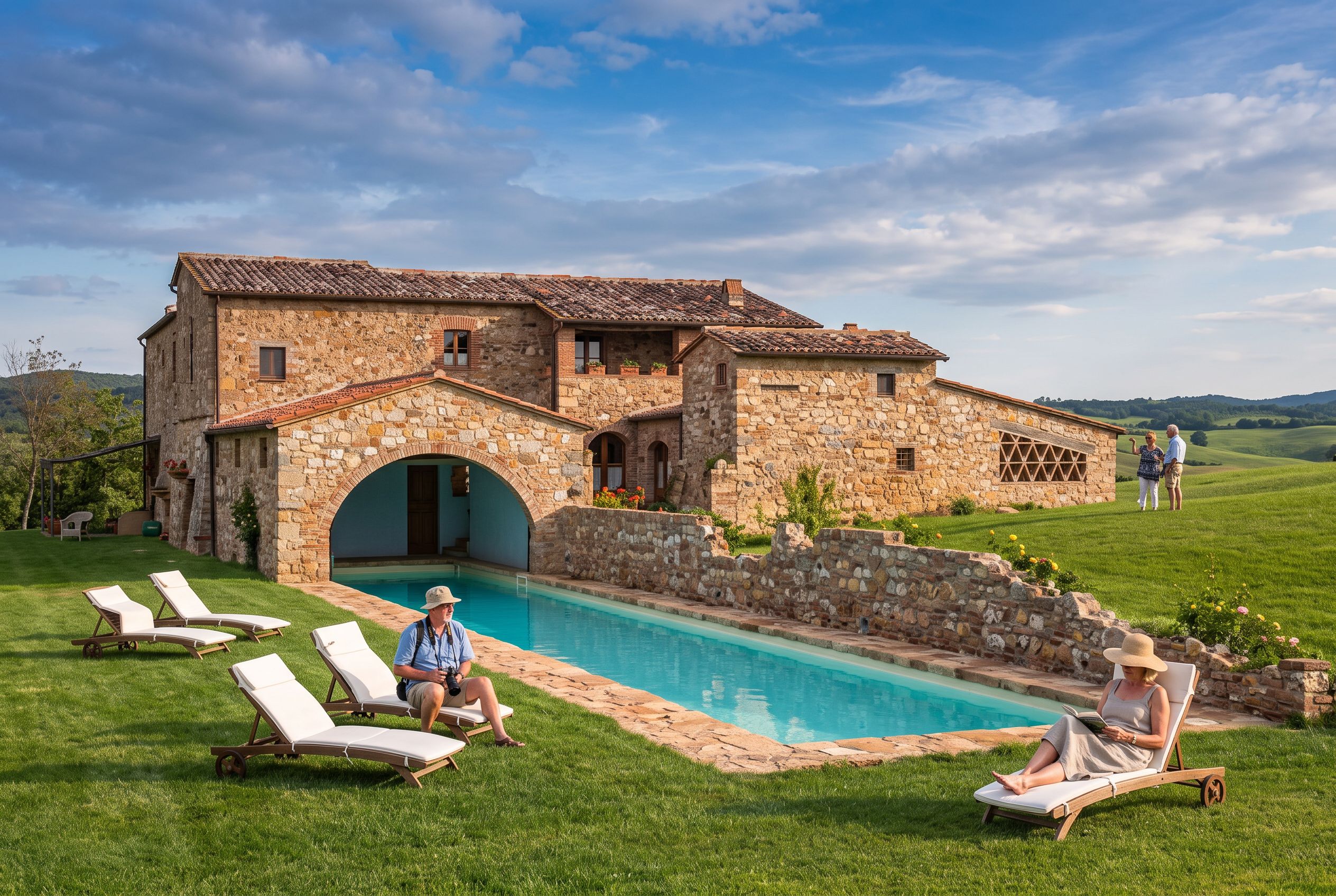 AI-edited
What makes a Tuscan stay genuinely comfortable after 50?
Comfort in Tuscany is about logistics before luxury: a working lift, a step-free entrance, air conditioning, easy parking, and a quiet room away from street noise matter more than designer bathrooms or infinity pools. Travellers over 50 consistently report that location, elevators, and road access determine their enjoyment more than any five-star amenity. Ask about elevators before you book — advice that applies to Florence palazzos and hilltop agriturismi alike.
The region's tourism data confirms the practical picture. Regione Toscana counted 15 million arrivals and 46 million overnight stays across 2024, a year the region itself describes as stable and in line with the one before it. Eurostat data shows that travellers aged 65 and over spend 58% of their tourism nights in the shoulder season, which it defines as March to June and September to November. Manageable crowds and manageable heat are the practical reason to do the same. Plan for April to June or September to October, and you've already solved half the comfort equation.
Florence: where city convenience meets genuine quiet
Florence offers the safest comfort bet in Tuscany for travellers who want walkability without rural logistics — provided you choose a hotel with a proper lift and request a quiet room away from street noise. The city's historic centre is compact, but its pavements and crowds demand energy. A well-located hotel with attentive staff transforms the experience.
Hotel Casci (€€) on Via Cavour exemplifies the comfort-first city stay. Recent guests consistently praise the family-run service, the breakfast and the central position, and the building has a lift that serves the upper floors. Independent hotel inspections describe that lift as small and dated, so travellers with large cases should ask about its dimensions before booking. The location offers an easy five-to-seven-minute stroll to the Duomo, with the Mercato Centrale and San Lorenzo nearby. As of August 2026, the hotel holds a Google rating of 4.1/5 from 223 reviews, with staff repeatedly commended for arranging museum reservations and recommending dinner spots. Breakfast draws consistent praise for its generosity and homemade items.
One practical note: the hotel occupies the second floor, one flight above the street, and there is no lobby at street level; you reach it by a lift or a staircase, and a few steps lead to some rooms. Florence's historic centre is a limited-traffic zone, and the city issues daily ZTL access passes in two categories, so drivers need to arrange access rather than simply pull up at the door. The hotel also handles guest laundry: reviewers describe dropping it at the desk in the morning and collecting it the same evening.
"The location is centrally located - close to Duomo and train station, but a couple of blocks away from the hectic crowds. It was a pleasure to return each day to the peace and tranquility of the hotel." — a guest wrote on Google in October 2016
For those who prefer apartment-style comfort, Residenza Il Villino B&B (€) offers large rooms, spacious bathrooms, and a quiet courtyard. It's a B&B rather than a full-service hotel, so manage expectations accordingly. For a broader look at the region, our complete guide to Tuscany for travellers over 50 covers base planning in depth.
Siena and Chianti: heritage charm with fewer hills
Siena rewards those who stay inside the walls but choose their hotel for lift access and quiet rooms, while Chianti's countryside estates offer the calmest sleep if you accept car dependency. Siena's hilltop setting means gradients everywhere; the right hotel makes all the difference.
Guild Living Siena Senior Resort & Residence (€€€) positions itself explicitly for senior travellers, though public details on accessibility remain limited. The operator calls the house Guild Siena and describes it as a senior living residence of 83 apartments in four hectares of woodland near the historic centre, marketed for stays of a week and longer and aimed at residents over 65 rather than at hotel guests. It is not an assisted residence, and it is not a hotel booking. The residence-style concept suggests modern construction, but verify lift access, bathroom layouts and whether your party can book at all before you plan around it. Siena's walkable centre is a genuine pleasure in the evening when day-trippers depart, and the city's relaxed pace suits extended stays.
In the Chianti hills, Castello di Verrazzano (€€€), near Greve, puts its guest rooms not in the castle itself but in the Foresteria Casanova, which the estate describes as reachable "by a pleasant walk of about one km" through the vineyards. A rich buffet breakfast is included in the room rate. The property sits close enough to Greve for winery visits and town access. The estate sits in the Chianti hills south of Florence, and the Foresteria has free self parking.
For a different kind of Tuscan comfort, the thermal spa towns offer their own appeal — see our guide to the best thermal spa towns and hotels in Tuscany for options that combine wellness with easy logistics.
The Val d'Orcia: countryside calm with a car
The Val d'Orcia delivers Tuscany's most photographed landscapes, and the right agriturismo offers genuine peace — but you will need a car, and you must confirm room layouts before booking. This region rewards travellers who accept driving as part of the experience and choose properties near town rather than isolated farmsteads.
Tenuta Santo Pietro (€€), just outside Pienza, stands out for its exceptional service and on-site dining. As of August 2026, it holds a Google rating of 4.6/5 from 204 reviews. Guests consistently praise manager Bertina for her welcoming, attentive approach. The restaurant serves fresh, locally sourced ingredients with homemade pasta and estate-produced wine and olive oil — many guests choose to eat there every night. The pool offers views toward Pienza, and the property sits a short five-to-ten-minute drive from town; the estate gives Siena as 56 kilometres away, a 45-minute drive.
One planning note: the twelve bedrooms differ considerably. Two ground-floor rooms are described by the estate as suitable for guests with disabilities, one of them with a large wheelchair-accessible bathroom with shower and bath. Others are reached by a private exterior staircase, and one loft room has a small stone staircase that the estate itself says may not suit every guest. The property sits close to a road. Request a room away from the road if noise concerns you.
Casa Vacanze I Girasoli (€€), in the Valdichiana between Arezzo and Siena, offers the clearest accessible-tourism positioning in this roundup. The property explicitly states it provides "full disabled and elderly access accommodation," with accessible rooms, bungalows, a pool, restaurant, bar, and parking within a green park setting. This is the quietest, most step-reduced countryside option we found. Its accessibility pages list lodgings without architectural barriers, large lifts, gradients under 5%, ramps to the bungalows and, on request, a pool lift, shower chair and hoist. The house is open from April to October only. The nearest railway station is Arezzo, 35 kilometres away, and guests arriving without a car are asked to book a taxi or the house transfer service when they reserve a room.
Lucca and Montecatini Terme: gentler alternatives
Lucca offers the gentlest walking city in Tuscany, with flat historic streets inside Renaissance walls, while Montecatini Terme pairs easy access with thermal spa comforts. Both work well for travellers who want culture without steep climbs.
Lucca's wall-top promenade provides a flat, shaded circuit perfect for morning walks. The city's hotels tend to occupy historic buildings, so confirm lift access when booking. Montecatini Terme, meanwhile, offers the Hotel Ercolini and Savi (€€), a four-star hotel that describes itself as a stone's throw from Montecatini Terme station, with the thermal baths close by; booking portals list a lift. The town's flat layout and spa culture make it a practical comfort base, and the train connection to Florence runs regularly.
For those considering a thermal-focused stay, the region's spa towns deserve dedicated attention — our thermal spa guide covers the best options in detail.
Is half-board worth it in Tuscany?
Half-board is absolutely worth it at countryside estates with strong on-site restaurants, but rarely worth it in city hotels where excellent trattorias sit minutes away. The distinction comes down to logistics: after a day of driving or walking, the ability to dine where you sleep is a genuine comfort. At properties like Tenuta Santo Pietro, guests report the restaurant is so good they eat there every night anyway.
| Property | Half-board verdict | Why |
|---|---|---|
| Tenuta Santo Pietro | Recommended | Estate wine, homemade pasta, relaxed pacing |
| Casa Vacanze I Girasoli | Recommended | On-site restaurant in a park setting |
| Hotel Casci | Skip | Florence's trattorias are minutes away |
| Castello di Verrazzano | Consider | Breakfast already included in the rate; dinner depends on plans |
In cities, half-board ties you to the hotel at dinner time, when Florence and Siena are at their most atmospheric. In the countryside, it eliminates the question of driving after a long meal — a genuine safety and comfort consideration.
What about parking and transfers?
Parking determines whether a Tuscan stay feels effortless or stressful — confirm it before booking, especially in Florence's ZTL zone and hilltop towns with limited access. In Florence, a car needs ZTL clearance before it reaches the door, not after. Siena's centre is largely pedestrianised. Countryside properties generally offer free parking, but verify the approach road — some agriturismi sit at the end of dirt tracks.
For travellers without a car, the smartest approach is to base in Florence or Lucca, both with excellent train connections, then take day trips. Montepulciano offers apartment options within the town walls for car-free travellers. If you're combining Tuscany with other Italian destinations, consider the train network — direct services connect Florence to Rome in about 90 minutes.
When should you book for maximum comfort?
Book for April through June or September through October, when crowds thin, temperatures moderate, and accommodation prices soften — Eurostat records 58% of the tourism nights of travellers aged 65 and over in the shoulder season, which it defines more broadly as March to June and September to November. July and August bring heat, crowds, and premium prices. Winter offers quiet but many agriturismi close, and cars may need winter tyres between 15 November and 15 April on many Tuscan highways.
High season runs from late April through mid-October, with July and August the most crowded. For the comfort-first traveller, the sweet spot is May-June or September, when the landscape is at its best and the pace remains civilised.
Your comfort checklist before you book
Before committing to any Tuscan property, ask these five questions directly. The answers will tell you more than any star rating.
- Lift access: Does the elevator reach all floors, and is it large enough for luggage?
- Step-free route: Are there steps at the entrance, to the restaurant, or to the pool?
- Bathroom layout: Walk-in shower or step-over tub? Grab bars? Bed height?
- Quiet rooms: Which rooms face away from streets, roads, or common areas?
- Parking and access: Is parking on-site, and is the approach road paved?
The answers themselves are a signal: an owner who sends photographs and measurements of doors and entrances before you book is likely to handle the rest of the stay with the same care. That level of responsiveness is the gold standard for comfort-first travel.
For a comprehensive planning resource, our Tuscany guide for travellers over 50 covers itineraries, transport, and practical considerations in depth. And if you're considering extending your Italian journey, our Lake Garda family guide offers another comfortable base for multi-generational trips.
"I'm disabled and in a wheelchair, and me and my family have just spend 7 days at this amazing place. Everything was way beyond expectations. The entire staff was extremely friendly and super helpful." — one Google reviewer wrote about Casa Vacanze I Girasoli in June 2025


