
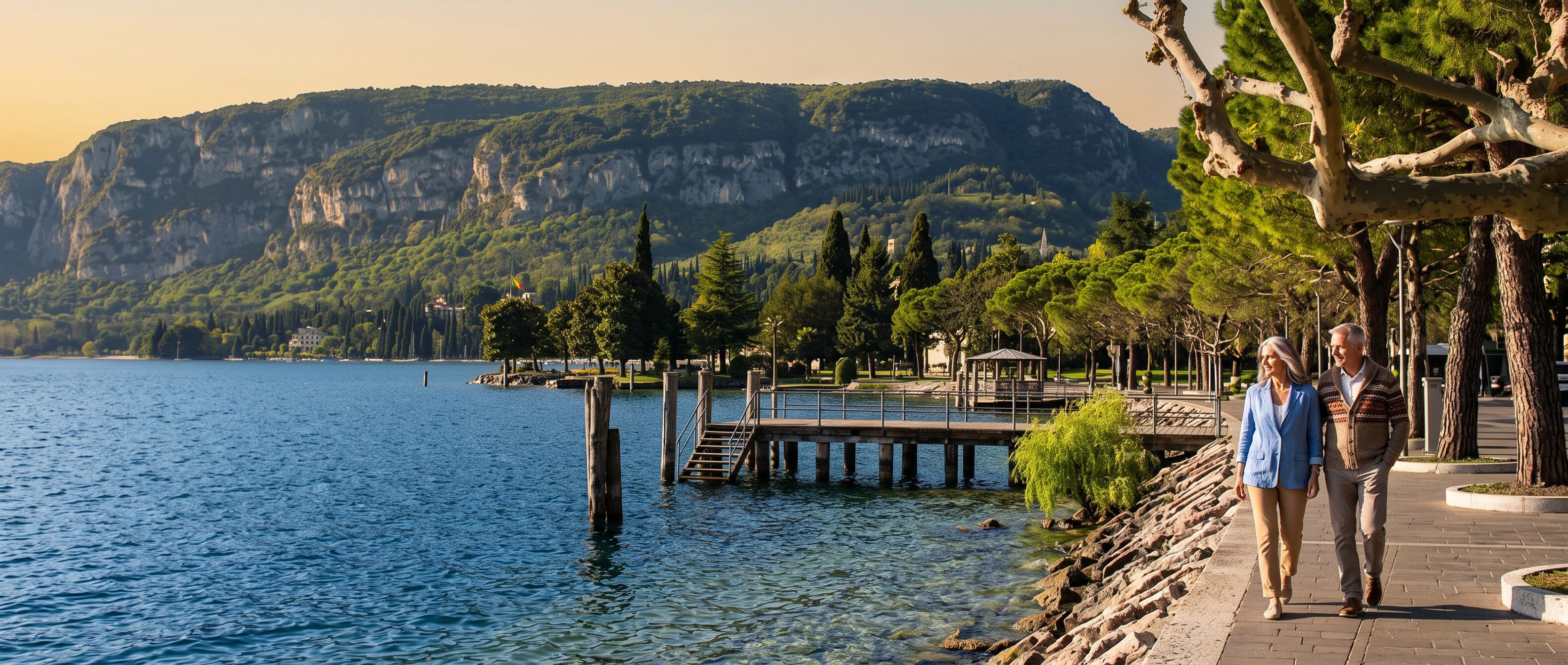
Lake Garda has a way of slowing time down. The water shimmers in shifting shades of blue, the mountains rise gently in the distance, and the pace of life along the shore feels deliberately unhurried. For grandparents travelling with grandchildren, this is precisely the point. The lake rewards those who resist the urge to rush, offering a holiday rhythm where morning gelato, afternoon ferry rides, and early dinners feel perfectly natural.
Italy's largest lake earns a straightforward verdict: Garda is one of Europe's most forgiving destinations for multi-generational travel. The southern shore is remarkably flat, the ferry system does the hard work for you, and the attractions that delight children—theme parks, cable cars, paddle steamers—are equally enjoyable from a bench with a coffee in hand.
 AI-edited
The key is choosing the right base and planning days that respect both generations' energy levels. This guide focuses on exactly that: how grandparents can enjoy Lake Garda with grandchildren of different ages, without anyone feeling rushed, exhausted, or left out.
Which towns are the easiest bases for grandparents and grandchildren?
Desenzano del Garda, Bardolino, Garda, and Lazise offer flat lakefront promenades, plentiful benches, and easy ferry access—ideal for grandparents with grandchildren. Save Sirmione and Malcesine for shorter, planned visits rather than full-day bases.
The southern lake towns were built for strolling, not climbing. Desenzano's waterfront stretches along a level promenade where grandparents can walk at their own pace while grandchildren dart ahead to inspect the boats. Bardolino's lakeside path connects to neighbouring Garda and Lazise, creating a gentle walking route that rewards both generations with ice-cream stops and swimming spots along the way.
These towns also share a practical advantage: they sit on the main ferry routes, which means you can leave the car parked and let the lake do the travelling. According to Navigazione Laghi, the lake's ferry operator, boarding is assisted by staff using gangways with a minimum width of 80 centimetres, and ships have had special stepless ramps since 2016 to bridge the gap between jetty and walkway. That makes ferries the most accessible transport option on the lake.
Can grandparents enjoy Gardaland without being exhausted?
Yes, if you approach Gardaland as a support role visit: arrive early, use the official app for its map and show reminders, focus on shows and gentle rides, and plan rest breaks in shaded areas. Queues are longest at peak times, so consider the park's Gardaland Express Time Saver tickets, which start at €27 online.
Gardaland is the lake's major theme-park draw, and for many grandchildren it is the highlight of the entire holiday. As of August 2026, the park holds a Google rating of 4.4 out of 5 from over 128,000 reviews, with guests consistently praising its cleanliness and friendly staff. The practical caveat for older visitors is the walking and the waiting: Gardaland sells queue-skipping Time Saver tickets for its busiest rides as a separate add-on, which is the operator's own answer to peak-day queues.
The trick is to plan the day around what you can enjoy together rather than what you feel obliged to see. The official Gardaland Resort App carries a GPS navigator to the rides, restaurants and shows and sends a reminder before each show starts, which makes it easier to build the day around sit-down entertainment. Many shows and gentle attractions are suitable for all ages. Closing times swing widely with the date, though: in high summer the park runs into the late evening—Gardaland sells a separate evening ticket valid from 5 p.m. between 27 June and 6 September—while spring and autumn days finish far earlier. Ticket offices shut two hours before the park does, so check the official calendar for the day you plan to go.
"So much fun, there's something for everyone. We also went during weekday in October, there was minimal queue and wait time even on popular rides. Absolutely recommended visiting if you have kids and are in the area." — a guest wrote on Google in October 2025 about Gardaland
If you are visiting in peak summer, weekday visits are noticeably quieter, and the free shuttle from Peschiera train station simplifies logistics: it runs every 30 minutes on every day the park is open, from half an hour before opening until half an hour after closing, and the ride takes about five minutes. For grandparents with limited mobility, check ride accessibility requirements directly with the park before your visit, and plan to spend time in the shaded family areas rather than chasing every thrill ride. Two admission rules are worth knowing in advance: children under 90 centimetres tall enter free, and guests with a disability who cannot use the rides unaided are admitted free of charge, with a reduced-fare ticket for the companion who assists them.
How do the ferries work for a multi-generational day out?
Ferries are the single most useful tool for grandparents on Lake Garda. They connect the major towns, reduce walking and driving, and offer children the simple joy of being on the water. The boat network is seasonal, so check the dates first: Navigazione Laghi published its 2026 Lake Garda timetables for 1 April to 15 May and for 16 May to 4 October.
One point is worth getting right before you set out: the numbered routes 164, 483 and 484 are ATV Verona bus lines along the Veronese shore, not boat services, and ATV publishes its lake timetables for 8 June to 9 September. The boats are run by Navigazione Laghi, whose network is built around the Desenzano–Peschiera–Riva ships and the Maderno–Torri car ferry, and whose fuller summer timetable takes over on 16 May.
A typical ferry day might look like this: morning boat from Bardolino to Malcesine, a gentle wander along the waterfront, lunch at a lakeside restaurant, the cable car up Monte Baldo, and an afternoon ferry back. The boats themselves are part of the experience—grandchildren love standing at the rail watching the wake, while grandparents appreciate the breeze and the absence of parking hassles.
For a more relaxed option, the tourist boats offer longer cruises that simply circle the lake without stopping, giving everyone a chance to see the shoreline from the water without any walking at all. Pack a picnic, find a shaded seat on deck, and let the lake do the rest.
Is the Malcesine cable car worth it for grandparents?
The Monte Baldo cable car is one of the lake's most rewarding experiences for all ages, offering panoramic views without any hiking. The town itself is steep and cobbled, so plan to arrive by ferry, stay near the waterfront, and use the cable car as your main activity.
Malcesine's medieval centre is picture-postcard beautiful, but it is not built for limited mobility. The streets rise steeply from the lake, and cobblestones make for uneven footing. The solution is to arrive by ferry, enjoy the flat waterfront area, and make the cable car your primary destination. Its valley station stands on Via Navene Vecchia, north of the old town and five minutes on foot from Malcesine Castle. Fares are split by year of birth rather than by ticket type: as of August 2026, a return to Monte Baldo costs €30 full price (€28 online) and €18 for anyone born in 2012 or later (€16 online), children up to 1.20 metres travel free, and a pushchair costs a flat €10 return and does not have to be folded. There is no reduction for over-65s.
The cable car ends at Tratto Spino, the top station at 1,760 metres, where the views across the lake are genuinely spectacular. Monte Baldo's true summit, Cima Valdritta at 2,218 metres, is a walking destination and is not served by the lift. The ride itself is gentle and enclosed, suitable for all ages, and at the top there are easy walking paths, a restaurant, and plenty of space for children to run while grandparents admire the panorama. For those who prefer not to walk at altitude, the panoramic terrace at the top station alone is worth the journey.
If you are interested in exploring Monte Baldo further, our guide to half-day hikes on Monte Baldo for active over-50s covers gentler options that work well for fitter grandparents. For everyone else, the cable car and the terrace café at the top station are more than enough.
Which beaches and lidos are easiest for grandparents to manage?
The southern shore offers the easiest beach access, with gently sloping entry points and grassy areas for picnics. Look for lidos with sunbeds, umbrellas, and cafés—they provide comfort for grandparents and safe swimming for grandchildren.
Lake Garda's beaches vary enormously. The northern lake is rocky and deep, while the southern shore around Desenzano, Bardolino, and Peschiera offers sandy or pebbled beaches with gradual entry into the water. For grandparents, the key is finding a spot with amenities: sunbeds and umbrellas for rent, a café for coffee and ice cream, and shade trees for the hottest hours.
Several lidos along the southern shore fit this description perfectly. They charge a small daily fee and generally provide clean facilities, staffed bathing assistance during the posted hours, and a relaxed atmosphere. Grandchildren can swim and build sandcastles while grandparents read, nap, or simply watch the boats pass. Depth varies sharply from one beach to the next rather than following any lake-wide rule, so treat the marked bathing zone and the lifeguard's posted hours as your guide; the water temperature in summer is pleasant without being cold.
For a change of scene, the lakeside promenades in Bardolino and Garda double as informal beaches, with grassy areas where families spread towels and picnic. These are free, easy to access, and perfect for a few hours of swimming followed by a gelato walk.
What are the best ice-cream stops and rest points?
Every town on Lake Garda has its gelaterias, and the best strategy is to plan your day around them. Look for benches with lake views, shaded piazzas, and cafés with outdoor seating—these are the rest points that keep both generations happy.
Gelato is the currency of Lake Garda family holidays. Grandchildren will remember the pistachio and stracciatella flavours long after they forget the castle visits. The practical trick is to use gelato stops as natural rest points: choose a gelateria near a bench or piazza, sit down, and let everyone recharge before the next activity.
In Bardolino, the lakeside promenade is lined with benches overlooking the water—perfect for an afternoon pause. In Desenzano, the main square offers shaded seating and people-watching opportunities. In Malcesine, the waterfront area near the ferry terminal has several cafés with views of the castle.
For grandparents, these rest points are not just pleasant—they are essential. A holiday that builds in regular sitting breaks is a holiday that everyone enjoys. The forums consistently recommend benches, lakeside promenades, gelato stops, and long lunches as the key to making a multi-generational day work.
How do you pace a day that suits both generations?
Plan one major activity per day, build in a midday break, and always have a backup plan for tired legs. The most common regret among travellers is overambition—trying to see too much and ending up with exhausted children and grandparents.
Experienced travellers on Lake Garda offer a simple formula: one base, ferry travel, one "big" attraction like Gardaland or Monte Baldo, and plenty of unscheduled lakeside time. The advice that recurs on travel forums is not to jump around every two or three days—you spend too much time packing and travelling instead of enjoying the place.
A realistic day might look like this: morning at the beach or lido, lunch at a lakeside restaurant, afternoon ferry ride or a visit to a single attraction, and early evening gelato followed by dinner. The midday break is crucial—both generations need time to rest, and the hottest hours of the day are best spent in the shade or on the water.
For grandparents with grandchildren of different ages, this pacing matters even more. A toddler needs naps and snacks; a teenager needs stimulation and independence. The lake's gentle rhythm accommodates both, provided you resist the urge to pack too much into each day.
What happens if it rains?
Have a backup plan ready. Gardaland has indoor attractions, several towns have museums and castles, and a ferry ride can be surprisingly enjoyable in light rain. Check the forecast daily and be flexible with your plans.
Rain on Lake Garda is rarely a full-day event, but it does happen. The best strategy is to have one or two indoor options in mind for each base town. Gardaland's themed areas include covered attractions and shows, making it a viable rainy-day option. The castles in Sirmione and Malcesine offer shelter and history in equal measure.
For a different perspective, the ferry system continues to operate in most weather, and a rainy boat ride can be atmospheric—the mountains disappear into cloud, the lake turns steel grey, and the towns take on a moodier character. Pack light rain jackets and embrace the change of pace.
When is the best time to visit with grandchildren?
May, June, and September offer the best balance of weather, crowds, and comfort. July and August are the hottest and busiest months, with queues at Gardaland and crowded beaches. Spring and early autumn are easier for both generations.
Lake Garda's tourism is highly seasonal, with the largest number of overnight stays concentrated in June through September. The Gardalytics data project, which compiles ISTAT municipal figures for the lake, puts 2023 at roughly 26.1 million overnight stays, with summer peaks of more than 52,000 stays a day on the Brescia shore.
For grandparents travelling with grandchildren, the shoulder seasons are far more comfortable. May and June offer warm weather without the intense heat, while September sees the crowds thin out and the water retain its summer warmth. The ferry schedules are more limited outside peak season, so check the seasonal timetable when planning a spring or autumn visit.
The verdict that recurs in September trip reports is consistent: warm enough for swimming, quiet enough for relaxed meals, and far less of the summer chaos that wears grandparents and grandchildren out alike.
Do we need a car, or can we rely on ferries and buses?
You can manage without a car if you base yourselves in a ferry-connected town and plan around the boat schedules. A car adds flexibility but brings parking challenges, especially in historic centres with restricted traffic zones.
The ferry system is the backbone of Lake Garda transport, and for grandparents with grandchildren, it is often the easiest option. Boats connect all the major towns, and the stepless ramps make boarding manageable for many travellers with limited mobility — though the operator is explicit that its most recent ships carry lifts and accessible toilets while studies are still running for the older ones, so it is worth asking before you fix a route. Buses supplement the ferries, particularly along the southern shore.
If you do bring a car, be aware of restricted traffic zones (ZTLs) in several towns. As of the 2026 season, Bardolino's ZTL is active from 1 March to 2 November and applies to cars, motorcycles, and mopeds. Sirmione and Riva del Garda also have access restrictions in high season. Check with your accommodation about parking arrangements before you arrive.
For those who prefer not to drive, the combination of ferries and local buses covers most visitor needs. Peschiera del Garda is particularly useful as a transport hub, with train connections to Verona and beyond.
What should grandparents pack for a Lake Garda family holiday?
Comfortable walking shoes with good grip, layers for changing temperatures, high-factor sunscreen, hats, and a refillable water bottle. If you are helping with a stroller, choose one with pneumatic wheels for the cobblestones.
Italian streets can be tougher than expected for strollers and walkers, and several traveller forums recommend pneumatic wheels for the mixed terrain. Comfortable shoes are non-negotiable—the flat promenades are easy, but the historic centres have uneven paving.
Weather on Lake Garda can shift quickly, especially in the north. Pack layers that can be added or removed as the temperature changes, and always carry a light rain jacket. Sun protection is essential from May through September, and the lake's reflective surface intensifies UV exposure.
For grandparents managing grandchildren's needs, a small backpack with snacks, water, and a change of clothes can make the difference between a smooth day and a difficult one. The lake's towns are well-supplied with pharmacies and shops, but having essentials on hand avoids unnecessary stops.
What about safety and healthcare?
Lake Garda is a straightforward destination for families, with pharmacies in every town and a 24-hour emergency department at the Ospedale di Desenzano del Garda. Lifeguard cover is not lake-wide: it is set town by town under the Veneto bathing ordinance, so read the signs at the beach you use and keep the emergency number 112 to hand.
The main safety considerations are sun exposure, water safety, and the uneven terrain in historic centres. Apply sunscreen regularly, supervise children near the water, and watch your footing on cobblestones. The lake's beaches are generally well-maintained, and the staffed lidos post the hours during which bathing assistance is provided.
For medical needs, the towns along the southern shore have pharmacies and medical services, and the emergency department at Desenzano is staffed around the clock. Peschiera del Garda has a hospital of its own: the Ospedale P. Pederzoli at Via Monte Baldo 24, whose Pronto Soccorso is open 24 hours a day, seven days a week. It is a private hospital, but one accredited with Italy's national health service and run as a presidio ospedaliero of ULSS 9 Scaligera, and the hospital states that admission through its emergency department is free for patients covered by that service. Inland, ULSS 9 Scaligera runs its own emergency departments at Bussolengo and Villafranca, both open around the clock, and there is a first-aid point at Malcesine for the northern lake. As with any international travel, ensure you have adequate travel insurance that covers both generations.
How much should we budget for a family trip?
Expect to pay €€ for a family-friendly hotel. Navigazione Laghi day passes run from €23.50 to €39.50 per adult depending on the zone, and a dated one-day Gardaland ticket is €44 per adult online against €59 at the gate. Meals and gelato are where the budget flexes, and the fixed-price menu turistico is usually the gentlest option.
Lake Garda is not a budget destination, but it is not prohibitively expensive either. The main costs are accommodation, which ranges from mid-range family hotels to luxury resorts, and attraction tickets. The ferry system offers day passes that provide good value if you plan multiple stops, and the fare structure in force since 1 April 2026 rewards a multi-generational group: children up to three travel free if they do not take a seat of their own, children aged 4 to 11 pay a child fare (€13.50 for a lower-lake day pass, €20.00 for the whole lake), and travellers over 65 pay a reduced fare from Monday to Friday only — €21.60 instead of €27.00 for the lower lake, €31.60 instead of €39.50 for the whole lake. The operator's Happy Family terms add up to two free child tickets, for ages 4 to 12, when two adults buy full-price day passes.
Gardaland tickets are the largest single expense, and the queue-skipping extras are sold separately: as of August 2026 the Gardaland Express Time Savers start at €27 online for the five-ride version and €57 for the seventeen-ride one. Buying three or more tickets together instead unlocks the Family & Friends rate, from €32 per person online — the park lists that offer as valid until 14 September, and it is often the better move for a grandparent-and-grandchildren group.
For meals, the lakeside restaurants offer excellent value for families, with children's portions and a relaxed atmosphere. The menu turistico (tourist menu) is often the most economical option, offering a fixed-price meal with several courses.
How do we make the most of our final day?
Keep the last day simple: a morning swim, a leisurely lunch, and a final gelato walk. Avoid packing too much into the departure day, and leave time for the inevitable "one more look" at the lake.
The best Lake Garda holidays end the way they begin—slowly. Grandparents and grandchildren alike will want one more ferry ride, one more swim, one more scoop of gelato. Build that into your final day rather than rushing to see one last attraction.
For those who want to extend their exploration, our guide to easy lakeside walks on Lake Garda covers gentle routes that work for all ages, while our e-bike routes for riders over 50 offers a different perspective on the lake's shoreline. The northern lake around Riva and Torbole has its own character, covered in our guide to sailing and windsurfing at the north lake.
Lake Garda rewards those who embrace its rhythm. The lake has been drawing visitors since Roman times, when it was known as Lacus Benacus, and it continues to work its magic on every generation. For grandparents and grandchildren, it offers something increasingly rare: a holiday where everyone can go at their own pace and still share the same memories.
"Awesome experience and the views from the top over the lake are epic. There are Llamas too! Lots of walking and biking trails in the summer. Skiing in the winter and a cool bar at the peak." — a review left on Google in September 2024 about the Malcesine–Monte Baldo cable car
For detailed planning, Navigazione Laghi publishes the current Lake Garda boat timetables and the full fare table, including the child and over-65 rates, while Gardaland's own opening-times calendar gives the exact closing time for the day you plan to visit.


