
The Dolomites reward travellers who hand over the logistics. For those who would rather not spend the winter comparing bus timetables and cable-car seasons, a guided small-group or private tour puts the mountain guide, the transfers and the daily route in someone else's hands. The appeal for travellers aged 50-70 is straightforward: comfortable transport, a pace that suits the group, and a guide who knows which lift is running and which path is gentle. This guide covers what the operators actually publish, what to ask before you pay a deposit, and where the documented gaps are.
The region has real infrastructure behind it. The UNESCO Dolomites Foundation began its accessibility work in 2014 with a programme called Accessible Dolomites, and the visitdolomites.com site now features 36 trails accessible to people with limited mobility, including disabled travellers, the elderly and families with small children, plus 13 panoramic viewpoints reached by fully accessible lift systems (the official accessible routes map). That makes the Dolomites workable for travellers who prefer comfortable transport and lighter walking, but the official material does not describe the whole area as uniformly barrier-free. Each route needs checking individually.
What kinds of guided tours of the Dolomites exist?
Guided Dolomites travel splits into three practical formats: small-group hiking tours of roughly 6 to 15 people, private guided day tours by car or minibus, and private guided hut-to-hut treks. Day tours usually run 10 to 11 hours from a city such as Venice, while multi-day hiking tours run seven nights or more and include luggage transfers.
The small-group hiking format is the one most operators describe in detail. Alpenwild publishes small-group, 7-night/8-day guided hiking tours throughout the summer, and says it can arrange private guided adventures for a family or group of friends consisting of as few as six people. Guided By Rainer advertises a small group experience of 10 to 15 people, with a tour that meets in Venice for a private bus transfer to Val Gardena (the operator's Dolomites programme).
Private guided formats suit travellers who want the route adjusted to the day. From Bolzano, a private day tour by car along the Great Dolomites Road is documented, and a guest review from June 2026 on Tripadvisor noted that the guide arranged the route to make the best use of weather and traffic. That flexibility is the main argument for private over small-group.
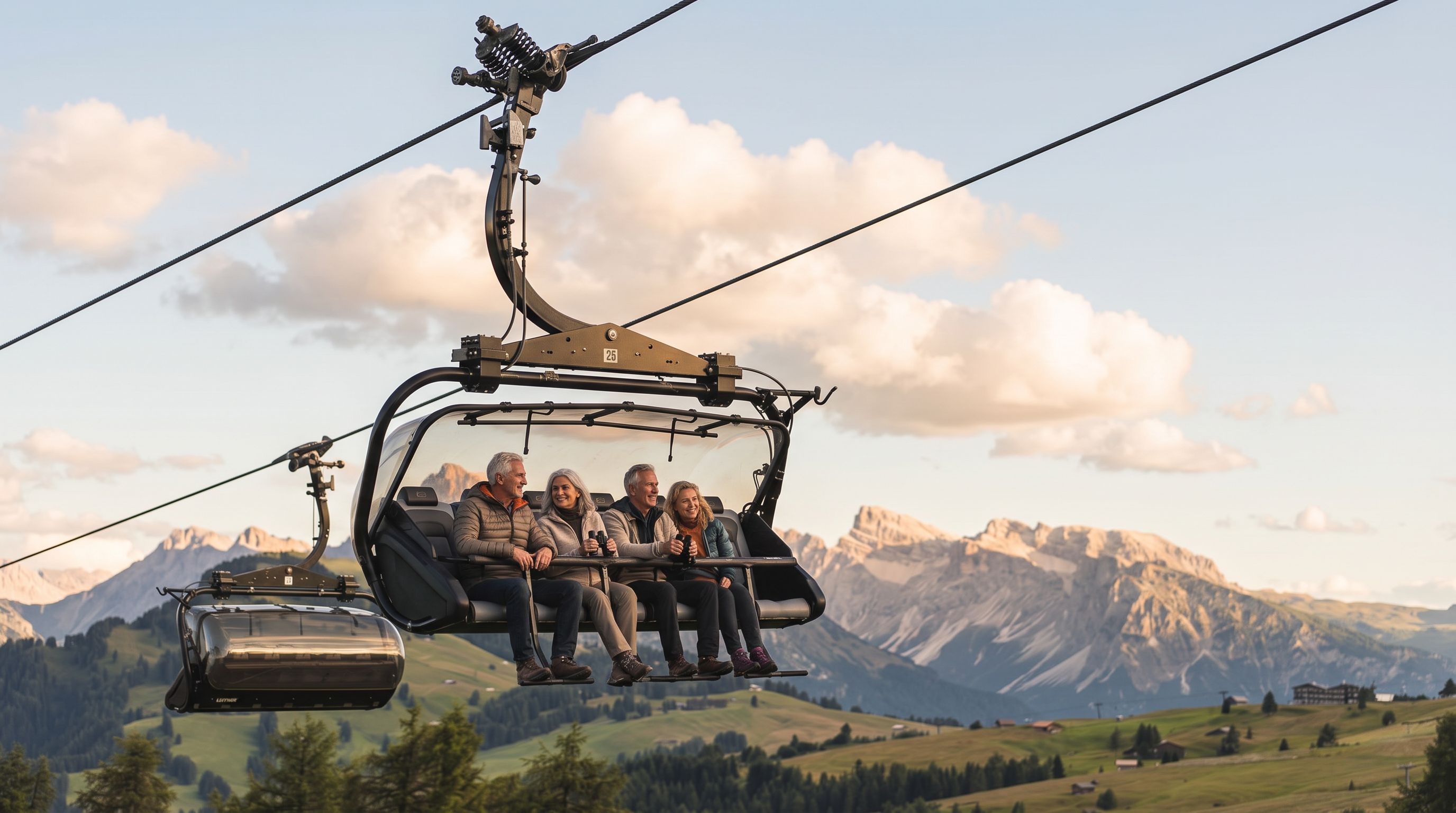 AI-edited
What does a guided tour of the Dolomites cost?
Published guide rates start at €380 for a day hike for up to five participants, rising to €420 for a multi-day hut-to-hut trek. Private guided treks run from €1,560 to €4,460 depending on length and start point. Per-person prices fall sharply as group size rises.
Guided Dolomiti publishes day hikes starting at €380 for up to 5 participants, while multi-day treks from hut to hut are €420; for larger groups, the price increases by 20% to 40% depending on group size (the operator's published rates). Those are guide fees, not full packages.
Mont Trekking publishes private-guided hut-to-hut pricing by route and duration. A 5 to 7 day trek from Val Gardena or Karerpass/Carezza runs €1,560 to €2,380. A 7 to 10 day trek from San Martino di Castrozza or Val di Fassa runs €2,300 to €3,480. A 9 to 11 day trek from Cortina d'Ampezzo, Toblach/Belluno or Zoldo runs €3,600 to €4,460. Rates are indicative and vary by season and booking channel.
For a single guided day out, Dolomagic lists a via ferrata day tour with a maximum of 6 participants, running mid-June to end September, at €600 for one person, €325 for two, €220 for three, €180 for four and €160 for five. The per-person drop is steep, which is worth remembering if you are booking as a couple.
Can you find genuinely gentle hiking tours?
Yes, but gentle is not a protected term. Some operators split each day into a moderate option and a more strenuous one, which is the clearest published structure for mixed-ability groups. Ask for daily uphill metres and descent, not just hiking time, before you commit.
A forum post on the Rick Steves Travel Forum from March 2024 described a 10-day small-group guided hiking trip in September 2022 that used a family-run operator, capped groups at 12 to 14 people, and split each day into a moderate option and a more strenuous one. The same post said the operator stayed in three villages: Dobbiaco, Corvara and Santa Cristina. That two-tier daily structure is the single most useful thing to look for if you walk at a gentler pace than the rest of the group.
The UNESCO programme also trained expert professional figures with skills for guiding persons with disabilities, through an educational programme extended across the whole of the Dolomites in 2017. Guides with that background are worth asking about by name.
What should be included, and what is usually not?
Inclusions vary widely between operators and are the most common source of surprise. EF Adventures states that transport for you and your luggage is included as private group transfers, with airport transfers included too. Other operators publish guide fees only, with meals, huts and lift tickets excluded unless stated.
Dolomite Mountains, based in San Cassiano in Badia and designing active travel in the region since 2009, publishes its booking terms in full. A 30% deposit secures the booking, or the full cost for bookings made within 60 days of departure, and the balance is due 60 days before departure. Once booked, changes to the itinerary or logistics carry a €100 per person change fee. Accommodation confirmation normally arrives 3 to 4 working days after the request, and the first-night voucher is emailed two weeks before arrival, with remaining vouchers handed over at the trip briefing.
That briefing is usually held the afternoon or evening of arrival, or on the first morning. Day 1 of all Dolomite Mountains tours is an arrival day with no or limited planned activities, and the final day is the official departure day on the same basis. Private airport transfers are offered from Venice, Milan, Verona and Innsbruck, with a private car costing approximately €400 to €600 each way depending on airport and destination.
One practical detail worth knowing before you rely on a card: credit card use in rifugi is very limited, and many do not accept credit cards at all. Carry cash for hut stops.
What questions should you ask before booking?
Ask whether the tour is private, semi-private or small-group, and what the maximum group size is. Ask whether the itinerary is a true gentle-hiking trip or includes steeper sections, via ferrata or long daily elevation gains. Ask who leads the trip, since operators publish different guide standards.
The list below covers the questions that separate a good booking from a disappointing one. Each one exists because published inclusions and formats genuinely differ between operators.
- Is the tour private, semi-private or small-group, and what is the maximum group size?
- Is the itinerary a true gentle-hiking trip, or does it include steeper sections, via ferrata or long daily elevation gains?
- Are luggage transport, airport transfers and hotel pickup included?
- Who leads the trip: a certified mountain guide, a local hiking guide, or a general escort?
- Does the price include meals, huts, lift tickets, guide expenses and VAT?
- Is the exact route open on your departure date, given that published seasons differ by route and month?
- What are the daily uphill metres and descent, not only the hiking time?
- If using a guide, is it private or shared?
- Which lifts are operating on your dates, and is the access road closed to private cars?
- Is there a disability or senior tariff, and is pre-booking required for parking or entry?
Do senior fares and reduced tariffs apply to guided tours?
Senior and disability reductions exist on individual lifts and passes, not across the region as a whole. The Seiser Alm cable car publishes a summer 2026 senior rate of €18 one-way and €26 return for those born in 1960 or earlier. Dolomiti Superski documents a 10% discount on some passes for the same age group.
Wheelchair users, blind passengers and people with 100% disability travel free on the Seiser Alm cable car, and some other disabled passengers with a certificate pay a reduced fare. In Val Gardena, adults and juniors with a disability of 51% or more receive a 20% discount on the Gardena Card, which covers 17 lift facilities for three or six consecutive days. Dolomiti Superski documents a 20% discount for people with a recognised disability of at least 51% on certain ski passes, though that is a winter-sport product rather than a sightseeing pass, and disability passes are sold only at sales points, not online.
Museum reductions are documented too. The Geological Museum of the Dolomites offers a reduced ticket of €4 for over-65s, and the DoloMythos Museum has a senior rate of €12 for ages 60+ against €14 for adults. No exact senior or over-65 fare for buses or trains across the whole Dolomites is documented; discounts are product-specific rather than universal, so each operator or route must be checked individually.
How accessible are guided tours for travellers with limited mobility?
Accessibility varies by valley and by product, and no region-wide guarantee exists. Some cable cars and transfers are barrier-free while others require checking individual accessibility pages before travel. Several day tours from Venice and Lake Garda state plainly that they are not wheelchair accessible.
The documented pattern is uneven. In South Tyrol, many regional trains are low-floor, stations have lifts, and public buses are barrier-free with ramps. The Südtirol Transfer shuttle is described as barrier-free on request for the last leg from rail or coach hubs to accommodation. In Val Gardena, public transport is free for blind and visually impaired people with appropriate ID, while full fares apply to people with limited mobility and families with pushchairs on regional buses.
On the tour side, the Viator Dolomites full-day tour from Lake Garda states that it is not wheelchair accessible but is near public transportation, with instant confirmation at booking and free cancellation up to 24 hours before the experience starts. The Viator Dolomites hiking tour from Venice states that it is not wheelchair accessible, is near public transportation, and is non-refundable and cannot be changed for any reason. The Viator Dolomiti via ferrata experience from Cortina states that it is not wheelchair accessible, with confirmation within 48 hours subject to availability and no refunds or changes.
For travellers who need step-free access, the UNESCO accessible routes are the strongest documented starting point. Each of the 36 trails has a detailed technical information sheet in English, German and Italian, letting the user analyse the trail and independently evaluate their ability to complete it. The 13 accessible viewpoints reached by lift systems are the other reliable option. A practical organiser's approach is to build the trip around documented lifts, plateaus and viewpoint access rather than assuming all trails or passes suit limited mobility.
How do you reach the start of a guided tour?
Most small-group tours meet at a city hub rather than in the mountains. Guided By Rainer meets in Venice for a private bus transfer to Val Gardena. Private transfers from Venice, Milan, Verona and Innsbruck are offered by at least one local operator at roughly €400 to €600 each way.
For travellers assembling their own arrival, direct buses run at least hourly between Bolzano/Bozen and Ortisei/St. Ulrich, according to Fodor's Community. Cortina Express is documented as running daily services to Alta Badia from July to September. Elsewhere, seasonal bus gaps on some routes make advance planning important.
Road distances give a sense of the scale. Cortina d'Ampezzo to Toblach is 33 km by road, about 50 minutes with clear roads and no traffic. San Martino di Castrozza to Val di Fassa is 47 km, about 45 minutes on the same basis. Cortina d'Ampezzo to Belluno railway station is 72 km, about 85 minutes with free-flowing traffic and no stops. These are measurements on the road network, not published operator times.
| Route | Distance | Driving time (clear roads) |
|---|---|---|
| Cortina d'Ampezzo to Toblach | 33 km | About 50 minutes |
| San Martino di Castrozza to Val di Fassa | 47 km | About 45 minutes |
| Cortina d'Ampezzo to Belluno (railway station) | 72 km | About 85 minutes |
When do guided tours run, and when is it quietest?
Guided hiking tours run from June to mid-October. The Dolomiti Supersummer season runs 14 May to 8 November 2026, with the Sellaronda summer opening from 13 June to 27 September 2026. June, September and early July are the most practical compromise for open lifts and fewer crowds.
May, October and November often bring limited lift operations and some closures. Dolomiti Superski notes that some resorts or individual lifts may open earlier depending on weather, which is the general operator caution for shoulder seasons. For Val Gardena lifts, the tourism board's updates show that openings can differ by lift and date, with some lifts opening on different days in spring and summer rather than all at once.
Fixed departures give a useful reference. EF Adventures lists a Dolomites hiking tour with 2027 departures including 5 to 15 June, 19 to 29 June, 24 July to 3 August, 4 to 14 September, 11 to 21 September and 2 to 12 October. InfoDolomites publishes an easy Dolomites gourmet hiking trip of 14 nights/15 days, offered from mid-June to late September, with a local English-speaking guide meeting guests at the hotel.
No sourced, place-wide statement on the calmest times to visit the Dolomites as a whole was documented in the material gathered. For a fuller picture of how the seasons shift across the year, see our guide to Dolomites festivals and quiet seasons.
What health and safety arrangements should you know about?
The single European emergency number 112 is documented for mountain rescue across the Dolomites. In the Veneto Dolomites, the medical emergency number is 118, with an operations centre active 24 hours a day, seven days a week. Pharmacies are documented at valley level, not region-wide.
In Val Gardena, pharmacies are documented in Ortisei, Santa Cristina and Selva di Val Gardena, and urgent medical emergencies are reported by calling 112. The Val Gardena telephone guide lists an outpatient doctor-on-call in Selva di Val Gardena at Nivesplatz, available from July to September and from December to April, plus hospitals in Bressanone and Bolzano at roughly 30 to 40 km away.
On the Belluno side, the health guide lists Belluno Hospital, Feltre Hospital, Agordo Hospital and Pieve di Cadore Hospital, with emergency rooms and first-aid points open 24/7. It also states that 76 affiliated pharmacies provide continuous pharmaceutical assistance through a shift system. For non-residents in main tourist resorts, the tourist medical guard charges €25 for an outpatient visit, €40 for a home visit and €5 for repeat prescriptions. In Alta Badia, Brunico Hospital is about 38 km away, with pharmacies listed in Corvara and La Villa.
If you take regular medication, pack enough for a full day away from a pharmacy. Our packing guide for Dolomites boots, layers and mountain weather covers the rest of the kit list.
How do you choose between operators?
Match the format to your walking, not the brochure to your budget. Small-group hiking suits travellers who want company and a fixed structure. Private guided day tours suit those who want the route adjusted to weather and energy on the day. Local operators based in the range tend to know which valleys and huts suit which traveller.
Dolomite Mountains states that it is based in San Cassiano in Badia and has been designing active travel in the Dolomites since 2009, with guides holding international mountaineering certifications who grew up on the terrain. The operator's trip designers say they know which valleys, huts and passes suit which traveller. That local knowledge is the practical argument for choosing an operator based in the range over one flying groups in from elsewhere.
Guest feedback on the day-tour products is broadly positive but worth reading carefully. The Dolomites full-day tour from Lake Garda carries 141 reviews on Tripadvisor as of September 2026, with multiple reviews describing it as a long day though still worthwhile. The private guided tour in the Dolomites from Venice carries 39 reviews as of July 2026, with reviewers describing the driver-guide as simply amazing and the organiser as really helpful with organising and reaching out to meet our needs. That tour runs 10 to 11 hours and states explicitly that it is not accessible and only near public transportation.
One guest wrote on Tripadvisor in July 2026 that the Dolomites trip was "one of the best experiences I have ever had."
For a private full-day tour of the Dolomites and Alpine lakes including Braies from Innsbruck, which carries 18 reviews as of September 2026, guests said the guide was knowledgeable, easy to talk to, friendly and professional, and that she took care of everything. Reviewers noted the day felt relaxed and well-organised, and that travellers were able to choose what would be the highlights of the trip. If you are weighing up where to base yourself before or after a tour, our five-day Dolomites itinerary for the over-50s sets out a sensible shape for the week.
What should you check in the final weeks before departure?
Confirm that the exact route is open on your dates, that the lifts you need are running, and whether any access road is closed to private cars. Lift reconstruction and temporary transport changes have been reported in Val di Fassa, so a route that ran last year may not run this year.
Best-documented disruption is in Val di Fassa, especially around Campitello and Col Rodella, where lift reconstruction and temporary transport changes were explicitly reported. Fassa.com described a new 3S gondola from Campitello to Col Rodella opening on 19 December 2025, with special mobility arrangements before that date including free parking at Campitello and extra ski-bus service. From 4 to 18 December 2025 there were specific access rules and extra shuttle support, including regular ski buses and a dedicated connection between the Campitello Col Rodella car park and the Belvedere-Pecol cable car in Canazei.
Elsewhere, the road to Seiser Alm/Alpe di Siusi is closed to private traffic while the cable car operates, typically 9:00 to 17:00, and fully open only when the cable car is stopped, roughly mid-April to mid-May and early November to early December. For Lago di Braies, car access in 2026 is restricted from 1 July to 15 September between 9:00 and 16:00, with access by public transport, foot, bicycle, or reservation and permit during that period. At Tre Cime di Lavaredo, car access to the Rifugio Auronzo parking area requires an online reservation and number-plate registration, with a daily vehicle cap.
Dolomiti Superski's FAQ notes that gondolas and cable cars can be used without skis, but that users should check whether they can walk on the slopes, because walking on slopes is strictly forbidden, and not all chairlifts are accessible to pedestrians. Transport planning is improving, with airport and rail shuttles into key Dolomite valleys, which suits older travellers who prefer escorted logistics over self-driving.
One last administrative point. Beginning 1 January 2022, all snow sports participants at Italian resorts with lifts must carry civil liability insurance, also called personal liability insurance. Travel insurance is not mandatory for Dolomite Mountains bookings, but the operator highly recommends it for all bookings.
For travellers who would rather see the hotel side of the trip before committing, our review of Rosa Alpina in San Cassiano covers one of the properties in the heart of the Badia valley.


