
The Dolomites reward a particular kind of travel. This is not a region to rush through in a car, ticking off passes and viewpoints between long drives. For travellers aged 50 to 70, the most comfortable pattern is a base-and-explore approach: settle in one valley, use lifts and short walks to reach the high ground, and let the mountains come to you. Five days is enough for a first, relaxed overview.
This itinerary assumes two bases rather than five. You unpack once in Ortisei, once in the Cortina area, and the days in between are built around lift opening times, with at least one rest afternoon. For those who want more, each day carries an option to add a hike or a via ferrata. The plan deliberately avoids the daily repacking that turns a mountain holiday into a logistics exercise.
How many days do you really need in the Dolomites?
One week is better if you want to combine valleys, passes and scenic drives without rushing.
one major hike or scenic area per day, with a separate lighter stop in town or at a lake if energy allows. Even the easier recommendations rely on buses, gondolas and short nature trails rather than doorstep walks. That is the rhythm this plan follows.
For a longer trip, the same sources suggest a week allows you to add a third valley or a scenic drive without stretching the days. The five-day version below is the compressed but still comfortable option.
When should over-50s plan a Dolomites trip?
The Dolomites' own travel guides describe summer as June to September and winter as December to March, with shoulder months bringing reduced operations and some closures. Multiple guides say the most reliable hiking window is late June through September, while June and September are quieter than July and August. One source explicitly recommends September or early October as the calmest practical window.
May, October and November are the least reliable months because lifts may run less often and some hotels or mountain facilities close. A winter caution is documented: icy conditions and frozen paths can make the Dolomites difficult for seniors in wheelchairs. For a five-day itinerary built around lifts, late June through September is the safest bet.
If you are planning around weather and crowds, our guide to when to visit the Dolomites for fine weather and fewer crowds covers the seasonal trade-offs in more detail.
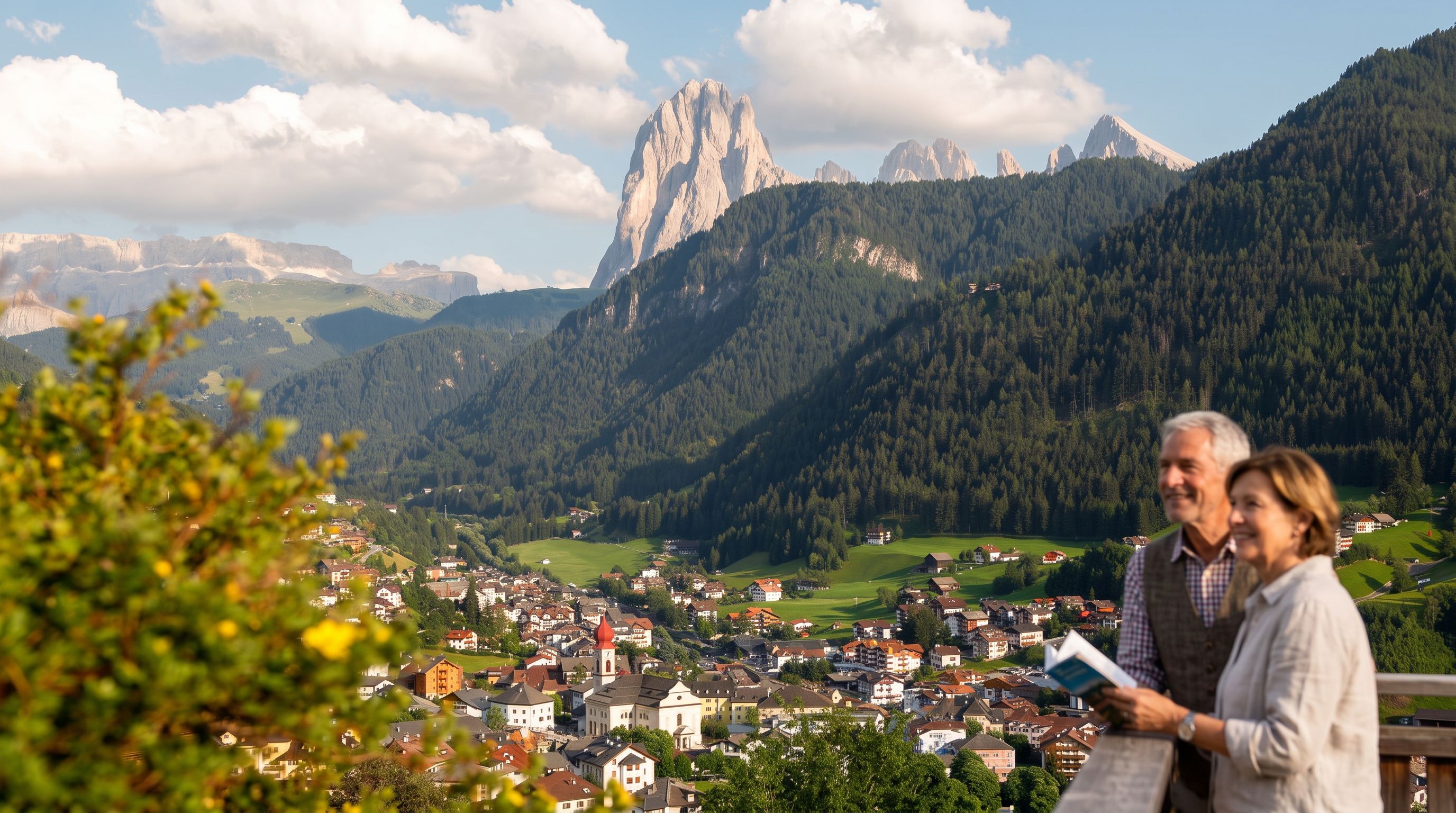
Day 1: Arrive in Ortisei and settle into Val Gardena
Ortisei is the best-documented base in Val Gardena for older travellers. The material gathered here documents barrier-free buses in the wider area and a mountain-rescue emergency framework using 112. A pharmacy is named in Ortisei: Pharmacy Sella at Reziaplatz 73B. The town also has many easy walks under 3 miles, according to traveller reports.
The first day is for arrival and orientation, not for a major outing. Barrier-free buses and low-floor regional trains are documented in the wider South Tyrol mobility material.
Spend the afternoon on a short walk in town or along the valley floor. The point is to adjust to the altitude and the pace, not to tick off a sight. If you have arrived by train, the Südtirol Transfer shuttle links train stations in Bozen and Brixen to accommodation, including barrier-free service on request.
 AI-edited
Day 2: Alpe di Siusi by cable car
The Seiser Alm cable car is the strongest documented example for older travellers because it explicitly lists a senior rate for those born in 1960 or earlier: €18 one-way and €26 return in summer 2026. The ride from Seis to the Seiser Alm takes about 15 minutes. The lift runs 22 May 2026 to 2 November 2026, with extended hours from 7 June to 6 September 2026.
Alpe di Siusi, also called Seiser Alm, is the day the itinerary earns its reputation as relaxed but not idle. The cable car replaces the climb, and the plateau itself offers flat meadow paths. The Hans and Paula Steger Nature Trail is described in traveller reports as about 20 to 30 minutes if a return walk feels like too much.
The cable car's spacious cabins are accessible to everyone and can accommodate up to 16 passengers, according to the operator. Travel is free of charge for blind passengers, people with 100% disability and wheelchair users. Passengers with disabilities are entitled to a reduced fare for the return journey. For reasons of space, wheelchair users are given priority when boarding.
One planning note: during the season, the road up to the Seiser Alm is closed to cars from 9:00 am to 5:00 pm. In high season, the operator advises allowing for often long queues when buying tickets. Holders of an official European Disability Card may drive up at any time.
Day 3: The Sella passes and a rest afternoon
The Sella passes connect Val Gardena to Alta Badia and the Cortina side. Piz Boè is described as a day starting at Passo Pordoi, about 45 minutes from Badia, with the option to ascend on foot or by cable car to Rifugio Boè. This is the day to build in a rest afternoon, because the passes are best seen without rushing.
The Sella group is the high ground between Val Gardena and the valleys to the east. For a relaxed day, drive or take transport over Passo Gardena and Passo Pordoi, stopping at the viewpoints rather than committing to a full hike. The cable car option at Passo Pordoi gives access to Rifugio Boè without the climb.
This is also the day to note the access changes. Reporting in mid-2026 says a pilot access regime starts in September 2026 at Passo Gardena, limiting day-tripper cars and allowing only 150 pre-booked vehicles per day. Overnight stays matter: several access rules exempt hotel guests, which makes base-and-explore travel more practical than day-tripping.
If you want more, the via ferrata options in the Sella group are well documented, but they require equipment, a guide and a head for exposure. For most travellers in this age bracket, the cable car to Rifugio Boè and a short walk from there is the more sensible version of the same day.
Day 4: Transfer to the Cortina area
The Cortina area is the eastern base for the Tre Cime and the Braies valley. The Drei Zinnen / Tre Cime Nature Park Visitor Center in Toblach/Dobbiaco is documented with free admission, opening hours and walk-from-station access in about 3 minutes. It is closed on official holidays except August 15th.
The transfer from Ortisei to the Cortina area takes you through some of the best-known scenery in the Dolomites. This is a travel day, not a hiking day. The visitor center at Toblach/Dobbiaco is a good first stop: it is located in the Grand Hotel Toblach cultural center, which signals the area's reuse of historic Alpine tourism infrastructure.
If you prefer a museum stop, the DoloMythos Museum is documented as opening daily except 25 December, with senior pricing of €12 for those aged 60 and over versus €14 for adults. Guided tours are available on request. The Geological Museum of the Dolomites has a reduced ticket of €4 for over-65s.
MMM Dolomites on Monte Rite is described as closed in one source, and its official page says it is open only from 1 June to 30 September, 10:00 to 17:00, with last admission at 16:30, closed on Tuesdays. Check before planning around it.
Day 5: Tre Cime, Braies or a softer option
The Tre Cime loop is described as around 4 hours, and Lago di Sorapis as about a 5-hour round trip from Passo Tre Croci. Both can dominate a day for older travellers if weather or altitude slows the pace. For a softer final day, the Val d'Anna walk from Ortisei is described as an easy 25-minute uphill walk.
The final day offers a choice. The Tre Cime di Lavaredo loop is the classic, but 2026 reports say motorists must reserve and pay in advance for the toll road and parking, with one report describing a roughly €40 car fee and a high-season queue problem. If you go, book ahead.
Lago di Braies is the other headline sight, but coverage in 2026 says peak-season car access is controlled from 1 July to 15 September, with rules applying between 9 a.m. and 4 p.m. and bookings or permits required for motorists. Again, the overnight-stay exemption matters.
For a gentler close to the trip, the paved Panorama Path from Santa Cristina is described in traveller reports as an easy option. The point of the final day is to end on a high note, not to exhaust yourself before the journey home.
Can you do this itinerary without a car?
A public-transport version of this itinerary is documented. One five-day public-transport plan strings together Dobbiaco, Lago di Braies, Tre Cime di Lavaredo, Ortisei, St. Jacob's Church, Seceda and Alpe di Siusi using trains, buses and shuttles.
Dolomitibus serves the Dolomites areas in the neighbouring province of Belluno, while South Tyrolean transport information is handled by the integrated transport system on that side of the range. In South Tyrol, many trains have low-floor access and stations have lifts, and public buses are barrier-free with ramps.
For a car-free five-day trip, the practical pattern is to base in Ortisei and use the valley's buses and lifts, then transfer to the Dobbiaco or Cortina area for the eastern sights.
If you are packing for a trip that mixes lifts, short walks and possible rain, our guide to packing for the Dolomites covers boots, layers and mountain weather.
Health, safety and practical planning for older travellers
Emergency numbers documented are 112 for Val Gardena and the Sciliar/Alpe di Siusi area, and 118 in the Belluno-area Dolomites network. The official ULSS1 Dolomiti guide says emergency rooms and first-aid points are open 24/7, and rescue resources can be activated, including helicopter rescue when needed.
ULSS1 Dolomiti says it coordinates 76 affiliated pharmacies to provide continuous 24-hour pharmaceutical assistance, with the current on-duty pharmacy list published online. Belluno Hospital, Feltre Hospital, Agordo Hospital and Pieve di Cadore Hospital are all listed with addresses in the official health-and-safety guide.
On mobility, the official accessible-program source says the routes are designed for people with limited mobility, including older visitors, and that each route has maps, GPS coordinates, terrain details and stopping points. The same source says there are 13 panoramic viewpoints reached by fully accessible lift systems. The Dolomites are part of a UNESCO property and the accessible-routes program is run within the UNESCO Dolomites framework, with route sheets available through the official accessible Dolomites planning page.
exact accessibility details for many individual hotels, restaurants and transfer services in the Dolomites are not documented in the gathered sources. Cancellation terms for the named sites and services are not documented either. Ask when booking.
Options for the more active: hikes and via ferrata
Seceda can be reached by cable car from Santa Cristina, with a hike to Rifugio Firenze and onward to Rifugio Troier before another lift ride from Fermeda to the Seceda ridge. Piz Boè offers a cable car ascent to Rifugio Boè from Passo Pordoi.
The Seceda option is the more forgiving of the two because it uses lifts at both ends. Travellers describe parking at Santa Cristina, taking the cable car to Col Raiser, then hiking to Rifugio Firenze and onward to Rifugio Troier before another lift ride from Fermeda to the Seceda ridge. The walking is moderate, and the escape route is a lift rather than a long descent.
Via ferrata routes in the Sella group and around Cortina are well known, but they require equipment, a guide and a head for exposure.
For the more active traveller, the key is to build in a rest afternoon after any demanding day.
What to expect on the ground
The Dolomites are best approached as a lift-assisted, valley-based destination rather than a single town or compact historic center. The strongest documented low-strain options are in Val Gardena, Alpe di Siusi/Seiser Alm, Villnöss/Funes, Dobbiaco/Toblach and the UNESCO accessible routes network across the Dolomites systems.
The Dolomites UNESCO Info Point in Villnöss/Funes has a documented pattern of summer daily opening, a Monday rest day outside holiday periods, and full closures in spring and autumn shoulder periods. It is located at Zans/Villnöss, and accessible toilets are documented at the Zans car park.
Accessible public toilets are documented in Kastelruth, Seis am Schlern, Völs am Schlern and Tiers am Rosengarten. In the Seiser Alm area, the cable car is fully accessible and several accessible toilets are listed in surrounding villages and lift stations.
For the cultural side of the trip, the Dolomites' interpretation is tied to geology and mountain landscape, not just hiking. The official accessible-program material explicitly connects the landscape to the "history of the Earth." If you want to plan around festivals and quieter periods, our guide to the Dolomites through the year covers what happens when.
Booking notes and what to confirm before you go
Expect more booking, less spontaneity at the best-known Dolomites viewpoints and trailheads, especially for car access in summer. Several access rules exempt hotel guests, which makes base-and-explore travel more practical than day-tripping. For late-summer or early-autumn visits, the most likely friction points are road caps, parking reservations, shuttle dependence and timed entry windows at the major icons.
The Seiser Alm cable car publishes a multi-ride card for 3 ascent and descent rides during the season at €73. The standard ticket is €21 one-way and €30 return, while the senior rate for those born in 1960 or earlier is €18 one-way and €26 return in summer 2026. People with disabilities with a valid disability ID pay the same as the senior rate.
At both the valley station and the mountain station of the Seiser Alm cable car, there are shops, rental outlets, restaurants and ticket offices. In high season, allow for long queues when buying tickets.
For the Tre Cime and Braies, book parking or permits in advance where required. The Drei Zinnen / Tre Cime Nature Park Visitor Center has free admission, and its opening hours and contact details are documented. No booking requirement or cancellation terms are documented for it.
Rates and access rules are indicative and vary by season and booking channel.
The five-day plan in summary
Two bases, five days, one major sight per day. Day 1 in Ortisei, Day 2 on Alpe di Siusi by cable car, Day 3 over the Sella passes with a rest afternoon, Day 4 transfer to the Cortina area, Day 5 for Tre Cime, Braies or a softer walk. The plan is relaxed but not idle, and it leaves room to add a hike or via ferrata for the more active.
The strongest documented low-strain options are in Val Gardena and the Seiser Alm, with the eastern sights reachable from a second base.
For the food side of the trip, our guide to Dolomites hotels worth booking for the food covers where to eat well. Hotel reviews and budgeting have their own dedicated guides and are not covered here.
the gathered sources do not document a region-wide mandatory entry permit for the Dolomites itself. Access is by trail, lift, visitor center or transport service, and the local rules vary by valley and season. Check the current rules for each area before you travel.


