
For travellers aged 50–70 who prefer organised travel, Hallstatt presents a unique challenge: its beauty is matched only by its logistical complexity. The narrow cobblestone streets, the ferry connection required from the train station, and the sheer volume of day-trippers can overwhelm even the most seasoned traveller. This guide cuts through the noise, focusing exclusively on small-group and private guided tours that offer comfortable transport, an unhurried pace, and the insider knowledge that makes a visit to this UNESCO World Heritage site genuinely rewarding.
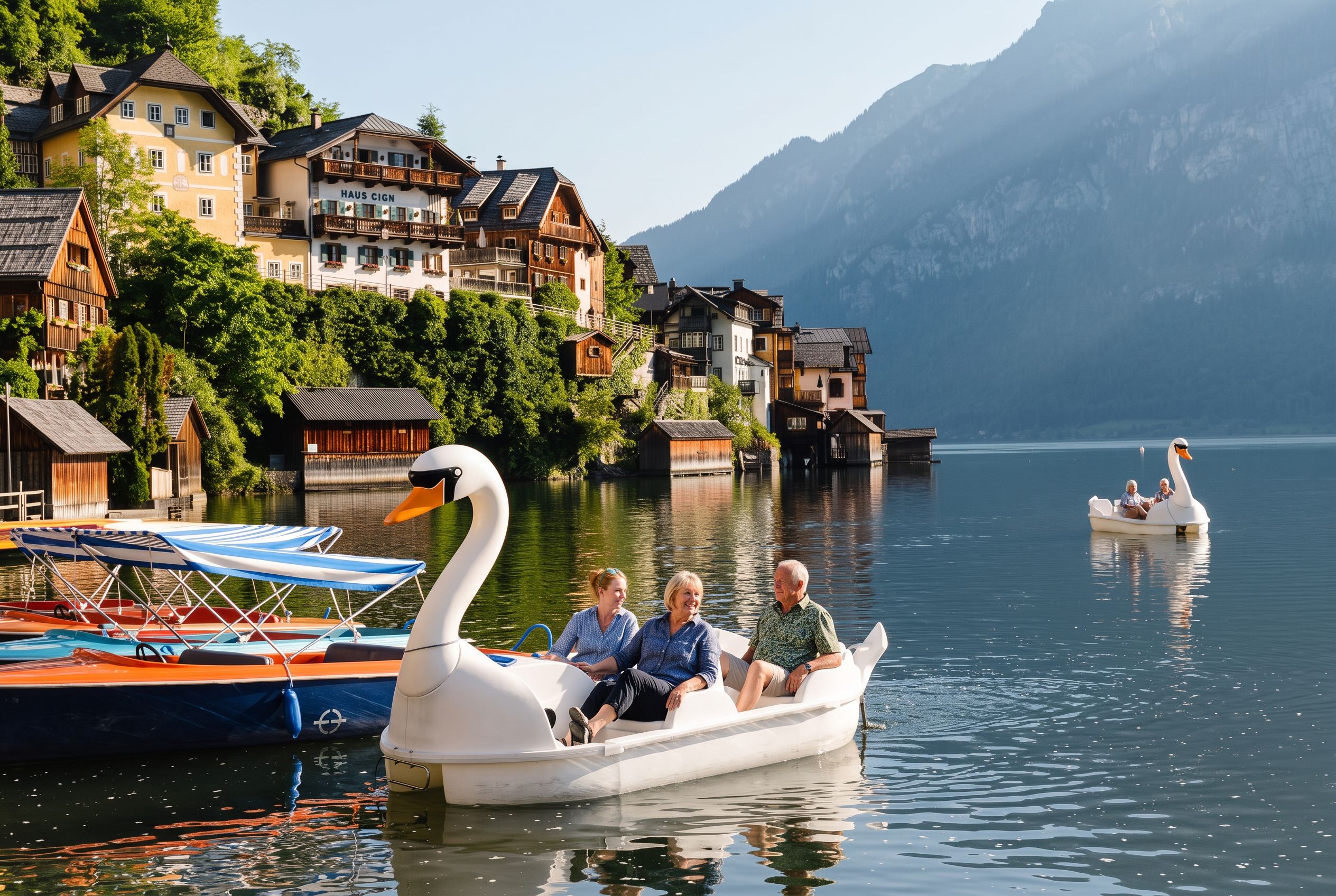 AI-edited
Why choose a guided tour over going it alone?
Guided tours eliminate the three biggest headaches of visiting Hallstatt: the complex train-ferry connection, the stress of finding parking in a village that restricts vehicle access, and the need to navigate cobblestones and steep hills while managing your own schedule. For anyone who would rather not manage the logistics, a well-chosen tour turns a potentially exhausting day into a relaxed, informative one.
The practical reality is that Hallstatt’s train station sits across the lake from the village, so arriving by rail means a short ferry crossing timed to meet the trains. Hallstatt Schifffahrt charges €4.00 one way and €8.00 for a return ticket between the station and Hallstatt Markt, and puts it plainly on its own fares page: “No card payment possible – cash only!” In the 2026 timetable the daily crossings run from 08:35 until the last boat at 18:30; the earlier 07:32 departure is marked for school days, Monday to Friday, only. Spaces in the P1 and P2 car parks cannot be reserved at all, which is why the tourist office advises arriving early or coming by bus or train. A guided tour from Salzburg or Vienna handles all of this for you, with a direct bus and an English-speaking guide who manages the pace.
The trade-off is money against effort, and the gap is real: a scheduled half-day coach tour from Salzburg starts at €80 per person, while the same trip by train and ferry costs a fraction of that but hands you every connection. A guest wrote on Google in January 2026 about a half-day Hallstatt tour from Salzburg:
“We took the morning 1/2 day tour from Salzburg to Hallstatt… Transport is a modern mini-van, that takes up to 8 people.” — a guest on Google, January 2026
For those who prefer a longer stay with a slower rhythm, our four-day itinerary guide covers staying overnight, but for a day trip, a guided tour is the most practical choice.
What tours are available from Salzburg?
Half-day guided tours from Salzburg are the most efficient option. Panorama Tours lists its Hallstatt half-day tour at €80 per person for five and a half hours, including transport, a guide and a 2.5-hour stay in the village; Salzburg Sightseeing charges €85 for the same format. Full-day tours adding the Dachstein Ice Caves or Bad Ischl cost more.
The drive from Salzburg to Hallstatt covers about 87 kilometres and takes 70–90 minutes each way, which makes a half-day tour manageable. Vehicles vary more than the listings suggest: the scheduled departures are sold with a maximum of 60 travellers, while the small-group and private versions run in eight-seat minivans. Guides are typically local experts who cover the region’s history, its salt mining heritage and the strain of living in a UNESCO-protected village that the municipality records as home to 760 people with a main residence, as of April 2025.
For a more personalised experience, book a local guide in the village itself. The official Hallstatt guided tour is priced per group rather than per person — €168 in German and €198 in another language, for one to 25 people, lasting 60 to 90 minutes and arranged by appointment. It covers the guide alone, so you still have to reach Hallstatt under your own steam, but that structure lets you set the pace entirely, which helps if you need extra time on the cobblestones or want to linger by the water.
What about tours from Vienna?
Day trips from Vienna to Hallstatt are possible but long. The road distance is about 290 kilometres, roughly three to three and a half hours each way, and operators sell the trip as a full day of about 12 to 13 hours, usually with one stop in the Salzkammergut lake district en route.
Vienna-based tours leave the city centre in the early morning and are back in the evening; confirm both times with the operator, because departure points differ — most start near the State Opera or Schwedenplatz rather than at your hotel. The journey crosses the Salzkammergut lake district, and many tours build in a photo and coffee stop on the way. The day is long, but the coaches are comfortable and a guide breaks up the drive with commentary.
If you’re based in Vienna but prefer a shorter day, consider taking the train to Salzburg — ÖBB timetables give 2 hours 22 minutes for the fastest railjet services — and joining a tour from there. This adds flexibility and reduces time on the road.
What should I look for in a tour operator?
Ask what vehicle the tour uses: scheduled half-day departures from Salzburg are sold with up to 60 travellers, while small-group and private versions run in eight-seat minivans. The standard half-day tour allows about 2.5 hours in Hallstatt village; check that yours does too, and ask about the guide’s experience with older travellers.
Key questions to ask before booking:
- Group size: Is it guaranteed small, or could it be 40+ people on a full coach?
- Mobility support: Does the guide assist with cobblestones and stairs? Are there rest stops built into the walking portion?
- Attraction access: Does the tour include the Salt Mine or Skywalk? (See the 2026 closure note below.)
- Meals: Is lunch included, or is there time to find a café? Many tours stop at a restaurant with pre-arranged seating.
- Cancellation policy: Is it flexible in case of weather or health issues?
What attractions are available in 2026?
As of August 2026 the Hallstatt salt mine and the Skywalk are still closed for the funicular rebuild. Salzwelten gives the reopening as Saturday, 29 August 2026 at 09:00, so any tour running before that date cannot include them. The lakeside promenade, the village core and the World Heritage Museum stay open throughout.
The closure of the Salzbergbahn — the funicular that carries visitors up to the mine and the Skywalk viewing platform — is the significant change for 2026. Salzwelten announced on 11 August 2026 that the line had been rebuilt from scratch on the same alignment in 362 days for around €34 million, and that the new glass cabins have step-free boarding and automatic levelling that keeps the floor horizontal throughout the ride. Until the reopening, a daily bus shuttle runs from the Hallstatt bus terminal in the Lahn district to the Salzwelten Altaussee in Styria as part of an All-Inclusive Tour; that offer is bookable up to and including 31 August 2026.
For travellers aged 50–70, this closure simplifies planning: you can focus on the village itself — the market square, the Catholic parish church with its bone chapel (Beinhaus), and the level lakeside strip that offers the iconic “calendar photo” view. It is the ossuary chapel, not the church, that dates from the 12th century; it holds more than 600 painted skulls, admission is €2 for adults, and the tourist office is blunt about the way up: “the ascent is via numerous steps or via the somewhat steeper Kirchenweg”. The World Heritage Museum covers 7,000 years of salt mining, charges €11 rather than €12 for visitors aged 60 and over, and opens daily 10:00–18:00 from May to September, with last admission an hour before closing.
How accessible is Hallstatt for seniors?
Hallstatt is mixed for accessibility. The strip along the water is level and paved, while the historic core has cobblestones, stone stairs and short steep climbs. On the ferries it depends on the boat: the operator lists MS Hallstatt and MS Stefanie, the line ship to the train station, as wheelchair accessible, and MS Goisern and MS Dachstein as not.
Here’s what to expect on the ground:
| Area | Surface | Accessibility | Notes |
|---|---|---|---|
| Lakeside promenade | Flat, paved | Good | Level along the water; the easiest stretch on foot |
| Market square (Marktplatz) | Cobblestone | Moderate | Uneven; take your time |
| Upper town (to church) | Stone stairs, steep paths | Challenging | No lift or funicular; steps or the steeper Kirchenweg |
| World Heritage Museum | Historic building | Ask first | No accessibility details published; contact the museum |
| Ferry dock area | Paved, slight slope | Good | MS Stefanie to the station is wheelchair accessible |
The Heritage Hotel Hallstatt (Google 4.0/5 from 1,663 reviews as of August 2026; Tripadvisor 4/5 from 988 reviews as of July 2026) is spread across three historic townhouses, and that matters if stairs are a problem. The hotel states that the main building, Haus Kainz, has a lift, and that the rooms in Haus Seethaler, five minutes’ walk away, are also reached by lift; Haus Stocker, three minutes from the main house, was deliberately left in its original state and has none. Ask which house your room is in before you book.
For a detailed breakdown of what to pack for the terrain and weather, see our packing guide for Hallstatt.
What should I pack for a guided tour?
Pack layers, sturdy walking shoes with good grip, a waterproof jacket, and cash (Euros). The ferry and many small vendors do not accept credit cards. A wide-brimmed hat and sunglasses are essential for sun protection, and a small backpack for water and snacks is recommended.
Long-term averages put Hallstatt in July at about 24°C by day and 13°C at night, with rain recorded as frequent in every summer month. A lightweight fleece or sweater under a waterproof jacket will keep you comfortable through those shifts, and evenings by the lake are cooler than the daytime figure suggests.
Footwear is critical: the cobblestones become slippery when wet, and the climb to the church and ossuary runs “via numerous steps or via the somewhat steeper Kirchenweg”, in the tourist office’s own words. Avoid sandals or shoes with smooth soles.
Where can I find healthcare if needed?
Hallstatt has no pharmacy and no hospital, though a GP practice does operate in the village. The nearest pharmacies are in Bad Goisern am Hallstättersee, about 12 km by road. In Austria the emergency numbers are 144 for an ambulance, 122 for the fire brigade and 133 for the police; 112 works as the European emergency number.
The Apotheke im Baumhaus at Bundesstraße 112 in Bad Goisern is open Monday to Friday 08:00–18:00 and Saturday 08:00–12:00; the second pharmacy in the town, the Edelweiss Apotheke on Obere Marktstraße, closes over lunch between 12:30 and 14:00. The nearest hospital is the Salzkammergut Klinikum in Bad Ischl, about 22 km and half an hour away by road; the Vöcklabruck site of the same group is roughly 69 km. Your tour operator will have emergency protocols and can assist with transport if needed.
For non-emergency advice there is a GP practice in Hallstatt itself, the Ordination Dr. Sonja Gapp at Salzbergstraße 224, which asks for appointments by telephone. Outside surgery hours the Austrian GP on-call service answers on 141, staffed 19:00–23:00 on working days and 08:00–23:00 on Saturdays, Sundays and public holidays, with a call ahead required.
What is the best time of year to visit?
May, June and September offer the best balance of manageable crowds and pleasant weather. On the busiest August days well over 10,000 visitors arrive in a village of 760 residents, and 2025 closed with roughly 1.2 million day visitors in total. Early June and late September suit anyone wanting a quieter visit.
July is the wettest month of the year in Hallstatt, and precipitation stays high through June and August, while November and the late-winter months are the driest. For guided tours, the shoulder seasons of May–June and September mean shorter queues at the ferry, more space along the water and a more relaxed pace overall.
If you must visit in July or August, book the earliest departure your operator offers, before the day-tripper coaches arrive — the first scheduled ferry from the station leaves at 08:35, so nobody coming by rail is in the village before then. The village is noticeably quieter before 11:00 AM and after 4:00 PM.
What questions should I ask before booking?
Ask about group size, mobility support, the exact itinerary, whether lunch is included, and the cancellation policy. Confirm that the tour does not promise Salt Mine or Skywalk access unless it explicitly includes the Altaussee alternative.
Here’s a checklist to use when contacting tour operators:
- Group size: “What is the maximum number of guests on this tour?”
- Walking distance: “How many kilometres will we walk, and what is the terrain like?”
- Rest stops: “Are there planned rest breaks with seating?”
- Mobility support: “Can the guide assist with stairs or uneven surfaces?”
- Attractions: “Does this tour include the Salt Mine or Skywalk? If so, how are you handling the 2026 closure?”
- Meals: “Is lunch included, or is there time to purchase food?”
- Pickup: “Do you pick up from my hotel, or is there a central meeting point?”
- Cancellation: “What is your cancellation policy in case of illness or weather?”
Are there any hidden costs to watch for?
Yes. The ferry is cash-only and costs €4.00 one way, and many small vendors in the village do not take cards. Salt mine and funicular tickets are charged separately once the Salzbergbahn reopens on 29 August 2026, and lunch is often left out of the base price.
When comparing tour prices, ask for a full breakdown of what is included. A tour advertised at €80 may not cover the €4.00 ferry crossing or, from 29 August 2026, the Salzwelten tickets: €29 for the funicular return trip and €49 for the combined mine and funicular ticket. Until then the alternative is the Salzwelten All-Inclusive Tour to Altaussee at €44 for adults, which leaves the Hallstatt bus terminal daily at 13:30 and is back at 17:00, bookable up to and including 31 August 2026.
For those considering an overnight stay, the Heritage Hotel Hallstatt serves its breakfast buffet daily from 07:30 to 10:30 in the restaurant of the main building and asks for a reservation. The buffet is open to non-residents as well, so arriving at the start or the end of that window is the simplest way to avoid the busiest half hour.
For more on choosing where to stay, see our guide on choosing your base around Hallstatt.
What are the main advantages of a private guide?
A private guide offers complete control over the pace, the ability to avoid crowds by timing your visit strategically, and personalised commentary tailored to your interests. For seniors with mobility concerns, a private guide can choose the flattest routes and provide hands-on assistance.
There is also a cheap way to test the format before paying for a private guide. The municipality runs a World Heritage walking tour of Hallstatt every Monday from 16:30 to 18:00, meeting at the tourist office at Seestraße 114, for €5 per person paid on the spot; entry to the ossuary costs a further €2. A private guide, booked by appointment through the same office, can adjust the route in real time — more time at the World Heritage Museum if you are interested in history, or longer by the water for photography.
For those who prefer a private vehicle, some operators offer car-and-guide packages that include pickup from your hotel in Salzburg or Vienna, door-to-door transport and a full day of flexible exploration. These are quoted as a total for the vehicle and guide, so they become sensible value for four to eight people travelling together — ask for the total group rate rather than a headline per-person figure.
One Google reviewer described the private version of a Salzburg operator’s tour in September 2025:
“We booked a private minivan tour for four people, and it was the perfect way to explore the city and its beautiful surroundings.” — a review left on Google, September 2025
What should I expect from the weather?
Hallstatt has a humid continental climate with heavy precipitation all year. July averages 24°C (75°F) by day and 13°C (55°F) at night. Rain is frequent from May to August, and July is the wettest month of the year — a waterproof layer belongs in the day bag even in high summer.
Published climate series for Hallstatt disagree on the annual total — figures between roughly 1,400 mm and 1,800 mm are quoted — but they agree on the pattern: rain is possible in every month, and the summer months carry most of it. The driest stretch is November and the late-winter months, and even then rain is possible. Always pack a waterproof jacket, regardless of the season.
For seniors, the key weather consideration is the rapid shift from sun to rain, common in alpine climates. A compact umbrella and a waterproof layer should be within easy reach during your tour.
Is Hallstatt safe for senior travellers?
Hallstatt is very safe in terms of crime; the real pressure is crowd management. In peak season the narrow lanes can be blocked by visitors with suitcases and umbrellas. Cars cannot enter the historic centre at all — two barriers close it off, and even guests booked in the centre are shuttled in from the P1 car park.
Coaches use the bus terminal at the southern edge of the village for drop-off only and then park about 1.5 km away towards Obertraun; since 1 June 2020 every tour bus has had to book an entry and exit slot in advance, and the exit slot must be at least two hours and twenty minutes after arrival — which is why a coach tour rarely gives you less time than that on the ground. Day visitors arriving by car are guided by an electronic system to P1, P2 or P4 and walk in from there; the ferry serves the railway station, not the car parks. Your guided tour handles all of this, but it is worth knowing that the village can feel crowded at peak times.
For a more detailed look at a specific hotel’s accessibility and amenities, read our dossier on the Seehotel Grüner Baum.


