
Located on a narrow strip of land between the Dachstein massif and a deep alpine lake, Hallstatt is one of Europe’s most photographed villages. But for travellers aged 50 to 70, the real question is not whether to go, but how to experience it without being swept away by the midday tide of selfie sticks and coach parties. This four-day itinerary, built around a single base in nearby Bad Ischl, is designed to do exactly that: give you the iconic views, the salt history, the lake cruises, and the mountain air, all at a pace that leaves room for a proper afternoon rest.
The plan is deliberately relaxed. Each day has a clear morning focus, a leisurely lunch, and an afternoon that either continues gently or leaves you free to put your feet up. We avoid the peak hours when Hallstatt’s narrow lanes become impassable, and we use Bad Ischl—the historic imperial spa town 21 kilometres away—as a calm, well-connected hub with excellent train and bus links. You could also base yourself in Hallstatt itself, but as we cover in our dedicated hotel dossier on Seehotel Grüner Baum, that option comes with its own trade-offs in space and quiet.
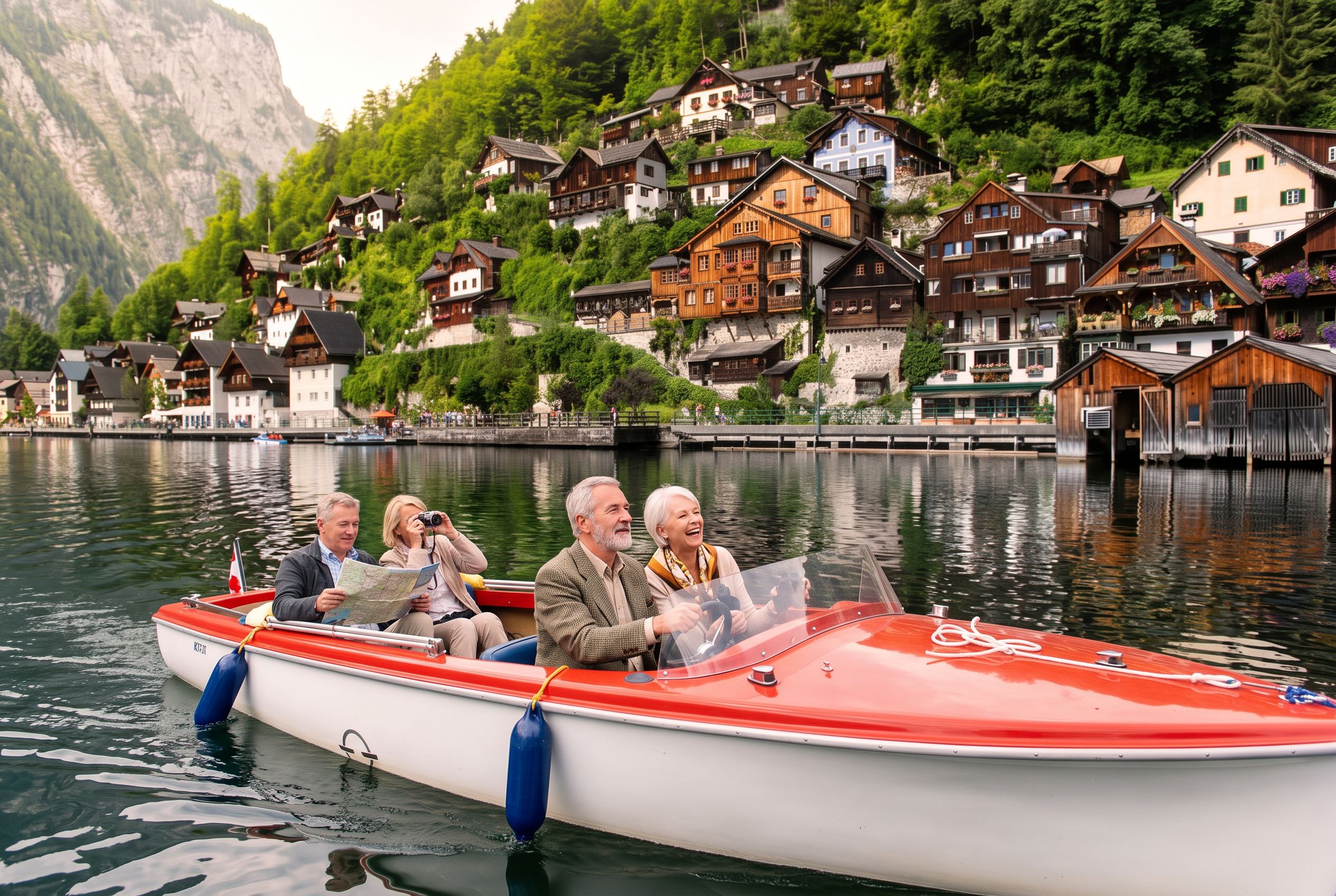 AI-edited
Why base in Bad Ischl rather than Hallstatt itself?
Bad Ischl offers a quieter, more spacious base with trains to Hallstatt station roughly every hour (20 minutes on the fast REX, 37 on the stopping service, plus the ferry across the lake), lower accommodation costs, and the added bonus of imperial spa history. You trade a lake view for a good night’s sleep and a proper breakfast room without the 8 AM queue for the ferry.
Bad Ischl was the summer residence of Emperor Franz Joseph, and its broad avenues, formal parks, and working-class charm feel a world away from Hallstatt’s tourist crush. The town has several pharmacies, a hospital whose acute admissions unit is open around the clock for emergencies (Salzkammergut Klinikum Bad Ischl, about 21 km from Hallstatt), and a range of restaurants that serve dinner at civilised hours—something not always guaranteed in Hallstatt’s overstretched kitchens. For a deeper look at medical facilities and peace of mind, see our health and pharmacy guide for the region.
From Bad Ischl’s train station, trains run roughly hourly to Hallstatt station, where you transfer to the ferry across the lake. The crossing takes about fifteen minutes and the boat runs almost hourly, timed to meet the trains. A single fare is €4 and the return, which doubles as an open ticket, €8 — and the shipping company takes no cards at all, so bring notes and coins. The scheduled boat between the station and the village, the MS Stefanie, is listed by the operator as wheelchair accessible. If you have limited mobility, ask the crew for assistance; they are used to helping travellers with luggage.
Day One: Arrival, Lake Cruise, and the Evening Village
Arrive in Bad Ischl by late morning, check into your accommodation, then take the early-afternoon train and the ferry to Hallstatt for the 15:00 lake cruise and an early-evening stroll. The goal is to see the village at its most atmospheric—after the day-trippers have left, and still catch the last connection home.
From Bad Ischl, catch the 13:10 or 14:04 train to Hallstatt station — 37 minutes on the stopping service, 20 on the fast REX. The ferry meets the trains, runs almost hourly, and the crossing takes about fifteen minutes. Once in Hallstatt, walk the flat lakeside promenade from the ferry pier towards the Market Square (Marktplatz). This is the easiest walking surface in the village—paved, level, and lined with benches where you can sit and watch the light change on the water.
At 15:00, board the scheduled Round-trip South at the village pier. It runs from May to September only, leaving Hallstatt Markt at 11:00, 13:00, 14:00 and 15:00 (with a 16:00 sailing in July and August), calling at Hallstatt Lahn and Obertraun before returning, and costs €18 for adults. The boat stays close to the shoreline, giving you uninterrupted views of the church spire, the pastel-coloured houses, and the sheer rock face of the Dachstein behind them. It is a seated, low-impact activity that delivers the classic Hallstatt photograph without the need to jostle for position on the shore.
After the cruise, explore the Market Square at your own pace. The square is flat and compact, with a fountain, a plague column, and several shops selling wood carvings and Gmundner Keramik pottery. An early dinner at a lakeside restaurant (book ahead) is the natural end to the day — but check the way home before you sit down. The last ferry from the village pier to the station leaves at 17:45, connecting with the 18:07 train, and after that the only public link back to Bad Ischl is the bus from Hallstatt Lahn at 19:03, which reaches the bus terminal at 19:45. By 20:00 the coach parties have gone and the village returns to its residents, but seeing that hour from a Bad Ischl base means a taxi or a car. A Google reviewer put it this way in November 2025: “I think a stay of 1 or 2 days is required, so that you can see it at night and at dawn and with minimal crowds.”
Day Two: Salt Mine, Skywalk, and a Rest Afternoon
Take one of the first funiculars of the day — the first ascent is at 9 a.m. — to the Salt Mine and Skywalk. The guided mine tour takes about 90 minutes, but Salzwelten asks you to allow at least three hours for the whole visit, which puts you back in Bad Ischl in the middle of the afternoon rather than at lunchtime.
Important note for 2026 travel: The Hallstatt Salt Mine, Skywalk and Salzbergbahn funicular were closed for a complete rebuild from September 2025 until 28 August 2026. Salzwelten gives the reopening date as 29 August 2026: from that day the salt mine runs 9.30 a.m. to 4.30 p.m. (start of the last guided tour) until 24 October, and the new funicular 9 a.m. to 6 p.m. For dates before 29 August 2026 the operator's own substitute was the Altaussee Salt Mine, reached by its shuttle from the Hallstatt bus terminal (meeting point 1.20 p.m., departure 1.30 p.m., back in Hallstatt around 5 p.m., €44 including admission) — a shuttle that could only be booked up to 31 August 2026. For more on timing your visit, see our seasonal guide to Hallstatt.
The funicular carries you 360 metres above the rooftops of Hallstatt in a few minutes, and Salzwelten describes the ride itself — along with the Salzwelten Bistro at the top — as fully accessible. From the panoramic lift you cross the bridge to the Rudolfsturm and the Skywalk, a 12-metre platform that juts out over the mountainside. From there an approximately 15-minute walk leads to the Knappenhaus, where the guided tour begins; inside you cover about two kilometres of workings, ride the miners’ train back out, and can take the 64-metre slide (optional; there are stairs instead). The mine itself is not wheelchair accessible. The temperature underground is a constant 8°C, so bring a warm layer and sturdy shoes.
Reckon on being back at the funicular base around half past twelve. Walk through to the village pier and take the 13:45 ferry, the one the shipping company pairs with the 14:07 train, and you are in Bad Ischl at 14:48 — in good time for a late lunch at a café on the Esplanade. The rest of the day is yours to rest, read, or see Bad Ischl’s own attractions: the Kaiservilla (Emperor’s Villa) is about five minutes on foot from the station and offers a fascinating glimpse into Habsburg summer life. Be aware that the villa says of itself that it is not fully barrier-free for reasons of building conservation, that the guided route runs through stairwells, and that the park climbs steeply and is only partly passable by wheelchair.
Day Three: Gosausee and the Dachstein View
Leave Bad Ischl at 09:10. The public connection to the Vorderer Gosausee takes just over an hour with one change and sets you down at the “Vorderer Gosausee” stop beside the water, so no taxi and no long approach walk are needed. The view of the Dachstein glacier reflected in the lake is one of the most striking in the Salzkammergut.
Gosausee is a much quieter alternative to Hallstatt. The tourist board rates the circuit as easy, lists it expressly as suitable for seniors, and gives it as 4 kilometres with a walking time of one to one and a half hours; the surface is a mix of gravel and forest road, natural ground and a stretch of asphalt rather than a made-up promenade. The Gasthof Gosausee sits at the start of the circuit by the car park — not halfway round — and its fifty-seat terrace looks straight across the water at the Dachstein, which makes it the coffee stop at the beginning or the end of the walk rather than in the middle of it.
For the more active, the tourist board’s onward route from the same car park leads past the Gosaulacke to the Hinterer Gosausee: about two hours, again rated easy and again listed as suitable for seniors. One thing worth knowing before you plan: the 5fingers viewing platform, the row of metal balconies that gets mentioned in the same breath as the Dachstein view, is not in the Gosau valley at all. It sits on the Krippenstein above Obertraun, on the far side of Lake Hallstatt, and is reached by the Dachstein Krippenstein cable car plus a 20- to 30-minute walk from the section 2 mountain station.
Have lunch at the lake rather than doubling back into Gosau village, then take the 13:45 bus, which reaches Bad Ischl bus terminal at 14:45; the next departures are 14:50 and 15:45. The afternoon is free for a rest or a visit to the town’s thermal baths, the Salzkammergut-Therme at Voglhuberstraße 10, a short walk from the station.
“Probably the most beautiful place in the whole region. Walk around the lake is almost completely flat but be aware the extended walk to the Hinterer lake beyond Gosausee is a very challenging uphill hike.” — from a Google review of the Vorderer Gosausee, August 2024
Day Four: Obertraun and the Lakeside Walk
Take the 08:04 train from Bad Ischl to Obertraun-Dachsteinhöhlen (24 minutes) and walk the east-shore trail back towards Hallstatt. The tourist board puts this stage at about an hour, rates the trail easy and lists it expressly for seniors — one of the quietest walks in the region, though it ends at the railway station and not in the village.
The Ostuferwanderweg (waymarked A16) begins about five minutes from Obertraun station, opposite the boat pier, and follows the eastern shore of Lake Hallstatt. The way-keeper rates it easy walking and says it can be managed with an all-terrain pram, but it is not a promenade: the route runs beside the railway, crosses a suspension bridge over the deepest part of the lake and continues on a secured rock path before dropping to a smaller lakeside track, with information boards along the way explaining the vegetation. It ends at Hallstatt railway station — on the opposite shore from the village — so the ferry is not an option here but the only way across to the pier, the museum and a final coffee.
The museum walks you through 7,000 years of Hallstatt in chronological stations, combining original finds from the burial grounds with video animations, holographic displays, 3D sequences and life-size dioramas. From May to September it opens daily from 10 a.m. to 6 p.m., with last admission 60 minutes before closing; entry is €12, or €11 from the age of 60. One caveat matters more than any of that for this itinerary: the museum states on its own website that it is unfortunately not barrier-free. Allow 45 minutes to an hour for the main exhibits.
After lunch in Hallstatt, take the 13:45 ferry — the sailing the company pairs with the 14:07 train — and you are back in Bad Ischl before three. Your final afternoon is free for packing, a last stroll through Bad Ischl’s park, or a visit to the town’s Konditorei (cake shop) for a slice of the local specialty, the Ischler Törtchen—a chocolate-covered shortbread filled with apricot jam.
What about optional additions for the more active?
If you have energy to spare, add a morning at the Dachstein Giant Ice Cave (open daily 1 May to 1 November 2026, guided tour about 50 minutes) or a gentle bike ride at Lake Wolfgangsee. Both are accessible from Bad Ischl by train or bus and offer a change of scenery without adding stress to the day.
The Dachstein Giant Ice Cave is reached by section 1 of the Dachstein Krippenstein cable car from Obertraun up to the Schönbergalm middle station — not the top station — followed by a 15- to 20-minute walk on a partly asphalted path with 70 metres of ascent. The tour route inside runs 800 metres with 80 metres of height difference, all of it on steps, and the temperature holds at −2°C, so dress warmly and wear firm shoes. You collect your tour time at the cave ticket counter on the Schönbergalm; tours run continuously, and the last cable-car ascent that still allows a cave tour is 3.30 p.m., or 4.30 p.m. between 4 July and 13 September. Alternatively, rent a bicycle in St. Wolfgang (26 to 45 minutes from Bad Ischl by bus, depending on the connection) and ride the lakeside stretch at your own pace: the WolfgangseeSchifffahrt carries bicycles for €7.50, so you can pedal one way and come back by boat.
For those who prefer to keep things simple, the rest afternoon built into Day Two and Day Three is there for a reason. The Salzkammergut is best savoured slowly. Rushing from one viewpoint to the next defeats the purpose of a four-day itinerary designed for travellers who have earned the right to take their time.
How accessible is Hallstatt for seniors?
Hallstatt’s historic core is compact but challenging: cobblestone streets, stone stairs, and short steep climbs to the church and Bone House. The lakeside road through the village is asphalted and level. The new funicular, back in service since 29 August 2026, is described by Salzwelten as fully accessible, and the official regional register lists the Heritage.Hotel Hallstatt with a step-free entrance and a wheelchair-accessible lift — with the caveat that not every ÖNORM point is met.
The Heritage.Hotel Hallstatt (4.0 on Google from 1,665 reviews as of August 2026) is spread across three listed houses, and which one you are given matters more than the star rating. The Kainz house at the landing stage holds reception, the restaurant and the sauna, and has a lift. The Seethaler house is roughly a five-minute walk away on the hillside and also has a lift, with a view across the lake. The Stocker house, three minutes from the main building, is the oldest building in the village and has no lift at all. If mobility is a concern, ask for Kainz or Seethaler when you book. Luggage can be left in the hotel’s luggage room before check-in and after check-out until 9.30 p.m.
For a full breakdown of what to pack for the cobblestones and steps, read our packing guide for Hallstatt.
When should I visit to avoid the worst crowds?
Visit in May, June, or September. These months offer comfortable temperatures (15–22°C) and a fraction of the summer crowds — though in 2026 the salt mine and funicular were shut for rebuilding until 28 August, so September is the month that gives you everything. Arrivals are not counted, but the regional tourism director reckons on well over 10,000 visitors on the strongest August days, in a village of 760 residents—a ratio that makes the narrow streets feel like a shopping mall on Boxing Day.
Mayor Alexander Scheutz put 2025 at a good 1.2 million day visitors, a record, alongside 132,000 overnight stays; there is no turnstile, so nobody counts arrivals precisely. What is already in force is a slot system for coaches: roughly 30 slots a day instead of the former 80 to 90, each booked for at least two and a half hours, and no slot means no entry. A general cap on daily visitor numbers has been raised by both the mayor and the regional tourism director, but no figure has been set. The best strategy remains simple: arrive before 8:00 AM or after 5:00 PM, and stay overnight. Our itinerary does exactly that, using Bad Ischl as a base to avoid the midday crush.
For more on the best months for weather and quiet, see our seasonal guide.
| Month | Visitor Volume | Weather | Attractions Open |
|---|---|---|---|
| May | Moderate | 15–20°C, some rain | All except salt mine (rebuild to 28 Aug 2026) |
| June | High | 18–25°C, sunny | All except salt mine (rebuild to 28 Aug 2026) |
| July–August | Very high (10,000+ on peak days) | 20–30°C, warm | All except salt mine until 28 Aug 2026 |
| September | Moderate | 15–22°C, clear | All (mine open again from 29 Aug 2026) |
| October | Low | 8–15°C, misty | Most (Ice Cave runs to 1 Nov 2026) |
This four-day itinerary is designed to give you the essence of Hallstatt and the Salzkammergut without the stress. You will see the iconic views, learn the salt history, walk the lakeside paths, and—most importantly—leave with the feeling that you have experienced the place, not just photographed it.


