
Located on a narrow strip between a deep lake and sheer alpine walls, Hallstatt demands practical preparation from anyone who visits. For travellers aged 50 to 70, the difference between a comfortable day and a difficult one often comes down to what is inside your suitcase. This guide focuses on three essentials: footwear for cobblestones and stepped lanes, layers for the changeable alpine climate, and the right bag for a village where you will carry your own luggage.
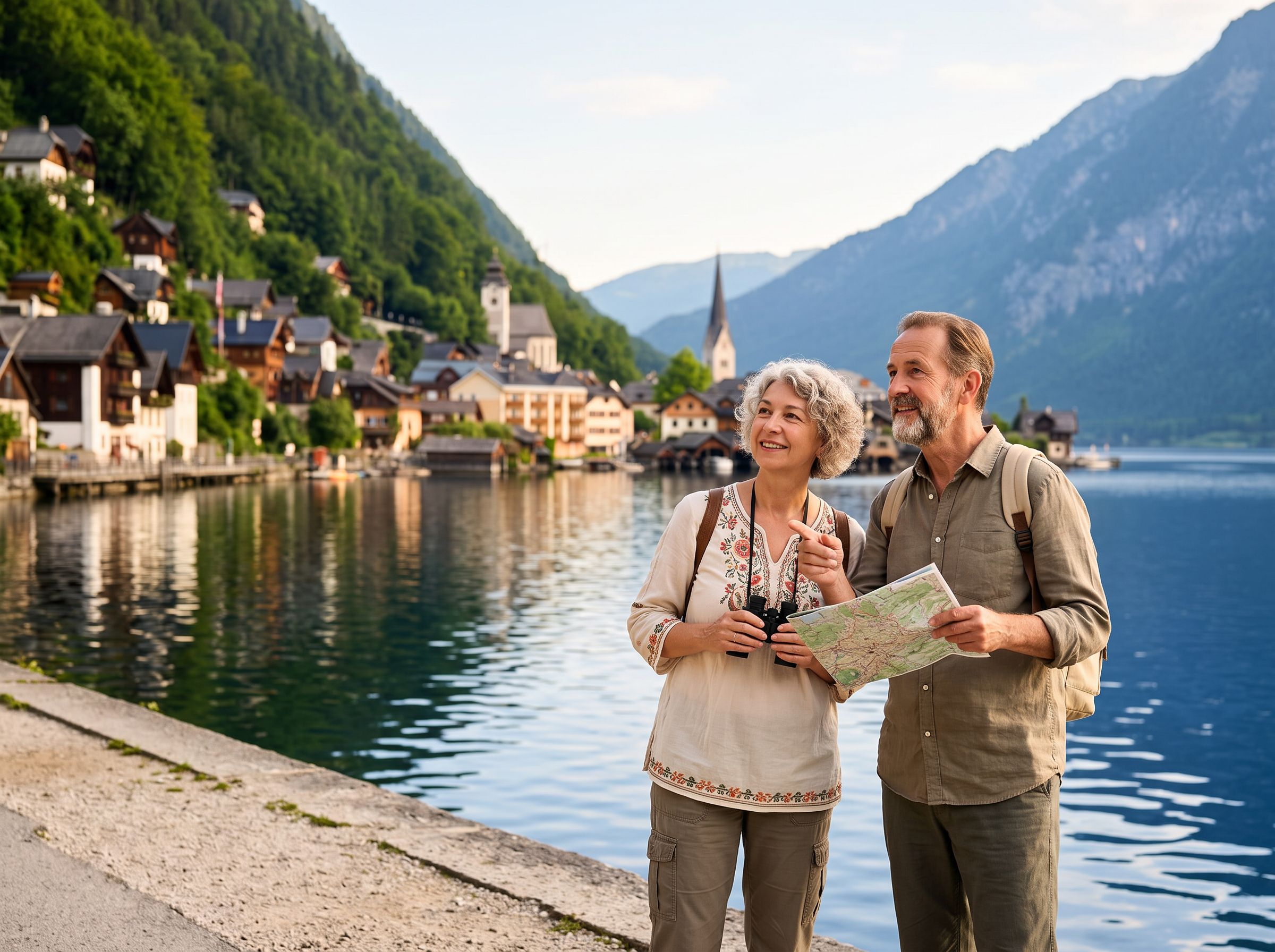 AI-edited
What shoes work best for Hallstatt's terrain?
Sturdy, waterproof walking shoes with good grip are non-negotiable. The village core is paved with uneven cobblestones, the lakeshore paths can be wet, and the walk from the top of the funicular to the mine entrance takes about fifteen uncovered minutes. Flip-flops or smooth-soled fashion shoes will leave you uncomfortable and unsteady.
The two operators who see the most visitors give the same advice on their own pages: the Salzwelten ask guests to come in sturdy footwear and warm clothing, and the Dachstein cave asks for sturdy shoes as well. What decides the day is the sole, not the brand — grip on wet, polished stone, and enough support to stand for a couple of hours.
Many seasoned travellers advise bringing two pairs of shoes. Use your primary walking shoes during the day, then switch to comfortable sandals or flats in the evening to give your feet a break. This also provides a backup if one pair gets soaked in the afternoon rain that is common even in July and August.
How many steps and steep sections will I encounter?
Hallstatt is compact but vertical. The historic core requires navigating stone stairs to reach the parish church and viewpoints. From the top of the funicular a panoramic lift reaches the Skywalk, and from there the operator describes an approximately 15-minute walk to the Knappenhaus, where the guided tour begins. The famous classic photo point needs no such climb: the regional tourist board calls it a short walk from the market square.
The World Heritage region records that most of this cultural landscape was listed by UNESCO in 1997, and its historic layout means that modern accessibility was never part of the original design. The lakeside promenade is the most senior-friendly area: the stretch along the water is asphalted, and it runs past the boat landing stages and the Museum Hallstatt. Focus your time there if steep climbs are a concern.
The rebuilt funicular railway to the Salt Mine and the Skywalk 999 reopens on Saturday 29 August 2026 at 9 a.m., after a closure that began on 1 September 2025. Before that date the village core and the lakeshore are the whole of Hallstatt for visitors, and both are rewarding. The operator calls the new funicular and the Salzwelten bistro fully accessible, but the mine tour itself is not wheelchair accessible.
What layers do I need for the mountain weather?
Pack lightweight, versatile layers: t-shirts, a fleece or sweater, and a quality waterproof rain jacket with a hood. Hallstatt sits in a wet alpine valley where afternoon thunderstorms are common even in summer. At Bad Goisern, the nearest climate station, July and August average about 25°C (77°F) by day but drop to about 13°C (55°F) at night, and measurable rain falls on some fifteen days in July.
Underground it is cool but not freezing: both Hallstatt and the Altaussee mine hold a steady 8°C (46°F) all year, and both operators ask visitors to arrive in sturdy footwear and warm clothing. Even with provided overalls, a sweater or long-sleeve layer under them is prudent. The damp cold from the lake combined with mountain air cuts through clothing quickly, so a waterproof outer layer is non-negotiable.
Sun protection matters even though the village sits at only 511 metres. Pack high-SPF sunscreen, UV-protection sunglasses, and a wide-brim hat. The lake reflects sunlight strongly, and you will be exposed during walks along the promenade.
| Layer | Item | Why |
|---|---|---|
| Base | Merino wool or synthetic t-shirt | Wicks moisture, dries quickly |
| Mid | Lightweight fleece or sweater | Insulation for cool evenings and the mine |
| Outer | Waterproof rain jacket with hood | Protection from afternoon thunderstorms |
| Accessory | Collapsible umbrella | Quick cover during short showers |
What kind of luggage works best?
Bring a lightweight daypack and a compact suitcase or duffel that you can carry for 5–10 minutes. No visitor drives into the historic centre at any hour: the village core is sealed off by two barriers, and that includes the hotels and apartments inside it. Luggage arrives on foot, by ferry or on the P1 hotel shuttle — never in your own car. Large, heavy suitcases are a serious burden on cobblestones and stepped lanes.
A guest who stayed at Hallstatt Hideaway wrote on Google in June 2026 that the staff carried the luggage up the steps to the room. From the ferry, though, the last stretch is yours alone: only the P1 shuttle brings bags to the door, and only for guests who parked there. A small backpack for the Salt Mine or the viewing platform lets you carry water, layers and snacks while your main bag stays at the hotel. Pack small euro notes in it too: the ferry between the station and the village is cash only.
The test is simple and unsentimental: if you cannot lift your suitcase onto a bus step or carry it up a short flight of stairs, it is too heavy for Hallstatt.
Where are pharmacies and medical care located?
Hallstatt village has no hospital and no pharmacy of its own. The nearest are the two in Bad Goisern, a bus ride of roughly 30 to 35 minutes. Apotheke im Baumhaus (Bundesstraße 112) opens Monday to Friday 08:00–18:00 and Saturday 08:00–12:00, closed on Sunday. Outside those hours they share a duty rota with three pharmacies in Bad Ischl; the Austrian Chamber of Pharmacists publishes which one is open.
For non-emergency medical questions the Austrian health advice line 1450 is free and staffed around the clock. Number 141 is the out-of-hours doctor service and is generally staffed only from 7 p.m. to 7 a.m., from Friday evening to Monday morning and all day on public holidays; neither line promises an English-speaking adviser. In life-threatening emergencies, dial 112 (Europe-wide) or 144 (Austria-specific). The nearest hospital is the Salzkammergut Klinikum in Bad Ischl, 20 km and about 26 minutes away by road; the same group's Gmunden site is 53 km away.
We have published a dedicated guide to Health, Pharmacies and Peace of Mind Around Hallstatt: A Practical Guide for Travellers 50–70 that covers this topic in full detail, including doctor contact information and what to do if you need prescription refills.
Pack a basic first-aid kit with blister pads, muscle balm, and any prescription medications with an extra three days' supply. The limited local medical services mean that minor issues need self-care.
What about the Salt Mine and ice caves?
The Hallstatt Salt Mine and Skywalk 999 reopen on Saturday 29 August 2026 at 9 a.m., together with the rebuilt funicular. Before that date the Salzwelten Altaussee stand in: a daily shuttle leaves the Hallstatt bus terminal at 1.30 p.m., bookable up to 31 August 2026, at €44 for adults including mine admission.
For the Dachstein ice caves near Obertraun, which stay open through the summer, you need warm layers whatever the month. The Dachstein Giant Ice Cave holds −2°C (27°F), and the walk from the Schönbergalm middle station up to the cave entrance takes about 15 to 20 minutes. Wear your waterproof walking shoes, as the cave floors can be damp and slippery. A fleece jacket and long trousers are sufficient; you do not need heavy winter gear. The same layers serve for the salt mine, where the Salzwelten ask guests to be at the funicular valley station 45 minutes before their tour and to allow at least three hours in all, with about two kilometres of walking underground.
Our article on When to Visit Hallstatt for Fine Weather and Fewer Crowds provides detailed month-by-month guidance on conditions and visitor numbers.
"You still have to walk 650 meters to the mine and a few hundred meters during the tour, so don't want high heels or uncomfortable shoes. The atmosphere inside the mine is cold (8°C). You will be given extra clothes, but be prepared for an hour and a half." — a visitor wrote on Google in April 2025
What should I leave at home?
Leave behind bulky suitcases, expensive jewellery, jeans (they are heavy when wet and take forever to dry), and any footwear without grip. Also skip formal evening wear — Hallstatt is casual. A clean pair of walking shoes and a nice scarf or jacket is all you need for dinner at the Seehotel Grüner Baum.
For a closer look at that historic property, read our hotel dossier: A Closer Look: Seehotel Grüner Baum, Hallstatt. Its restaurant, the Salzbaron, serves from 11.30 a.m. until 10 p.m. in summer and 9 p.m. in winter, so a late dinner after a long day on your feet is still possible.
Do not pack more than one week's worth of clothing. Laundry services are available at most hotels, and the compact nature of the village means you will wear the same practical pieces repeatedly. Focus on quality over quantity: one good waterproof jacket beats three mediocre ones.
How do I get to Hallstatt with luggage?
The primary arrival for day visitors is the ferry from Hallstatt train station to the village centre: €4.00 one way, €8.00 for the open return, and cash only — the boats take no cards. There is no direct train from Salzburg; the ÖBB timetable shows about 2 hours 7 minutes with two changes. Drivers use car park P1, because no car reaches the centre, and guests with a hotel ticket ride the free shuttle from P1 to their accommodation every half hour between 9 a.m. and 7 p.m. Buses reach the village on line 543 from Gosaumühle, where line 541 from Bad Ischl connects; fares follow the Upper Austria zone tariff.
The ÖBB VORTEILSCARD Senior is open to anyone aged 65 and over, costs €31 a year and gives 50% off ÖBB standard single tickets. Within a regional transport network the network's own senior fare applies instead, which can be lower; in Upper Austria the card counts as proof of entitlement for reduced single and day tickets. The Salzwelten publish no senior rate at all: from 29 August 2026 adults pay €49 for the combined mine and funicular ticket, €29 for the funicular return on its own and €33 for the mine if you walk up.
For a deeper understanding of the village's seasonal rhythms, read Hallstatt Through the Year: Traditions and Quiet Seasons, which covers local festivals and the best times for a peaceful visit.
What is the bottom line for packing?
Pack for stability, warmth, and rain. Your shoes are your most important item. Your waterproof jacket is your second. Everything else is negotiable. Hallstatt is beautiful but physically active; prioritising foot stability and weather adaptability ensures comfort for the 50-plus traveller.
The village rewards those who come prepared. With the right shoes, you can explore the cobblestone lanes without fatigue. With the right layers, you can enjoy the lakeside promenade even when afternoon clouds roll in. And with lightweight luggage, you can move from ferry to hotel without strain.
Hallstatt asks you to walk, climb, and adapt. Pack wisely, and you will find it one of the most rewarding destinations in the Austrian Alps.


