
Hallstatt’s beauty is undeniable, but its healthcare infrastructure is not. For travellers aged 50–70, the key to a relaxed visit lies in knowing exactly where to find a doctor, how to reach a pharmacy, and what to pack for the mountain weather. This guide gives you the facts, not the fluff.
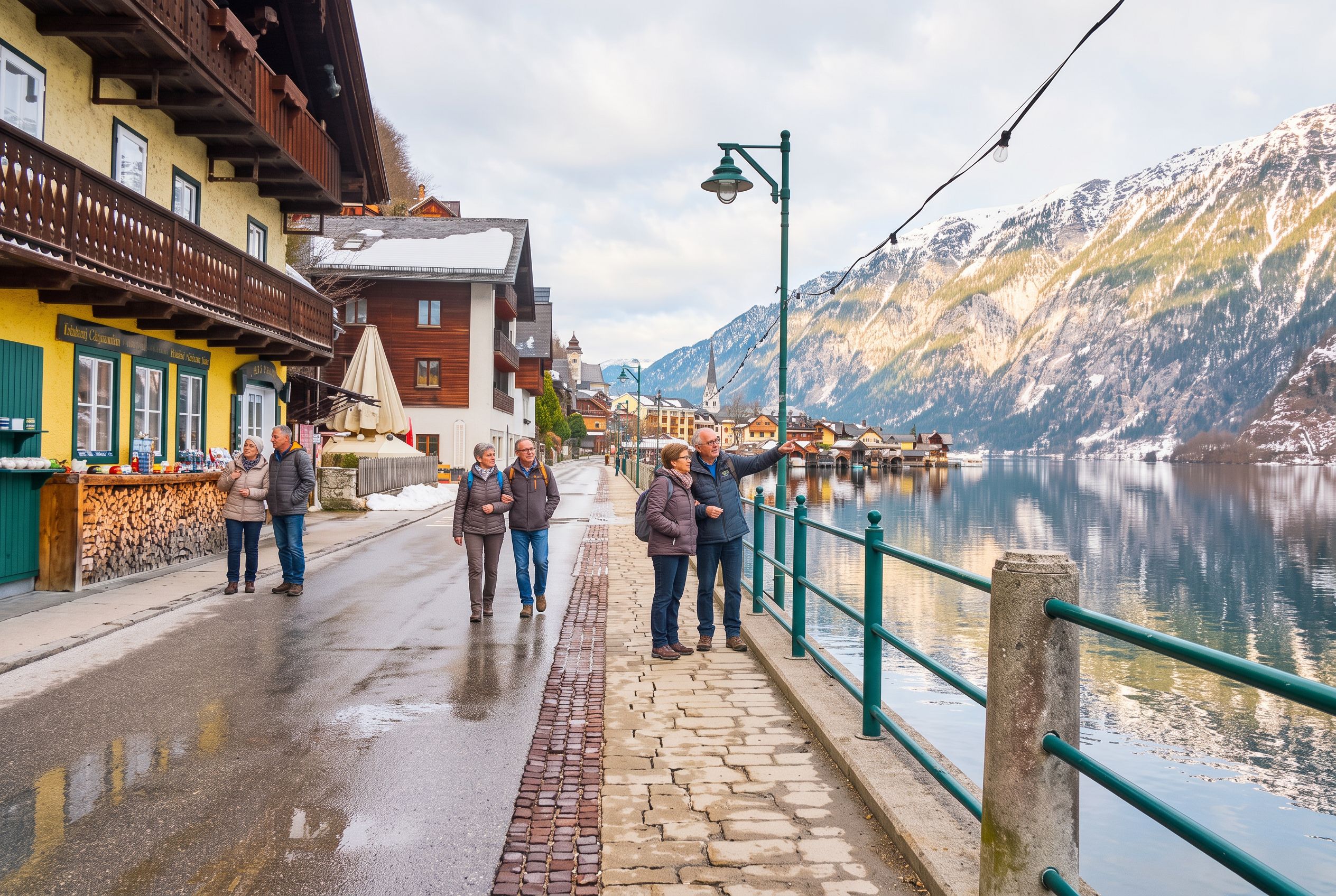
Hallstatt sits in the Salzkammergut region of Upper Austria, a landscape of deep lakes and steep alpine slopes. The village itself is tiny—a UNESCO World Heritage site with 760 residents as of April 2025—and on the busiest August days the regional tourism director estimates well over 10,000 visitors in the village. That popularity means the narrow streets and cobblestone paths can feel crowded, especially in July and August. For seniors, the terrain is the first thing to plan around: uneven stone underfoot, steep staircases linking the lakeside promenade to the upper village, and no direct car access to the historic core. You will walk, and you will need sturdy, non-slip shoes.
 AI-edited
Getting to Hallstatt is a journey in itself. There is no direct train into the village. You arrive at Hallstatt Station on the opposite shore, then take the Hallstatt Ferry—a seven-minute crossing timed to the trains and running all year round. In the 2025/26 timetable the first boat leaves the station for the village at 07:32 and the last at 18:30, so a late train can leave you without a ferry; extra summer departures are posted at the landing stages. The operator states that wheelchair access is possible on the station boat, but the station platform itself may involve stairs. Buses stop at the ferry landing and nearby parking areas; they do not drive into the narrow village centre. For a full breakdown of mobility options, see our dedicated guide: How Accessible Is Hallstatt for Older Travellers? A Practical Guide for 2026.
Where is the nearest doctor in Hallstatt?
Dr. Sonja Gapp, a general practitioner who works with all Austrian health insurance funds, holds surgery in Hallstatt at Salzbergstraße 224 on Monday, Tuesday and Friday from 8:00 to 12:00 and on Wednesday from 17:00 to 19:00. On Thursday she is in Obertraun from 8:00 to 12:00. Outside those hours the GP on-call service answers on 141.
Dr. Gapp’s practice welcomes tourists and has a strong reputation. As of August 2026, Google reviews rate her 4.8 out of 5 from 16 reviews. Guests consistently report that she is kind, takes plenty of time, and helps with needed prescriptions. A Google reviewer wrote in June 2018: “Very kind to traveler to support medicines needed. If you are traveling around, it would be good idea to seek medical support here.”
If Dr. Gapp is unavailable, the nearest alternative is the group practice of Dr. Angelika Mauel and Dr. Lukas Mannert at Sophienbrückenstraße 19 in Bad Goisern, about 12 km away by road. Between them they cover Monday to Wednesday and Friday mornings from 07:30 to 12:30, Monday evening from 17:00 to 19:00 and Thursday afternoon from 15:00 to 18:00; the telephone is answered from 08:30 to 11:00, and both work with all Austrian health insurance funds. Mobi Doctor is a different kind of option: not a doctor who comes to the village but an online video consultation with an English-speaking, EU-registered physician, available daily from 7:00 to 23:00 with a typical wait of about fifteen minutes.
Where is the nearest pharmacy?
There is no pharmacy inside Hallstatt village. The two nearest pharmacies are in Bad Goisern, about 12 km away, some twenty minutes by car; by bus you change from line 543 to line 541 at Gosaumühle. Both close on Sundays, so plan accordingly.
The two options in Bad Goisern are:
- Edelweiss Apotheke – Obere Marktstraße 4, telephone +43 6135 7220. Open Monday to Friday 08:00–12:00 and 14:00–18:00, Saturday 08:00–12:00. Closed Sunday.
- Apotheke im Baumhaus – Bundesstraße 112, telephone +43 6135 50933. Open Monday to Friday 08:00–18:00, Saturday 08:00–12:00. Closed Sunday.
The Apotheke im Baumhaus has earned a Google rating of 4.8 out of 5 from 30 reviews as of August 2026, and the Edelweiss Apotheke stands at 4.9 from 33. Guests praise the friendly, competent staff and the beautifully decorated interior. One Google reviewer wrote in August 2026 that the team “helped me with everything, told some really good jokes. 10/10 experience.” If you need a COVID test for a return flight, ask the pharmacy for its current service and prices; neither pharmacy publishes them.
If you need a pharmacy on a Sunday, one house in the rota is on duty. The rota that covers Bad Goisern runs together with Bad Ischl, so the duty pharmacy may be one of the three in Bad Ischl rather than one of the two in Bad Goisern — check before you set out. The duty fee follows the Arzneitaxverordnung: €3.80 between 20:00 and 08:00, and €1.30 on Sundays and public holidays between 08:00 and 20:00, charged once per bill rather than per item.
What about hospitals? Where do I go in an emergency?
For serious emergencies the nearest hospital is Salzkammergut Klinikum Bad Ischl, about 20 km away and roughly 25 minutes by car, with acute admissions open around the clock. The Gmunden site of the same hospital is about 53 km away, close to an hour. Dial 144 for an ambulance, 112 for any emergency and 140 for mountain rescue.
Bad Ischl is the regional medical hub. The Salzkammergut Klinikum Bad Ischl at Dr.-Mayer-Straße 8–10 keeps its acute admissions unit open around the clock, and it is the practical choice for Hallstatt visitors. Gmunden belongs to the same hospital but lies at the far end of the lake district, close to an hour away. If you make the journey by bus, note that the last bus from Bad Ischl station back towards Hallstatt, Gosau, Obertraun and Bad Goisern leaves at 18:16. For anything short of an emergency, call 1450, Austria's free health advice number, or 141 for the GP on-call service, staffed at night from 19:00 to 7:00, from Friday 19:00 to Monday 7:00 at weekends and all day on public holidays. The German number 116 117 does not work in Austria.
Whether you pay yourself depends on your cover, not on your passport. With an EHIC or GHIC, contracted doctors and public hospitals must treat you on the same terms as an Austrian patient, and both Dr. Gapp in Hallstatt and the group practice in Bad Goisern work with every Austrian health insurance fund. Without that cover you are a “Selbstzahler” and settle the bill yourself; the Ärztekammer Oberösterreich publishes a private fee schedule, in force since 1 February 2023, rather than a fixed tourist price, so ask what a consultation will cost before treatment and keep every receipt. This is where travel insurance becomes essential.
| Service | Location | Contact | Distance from Hallstatt |
|---|---|---|---|
| Ambulance | Regional | 144 | — |
| European emergency | Any | 112 | — |
| Mountain rescue / alpine emergency | Regional | 140 | — |
| GP on-call service (nights, weekends, holidays) | Regional | 141 | — |
| Health advice line (non-emergency) | Any | 1450 | — |
| Hospital | Bad Ischl | +43 5 055472-0 | 20 km |
| Hospital | Gmunden | +43 5 055473-0 | 53 km |
| Dr. Sonja Gapp | Hallstatt | +43 6134 8401 | In village |
| Apotheke im Baumhaus | Bad Goisern | +43 6135 50933 | 12 km |
| Edelweiss Apotheke | Bad Goisern | +43 6135 7220 | 12 km |
How do I travel with medication to Austria?
Keep all medication in original, labelled containers. Carry a doctor’s letter in English or German listing the generic name, dosage, and your condition. Pack everything in your hand luggage. For controlled substances (strong painkillers, anxiety meds), stays of more than five days need a prescription from your doctor at home.
This is the single most common stress point for travellers 50–70. The Austrian Ministry of Health puts it plainly: leave the medicines in their original packaging, because that is what labels them clearly. What officials may ask for is a confirmation from your treating doctor stating your personal details, the necessity of continuing treatment, and the generic name of the drug with its dosage. If you use a pill organiser for convenience, keep the original boxes in your bag and only transfer a day’s worth at a time.
For standard prescription medication, the permit-free limit is what you personally need, and at most three retail packs of the smallest size; proof of personal need from your treating doctor is required, and the ministry recommends a certified German translation if the letter is written in another language. For controlled substances (e.g., morphine-based painkillers, certain sleeping tablets), the rules are stricter: for stays up to five days no extra certificate is needed, but proof of prescription is still required. For stays of more than five days and up to 30 days you need a prescription from your doctor at home, and the quantity may not exceed 30 days' worth; for longer stays the medication has to be prescribed in Austria. The Austrian Ministry of Social Affairs provides detailed guidance on their official website: Bringing medication into Austria – English version.
Bring a buffer of 3–5 days’ extra medication. If you drop pills or run out, replacing them in a small town like Hallstatt is difficult. Common over-the-counter remedies in Austria (pain relievers, antacids, antihistamines) are available at pharmacies, but antibiotics and strong painkillers require a doctor’s prescription obtained at a clinic—not just a pharmacy visit.
What about EHIC, GHIC, and travel insurance?
The European Health Insurance Card (EHIC) or UK Global Health Insurance Card (GHIC) gives you access to state-provided healthcare in Austria at the same cost as a resident. It covers treatment by contracted doctors and public hospitals, but not treatment in a private facility, not ski or mountain rescue, and not repatriation. You still need comprehensive travel insurance.
For UK residents, the GHIC replaced the EHIC after Brexit. It works in Austria and covers medically necessary treatment in public hospitals. However, it does not cover ski or mountain rescue — the NHS names that exclusion in as many words — and in Austria the alpine emergency number is 140. It also does not cover private ambulance transport back to the UK.
For EU/EEA residents, your EHIC remains valid. Carry it with your passport. In Austria the billing normally runs directly between the local fund and your own insurer, so at a contracted doctor you should not have to pay upfront. Keep all receipts and paperwork anyway.
For travellers from outside Europe (US, Canada, Australia, etc.), your domestic health insurance likely offers limited or no coverage abroad. You must purchase a travel insurance policy that includes medical evacuation and repatriation. Look for policies that specifically mention “mountain rescue” or “helicopter evacuation” if you plan to hike.
How do I cope with Hallstatt’s mountain weather?
Hallstatt’s mountain-lake location creates rapid weather shifts. A warm morning can become windy, rainy, or chilly by afternoon. Layering is critical. Pack a lightweight wind/rain jacket, thermal layers, and a hat for sun protection—the mountain sun is intense even on cool days.
July is on average the warmest month. At Bad Ischl, the nearest official climate station and at almost exactly Hallstatt's altitude, GeoSphere Austria recorded a monthly mean of 20.1°C for July 2024. However, the weather can change in minutes. One moment you are walking along the lake in sunshine; the next, a cold wind sweeps down from the Dachstein glacier. Always carry a waterproof jacket, even on clear mornings.
Sun protection is not optional. The combination of altitude (Hallstatt sits at 508 metres) and reflection off the lake water intensifies UV radiation. Use high-SPF sunscreen, wear a wide-brimmed hat, and bring sunglasses. For hiking, long sleeves and trousers also protect against tick bites, which carry TBE (tick-borne encephalitis) risk in spring and summer. Austria counts as a TBE risk area and no province is free of it, so consider vaccination if you plan to hike regularly. Austria's national vaccination board recommends boosters every five years up to the age of 60 and every three years from 60.
Your first-aid kit should include blister treatment (e.g., Compeed), antiseptic wipes, bandages, and basic pain relievers. For a full packing checklist, see the Austrian health portal: Reiseapotheke – checklist from the Austrian Ministry of Health.
| Item | Why it matters | When to use |
|---|---|---|
| Waterproof wind/rain jacket | Sudden rain and wind are common | All seasons |
| Thermal base layer | Temperature drops quickly in the evening | Spring, autumn, winter |
| Wide-brimmed hat | Intense UV at altitude and near water | May–September |
| High-SPF sunscreen (SPF 50+) | Reflection off lake increases exposure | All sunny days |
| Sturdy, non-slip walking shoes | Cobblestones and steep paths are slippery | Always |
| Blister plasters (Compeed) | Uneven terrain causes foot stress | As needed |
| Tick repellent | TBE risk in grassy and forested areas | Spring and summer |
What about quiet accommodation for light sleepers?
Hallstatt can be noisy due to crowds and early-morning tour groups. For a calm stay, consider hotels on the quieter upper slopes or in neighbouring Bad Goisern. Our dedicated guide covers the best options: The Quietest Places to Stay Around Hallstatt: A Calm-Seeker’s Guide for Light Sleepers.
If you are a light sleeper, avoid rooms facing the main promenade or the ferry landing. The first boat leaves the village for the station at 07:00, the first arrival from the station is shortly after 07:30, and coach groups follow through the morning. Hotels on the upper village road (Salzbergstraße) or in the forested areas above the lake are significantly quieter. Bad Goisern, further up the lake, offers full-service hotels with spas and has both pharmacies as well as several doctors' practices—a practical trade-off for peace of mind.
What about seasonal considerations?
Summer (June–August) is peak season with crowds and limited parking. Winter (December–February) is quieter but brings snow and ice on the paths. Spring and autumn offer milder weather and fewer visitors, but some services may have reduced hours.
For a deeper look at how the seasons affect your visit, read our guide: Hallstatt Through the Year: Traditions and Quiet Seasons. It covers the Christmas markets, the quieter winter months, and the best times for a calm, unhurried experience.
One final note on costs: this guide focuses on health and peace of mind, not trip budgeting. For a full breakdown of what a comfortable Hallstatt trip costs, including accommodation, meals, and transport, see our separate guide: What Does a Comfortable Hallstatt Trip Cost? A Practical Budget Guide for Travellers Over 50.


