
Hallstatt offers a partial welcome for older travellers with limited mobility. The level, asphalted lakeside street is a genuine highlight, but the historic core's steep cobblestones, steps, and the closure of the funicular up to 28 August 2026 mean that a comfortable visit requires careful planning. This guide gives you the honest, ground-level picture.
Perched on a narrow strip between a deep lake and sheer mountains, this UNESCO World Heritage village is as famous for its picture-postcard looks as it is for its challenging terrain. For travellers aged 50 to 70 who tire easily or use a walking stick, walker, or wheelchair, the key is knowing which parts of Hallstatt work and which are best admired from a bench. Let's break it down, honestly.
 AI-edited
What is the most accessible route through Hallstatt?
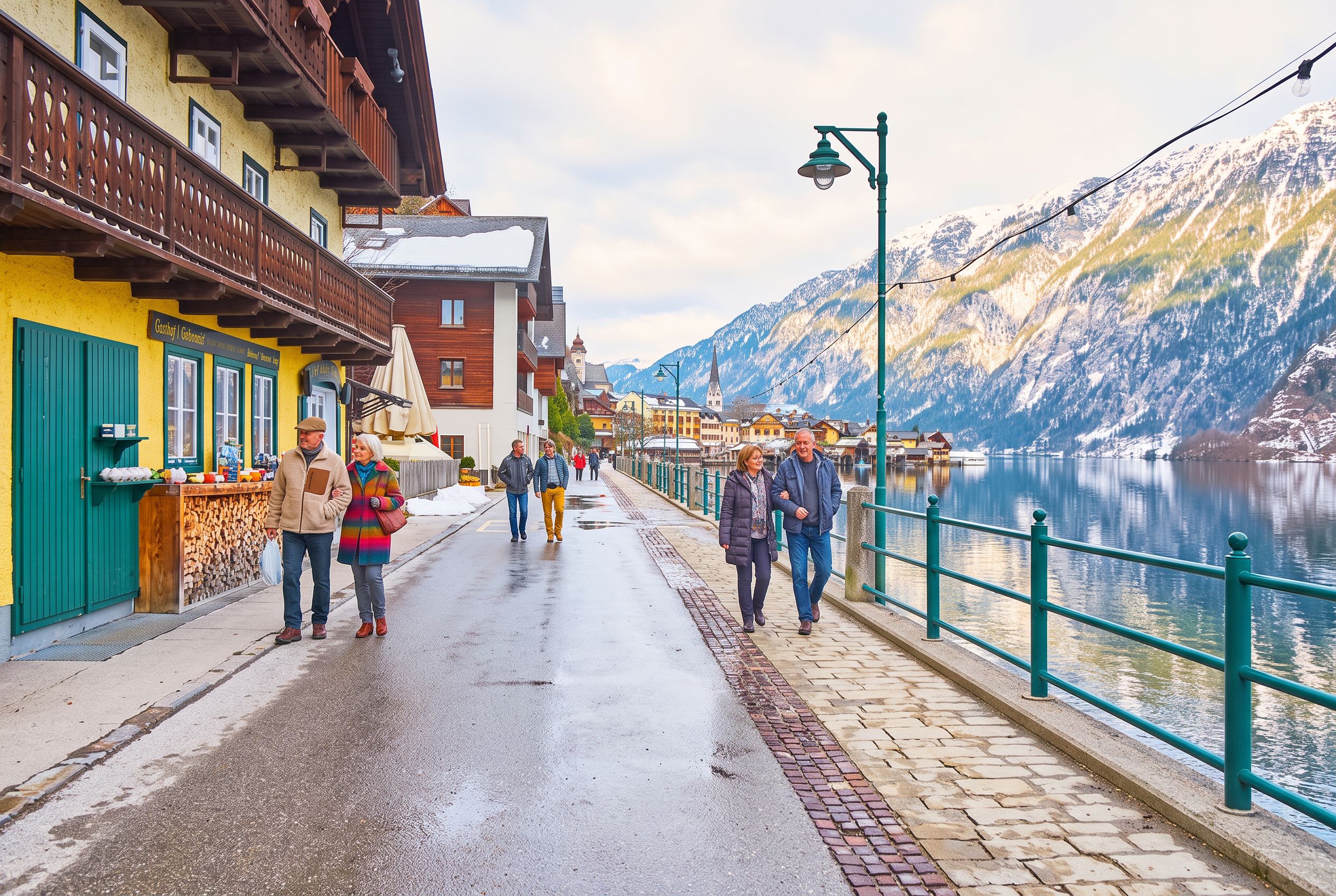
The lakeside street Seestraße is your primary accessible route. It is asphalted rather than boarded, runs level along the water with iconic views of the town and mountains, and a first-hand report by a wheelchair user calls this stretch well rideable. It is the flattest continuous route in the village and leads directly to the Market Square.
This promenade is the beating heart of the accessible Hallstatt experience. It's wide enough for two people to walk side-by-side, and the surface is smooth and even. You'll find benches spaced along the route, perfect for resting and taking in the scenery. From here, you can access the ferry terminal, several cafes with outdoor seating, and the main Market Square (Marktplatz). The square itself is relatively flat and navigable, though the surrounding side streets are a different story entirely.
Recent guests consistently report that this path is the town's saving grace for those with mobility concerns. Guest reviews frequently mention staying on the promenade and the square instead of attempting the back streets; one Google reviewer called the market square at the end of it "very calming and relaxing. A nice place to stroll and take in the charm of the town" in June 2025.
Is the Hallstatt Skywalk and funicular accessible?
As of mid-August 2026, the funicular to the Skywalk and the Salt Mine is still closed for its rebuild, and the operator has set the reopening for Saturday 29 August 2026 at 09:00. Until that date the only way up is the serpentine path from the valley station, about an hour on foot, which is not suitable for anyone with limited mobility.
When the new funicular does open, it is designed to be significantly more accessible. In its press release of 11 August 2026 the operator, Salzwelten, states that barrier-free boarding and automatic levelling keep the cabins horizontal throughout the ride, and that each vehicle carries 60 people. Above, the regional tourist board describes the World Heritage View platform as reachable barrier-free from the top station by lift plus a two-minute walk, and names older visitors as the group it suits. The mine tour itself remains a different matter: the operator states plainly that the salt mine is not wheelchair accessible.
How do I board the lake ferry with limited mobility?
The ferry between Hallstatt station, on the opposite shore, and Hallstatt Markt is the main entry point for rail travellers, and it is better than its reputation. The line vessel MS Stefanie runs 365 days a year, and the operator states that wheelchair access is possible on this boat. The gangway still moves with the lake level, so ask the crew for help boarding.
If you are arriving by train, you must take this short ferry ride to reach the village. The walk from the ferry dock to the promenade is flat and short. For those using a walker or wheelchair, it is wise to ask the ferry crew for help boarding. There is no way round the water: the tourist board states that the station lies on the opposite shore and that this is why the ferry is needed. Two of the four boats in the fleet, MS Goisern and MS Dachstein, are listed by the operator as not wheelchair accessible, so check which vessel you are boarding on the summer round trips.
What about the stepped lanes and the climb to the church?
The historic back streets of Hallstatt are steep, narrow, and paved with uneven cobblestones. Many lead to hotels and shops via flights of steps. The iconic Catholic Church and its associated Bone House (Beinhaus) are located on a hill and are not accessible by wheelchair due to stairs. These areas are best avoided if you have significant mobility challenges.
This is the honest warning. The charm of Hallstatt's medieval layout is also its primary barrier. The streets that climb away from the lake are not just steep; they are often only two feet wide, making it impossible for two people to pass, let alone a wheelchair. The path to the church, while short, is a steep uphill climb on old stone. The tourist board describes the approach to the ossuary as an ascent over numerous steps, or over the somewhat steeper Kirchenweg. For travellers who use a walking stick, these areas can be managed with caution and plenty of rest stops, but for wheelchair users, they are impassable.
How do I get to and around Hallstatt with limited mobility?
Day visitors park in P1, P2 or P4 outside the village centre, since P3 is reserved for coaches and motorhomes. The tourist board gives the walk into the centre as 20 minutes from P1, 15 minutes from P2 and 40 minutes from P4. There is no public shuttle: the P1 shuttle carries only guests who hold a hotel ticket.
Parking is a significant challenge. Spaces are first-come, first-served, and there are no reservations. The main car park P1 at Lahn has four designated disabled bays and 210 open spaces plus 200 in the garage, and the accessible public toilet stands at the adjoining bus terminal. Staying overnight does not buy you a permit to drive closer: the tourist board states that the centre is closed off with two barriers and that access to the apartments and hotels there is not possible. What guests get instead is a hotel ticket for P1 plus the shuttle to the door. For a day trip, a private transfer or a day bus excursion from Salzburg is often the most practical and least stressful option, as it eliminates the parking and ferry hassle entirely. For more on choosing the right base, see our guide on choosing your base around Hallstatt: village or quieter shores.
Where are the accessible public toilets and rest stops?
The public toilet at the Hallstatt Lahn bus terminal is the reliable one: the regional register calls it fully wheelchair-suitable and compliant with the Austrian ÖNORM, open daily 07:00–19:00 for one euro. The second public toilet, at Badergraben in the village, is open around the clock for one euro but carries no accessibility rating. A wheelchair user's report also lists an accessible toilet in the funicular building, reached with a Euro key.
Knowing where facilities are is half the battle. The toilet at the bus terminal is your most reliable option. In the village center, the public toilet situation is less certain. Many cafes and restaurants will allow you to use their facilities if you ask politely. The lakeside promenade is well-supplied with benches, and the cafes around the Market Square have outdoor seating where you can rest and people-watch. For a more structured rest, consider the local specialties guide for recommendations on cafes with easy access.
What is the overall terrain difficulty for seniors?
The terrain is a tale of two halves. The asphalted lakeside street is easy and level, and a wheelchair user's published report calls it well rideable. The historic village core is difficult, with significant elevation changes, uneven cobblestones, and numerous steps. The village can be explored comfortably in 2–3 hours if you stick to the accessible routes.
For a traveller who uses a walking stick, the promenade and Market Square are a delight. The back streets require careful footing and a willingness to turn back if a path becomes too steep. For a walker or wheelchair user the accessible zone is wider than the village core suggests: the lakeside street, the ferry crossing on MS Stefanie, the level first stretch of the Echerntalweg and, from 29 August 2026, the funicular and the Skywalk. The Museum Hallstatt, for example, publishes no accessibility information at all, and the regional tourist board's entry refers enquiries to the house itself, so call ahead on +43 6134 8280-15 if step-free access matters. The municipality counted 760 residents with a main residence in April 2025, and the mayor puts the village's capacity at about 700 guest beds, so infrastructure is limited and planning is essential.
When is the best time to visit for a comfortable experience?
The shoulder seasons of May-June and September-October offer the best balance of pleasant weather and manageable crowds. Nobody counts arrivals, but the region's tourism director estimates that on the strongest days, traditionally in August, well over 10,000 visitors come into the village, which makes the narrow streets crowded and hard to navigate. Winter weekdays are quiet but can have snow and ice on the cobblestones.
For older travellers, crowds are not just an annoyance; they are a safety hazard on uneven ground. Visiting early in the morning (before 9 AM) or late in the afternoon (after 4 PM) helps avoid the worst of the crush. The best weather is typically in September, with warm days and fewer people. If you are planning a spa day to complement your visit, consider taking the waters at Bad Ischl, which is a short drive away and offers excellent thermal baths.
"The iconic Marktplatz square. It's historic and is a great tourist attraction. It's busy at noon so I would recommend visiting it early morning or at evening." — a review left on Google in June 2026
What are the key costs for an accessible visit?
The village itself is free to enter. Parking is tiered with the first 15 minutes free, the ferry between the station and Hallstatt Markt costs €4.00 single or €8.00 return and takes cash only, on the operator's tariff valid from 1 January 2025. As of August 2026 the museum charges €12 for adults and €11 from age 60, the funicular €29 return once it reopens, and the Bone House €2.00.
For a practical budget overview, see our guide on what a comfortable Hallstatt trip costs. The main expense for an accessible visit is often the transport, as you may rely on taxis or private transfers more than the average visitor. Booking accommodation well in advance is essential, because the village has only around 700 guest beds according to its mayor.
| Transport Mode | Cost (Approx.) | Accessibility Notes |
|---|---|---|
| Parking (P1 Lahn) | Tiered fees; first 15 min free | Four disabled bays; accessible toilet at the adjoining bus terminal |
| Ferry (train station to Hallstatt Markt) | €4.00 single, €8.00 return, cash only | MS Stefanie listed by the operator as wheelchair accessible |
| Shuttle (P1 to accommodation in the centre) | Free with a hotel ticket | Hotel guests only, half-hourly 09:00–19:00; no accessibility rating published |
| Skywalk Funicular | €29 return | Closed until 28 Aug 2026; from 29 Aug the operator describes boarding as barrier-free |
What is the honest bottom line for older travellers?
Hallstatt is a beautiful destination that can be enjoyed by older travellers with limited mobility, but only if you accept its limitations. The asphalted lakeside street is the part that works, and a wheelchair user's published report calls it well rideable; the lanes climbing away from it are not. Plan your visit around the level ground, check whether your dates fall before the funicular reopens on 29 August 2026, and book accommodation and transport well in advance.
The key to a successful visit is managing expectations. You will not see the famous view from the Skywalk if you travel before 29 August 2026. You will not be able to visit the Bone House or the upper streets. But you will have a memorable, peaceful time walking along the lake, watching the swans, and enjoying the unique atmosphere of this UNESCO village from the most accessible vantage point. For those who want a deeper exploration of the region, note that the Altaussee salt mine is not an accessible substitute: its operator states that the mine tunnels are not suitable for wheelchairs, and the mine closes for maintenance from 3 to 30 November 2026.
For opening dates and fares, the operator's own Salzwelten Hallstatt page is the source that is kept current; the regional tourism entry for the funicular still carries the superseded date of June 2026. For everything else, the region maintains an accessible holidays hub listing barrier-free accommodation, parking, toilets, walks and sights. Guided tours of the village can be booked barrier-free through the Austrian Guides, and travellers who need a barrier-free bus or train are asked to give notice on +43 51717.


