
Located on the western shore of the Hallstätter See, this UNESCO World Heritage village had 760 residents with their main address here in April 2025, and the visitor load is out of all proportion to that. Nobody counts arrivals: the regional tourism director expects well over 10,000 people on the strongest days, traditionally in August, while the wider holiday region books around a million overnight stays a year, close to 150,000 of them in Hallstatt itself. For travellers aged 50 to 70, the challenge is not finding things to do — it is timing your visit to experience the authentic traditions without the midday crush. This guide walks you through Hallstatt’s year-round cultural calendar, from the lake procession in late spring to the single-day Christmas market in December, with honest notes on accessibility and crowd levels at each season.
 AI-edited
What makes the Corpus Christi lake procession so special?
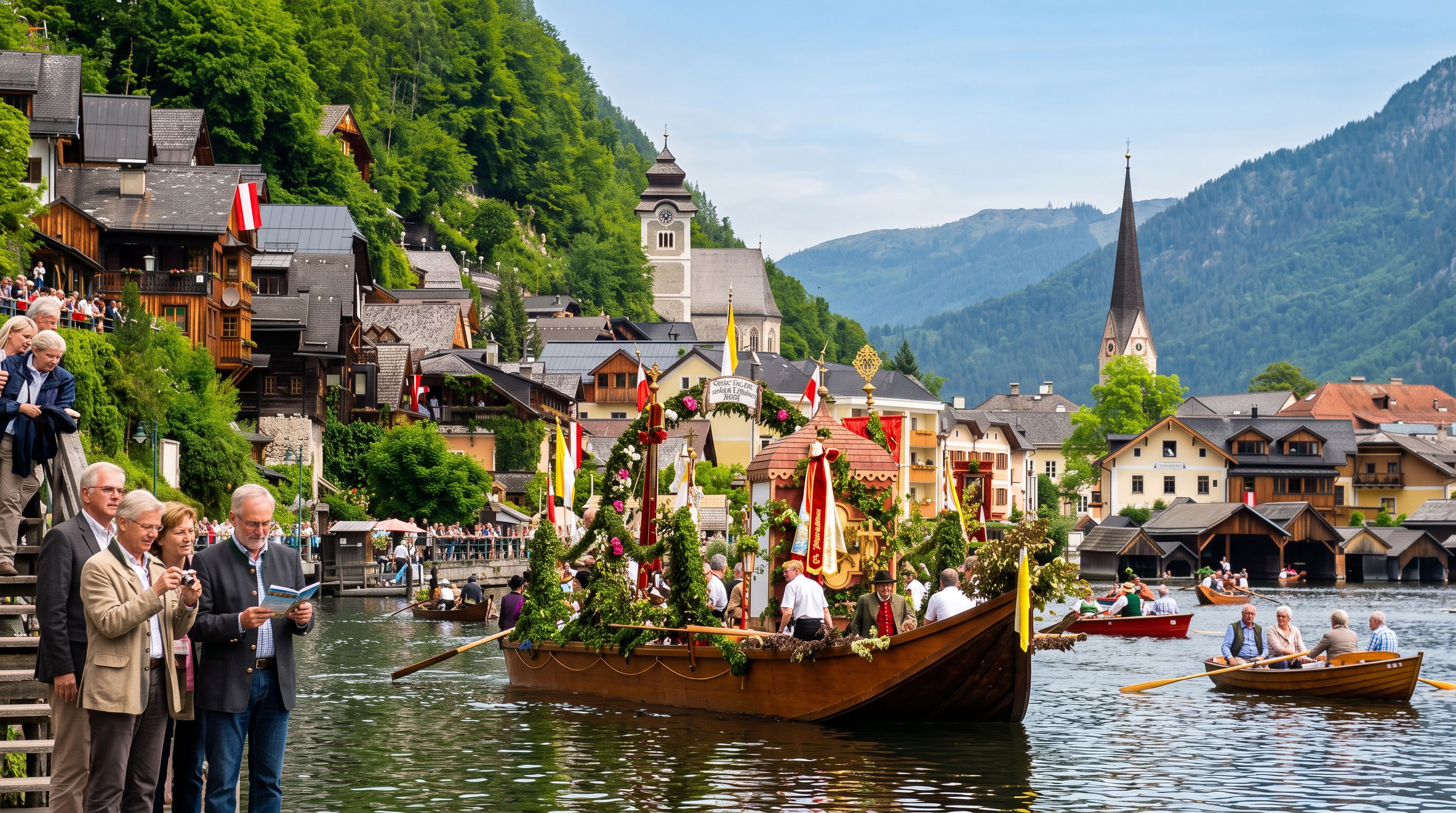
The Fronleichnam lake procession is Hallstatt’s most significant annual event. It moves with Corpus Christi rather than sitting on a fixed date — it fell on 4 June in 2026, and the tourist board already lists the next one for Thursday 27 May 2027 — and it always begins with High Mass at 9:00 in the Catholic parish church, followed by the first blessing station on the festively decorated Market Square. Seniors can watch from the shore or from one of the excursion boats; of the round-trip boats only the MS Hallstatt is listed by the operator as wheelchair-accessible. The procession passes four blessing stations, the last of them out on the lake in sight of the Salzberg.
The procession is documented from 1623 and has counted since 1628 as a perpetual endowment of the Hallstatt salt mine — the "eternal endowment" that locals still refer to. Unlike a parade on land, the flower-decked traditional boats, the Fuhren, carry the Blessed Sacrament across the still morning water. The day starts earlier than the Mass: from 6:00 the Fronleichnam marksmen fire from a Plätte on the lake, one shot on every full hour, moving closer to the church until they greet the clergy at 9:00. After the fourth station the procession returns to land and marches back to the Market Square behind the Salinenmusikkapelle for the final blessing and a Te Deum — a manageable half-day outing.
For those who prefer solid ground, the Market Square (Marktplatz) offers a flat viewing area at lake level with cafés around it, and the Seestraße runs along the water as an asphalted lakeside road. Treat blanket accessibility claims with care here: no official source describes the whole procession route as wheelchair-accessible, and the church at the top of the Kirchenweg is reached over steps. What is documented is the fleet — the operator lists the MS Hallstatt and the ferry MS Stefanie as wheelchair-accessible and the MS Goisern and MS Dachstein as not (Hallstättersee Schifffahrt).
When are the quietest seasons for a cultural visit?
Late September through October and the weeks of late November offer the best balance of mild weather, low crowds, and active traditions. Nobody counts arrivals, but the regional tourism director expects well over 10,000 people on the strongest days, traditionally in August, in a village of 760 residents. November is the quietest month that still has tradition on the calendar: the miners’ Barbaramesse falls on Sunday 29 November 2026, and the salt mine and funicular move to winter hours from 25 October.
The timetables explain the rhythm better than any advice can: the first boat leaves the Market Square for the railway station at 07:00, the first boat from the station reaches the village at 08:35, and the last crossing back leaves the Market Square at 18:07. Staying overnight is what buys you the hours on either side of that window. Guest reviews frequently mention the same rhythm: an all but empty promenade in the early morning, and a village that is hard to move through by mid-morning.
"In fact we came early (about 8 am) and did it all in about 2 hours and left when everyone else arrived." — from a Google review of Hallstatt's market square, April 2026
May and June are the shoulder months to target for the lake procession, while September brings autumn colours and the Almabtrieb (cattle drive), when the cows come down from the alpine pastures in flower crowns and bells. It has no fixed date — the holiday region says plainly that neither the drive up nor the drive down is pinned to a day, because both depend on the weather and on how the grass has grown. The festivities belong to the neighbouring villages rather than to Hallstatt: the Moosalm cattle-drive festival in Gosau fell on 19 September in 2026. For a deeper dive into accommodation that guarantees quiet nights, see our guide to The Quietest Places to Stay Around Hallstatt: A Calm-Seeker’s Guide for Light Sleepers.
What is the Hallstatt Christmas market really like?
The Hallstatt Christkindlmarkt is a single-day event held on December 8 each year, from 10:00 AM to 6:30 PM on the Market Square. Unlike the sprawling markets of Salzburg or Vienna, this is a small, community-based affair serving traditional food, mulled wine, and regionally made crafts — ideal for seniors seeking a relaxed, non-commercial Advent experience.
The market features a life-size wooden crib built by pupils of the HTBLA Hallstatt, the traditional sound of tower brass players, a big lit Christmas tree and a handful of stalls selling Lebkuchen (spiced honey-nut biscuits), hand-worked tree decorations and regional crafts. Because it lasts only one day, the square does get busy — but the crowd is manageable compared to the summer crush. The date does not move to suit the week: it is 8 December whatever the weekday, and in 2026 that is a Tuesday. Admission is free.
For seniors, the compact layout is a blessing: the whole market fits on the Market Square itself, at lake level, with no climb involved, and cafés around the square stay open for anyone who wants to sit with a cup of Glühwein and watch the evening lights on the water. The holiday region lists the market as running to 18:30, the Upper Austria events register to 18:00 — worth a check before you plan a late arrival. Either way the evening stays quiet for a peaceful dinner.
What autumn traditions should I look for?
September and October bring the Almabtrieb (cattle drive), and late November the Barbaramesse (St. Barbara’s Mass), honouring the patron saint of miners — in 2026 it is sung on Sunday 29 November at 10:30. These events are smaller, less crowded, and deeply rooted in the community’s salt-mining heritage — perfect for travellers who prefer authentic local customs over tourist spectacles.
The Almabtrieb has no fixed date at all. The holiday region states that neither the drive up nor the drive down is tied to a day, because both depend on the weather and on the grass, and that the Gosau drives happen only after an accident-free season on the alp — no staged spectacle. Cows wearing elaborate headdresses of flowers, pine branches and bells are led down to their winter barns; at the Moosalm festival they graze beside the festival ground while local groups play. The events belong to Gosau and Bad Goisern rather than to Hallstatt itself, and in 2026 the Moosalm drive fell on 19 September, with the sheep sorting in Gosau and Bad Goisern in the same weeks. It is a genuinely moving sight — the bells echo through the valley for hours.
St. Barbara’s Mass takes place in the Catholic parish church of Mariä Himmelfahrt, and the date is worth checking each year rather than assuming 4 December: in 2026 it is on Sunday 29 November at 10:30. The miners attend in person, and the Hallstatt male voice choir sings the Bleiberg Miners’ Mass. The church itself is worth visiting year-round for its Gothic altarpiece and the views from its small cemetery.
For those interested in the culinary side of autumn, the weekly Wednesday market at the Bathing Beach is the place to find Erdäpfelknödel (potato dumplings filled with smoked cheese) and Holzknechtnockn (dumplings in rich broth, originally a lumberjack meal). Our dedicated guide to What to Eat Around Hallstatt: A Practical Guide to Local Specialties for Travellers Over 50 covers these dishes in detail.
Which museums and historic sites are senior-friendly?
The World Heritage Museum (Hallstatt Museum) at Seestraße 56 is the main indoor attraction, covering 7,000 years of salt-mining history — but read the museum’s own warning first: it states on its website that it is unfortunately not barrier-free. Admission is €12, or €11 from the age of 60 and for guest-card holders, with last entry 60 minutes before closing. The flat, easy walking in the village is the Market Square and the asphalted lakeside road; the Bone House and the parish church above it are not part of that.
The museum’s exhibits include prehistoric salt-mining tools, Bronze Age artefacts, and a detailed model of the ancient mine tunnels. The museum opens daily all year, but the hours move with the season: 10:00 to 18:00 from May to September, 10:00 to 16:00 in April and October, and 11:00 to 16:00 from November to March. Overnight guests holding a guest card and visitors from 60 pay the reduced €11. It carries a Google rating of 4.5 out of 5 from 398 reviews as of 25 August 2026 — but the stairs inside are real and the museum promises no step-free route, so anyone who cannot manage a flight of steps should ask at the desk before buying a ticket.
The Bone House (Ossuary) at St. Michael’s Chapel contains over 600 artistically painted skulls, many of them decorated at the end of the 18th century. Getting there is the hard part: the tourist board describes the ascent as going up numerous steps, or over the somewhat steeper Kirchenweg. No railway serves the upper village; the funicular that is sometimes mistaken for one climbs the Salzberg, on the other side of the valley, not the church hill. Admission is €2, and the chapel keeps short winter hours: Wednesday to Sunday, 11:30 to 15:30, from 1 November to 31 March.
The salt mine, the Skywalk viewpoint and the funicular were closed for a complete replacement of the historic Salzbergbahn, and the operator reopened all three on Saturday 29 August 2026 — so any date from then on falls inside the new season, and anything you read about a reopening in June or in September 2026 is out of date. Summer hours run to 24 October 2026 (funicular 9:00 to 18:00, last guided tour into the mine at 16:30), winter hours from 25 October 2026 to 6 January 2027. The new cars take 60 passengers each, more than double the old capacity, in glass cabins with barrier-free boarding and automatic levelling that keeps the floor horizontal on the climb — part of a rebuild costing around €34 million. The guided tour inside the mine itself is not wheelchair-accessible.
Which areas and times should I avoid?
The Market Square and the lakeside road fill up in the middle of the day, when the boats from the railway station and the coach groups overlap: the boat runs from 08:35 until 18:30, and every coach has to book a slot it cannot leave for two and a half hours. The official photo point is not where most articles put it — the tourist board places it on Gosaumühlstraße, at street level and a short walk from the Market Square, and calls it easily accessible.
The lanes really are narrow. The municipality describes Hallstatt as a Zeilensiedlung — a single line of tall houses pressed between the lake and the cliffs, built compactly and several storeys high precisely because there was no room to spread out. Visitors cannot drive into the historic centre at all: the tourist board states that the centre is closed off with two barriers, and even guests booked into accommodation there are brought in by shuttle from the P1 car park. That leaves the lanes to walkers, wheeled suitcases and prams. For a calmer quarter of an hour, walk north along the lakeside road to the photo point on Gosaumühlstraße, which is at street level and clear of the tightest section.
The Heritage Hotel Hallstatt, at Landungsplatz 101 a few steps from the ferry dock, holds a Google rating of 4.0/5 from 1,665 reviews as of 25 August 2026. The house is spread over three listed buildings, and for anyone who counts stairs the difference matters: the main Kainz House has a lift, the Seethaler House about five minutes’ walk away has a lift, and the historic Stocker House has been kept close to its original state and has none. Lake-view rooms with balconies in the main building are quieter and more convenient for seniors. For a full breakdown of accessibility across Hallstatt’s accommodations, see How Accessible Is Hallstatt for Older Travellers? A Practical Guide for 2026.
| Season | Visitor pressure | Best Time to Visit | Crowd Level |
|---|---|---|---|
| July–August | Peak — well over 10,000 on the strongest August days | Before 9 AM or after 6 PM | Very high |
| May–June | High, but short of the August peak | Morning or late afternoon | Moderate |
| September–October | Moderate; boats and coaches still running | Anytime except weekends | Low to moderate |
| November–February | Lowest of the year | Midday (shorter daylight) | Low |
What practical tips will make my visit smoother?
Bring cash: the Hallstättersee shipping company states plainly that no card payment is possible on its boats, and several small shops are the same. Plan the evening around the timetables rather than around closing time — the last boat from the Market Square to the railway station leaves at 18:07, the last boat from the station into the village at 18:30, and the last bus towards Hallstatt leaves Bad Ischl station at 18:16. The boat timetable is identical every day of the week, Monday to Sunday, with one extra early sailing at 07:32 on school days.
For the best lake views, take the bus to Hallstatt and return by boat — the crossing on the Stefanie, one of the two boats the operator lists as wheelchair-accessible, offers a different perspective of the town’s famous silhouette. The Dachstein Krippenstein cable car in Obertraun gives panoramic views of the glacier and the Salzkammergut, but it does not run all year: the 2026 summer season lasts from 1 May to 1 November and the winter season from 19 December 2026 to 29 March 2027, which leaves November and early December closed. The operator publishes nothing about wheelchair access.
One date to watch if you are coming by train in autumn: the ÖBB have announced bundled works on the Salzkammergut line for autumn 2026, provisionally from 10 October to 2 November between Gmunden and Bad Ischl, with buses replacing trains over the closed stretch. That section sits on the main approach from Attnang-Puchheim, so it falls squarely inside the quiet late-autumn window this guide recommends — and a change into a bus with luggage is worth planning for rather than discovering on the platform. The railway calls the dates provisional, and asks passengers to check their connection and the location of the replacement stop shortly before travelling and to allow extra time.
Two signposted themed trails work well when you would rather not climb far. The village trail leads through the Markt in about an hour, past 20 signposted points on the salt town’s history. The Echern Valley themed trail is the longer one: the tourist board calls it easy to walk, describes a circular route of roughly two hours with ten information boards on the valley’s waterfalls, glacier mills and the painters and explorers who came here, and recommends sturdy shoes. Two caveats the board makes itself — the trail is meant for April to November, and in winter the boards are covered over.
For a detailed breakdown of costs, including accommodation, meals, and attraction fees, consult What Does a Comfortable Hallstatt Trip Cost? A Practical Budget Guide for Travellers Over 50.


