
Hallstatt is one of Austria’s most expensive destinations, and for travellers aged 50–70 the fixed costs are easy to pin down: the ferry from the station is €4.00 per person each way, and the combined salt mine and funicular ticket is €49.00 per adult once the mine reopens on 29 August 2026. Accommodation is the variable that decides your budget, and every room rate carries a local tax on top — €3.00 a head per night until the end of September 2026, €4.00 after that. The main cost drivers are accommodation (limited supply pushes rates high), the mandatory ferry, and the salt mine. Understanding where your money goes—and where you can save without sacrificing comfort—makes all the difference.
 AI-edited
How much does accommodation really cost?
Accommodation is the biggest expense, and the published rates spread very wide: the regional tourist board lists Hallstatt doubles from €77.50 per person per night at one house and from €228.00 per unit at another, with suites above €470.00. Read the basis before you compare, because some houses quote per person and others per room. Add €3.00 city tax per person per night, rising to €4.00 from 1 October 2026.
The municipality’s own accommodation directory lists 43 registered establishments in Hallstatt, most of them apartments and guesthouses rather than hotels, and demand far exceeds supply. As of August 2026, the Heritage.Hotel Hallstatt holds a Google rating of 4.0/5 from 1,664 reviews, with guests consistently praising its central location and breakfast. The Hallstatt Hideaway, an adults-only house in the heart of the village with private terraces and a private lakeside garden, earns a Google rating of 4.2/5 from 292 reviews. Lifts are less rare than the village’s reputation suggests: the regional directory lists the Heritage.Hotel with a handicapped-accessible lift and a step-free entrance, and the municipality describes the Boutiquehotel Strand as barrier-free with a lift. Cars still cannot enter the old town, so you will walk from the car park or ferry dock with your bags.
For a quieter, more affordable base, consider Obertraun, about 5 kilometres from the Hallstatt market by road and roughly ten minutes by car. From May to September the scheduled boat also links the two, and the lakeside setting is equally beautiful. For a fuller comparison of bases, see our guide Choosing Your Base Around Hallstatt: Village or Quieter Shores.
| House and room type | Lowest published rate | Basis |
|---|---|---|
| Seehotel Grüner Baum, double | from €77.50 | per person, per night |
| Seehotel Grüner Baum, suite | from €110.00 | per person, per night |
| Heritage.Hotel Hallstatt, double | from €228.00 | per unit, per night |
| Heritage.Hotel Hallstatt, suite | from €473.00 | per unit, per night |
| Boutiquehotel Strand, junior suite | from €300.00 | per unit, per night |
| City tax, every house | €3.00 (€4.00 from 1 October 2026) | per person, per night |
What about the salt mine and cable car?
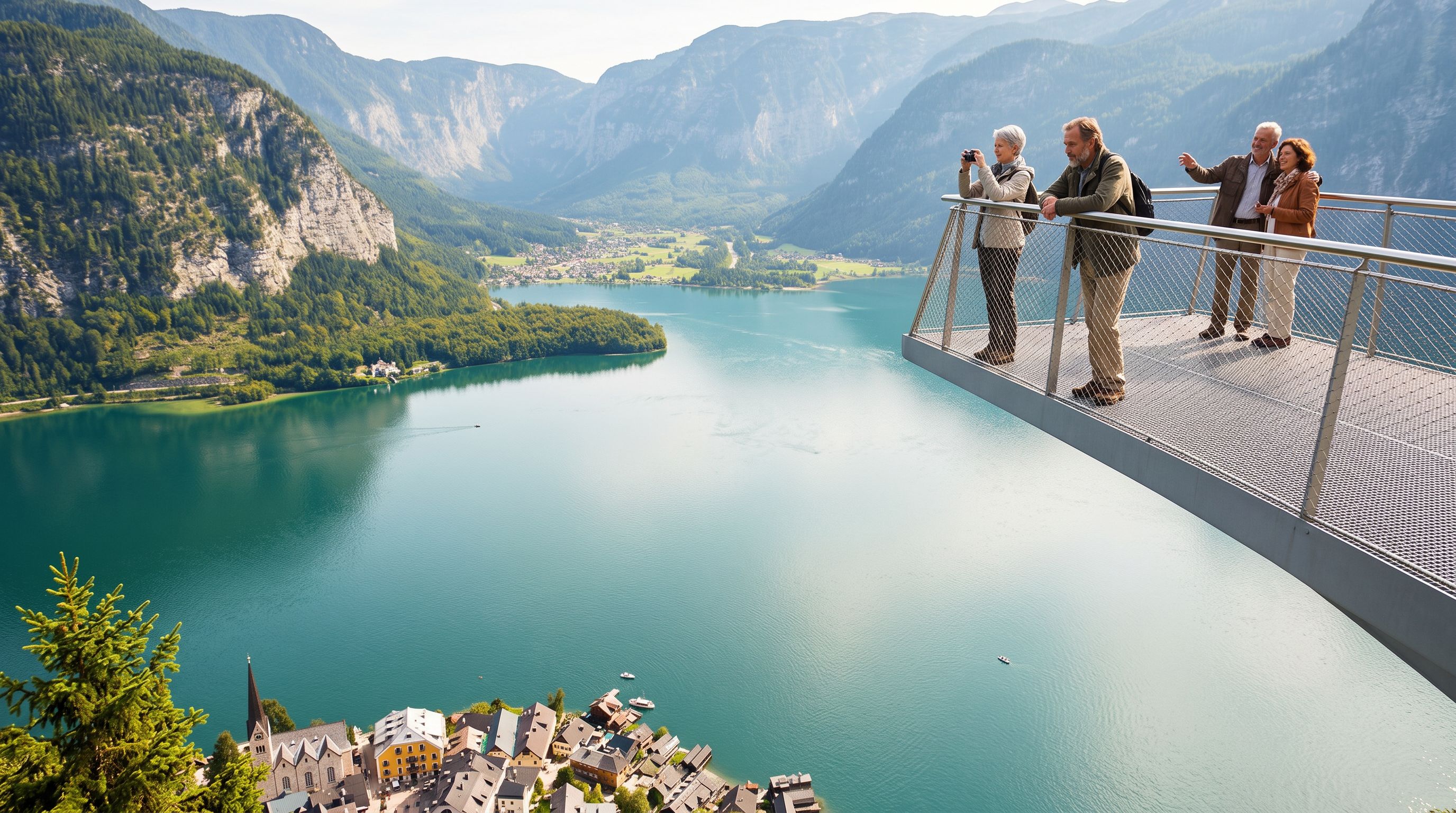
The salt mine and Skywalk are the two must-do attractions, and both are closed for rebuilding until 28 August 2026. From 29 August the combined mine and funicular ticket costs €49.00 per adult. The funicular alone is €29.00 return, the mine alone €33.00 for walkers, and the Skywalk platform is reached from the funicular’s top station. Walking up the old miners’ path instead saves €16 but climbs 300 metres in about an hour.
The salt mine is a 7,000-year-old working mine and a UNESCO World Heritage site. The guided tour lasts around 90 minutes and includes a 64-metre miners’ slide—great fun, but be aware it is chilly underground (around 8°C year-round), so bring a sweater even in summer. Plan at least three hours for the whole visit, and be at the funicular’s valley station 45 minutes before your tour starts. The Skywalk platform juts twelve metres out over the village, 360 metres above the rooftops. Two points matter for anyone who walks with care: the funicular ride and the Salzwelten bistro are barrier-free, but the mine itself is not wheelchair-accessible, and a 15-minute uphill walk separates the top station from the tour entrance. From 29 August to 24 October 2026 the funicular runs daily from 9:00 AM with the last descent at 6:00 PM, and the mine’s last tour of the day starts at 4:30 PM.
How expensive are meals and drinks?
Hallstatt’s restaurants publish almost nothing online, so plan with allowances rather than prices. Two documented items are worth knowing before you sit down: the Heritage.Hotel’s Seeauer restaurant adds a €4.90 cover charge per person, and the Bräugasthof takes no table reservations at all during the summer months. Self-catering from the village grocery is the one reliable saving.
Hallstatt’s restaurant prices are higher than comparable Austrian villages due to its tourist density. At the Seeauer, the Heritage.Hotel’s restaurant, the lunch card runs from noon to 4:30 PM and the evening card from 5:30 to 9:00 PM between April and October, with hot food until 8:30 PM; evening tables are booked either for 5:30 to 7:30 PM or from 7:30 PM onwards, and the house asks for smart casual dress and closed shoes. The Bräugasthof sits on Seestrasse, the lakeside street that carries most of the village’s restaurants. For a cheaper option, the village grocery MarktGschäftl at Seestrasse 169 sells picnic supplies—there is no Spar in Hallstatt itself, the nearest one being the EUROSPAR in Bad Goisern, 12 kilometres away. Many hotels include breakfast, which is a substantial buffet; a hearty breakfast can easily double as a late lunch if you plan a big early meal.
For a deeper dive into local food, see our dedicated guide What to Eat Around Hallstatt: A Practical Guide to Local Specialties for Travellers Over 50.
What do boat trips and ferries cost?
The mandatory ferry from the train station to the village costs €4.00 per person one way and €8.00 for the return ticket, and the operator takes cash only. The scheduled round trip from the market via Lahn to Obertraun and back costs €18.00 per person, or €12.00 for the single leg to Obertraun, and runs from May to September. There is no lakeside train station; the ferry is the only direct link.
This is Austria’s only year-round scheduled boat line, and one timetable covers the whole year. Boats from the station to the village market run from 7:32 AM to 6:30 PM; in the other direction the first sailing leaves the market at 7:00 AM and the last at 5:45 PM, which is the figure that matters if you plan to catch an evening train. The boat ride is short but scenic—about 15 minutes across the lake. For a longer experience, the round trip to Obertraun and back leaves the market at 11:00 AM, 1:00 PM, 2:00 PM and 3:00 PM from May to September, with a 4:00 PM sailing added in July and August. In poor weather the operator may cancel sailings. Tickets are sold at the ferry dock; again, cash is king.
"I recommend a ride on Lake Hallstatt. The cruise takes 50 minutes. In July 2024, we bought tickets on the spot for 15 euros per person. Payment in cash only. The views from the boat are beautiful." — a passenger wrote on Google in July 2024
Where is Hallstatt dear versus reasonable?
Hallstatt is most expensive for accommodation and sit-down restaurant meals. Public transport stays modest: a one-zone regional bus ticket is €3.00 full fare and €1.70 for travellers over 65, and a one-zone day ticket €6.00 or €3.40 reduced. The attractions are the bigger line: €33.00 for the mine alone, €29.00 for the funicular return, €49.00 for both together. Self-catering at the village grocery on Seestrasse is a real money-saver.
The premium is driven by Hallstatt’s UNESCO status and by day-visitor numbers that regional press put at around 1.2 million for 2025, a record. Local buses stay cheap, but the routing takes a moment to learn: from Bad Ischl you take line 541 and change at the Gosaumühle stop onto line 543 for Hallstatt, with line 544 running back; line 542 goes from Gosaumühle to Bad Ischl. Fares follow the Upper Austrian transport association’s zone tariff, and travellers from 65 pay the reduced fare on single and day tickets, with the ÖBB Vorteilscard Senior accepted as proof. That card costs €31 a year, is open to everyone from 65 regardless of gender, and cuts ÖBB standard single tickets by 50 per cent; inside a transport association the regional senior discount applies instead and can be smaller.
Where you can save: skip the guided tours — Panorama Tours lists its Hallstatt trip from Salzburg from €80.00 per person for five and a half hours, of which two and a half are actually in the village — and use public transport instead. Where you should spend: book a hotel with breakfast included, which spares you both the outlay and the search for an open café before a day of walking.
Sample daily budgets for comfortable, mid, and frugal styles
Below are three daily budgets per person for a summer 2026 visit, excluding long-distance travel to Hallstatt. The attraction and city-tax rows are published prices; the accommodation, meal and local-transport rows are planning allowances, because Hallstatt’s houses publish only starting rates and its restaurants publish next to nothing.
| Category | Frugal | Mid-range | Comfortable |
|---|---|---|---|
| Accommodation | €40–€60 (Obertraun guesthouse) | €100–€150 (village 3-star) | €180–€260 (lake-view hotel) |
| Meals allowance (3 meals + 1 drink) | €25–€35 (self-catering + 1 meal out) | €50–€70 (2 sit-down meals) | €80–€120 (3 restaurant meals) |
| Attractions (salt mine + funicular) | €33 (walk up, mine only) | €49 (mine + funicular) | €67 (mine + funicular + lake round trip) |
| Local transport (ferry, bus) | €10–€15 | €15–€20 | €20–€30 |
| City tax | €3 | €3 | €3 |
| Total per day | €111–€146 | €217–€292 | €350–€480 |
How to save without sacrificing comfort
Book accommodation well ahead for summer visits to secure the best rates. Stay in Obertraun or Lahn for quieter, cheaper lodging. Use the ÖBB Vorteilscard Senior, €31 a year for anyone from 65, for 50 per cent off ÖBB standard single tickets, and claim the reduced regional fare on the buses. Bring cash for the boat, which takes no cards at all.
How busy the peak really gets is disputed: the regional tourism director puts high-season day visitors at 3,000 to 3,500 and expressly rejects the 10,000 figure that circulates locally, while press reports describe up to 10,000 on the very busiest August days. Either way, the pressure is managed rather than left to chance — coaches must book an entry and an exit slot online, with a minimum stay of two hours and twenty minutes, and they are barred from the village between 5:00 PM and 8:00 AM. Shoulder months (May, June, September) bring comfortable weather and thinner crowds. The Salzwelten timetable is the one to check before you fix dates: mine and funicular are shut for rebuilding until 28 August 2026, run daily from 29 August to 24 October, and then keep shorter winter hours until 6 January 2027.
For a full overview of the region, including transport and timing tips, read our comprehensive guide Hallstatt and the Salzkammergut for Travellers Over 50: A Realistic Guide.
What about health and safety?
Hallstatt is generally safe, with low crime. The main risks are physical: narrow, slick cobblestones, steep stairs, and unfenced lake edges. There is a GP practice in the village itself, at Salzbergstrasse 224; the nearest pharmacy is the Apotheke im Baumhaus in Bad Goisern, 12 kilometres away, and the nearest hospital with round-the-clock emergency admissions is the Salzkammergut Klinikum in Bad Ischl, 22 kilometres away. Bring a basic first-aid kit and sturdy walking shoes.
The village’s pedestrian lanes narrow to single file in places, and after rain the cobblestones become slippery. The lakefront has no barriers in many spots, so caution is advised, especially for those with balance concerns. Rest benches are sparse; plan for frequent short rests rather than long continuous walks. The emergency number for ambulance is 144, mountain rescue 140, and the single European emergency number 112.
For a relaxing day away from the crowds, consider Taking the Waters at Bad Ischl: A Spa Day Near Hallstatt, which the regional tourist office puts at about 40 to 50 minutes by bus from Hallstatt; note that the last bus back from Bad Ischl towards Hallstatt leaves at 6:16 PM.
What should I pack for a comfortable trip?
Pack layers, a waterproof jacket, sturdy walking shoes with good grip, and a small backpack. Bring cash (€50–€100 in small bills), a reusable water bottle, and insect repellent for evenings near the lake. Avoid bulky luggage—you will carry it from the ferry through narrow streets.
Summers here are mild rather than hot, and rain is frequent enough to plan around: the boat operator warns outright that sailings can be cancelled in bad weather. A light waterproof jacket or compact umbrella is essential. The salt mine is chilly (8°C), so a sweater or fleece is useful even on warm days. Sturdy walking shoes with good grip are non-negotiable; sandals are unsafe on slick cobblestones. A small backpack leaves your hands free for the ferry and stairs.
Frequently asked questions
Is Hallstatt worth the cost for a day trip?
Yes, if you plan carefully. A day trip from Salzburg costs €140–€160 per person and gives you enough time to see the salt mine, Skywalk, and village core. Coming by public transport means a change: bus line 150 from Salzburg main station to Bad Ischl runs hourly, at times every half hour, and from Bad Ischl it is another 40 to 50 minutes by bus, changing from line 541 to line 543 at the Gosaumühle stop. The hard deadline on the way back is the last bus from Bad Ischl towards Hallstatt at 6:16 PM. That is tight: the mine tour alone runs 90 minutes, the operator asks you to be at the valley station 45 minutes beforehand, and it advises allowing at least three hours for the whole visit. If you want to add a boat ride or visit the Bone House, consider an overnight stay. For a more relaxed pace, stay overnight—the village empties after 5 PM when the day-trippers leave.
Can I use my credit card in Hallstatt?
Not reliably. Most hotels, restaurants, and the ferry require cash. Bring at least €50–€100 in small bills (€5, €10, €20). The boat is the clear cash-only case: the operator states plainly that card payment is not possible, and a return ticket is €8.00 per person. Elsewhere cards are taken more widely than the village’s reputation suggests — the car park pay machines accept cash, Maestro, Mastercard or Visa, and bus tickets bought from the driver can be paid by cash or by debit or credit card. Individual guesthouses and small shops set their own rules and do not all publish them, so carry small notes for the boat and incidentals. Two cash machines stand on Seestrasse, at numbers 99 and 114.
How do I get from the train station to the village?
Take the ferry from Hallstatt Bahnhof across the lake to the village. It costs €4.00 per person one way, €8.00 for the return ticket, and takes about 15 minutes. Cash only. The train station is on the opposite shore of the lake; there is no bridge or road connection. The ferry is the only direct link. Boats from the station run from 7:32 AM to 6:30 PM, and the last boat back from the market to the station leaves at 5:45 PM, so fix your return before you settle in for a late lunch. If you miss it, the road detour around the lake covers about 15 kilometres and takes some 40 minutes by car.
What is the best time of year for a comfortable visit?
Late May, June, or September offer the best balance of comfortable weather, moderate crowds, and lower prices. July and August are peak season, with day-visitor estimates ranging from the tourism office’s 3,000 to 3,500 up to press reports of 10,000 on the busiest days. Winter brings lower rates and quieter lanes, but shorter hours: from 25 October 2026 the funicular runs 9:00 AM to 4:00 PM and the mine’s last tour starts at 3:00 PM, and both close after 6 January 2027. For a comfortable experience, avoid weekends and public holidays. Arrive by 9:00 AM to beat the tour bus crowds. The village is most peaceful in the late afternoon after 4:00 PM.


