
The fairy-tale village of Hallstatt, pressed between a deep alpine lake and a sheer mountain wall, is one of Europe's most photographed places. But its beauty comes with a modern challenge: coach after coach unloads into its narrow streets in peak season, in a village of 760 residents. Every coach has to pre-book an entry and an exit slot at the terminal, and the exit slot must fall at least two hours and twenty minutes after arrival — which is exactly why the crush builds and holds for hours either side of noon. For travellers aged 50 to 70 who value both comfort and calm, the secret lies not in avoiding Hallstatt altogether, but in choosing the right hour, the right day, and the right month.
This guide focuses entirely on weather, crowds, and seasonal operations — the ferry schedule, the funicular, the snow, and the coach-tour rhythms that define the village day. We will not cover Hallstatt's festival calendar here; that subject has its own dedicated guide in our Hallstatt Through the Year: Traditions and Quiet Seasons feature.
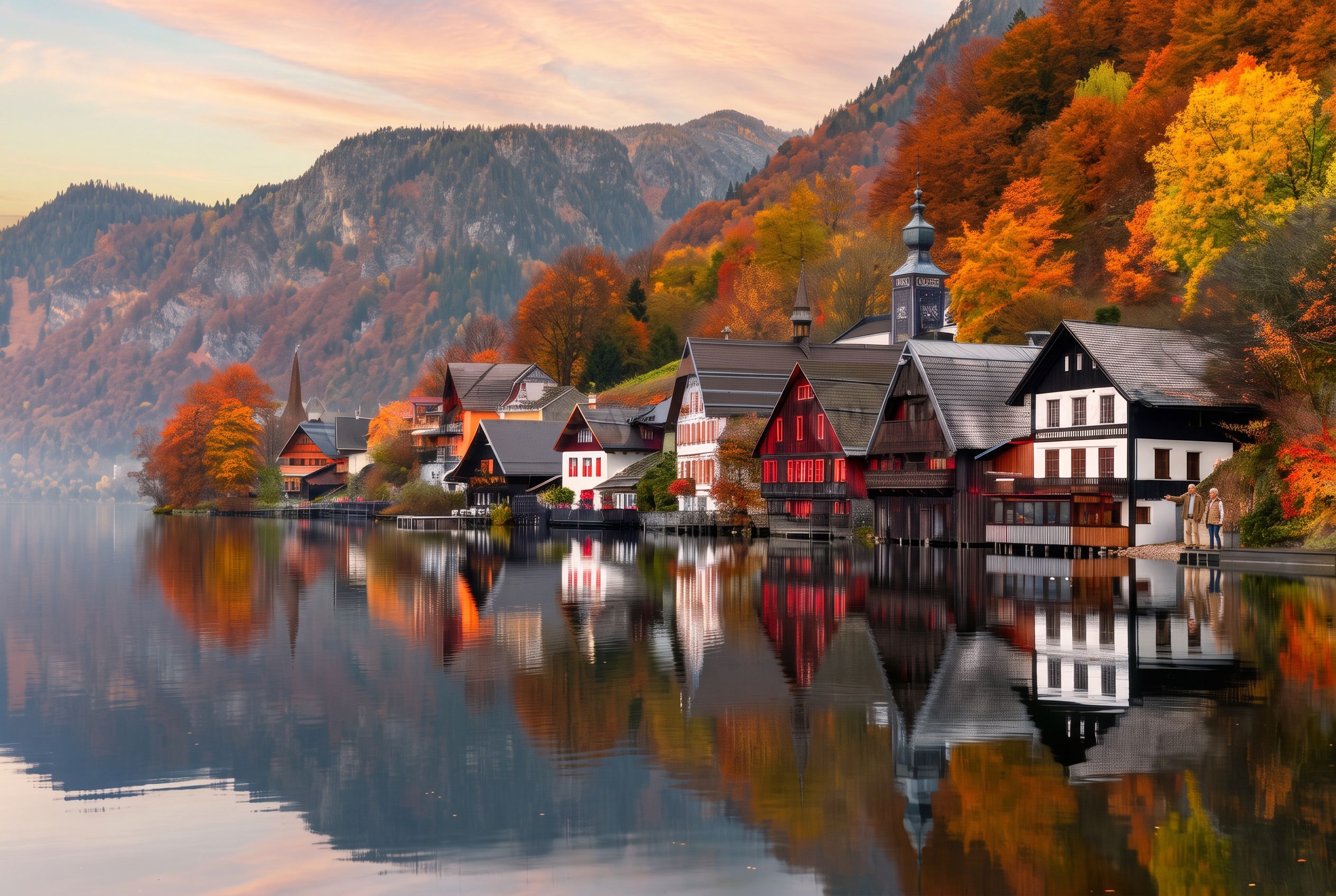 AI-edited
What is the single most important timing rule?
Stay overnight in the village, or come on a Tuesday, Wednesday, or Thursday and plan around the boat. The first ferry from the station leaves at 8:35 AM and the last one back at 5:45 PM, the same seven days a week, so rail day-trippers are gone by early evening. An overnight stay transforms Hallstatt from a crowded stop into a tranquil, atmospheric retreat.
This is the single most consistent piece of advice from seasoned travellers aged 50 and older. The village is tiny — you can walk its entire length in twenty minutes — but the experience changes completely once the tour buses depart. Guests consistently report that night-time noise is low once day-trippers leave, making evenings quiet and restorative. Motor craft are banned on the lake all year by provincial order, apart from electric motors up to 1,000 watts and a capped fleet of nine commercial vessels, of which at most four may run a combustion engine — which adds to the sense of calm after dark.
If you cannot stay overnight, plan your arrival for the first ferry of the day. The published timetable, valid from 14 December 2025 to 13 December 2026, runs the same seven days a week: the first crossing from Hallstatt station leaves at 8:35 AM and the last at 6:30 PM, with one extra 7:32 AM sailing on Monday to Friday during Austrian school terms. There is no separate weekend version.
Which months offer the best balance of weather and quiet?
Late September and early October offer the ideal compromise: September averages 10°C overnight and 20°C by day at the Bad Goisern weather station, the foliage turns, and the school-holiday crush is over. The Salt Mine, the Hallstatt Skywalk, and the funicular all run their summer timetable to 24 October before switching to shorter winter hours.
May is another excellent window. Wildflowers bloom along the lakeside, the Bad Goisern station averages 8°C overnight and 20°C by day in May, and the summer crush has not yet begun. Late April is more of a gamble: some hotels and restaurants are still shaking off winter closures, and the Dachstein Krippenstein cable car above Obertraun sits between its seasons — it does not start its summer operation until 1 May.
June is a transitional month: the weather is often very good, with long daylight hours, but crowds begin building sharply toward the end of the month. If you choose June, target the first two weeks and be in the village before the first coaches clear the terminal.
| Month | Average Temp (°C) | Crowd Level | Attractions Open |
|---|---|---|---|
| Late April – May | 4–20 | Low–Moderate | Cable car from 1 May |
| June | 12–24 | Moderate (rising) | All open |
| July – August | 13–25 | Extreme (avoid) | All open |
| September | 10–20 | Low–Moderate | All open |
| October | 5–15 | Low | Summer hours to 24 Oct |
| November – March | −4 to 10 | Very Low | Mine and funicular to 6 Jan 2027 |
When should I absolutely avoid Hallstatt?
Avoid July and August entirely if you prioritise peace and comfort. These are also the wettest months at the nearest weather station, narrow streets become impassable, and the village feels more like a theme-park queue than a UNESCO World Heritage site. August is particularly intense, with one booked slot following the next from mid-morning onwards.
Weekends in any month from June through September are also problematic. The boat is not the reason: the ferry keeps the same timetable seven days a week. What changes at the weekend is the number of Austrian and German visitors sharing the village with the coach groups. Austrian public holidays and long weekends in October also attract a surge of domestic visitors.
If you must visit in summer, the only viable strategy is to arrive on the first boat, get out of the village around midday (take the ferry to the quieter eastern shore and walk part of the Ostuferwanderweg, the east shore trail with its suspension bridge), and return in the late afternoon when the coaches depart. Guest reviews written in the summer months repeatedly describe the village as extraordinarily crowded during the middle of the day.
What about winter — is it worth the cold?
Winter in Hallstatt is magical but requires accepting significant trade-offs. January and February are the quietest months of the year, with near-empty streets and a hushed, snow-dusted atmosphere. The Salt Mine, its funicular, and the Hallstatt Skywalk do run a winter season, but only to 6 January 2027; after that the whole mountain side of the village closes. Days are short, skies are often overcast, and some restaurants close early.
For travellers aged 50 to 70 who enjoy winter landscapes and don't mind limited opening hours, February offers an experience that summer visitors never see: the village under a blanket of snow, with steam rising from the lake and the mountains silent. The Dachstein Krippenstein cable car above Obertraun runs a winter season of its own — 20 December to 6 April in 2025/26, with the 2026/27 season opening on 19 December — so you can still reach the high viewpoints if weather permits.
Hallstatt's Christkindlmarkt is a single day rather than a season: the municipality runs it on the market square on 8 December, from 10 AM to 6 PM. Around that one day the village keeps winter hours rather than shutting down — the World Heritage Museum is open daily from 11 AM to 4 PM in November and December and again from January to March, and at least one market-square kitchen serves until 9 PM through the winter. Plan meals and supplies around those shorter hours.
"Visiting Hallstatt in January was a great decision. Unlike in the summer, there were very few people, making it the ideal time to explore the town without the crowds. … It was a smooth and easy way to reach the center. Highly recommended for a winter trip!" — one Google reviewer wrote in February 2026
How do the ferry and funicular schedules affect my timing?
The ferry from Hallstatt station to the village runs 365 days a year and takes seven minutes. It is the only connection for train travellers and is cash-only: €4 one way, €8 for an open return. The rebuilt funicular to the Salt Mine reopened on 29 August 2026 and runs a winter season through to 6 January 2027.
The ferry schedule is your most important logistical tool. The first crossing from the station is at 8:35 AM, seven days a week, and the last boat back from the village leaves at 5:45 PM — the same figure all year, though extra summer sailings are posted at the landing stages. If you miss it, you face a long walk or an expensive taxi around the lake — a mistake several older travellers have reported on forums.
The funicular was not running partway during the works — it was out of service altogether while it was rebuilt, and it reopened on 29 August 2026. Each of its two new cabins carries up to 60 people, double the old capacity, and the operator describes the ride itself and the Salzwelten bistro at the top as barrier-free, while stating plainly that the mine itself is not wheelchair accessible. Check current conditions before booking, as this may affect travellers with limited mobility. Our How Accessible Is Hallstatt for Older Travellers? guide has detailed information on this point.
What about rain — which months are wettest?
June, July, and August are the wettest months. At Bad Goisern, the nearest long-running weather station, June averages 18 days on which some rain falls and July brings the heaviest totals, about 183 millimetres. This surprises many visitors who expect summer to be dry. May and September are drier, and October drier still — though you should carry a waterproof jacket in any season.
The rain in Hallstatt often comes as afternoon showers rather than all-day downpours. Morning light is generally better for photography, and the lake reflects the surrounding mountains most clearly in the early hours before the wind picks up. If you are hiking the upper trails, be aware that wet wooden staircases become treacherous — snow-proof, ice-friendly shoes are recommended even in spring and autumn.
The long-term record from the GeoSphere Austria station at Bad Goisern puts October ahead of every other month for rain-free days: about 17 of its 31 days stay dry, against roughly 12 in June. September sits in the middle at about 15. If you want reliable weather without the summer crowds, October is the stronger bet of the two.
What should I know about mobility and walking?
The village core is mostly flat and paved, but the narrow alleys can be uneven and become dangerously crowded between 11 AM and 4 PM. The main street, Seestraße, is a bottleneck. For easier walking, use the lakeside road south to Lahn — about 1.2 kilometres on the level — rather than climbing the steep hill to the upper bus stop.
Accessibility varies sharply from house to house, and sometimes within a single house. The Heritage.Hotel Hallstatt is spread across three historic buildings: the main house Kainz has a lift, the Seethaler house five minutes away has a lift, and the Stocker house three minutes away has none at all. Always verify lift and walk-in shower availability before booking — a step that several older travellers have emphasised on forums after difficult experiences.
The Salt Mine is the one outing that asks real stamina. From the top station a panoramic lift takes you to the Skywalk, and the operator then describes a walk of about fifteen minutes to the Knappenhaus, where the guided tour begins; inside the mountain you cover roughly two kilometres. The mine temperature stays at a constant 8°C year-round, so bring a warm layer and sturdy shoes. Groups are capped at 70 people, which can make it hard to hear the guide from the back. The combined ticket is €49 for adults and covers the funicular return trip and the mine tour; the funicular on its own is €29, and walkers who climb up pay €33 for the mine alone — the tariff that applies from the reopening in August 2026.
The eastern shore trail is a far quieter alternative to the village core, but it is not a level promenade. Take the MS Stefanie across the lake to the train station and pick up the Ostuferwanderweg, which crosses a suspension bridge above the deepest point of the lake, 125 metres down. The tourism board grades the walk easy and passable with an off-road pushchair, but describes a gravel track between the shore and the railway that runs constantly up and down — worth knowing before you commit to it with a stick or a wheelchair.
What practical details should I know before I go?
Bring plenty of cash: the ferry costs €4 one way, €8 for an open return, and takes no cards at all. Parking cannot be reserved in advance, so arrive early or come by bus or train. The nearest hospital is the Salzkammergut Klinikum in Bad Ischl, about 21 kilometres away, and there is no pharmacy in the village — the two nearest are in Bad Goisern.
Dinner reservations are worth making in peak season, less because the village shuts early than because the choice is small: the restaurant at the Seehotel Grüner Baum on the market square, for instance, serves from 11:30 AM until 10 PM in summer and until 9 PM in winter. Check opening hours when you arrive. For health-related preparations, see our Health, Pharmacies and Peace of Mind Around Hallstatt guide.
The Salt Mine and the Hallstatt Skywalk hold Google ratings of 4.6 out of 5 from more than 6,000 reviews and 4.8 out of 5 from close to 8,000, as of August 2026, with guests consistently praising the views and the historical content. Group size is the recurring gripe; the operator's own ceiling is 70 people per tour. The mine opens at 9:30 AM; an early slot is the one to aim for, and you are asked to be at the funicular valley station 45 minutes before your tour starts.
If the ferry times do not suit you, scheduled buses reach the village directly: line 150 runs from Salzburg to Bad Ischl, and from there line 541 and then 543 set you down at the Hallstatt Lahn terminal beside the lake, no boat needed. Watch the cut-off, though — the last bus from Bad Ischl in this direction leaves at 6:16 PM. One more date for the diary: ÖBB has flagged track works on the Salzkammergut line between Gmunden and Bad Ischl, expected from 10 October to 2 November 2026, with buses replacing trains.
| Item | Cost (€) | Notes |
|---|---|---|
| Ferry (station to village) | 4 one way, 8 return | Cash only, 7 minutes |
| Salt Mine (incl. funicular) | 49 | Winter season ends 6 Jan 2027 |
| Dachstein cable car | 46.70 (44.40 for seniors) | 1 May–1 Nov, winter from 19 Dec |
| Parking | 12 (5–6 h) to 20 (day) | No advance reservation |
What is the bottom line for travellers 50 to 70?
Target late September or the first week of October for the best combination of mild weather, open attractions, and manageable crowds — and check the Salzkammergut rail works planned from 10 October before you book. If you prefer absolute quiet and don't mind cold, choose February. In any season, stay overnight, come on the first boat of the day, and avoid weekends. The village transforms completely once the day-trippers leave — and that transformation is worth the planning.
Hallstatt is not a place to rush through. It rewards those who slow down, who sit by the lake at dusk, who walk the quiet streets after dinner. The crowds are real, but they are also predictable. With the right timing, you can experience the fairy-tale village that the postcards promise — without feeling like you are in a postcard yourself.


