
Rome rewards a guide more than almost any city in Europe. The Vatican Museums alone cover 7 km of walking routes across two floors, with steps, ramps and long corridors throughout, according to the Vatican Museums' own visitor guidance. The Colosseum's archaeology needs explaining before it makes sense. For travellers aged 50 to 70 who would rather not organise every ticket, queue and transfer themselves, the small-group and private tour market offers a genuine alternative to independent sightseeing. This guide covers what those tours actually include, where the walking and stair pressure falls, what to ask before paying, and how to match a format to your own stamina rather than to a brochure's promises.
It stays strictly with guided and small-group experiences. Self-guided itineraries are covered separately in a four-day Rome itinerary for the over-50s.
Is it worth doing guided tours in Rome?
For the Vatican Museums, the Colosseum, the Forum and the Palatine Hill, guided entry is widely judged worth the extra cost. Those four sites combine heavy crowds, complex archaeology and long distances on foot. A guide supplies context, a route and a timed entry, which removes the two things that exhaust older visitors most: queueing and navigating.
Guest feedback across the review sets points the same way. Travellers aged 50 and over consistently report that guided Rome tours earn their price when a site is complex, crowded or physically tiring, and that is precisely the profile of the Vatican and the Colosseum. The Colosseum holds a Google rating of 4.8 out of 5 from 507,011 reviews, and the Vatican Museums 4.6 out of 5 from 210,289 reviews, as of September 2026. Both figures describe monuments that draw crowds year-round, not quiet corners.
There is a second, less obvious benefit. Rome's public transport has been disrupted for years by Jubilee-era works. Metro A has repeatedly closed sections for maintenance, with replacement buses running and the line ending early on Sundays through Thursdays, affecting access to central Rome and the Vatican area, according to Wanted in Rome. A tour that begins at a fixed meeting point and ends at a known place removes some of that uncertainty from your day.
What tour formats exist, and which suits older travellers?
Rome's guided market runs across four formats: small-group walking tours, private walking tours, private vehicle or golf-cart tours, and semi-private tours. Group sizes in the published listings range from 6 to 20 people. Private formats cost more but let you set the pace, which matters most where stairs and standing time are the constraint.
The published caps vary sharply, and this is the single most useful number to check. Through Eternity caps its Vatican small groups at no more than 12 guests and offers private and small-group formats with skip-the-line entry included as standard. What a Life Tours runs small-group and private Vatican tours, again with a small-group cap of no more than 12 people. VaticanTour.com advertises a Colosseum, Roman Forum and Palatine Hill small-group tour with a maximum of 15 people per group, an English-speaking official Rome tour guide and instant confirmation. A Viator-listed Vatican small-group tour describes itself as semi-private, with a group of 6 people.
Golf-cart tours are a separate category and worth understanding before booking. One Rome golf-cart listing describes a 3-hour private tour starting at the customer's hotel if they are staying within Rome's historic centre inside the Aurelian Wall, with a meeting point at Piazza del Gesù 47 otherwise. Another runs in the evening with up to seven other travellers, starting at Piazzale Flaminio 15 and ending at Piazza di Spagna. A Viator golf-cart tour caps at 14 travellers, meets at Via del Colosseo 31 and ends at Trevi Fountain.
What should I know about Vatican guided tours?
Vatican guided tours are the most requested and the most physically demanding. The Museums cover 7 km of walking routes across two floors with steps, ramps and long corridors throughout, per the Vatican Museums' own guidance. Standard group tours run 2.5 to 3 hours and cover the Gallery of Maps, Raphael Rooms and Sistine Chapel. Wheelchair users face documented limits on several standard tours.
Accessibility at the Vatican is better documented than at most Rome sites, and the detail matters. The Vatican Museums state that disabled visitors with a certified invalidity of at least 67% enter free, that a companion may also enter free if the visitor is not self-sufficient, and that both are guaranteed priority skip-the-line entry. Free wheelchair hire is available from the cloakroom subject to availability, with a valid identity document and deposit required. Mobility scooters and electric wheelchairs are accepted in most areas, though some spaces require transfer to a traditional wheelchair. There is a separate accessible entrance opposite the Pinecone Courtyard, and lifts and ramps run throughout the main gallery circuit on both floors.
Group tours are a different matter. The Museums themselves organise guided tours, but their standard tours are not open to visitors in wheelchairs; the exception named on the page is "Vatican Gardens without barriers". Among private operators, a Viator-listed Vatican small-group tour states that guests with wheelchair accessibility needs will find difficulty and advises booking the private version for a barrier-free route. A Musement Vatican tour states it is not suitable for wheelchairs, strollers or people with reduced mobility.
 AI-edited
Meeting points carry their own small traps. One Viator-listed Vatican small-group tour meets at Via Tunisi 4, at the bottom of steps, with the closest Metro stop being Line A Ottaviano–Musei Vaticani. A Vatican breakfast tour product notes its start is "at the bottom of the steps" across from the Vatican Museums entrance. If steps at the meeting point are a problem, that is a question to settle before booking, not on the morning.
Two practical notes from the review sets. The Vatican Museums enforce a dress code: shoulders and knees must be covered, and sleeveless or low-cut tops, shorts above the knee, miniskirts and hats are not permitted. Photography and talking are not allowed in the Sistine Chapel. Much of the museum has no air conditioning apart from the Sistine Chapel, and summer visits are reported as very hot and stuffy. Guests also report spending anywhere from four to ten hours inside, so a full day is realistic for anyone wanting to see the main galleries.
How do Colosseum and Forum tours work?
The Colosseum opens daily at 8:30 am year-round and is closed on 25 December, 1 January and 1 May, according to the official Colosseum opening page. Entry is timed, with arrival about 15 minutes before the slot sufficient. The ticket also covers the Roman Forum and Palatine Hill, and the combined visit is reported to take most of a day.
Two operational details shape how a guided day should be planned. First, a no-backtracking policy is enforced inside the Colosseum, so each level needs to be seen before moving on. Second, the Colosseum ticket allows the Forum and Palatine to be visited within 24 hours before or after your Colosseum booking, so the two halves of the day do not have to run back to back. That flexibility is useful for anyone who would rather split a long walking day in two.
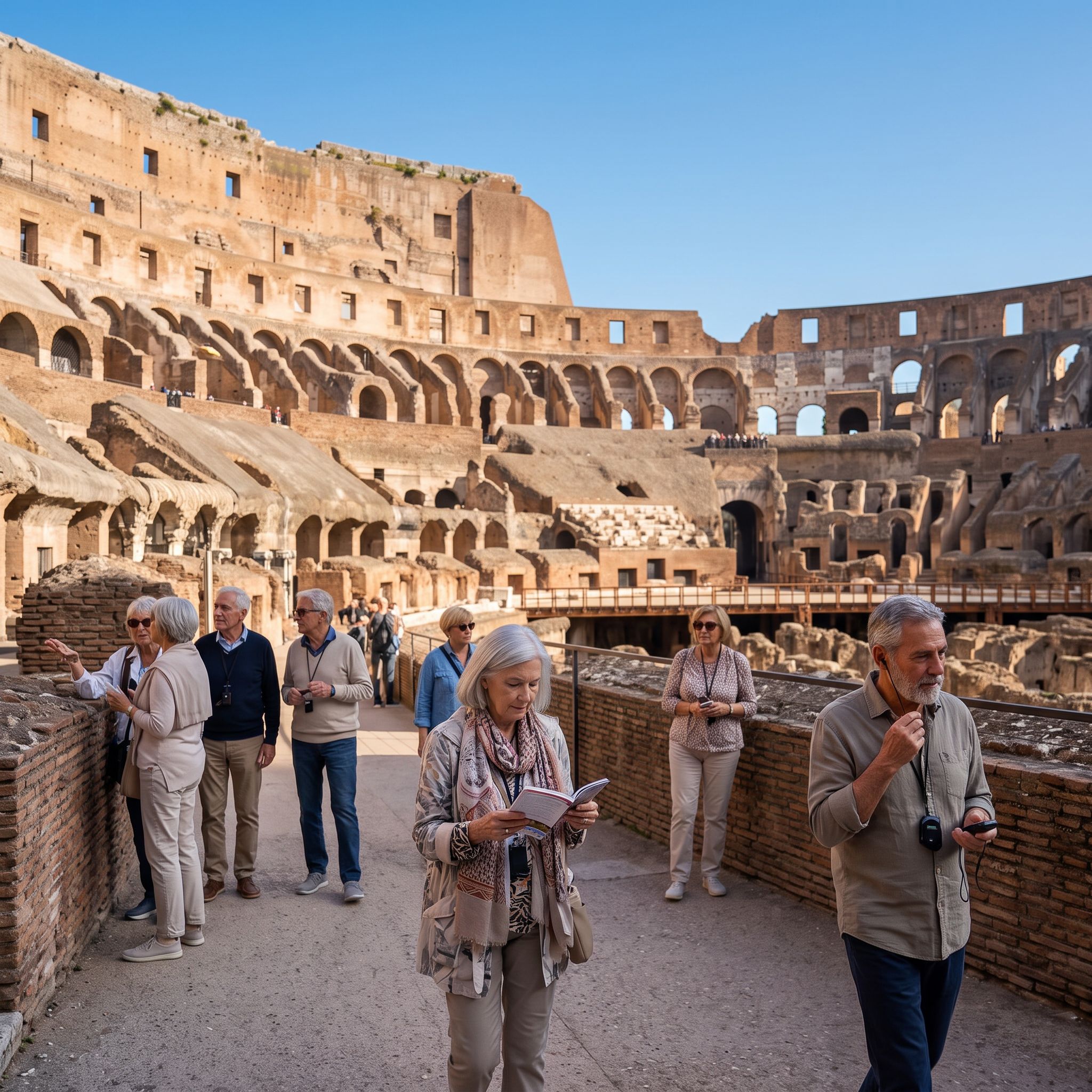
Small groups are the format most often recommended for this site. Guest feedback reports that groups of around 12 to 15 people are easier to follow than larger ones, and that guided tours add substantial context. The underground hypogeum and arena floor are singled out by those who booked those areas.
"We got small group and be able to go underground with a guide who is an experience archeologist, we love all the stories and opinions that he said as an archeologist." — a guest wrote on Google in September 2026
Heat is the recurring physical complaint. The site is largely open and unshaded, and summer visits are reported as very hot. Visitors recommend bringing water, a hat or umbrella for the queue, and a handheld fan, and advise comfortable shoes because most of the visit is spent walking or standing. Early morning or late afternoon entry is repeatedly recommended to avoid the worst of the heat and the queues. The Colosseum's official schedule includes separate evening and night product times on Tuesdays, Thursdays and Fridays in the season shown, which is worth checking if you would rather tour after the heat has passed.
What does "skip the line" actually mean?
"Skip the line" in Rome usually means pre-booked timed entry, not a line-free experience. It removes the on-site ticket queue. It does not remove the security queue, and it does not guarantee a quiet gallery. Several travellers report learning this distinction only after arriving.
Forum discussions are consistent on the point: the skip-the-line benefit is mainly avoiding the on-site ticket queue, not security. Multiple posters say that advance booking gets you into the correct queue faster, and several mention that tour groups get a dedicated path or easier entry than walk-up visitors. One thread recommends reaching the Vatican Museums 15 to 20 minutes early, while another says 20 to 30 minutes early is safer because crowds and security can be confusing. The official Colosseum guidance is to arrive at the meeting point at least 15 minutes before your tour's stated start time.
There is a second distinction worth knowing. In forum discussions, travellers note that the shortcut from the Sistine Chapel to St Peter's Basilica is for tour groups, while independent visitors still have to go back out and join the Basilica line. That shortcut is a real advantage of a guided Vatican visit, and it is not something a standard ticket delivers.
On sourcing, several Reddit posters advise buying directly from the Vatican rather than through resellers, because third-party sellers may charge more and still cannot avoid security. One Reddit post notes that the quality of a Viator booking depends on the actual operator, which is why some travellers compare suppliers carefully even when booking through a large platform. That is a reasonable habit for any Rome tour purchase.
What do Rome guided tours cost?
Published prices range widely by format. Group tours run from around €55 per person for the Colosseum route and €65 per person for the Vatican route. Private tours run from roughly €420 to €595 per group depending on operator and itinerary. Rates are indicative and vary by season and booking channel.
AllTours Rome publishes €55 per person for the Colosseum, Roman Forum and Palatine Hill route and €65 per person for the Vatican Museums and Sistine Chapel route in group format, and €450 per group for the Colosseum route and €500 per group for the Vatican route in private format. Real Rome Tours lists a private Colosseum and Roman Forum tour from €470 for one to two participants, with extra charges for additional adults and children, and a private Vatican tour from €595 for one to two participants. Official Guides quotes a Colosseum Underground, Palatine Hill and Roman Forum private tour at €420 total for up to 8 people, and a Classic Rome private day combining Colosseum, Roman Forum, Pantheon and Trevi Fountain at €580 total for up to 8 people.
Guide-only rates are a separate line item. AllTours Rome says a private guide for walking tours is typically €180 to €300 per group for three hours, and a full-day private guide €400 to €600 per group plus tickets. Official Guides gives half-day private guiding at €240 to €390 per group and full-day private guiding at €460 to €590 per group, with museum entry tickets, transport and meals not included. A full-day private driver-guide day is quoted at €700 to €1,000 per group, with vehicle, driver and fuel included, while the licensed guide for sites is an extra charge if requested.
What about mobility, walking and stamina?
Walking load is the main variable across Rome tours, and operators do not standardise stamina levels. VaticanTour.com states plainly that all its semi-private tours are classed as walking tours, and asks anyone with a walking disability or wheelchair to contact them personally, because some tours may only be available as a private tour. That is the model to expect across the market.
Ask about walking time, stairs and standing time before booking. The published Rome pages give duration and vehicle format but do not standardise stamina levels across operators. Ask whether the itinerary includes actual entry to the Colosseum or Vatican Museums, because at least one golf-cart operator states its short tour is sightseeing only and does not enter ticketed sites. Ask whether the guide includes the dome ascent or only the basilica and terrace, because the dome involves many stairs even after the lift to the terrace. Published Rome visitor guidance says the basilica itself is largely navigable for wheelchair users and that the most accessible entry is via a mechanised ramp near the right-hand side of St Peter's Square, but the dome is not wheelchair accessible and the upper climb remains strenuous.
Guest feedback describes the Vatican as "not particularly accessibility-friendly", with significant walking and numerous staircases, and one review describes a disabled visitor having to contend with crowds around the lifts and being misdirected by guards. Reviews also note that elevators are available for disabled and elderly visitors and that staff were described as extremely helpful. Both things can be true in the same building, which is why the specific route matters more than the general reputation.
For the Colosseum area, accessibility specifics are not documented on the surfaced opening-times page for the Colosseum, Roman Forum and Palatine, according to the Parco archeologico del Colosseo. Ask the operator directly about uneven paving, standing periods and the fixed entry times at the archaeological site.
How do I get to the meeting points?
Rome's public transport is broadly accessible on paper. ATAC states that 100% of buses have boarding platforms and wheelchair areas, that 70% of trams have platform-level floors, and that all metro stations are accessible except Spagna, Barberini, Repubblica and Vittorio Emanuele on Metro A. Metro A also has a booking service for stair lifts or wheelchairs.
Two exceptions matter for tour planning. Trains on the Termini-Centocelle line are not accessible, and ATAC states that accessible journeys there are provided by bus line 105. And the four Metro A stations named above lack lifts or stair lifts, which is relevant because Metro A serves the Vatican, Spanish Steps and Termini approaches, the corridors most tour itineraries use.
Construction has added a second layer of uncertainty. Colosseo/Fori Imperiali and Porta Metronia, two new Metro C archeo-stations, opened in December 2025, improving access in the historic centre, according to a Webuild press note. A further phase of Metro C was awarded in 2025, with later reporting noting that work continued at Venezia station. Piazza Venezia has been heavily affected by excavation for the new station, with Reuters reporting it had been largely inaccessible to vehicles and that the station was not expected to open for a decade. Walking and coach itineraries in the historic centre have faced construction pinch points around Piazza Venezia, Piazza Navona and the Pantheon area.
ATAC's customer service page lists ticket and pass information and mobility information, and provides route and timetable details via Infoatac and ChiamaRoma. It does not document senior or over-65 discounts retrieved, and no Rome-wide senior fare for public transport is documented here. One Rome transport and tourism page states there are no generalised reduced fares for elderly tourists unless they are registered residents of Rome. Treat any senior discount you see advertised as something to confirm at the ticket office.
What should I ask before booking?
Ask five things before you pay: whether the tour is truly private, small group or mixed-format; whether tickets are included; whether the itinerary enters the ticketed sites; what the walking, stair and standing load is; and where the meeting point is. Rome listings differ sharply on all five, and the answers change the value of the booking.
On format, the range is wide. Some listings are private only, while others cap the group at 14 or 15 people, and one Vatican product caps at 6. Ask for the number in writing. On tickets, Rome guide pages state that tickets and transport are often separate, so a guide-only quote is not comparable to an all-inclusive one.
On meeting points and pickup, ask directly. Some Rome golf-cart tours start from central meeting points while others offer pickup only within the historic centre inside the Aurelian Wall. If you are staying outside that boundary, the difference is a taxi ride at your own cost.
On credentials, several Rome listings explicitly advertise licensed or official Rome tour guides and skip-the-line access. Ask whether the guide is licensed and whether the entry is official or reserved. On scheduling, ask whether the itinerary runs early morning, evening or shoulder season, since official Colosseum hours vary by date and evening products are separate from daytime entry. Ask whether the booking includes a timed entry ticket and whether any city pass still requires separate reservation, because the Colosseum's official rules state that Roma Pass holders must book admission in advance.
Two further questions are worth adding. Ask whether the operator offers wheelchair-friendly routing, because the Vatican Museums permit wheelchairs and run accessible circuits, but some areas remain restricted and may require transfer to a standard wheelchair. And ask about cancellation terms, which are not documented in the retrieved source material for the named tour services, so the operator's own booking page is the place to check.
When should I book, and what about the calendar?
Book well ahead for the Vatican and the Colosseum. The Vatican Museums are open Monday to Saturday, closed on Sundays except the last Sunday of each month, which is free entry and described by Through Eternity as the busiest day. The Colosseum's summer hours run to 19:15, with shorter winter hours.
The Vatican Museums' visitor page gives Monday to Saturday 8:00 to 20:00 and last Sunday of the month 9:00 to 14:00, with closures on Sundays except the last Sunday and on several feast days. The Vatican Museums' own pricing page notes that the free last-Sunday entry is subject to the calendar of museum openings and closures. Note that sources differ on the full opening calendar; confirm the date you plan to visit directly with the Vatican Museums before booking a tour around it.
On the Colosseum side, the surfaced page gives seasonal hours for 29 March to 30 September 2026, with the Colosseum opening at 8:30 and closing at 19:15, and closure on 25 December 2026. Free admission applies on the first Sunday of the month and on a few national dates such as 25 April, 2 June and 4 November, according to the Parco archeologico del Colosseo. A colosseum.roma.it page notes that exceptional closures can happen for events, urgent maintenance or authority decisions, though the exact day is not predictable from that statement alone.
One Vatican scheduling quirk is worth knowing before you choose a day. A Musement Vatican tour notes that the special access passage between the Sistine Chapel and St Peter's Basilica is closed on Wednesday mornings and during some celebrations, including Easter ceremonies, and that the tour explores more Vatican Museums galleries on closure days instead. If the Basilica shortcut is a reason you are booking, check the day of the week. For a wider view of how Rome's calendar shapes crowds, see Rome through the year: festivals, holy days and quiet seasons.
What practical preparations matter most?
Supportive walking shoes are the single most defensible preparation. Rome's walking environments include cobblestones and access constraints at some sites and stations. A modest outfit covering shoulders and knees is required for Vatican entry. Emergency numbers are 112 for police and fire, 118 for doctor on duty and ambulance, and 060606 for Roma Capitale's call centre.
On clothing, the Vatican dress code is enforced, so pack a layer that covers shoulders and knees even in summer. On footwear, the terrain guidance points to cobblestones and uneven paving, which makes sturdy shoes the priority over anything fashionable. For a fuller packing treatment, see packing for Rome: shoes, cobbles and summer heat.
On health, the retrieved sources do not document the nearest pharmacy or clinic for Rome as a whole, so that level of detail is not confirmed here. What is documented is the emergency number set above. If you take regular medication, plan to carry it with you rather than relying on finding a pharmacy mid-tour.
On terrain, the retrieved sources do not give a general official assessment of bench availability or a citywide cobblestone severity ranking. What is documented is that some Vatican-area tours begin at steps near the Vatican Museums, and at least one meeting point is at the bottom of the steps across from the museum entrance. That is a mobility planning detail, not a general statement about the city.
On booking ease, Rome's tour market is well served by customer care lines. Through Eternity offers customer care by phone, and ATAC provides mobility information and assistance via ChiamaRoma and Infoatac. For travellers who prefer organised travel, that support structure is part of what you are paying for, and it is worth testing with a question before you commit to a booking.
How do I match a tour to my own stamina?
Match the format to the site, not to the price. The Vatican Museums and the Colosseum area are the two sites where walking and standing load is highest, so those are where a private or tightly capped small group earns its premium. For a single piazza or a short evening circuit, a golf cart or a short walking tour is enough.
A workable approach is to rank your days by physical demand before you book anything. The Vatican Museums, with 7 km of routes across two floors, sit at the top. The Colosseum, Forum and Palatine combined visit takes most of a day and is largely open and unshaded. A golf-cart circuit of the historic centre involves minimal walking and is singled out in guest feedback as especially good for people over 60. One Tripadvisor review of a Rome Highlights golf-cart private tour praises a guide who "can accommodate all the needs" and a tour customised around walking ability.
There is one caution from the review sets worth carrying into any booking. Rome & Italy Travel reviews describe the Vatican and Colosseum as "very rushed", with guests saying they would have liked more time to stop and enjoy the sites. That is a pacing complaint, not a verdict on the operator, and it is the reason to ask about time inside each site rather than only about the total tour duration. A tour that lists three monuments in three hours is telling you something about how long you will stand in front of each one.
Finally, book the format that lets you stop. Guest feedback repeatedly favours small-group and private formats because they allow guests to pause, ask questions and avoid the stress of navigating crowded entrances alone. For travellers aged 50 to 70 who prefer organised travel, that ability to pause is the feature worth paying for, more than any single inclusion on the itinerary.


