
Rome rewards the unhurried. The centro storico packs some of the world's most recognisable squares into a space so compact that the Pantheon and Piazza Navona sit roughly 300 metres apart, a walk of four to five minutes through narrow, largely pedestrianised streets. For travellers aged 50-70 who want the pleasure of wandering without the exhaustion of a forced march, the city offers a handful of genuinely gentle circuits: the Navona, Pantheon and Campo de' Fiori triangle, the quieter lanes toward Tiber Island and Trastevere, and the shaded, paved avenues of Villa Borghese.
This guide covers flat or gently level strolls only. It gives distances, surface notes, shade and bench information, and places to pause. It does not cover long walking tours or the more uneven archaeological terrain, and where a subject has its own dedicated guide, that is noted. The aim is simple: to help you plan a day of short, rewarding walks with a coffee or a bench never far away.
Can you walk around Rome easily?
Yes, in the historic centre, provided you choose your route. The centro storico's headline sights cluster within a few hundred metres of each other, and much of the area is pedestrianised. The catch is the surface: many streets are paved in sampietrini, small basalt blocks that have settled unevenly over time, so a short walk can demand more attention than its distance suggests.
The practical answer is to walk in short hops and treat the city as a series of small, linked stages rather than one continuous route. One accessibility source suggests planning 4 to 6 km per day as a reasonable target for limited mobility, noting that Rome's major attraction clusters are compact but separated by challenging streets. That figure is a ceiling, not a target to chase.
Several forum contributors who travel in this age bracket describe the centre as easier than newcomers expect, precisely because so much of it is closed to traffic. A Rick Steves forum post notes that the "Centro Storico anywhere", meaning Campo de' Fiori, Piazza Navona, the Pantheon, Trevi Fountain and Piazza di Spagna, is mostly pedestrianised, so there is little to worry about from cars or mopeds. The same thread stresses mixing walking with pauses in piazzas and cafés rather than planning long continuous hikes.
What is the easiest centro storico circuit?
The most reliable gentle circuit links Piazza Navona, the Pantheon and Campo de' Fiori. Published route pages give the whole loop as roughly 2.4 to 2.5 km, taking two to three hours at an unhurried pace. The straight-line distances between the three squares are only a few hundred metres each, and the route is almost entirely pedestrianised.
The Pantheon sits at Piazza della Rotonda in the historic centre, and the operator's own guide notes there is no metro station directly at it. The closest is Barberini on Line A, about 1 km away, a 12 to 15 minute walk. By bus, the nearest stop is Largo di Torre Argentina, served by lines 30, 40, 46, 62, 64, 81, 87 and 492, a four-minute walk from the entrance.
From the Pantheon, Piazza Navona is a five-minute walk, and Campo de' Fiori is eight minutes. The Pantheon to Piazza Navona route is direct and entirely pedestrianised, though the surface is cobblestone. A slightly longer variant of seven to eight minutes leaves the Pantheon piazza to the northwest via Via del Salvatore, passes the small church of Sant'Agostino (which holds Caravaggio's Madonna of the Pilgrims), and arrives at Piazza Navona's northern end. If you prefer the smoother option, one accessibility page recommends using Corso del Rinascimento rather than the narrow side streets when moving between the Pantheon and Piazza Navona.
 AI-edited
Within a 15-minute radius on foot of the Pantheon you also have the Trevi Fountain (10 minutes), the Temple of Hadrian (3 minutes), Sant'Ignazio church (3 minutes) and Largo di Torre Argentina (5 minutes). The operator's guide suggests a half-day of three to four hours comfortably covers the Pantheon plus three or four of these stops.
Is Piazza Navona easier to walk than the surrounding streets?
Yes. Piazza Navona is notably smoother than the surrounding centro storico because its surface is made of large stone slabs rather than small cobblestones. That makes it one of the most comfortable squares in the city to cross on foot, and a natural place to pause.
One accessibility source describes Piazza Navona as smoother than many nearby streets for exactly this reason. The square is also described in route guides as an open space and a natural pause, which is how it functions best: a wide, level place to sit, watch and rest before continuing.
Two practical notes for planning. First, the square's fountains were covered for restoration according to a July 2024 Reuters report, which directly affects one of the city's most scenic strolls. Check the current state of the fountains before you build a visit around them. Second, the surrounding streets are the ones to watch: the historic centre is repeatedly described as difficult because of sampietrini cobblestones, narrow sidewalks and uneven surfaces that are tiring and potentially trip-hazardous.
Campo de' Fiori is reached by a walk of about five minutes from Piazza Navona. One route page calls Corso Vittorio Emanuele II the only busy road on the whole itinerary, which is useful if you want to minimise difficult crossings. The streets between Piazza Navona and Campo de' Fiori are described as narrow, shaded and relatively quiet.
When is Campo de' Fiori at its best?
Campo de' Fiori is a market square, and the market runs Monday through Saturday from approximately 07:00 to 14:00. Arriving in the morning gives you the market at full strength and the square at its most characterful. By early afternoon the stalls are packing away and the square shifts to its café and evening character.
The operator's half-day itinerary describes Campo de' Fiori as Rome's most characterful market square, operating a daily produce and food market Monday through Saturday from approximately 07:00 to 14:00. Route pages present it as a lunch stop with the market active into early afternoon, which fits neatly with a morning circuit that begins at the Pantheon or Piazza Navona.
For a gentle day, the natural sequence is to start at the Pantheon early, walk the five minutes to Piazza Navona, pause there, then continue the five minutes to Campo de' Fiori for lunch. That is a total walking distance of well under a kilometre between the three stops, with two substantial squares in which to sit down.
Are the Tiber Island and Trastevere lanes an easy stroll?
Trastevere is consistently described as narrow, heavily cobbled and the least accessible central area for walking. Viale di Trastevere, the main artery, is flatter and more usable than the side lanes. The exact Tiber Island and Trastevere lanes circuit has no published route length, bench count or shade notes in the material reviewed.
That is an honest limitation rather than a warning. One Rome walking compilation lists "The Pantheon to Trastevere via Piazza Navona" and "A walk above and around Trastevere" as recognised strolling areas, but it does not publish the exact route length or facilities for the precise Tiber Island and Trastevere combination. A route-length and amenities description for that exact circuit is not documented.
A Rick Steves forum post describes Trastevere as a lot quieter for strolling, with fewer cars and scooters than areas near the Pantheon and Colosseum. Another forum post recommends starting in Testaccio and strolling along the Tiber, including a street-level path toward Isola Tiberina, with a route that can end in Trastevere via Ponte Sisto. Travellers who expected central Rome to be the easiest place to wander report finding Trastevere calmer for strolling and lingering.
If you go, treat Viale di Trastevere as your walking spine and dip into the side lanes only briefly. The cobbles in the lanes are the issue, not the distance.
Is Villa Borghese the best place for a shaded, bench-lined walk?
Villa Borghese is the strongest option for a low-exertion, shaded stroll. Turismo Roma states the park is open from dawn to dusk, that the roads are paved, and that accessibility services are available. An accessibility guide describes the main paths as paved with asphalt or smooth stone, wide enough for comfortable wheelchair use, with benches at regular intervals.
The park is free to enter, and reviewers consistently describe it as a calm break from the noise and crowds of central Rome. It is reachable on foot in about 15 minutes from the Spanish Steps, or by metro Line A to the Piazza di Spagna stop. Cafés, snack stands and public toilets are available inside the park.
Shade is a genuine feature here rather than an afterthought. A Rome ticketing guide describes Villa Borghese as having shaded pathways, gently sloping lawns, benches for quiet reflection and plenty of shaded spots. Turismo Roma notes the villa contains buildings, sculptures, monuments and fountains by Baroque, Neoclassical and Eclectic artists, surrounded by ancient trees, ponds, Italian gardens and large open spaces.
"It is beyond beautiful, perfect if you are looking to spend the morning in a quiet place far from the noise of the city. There are also multiple fountains so you can hydrate yourself." (Google, 5/5, July 2026)
Two planning notes. The park is very large, and reviewers note it is easy to lose your bearings, so a map helps. Weekends and holidays are crowded, and the rowboat queue on the small lake can run long. Rental options inside the park include bikes, pedal carts, golf carts and rowboats on the small lake, at about €5 for 20 minutes according to guest reviews. The Galleria Borghese requires advance booking, and reviewers report tickets selling out weeks or months ahead.
As of September 2026, Villa Borghese holds a Google rating of 4.6 out of 5 from 95,780 reviews. The Pantheon, for comparison, holds 4.8 out of 5 from 287,068 reviews.
What should I know before visiting the Pantheon?
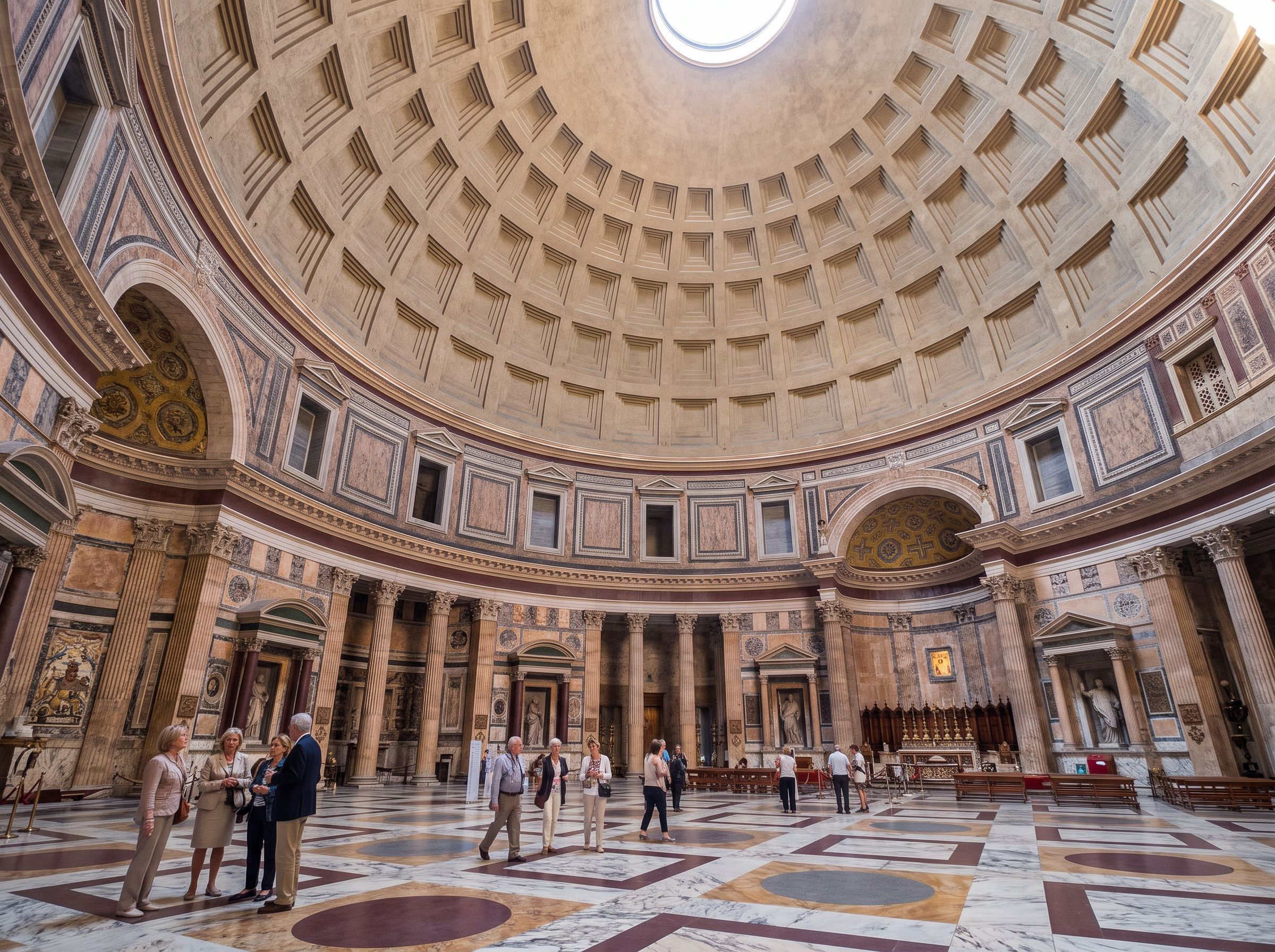
The Pantheon is one of Rome's most straightforward major monuments to enter. It has a level entrance from the piazza, with no steps reported at the main door. The visit is short, commonly about 30 to 60 minutes, and there is seating in the pews. It is an active church with a dress code covering shoulders and knees.
Entry is quick for those with pre-booked tickets, and staff are repeatedly described as helpful and efficient at keeping lines moving. Tickets can be bought on site at machines (card or contactless) or at a separate cash line, and reviewers recommend booking online in advance to avoid the longest queues. Arriving early in the morning or later in the evening means fewer crowds; midday and peak season are busy.
The interior dome, oculus and natural light are consistently described as the highlight, and the building is remarkably well preserved. Reviewers note the interior is calm and respectful despite crowds.
"The queue gets long quickly, so aim to go early. The ticket machines are intuitive and easy to use, and digital payments are fully accepted. So what are you waiting for?" (Google, 5/5, August 2026)
a July 2024 Reuters report noted the fountain outside the Pantheon was under restoration, affecting a classic gentle-stroll stop near the historic centre. Check before you plan a pause there.
What should travellers 50-70 plan around?
Four things matter most: mobility, health, safety and ease of booking.
On mobility, the key facts are the surfaces. The streets of the historic centre are largely cobbled, and the sampietrini are uneven and can be difficult to manage. Piazza Navona is smoother because of its larger stone slabs. Villa Borghese has paved roads and regular benches. Trastevere's side lanes are the least accessible central area, with Viale di Trastevere flatter and more usable.
One Fodors forum post warns that some streets have poor lighting and no sidewalks, making them less comfortable after dark. Nearest pharmacy and medical-help locations are not documented for these walking areas.
On booking, Rome city museums offer online pre-sale, call-centre booking and ticket-counter purchase, with a pre-sale fee of €1 for certain methods, according to the official Museo di Roma tickets page. The Galleria Borghese requires advance booking, and reviewers report tickets selling out weeks or months ahead. The Borghese Gallery is closed Mondays and on 1 January and 25 December.
On transport, a standard ATAC single ticket costs €1.50 and is valid for 100 minutes on all buses, trams and the metro. Rome's Metrebus urban fare is a flat €1.50 per ride, with a €8.50 daily cap on tap-and-go. Elderly concessions exist only for residents: annual discounted passes for over-65 residents with income conditions, and a free annual pass for over-70 residents with lower income conditions. There are no general reduced fares for elderly tourists unless they are registered residents of Rome.
When is the best time to stroll?
Early morning and evening are the calmest times, and spring or autumn are the most comfortable seasons. One source recommends early morning and evening over midday, and another suggests spring or autumn travel for comfort. These are general recommendations rather than month-by-month rules for the specific circuits covered here.
No official season-by-month walking rule is documented for the Navona, Pantheon and Campo de' Fiori circuit beyond opening hours and the surface and accessibility notes. The same is true for the Tiber Island and Trastevere lanes. Villa Borghese's only published seasonal rule is dawn to dusk.
If you want the squares at their quietest, the early morning window before the tour groups arrive is the one to take.
For the wider city, the most walk-friendly improvements reported are Piazza Pia, reopened as a fully pedestrianised square, and Piazza San Giovanni in Laterano, newly renovated and reopened in late 2024 with new paving, lighting, ground-level fountains and greenery. The biggest walk disruptions reported are Piazza Venezia, where Metro C excavation has left the area under major construction, and Piazza Navona, where the fountains were covered for restoration.
If you want to see more of Rome without adding walking, our guide to seeing Rome with little walking covers the low-exertion options in detail. For the practical business of moving between these areas, getting around Rome by metro, bus and taxi sets out the fares and routes. And if you would rather have company and a guide, small-group and guided tours of Rome for older travellers covers what to look for.
Where should I stay for these strolls?
Properties around Piazza Navona, the Pantheon, Piazza di Spagna and Via del Corso are repeatedly reported in guest reviews as excellent central locations for reaching major sights on foot. The trade-off is night-time noise, which is the most common complaint across the reviewed Rome properties, especially from piazza-facing rooms.
Reviews mention traffic, recycling trucks, street cleaners, diners and performers keeping the area noisy late into the night. Sleep quality suffers when soundproofing is weak or external noise is strong. The practical response is to ask for a room away from the square when booking, and to check whether the windows are double-glazed.
Access can be manageable in some places, with lifts available at several properties. Guest reviews specifically note that at Hotel Abruzzi near the Pantheon, the windows blocked outside noise well and allowed restful nights, and that the breakfast is served near the Pantheon. The same reviews note the lift starts on the first floor, which is worth knowing if stairs are a concern. Hotel Piazza di Spagna draws repeated praise for friendly and helpful staff, a generous breakfast for Italian standards, and very comfortable beds, with reviews explicitly describing repeat and happy guests.
Across the wider review set, recurring practical points include narrow lifts in historic buildings, occasional hot-water or shower-door problems, and breakfast that is sometimes described as limited or repetitive. Ask specifically about lift access, shower configuration and room position when you book.
For the official accessibility framing, Turismo Roma states that its accessible information is for people with disabilities or special needs, seniors, and families with children, and publishes detailed and verified accessibility information for cultural places in Rome. For Villa Borghese specifically, Turismo Roma's official listing confirms the park is open from dawn to dusk, that the roads are paved, and that accessibility services are available.
If you are planning to combine these strolls with time outside the city, our day trips from Rome for senior travellers covers the options that do not demand a long day on your feet.


