
Rome rewards the traveller who slows down. Away from the ticket queues and the marble corridors, the city keeps a set of green rooms where the afternoon can be spent sitting rather than striding: the broad, free acres of Villa Borghese with its little lake, the small Aventine garden that looks out over the rooftops, and the long, quiet expanse of Villa Doria Pamphilj across the river. Each suits a different kind of rest, and each can be reached without a car. This guide covers what the ground is like underfoot, where the benches and shade are, and how to arrive without exhausting yourself before you sit down.
For travellers aged 50 to 70 planning a gentler Roman day, the useful distinction is not which garden is prettiest but which one matches your energy on the day. One is compact and scenic, one is large and paved, one is spacious and partly sloping. All three are free to enter. None requires a reservation for the grounds themselves.
Which Rome park suits a restful afternoon?
Villa Borghese is the easiest choice for a long, gentle afternoon: the grounds are free, the main avenues are paved, and benches are placed along the way. The Giardino degli Aranci is the shortest and most scenic stop, a compact hilltop garden. Villa Doria Pamphilj is the roomiest and quietest, but its paths include gravel and slope.
The city tourism portal describes Villa Borghese as open from dawn to dusk and notes that accessibility services are available (Turismo Roma's Villa Borghese page). It is a historic villa-and-garden ensemble rather than a single garden, covering 30 hectares with more than 90 points of interest inside its borders, including the Borghese Gallery, the Bioparco zoo, museums and monuments. That scale is the point: you can walk ten minutes and sit down, or walk an hour and still be inside the same park.
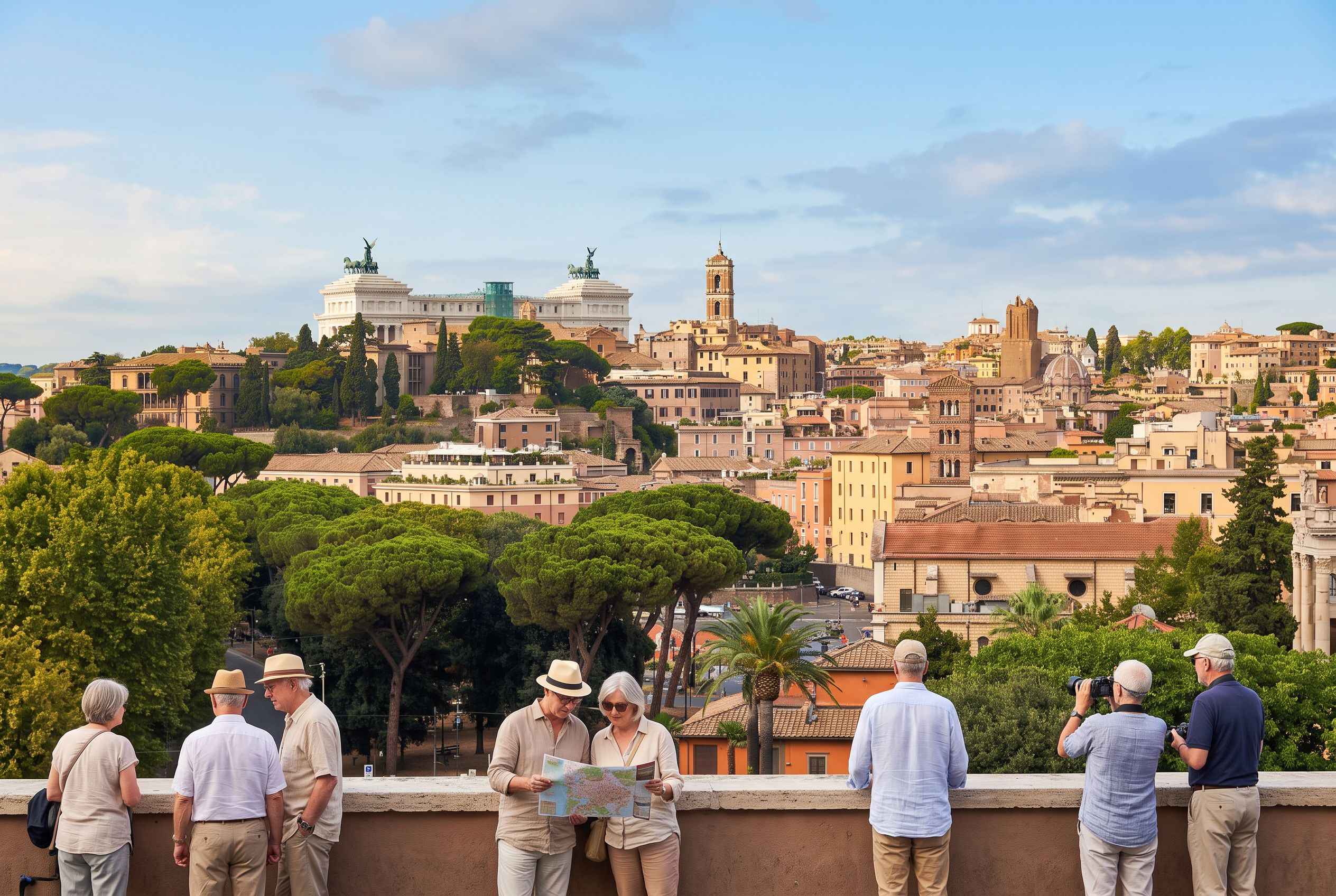
The Giardino degli Aranci sits on the Aventine, at Piazza Pietro d'Illiria, and Turismo Roma publishes it as part of the city's official sightseeing network. It is a small, elevated viewpoint garden rather than a walking ground, and its appeal is the outlook rather than the distance covered.
Villa Doria Pamphilj, entered at Via di San Pancrazio among other gates, is the largest and least visited of the three. Turismo Roma describes its paths as gravel, partly on a slope. For a slow walk with frequent pauses, that terrain is manageable on the flatter stretches and worth planning around on the inclines.
 AI-edited
How do you reach Villa Borghese without a long walk?
Villa Borghese has nine entrances, so the gentlest approach is to pick the gate nearest your transport rather than the park's centre. Two metro stations sit less than a kilometre from an entrance gate, and tram number 2 stops right outside. Metro Line A at Flaminio and Spagna both serve park edges.
The size of the park is exactly why the entrance matters. As the operator's own visitor information puts it, the large area covered by Villa Borghese justifies nine entrances. Arriving at the wrong one can add a kilometre before you have seen anything.
Published guidance for reaching the Borghese Gallery, which sits inside the park at Piazzale Scipione Borghese 5, notes that the best entry in terms of terrain is along Via Pinciana from Via Veneto. That is worth knowing even if you are skipping the gallery, because it is the flattest documented approach to the park's central zone. The same guidance puts the walk from Piazza del Popolo or the Spanish Steps at approximately 25 to 30 minutes, a scenic and pleasant stroll rather than a short hop.
For the wider picture of buses, trams and metro lines across the city, our guide to getting around Rome by metro, bus, taxi and on foot sets out the options in more detail. If your priority is minimising steps altogether, seeing Rome with little walking covers the low-exertion approaches.
What is the ground like underfoot in Villa Borghese?
The main circulation routes are broad and paved, and the Galleria Borghese's own accessibility page notes that the surrounding gardens offer paved walkways, though some paths may be uneven. Secondary paths can be gravel or dirt. Benches appear at regular intervals along the main routes, which suits anyone who needs to pause often.
This is the most useful thing to know before you go. The park's principal avenues are comfortable for a steady, unhurried walk. The narrower paths that branch off them are a different surface, and after rain the unpaved sections can become muddy. If you are walking with a stick, a rollator or simply a preference for certainty underfoot, staying on the wide avenues gives you the easier afternoon.
The city tourism portal notes that the park has no dedicated adapted route documented, while confirming that the roads themselves are paved. That distinction matters: the surface is good, but there is no signposted accessible circuit. Plan your own line along the main avenues rather than expecting a marked one.
Guest feedback across the review set consistently describes wide, flat, shaded paths and abundant benches, with rental bikes, pedal carts, golf carts and scooters available for covering the grounds. That last point is worth taking seriously. Forum advice from visitors repeatedly suggests renting a bike, surrey or golf cart rather than expecting to cross the whole park on foot. For a restful afternoon, a pedal cart turns a long walk into a seated one.
One accessibility guide documents wheelchair, bicycle and mobility-scooter rentals near the Pincio entrance and near the lake. The city tourism portal does not confirm these rental points, so treat them as likely rather than guaranteed and check on arrival.
What is there to do at the Villa Borghese lake?
The artificial lake, near the Bilotti Museum, is the park's quiet centrepiece. Boat rental runs daily from 9:30 until dusk, though hours can vary with the weather. The ticket costs 3 euros for adults for 20 minutes, and 1.50 euros for children. Accessible toilets are documented near the lake boathouse area.
Rowing on the Laghetto is the classic gentle pleasure here, and it is priced as a small one. The operator's own FAQ gives the figures directly: the artificial lake is near the Bilotti Museum, the ticket costs 3 euros for adults for 20 minutes, and the children's fee is 1.50 euros. The same page states that the boat rental service is available every day from 9:30 am until dusk, with the caveat that opening hours can vary depending on the weather.
Guest reviews add a second option: a pedal-boat rental at around 15 euros per hour, alongside the rowboats at about 5 euros per person for 20 minutes. Those figures come from guest feedback rather than the operator, so treat them as indicative and confirm at the boathouse.
The lake area is also where the park's practical provisions cluster. Accessible toilets are documented near the boathouse, and main paths link the lake with the other major sights inside the park. Cafés, snack stands and drinking fountains are inside the park, and toilets are available, though some are paid and require coins. Carry a few coins.
"It is beyond beautiful, perfect if you are looking to spend the morning in a quiet place far from the noise of the city. There are also multiple fountains so you can hydrate yourself." (Google, July 2026)
The one planning note: the park is very crowded on weekends and holidays, and the lake boat rental can draw long queues. A weekday morning is the calmer proposition.
Is the Orange Garden worth the climb?
The Giardino degli Aranci is a compact, elevated garden on the Aventine, and its reward is the view over Rome rather than any distance walked. It opens daily, with hours of 7:00 to 18:00 from October to February, 7:00 to 20:00 from March to September, and 7:00 to 21:00 from April to August.
This is the shortest of the three outings and, for many visitors, the most rewarding per step. Because it is a hilltop garden rather than a park, the experience is about pacing slowly, pausing and looking out. There is no circuit to complete and no far gate to reach.
What the records do not document is as important as what they do. Those specifics should be treated as not documented and confirmed locally rather than assumed in either direction. If you need a guaranteed seat, plan for the possibility that you will be standing at the viewpoint.
The garden's location at Piazza Pietro d'Illiria places it within the Aventine's quiet streets, which are themselves pleasant for a slow wander. If you are building an afternoon around gentle strolling rather than parkland, our guide to Rome's prettiest piazzas and easy strolls covers the surrounding walking territory.
What should you expect at Villa Doria Pamphilj?
Villa Doria Pamphilj is open from dawn to dusk and admission is free, with accessibility services noted by the city tourism portal. Its paths are gravel, partly on a slope, and there is no metro stop nearby. Buses 870, 781 and H serve the park, and line 8 connects Piazza Venezia to Monteverde.
This is the park for travellers who want space and quiet rather than a central address. It is large enough that the crowd thins quickly once you are past the gate, and the open stretches allow for slow walking with frequent stops.
The terrain is the trade-off. Turismo Roma describes the paths as gravel, partly on a slope, and points readers to the city's accessible section for fuller mobility information. That is planning information, not a warning: the flatter open stretches are comfortable, and the sloping gravel sections are the ones to approach deliberately. Footwear with a decent sole makes more difference here than in the other two gardens.
Arriving takes a little more thought. There are no metro stops directly near Villa Doria Pamphilj. The closest are Cornelia on Line A and Piramide on Line B, from which you continue by bus. Several buses serve the park, including 870, 781 and H, and line 8 connects Piazza Venezia to Monteverde, with alighting at San Pancrazio giving easy entry through the Via di San Pancrazio gate.
Published seasonal hours for the park run 7:00 am to 6:00 pm from October to February, 7:00 am to 8:00 pm from March to September, and 7:00 am to 9:00 pm from April to August. Note that the city tourism portal gives the simpler dawn-to-dusk formulation, so check locally on the day.
When are Rome's parks quietest?
Weekday mornings are the calmest window across all three gardens. Villa Borghese is very crowded on weekends and holidays, and its boat rental draws long queues. The Galleria Borghese's own accessibility page states that early-morning time slots are generally quieter and more comfortable, a principle that holds for the park outside it too.
No official source documents a formal calm-hours policy for Villa Borghese, so this is inference from what is published rather than a rule. What is documented is the crowd pattern: guest feedback consistently reports heavy weekend and holiday use, and the lake boat rental as a bottleneck.
Forum discussion of Rome's quieter green spaces suggests the Botanical Garden and the Baths of Caracalla as calmer alternatives to the famous central parks, while noting that even quieter spots can fill on weekends, especially scenic lookouts. If calm is the priority over convenience, that trade is worth considering.
For a restful afternoon, the practical sequence is straightforward. Arrive before midday, take the main paved avenues rather than the branch paths, sit at the lake or the Pincio terrace, and leave before the late-afternoon surge. The park is open every day from dawn to dusk according to the operator's FAQ, so there is no closing time pressing you out early.
What else is inside Villa Borghese?
The park holds more than gardens. The Galleria Borghese, at Piazzale Scipione Borghese 5, is a separate paid attraction with timed entry, advance booking required, and a Monday closure. It is open Tuesday to Sunday from 9:00 to 19:00, with last entry at 17:00, and only 360 people are admitted in each two-hour slot.
The gallery has its own dedicated guide, so this is a pointer rather than a section. Two facts are worth carrying, though, because they affect how you plan the park around it. First, tickets must be booked in advance, and they can sell out weeks or months ahead. Second, the gallery is closed on Mondays, 25 December and 1 January.
For anyone with mobility needs, the gallery publishes unusually clear information. Its accessibility page documents step-free access via the main entrance with assistance available on request, lifts connecting all exhibition levels, wheelchairs available free of charge on request, fully equipped accessible restrooms on the ground floor, and free entry for one accompanying visitor assisting a guest with disabilities (Galleria Borghese accessibility information). One accessibility guide notes that the elevator is small and may not fit large wheelchairs, so advance contact is advisable for specific mobility needs.
Also inside the park, the Museo Carlo Bilotti is documented by Musei in Comune as entirely accessible to people with disabilities, with a street-level entrance, an internal wheelchair available, and a platform stairway between floors. It is a lower-intensity cultural stop than the Borghese Gallery and needs no timed slot.
Recent restoration has added to the park's walkable space. The Giardino delle Erme reopened to the public in June 2024 after roughly four months of restoration, and the Loggia dei Vini returned to public use in June 2026 following phased work from 2024. The Loggia's reopening was tied to a contemporary art project, so it may feel busier than a purely quiet garden corner.
Practical notes for a restful afternoon
All three gardens are free to enter and none requires a booking for the grounds. Villa Borghese is open every day from dawn to dusk. Pets are allowed in the park. Emergency numbers in Rome are 112 for the unified emergency line, 113 for police, 118 for ambulance and medical emergency, and 115 for fire services.
Those emergency numbers are published by Rome tourism information (Rome emergency numbers). One source also lists the Rome Tourist Police at Via del Corso 482, telephone +39 06 6729 5287.
On health provisions, the records do not document a nearest pharmacy or a park-specific medical post for Villa Borghese, and none is documented for the other two gardens either. Carry what you normally need.
On cost, the picture is simple and worth stating plainly. Entry to all three gardens is free. The only published charges are the lake boat rental at 3 euros for adults for 20 minutes and 1.50 euros for children, and the separate admission for the Galleria Borghese and other attractions inside the park. No senior or over-65 fare is documented on the official pages for Villa Borghese park, the Galleria Borghese, the Giardino degli Aranci or Villa Doria Pamphilj, consistent with the gardens being open public parks.
One further note on the wider city: Rome's municipality launched a ten-year programme, "100 parchi per Roma," to recover and upgrade green areas, and reported in February 2024 that the first 21 interventions had been identified with 16 projects financed. RomaToday reported in August 2026 that nine construction sites had started. Some green spaces are therefore in active redevelopment rather than settled parkland, and conditions can change by area.
If you are extending your stay beyond the city, our guide to senior-friendly day trips from Rome covers the options that do not require a punishing journey.
Finally, a word on where to base yourself. Guest reviews of hotels around Villa Borghese consistently praise calm locations, comfortable beds and attentive service, with the recurring complaints being room size, occasional street or event noise, and breakfast pricing. If you are booking near the park, ask specifically about room size and whether any event space sits near your room. As of September 2026, Villa Borghese holds a Google rating of 4.6 out of 5 from 95,787 reviews.


