
Tuscany's thermal waters have drawn weary travellers for centuries, and for good reason. The mineral-rich springs around Saturnia and Bagno Vignoni offer genuine therapeutic benefits, from easing arthritic joints to improving circulation. But for travellers aged 50 to 70 seeking rest and wellness, the practical realities matter as much as the romance. The free cascades at Saturnia are iconic but demanding; the historic pool at Bagno Vignoni is beautiful but no longer open for bathing. This guide cuts through the hype to tell you exactly what to expect, how to prepare, and which option suits your mobility and comfort level.
 AI-edited
What are the main thermal bathing options in this region?
You have three distinct choices: the free Cascate del Mulino at Saturnia, the ticketed Terme di Saturnia day spa, and the historic village of Bagno Vignoni, where the famous central pool is for viewing only and bathing happens at nearby spa facilities.
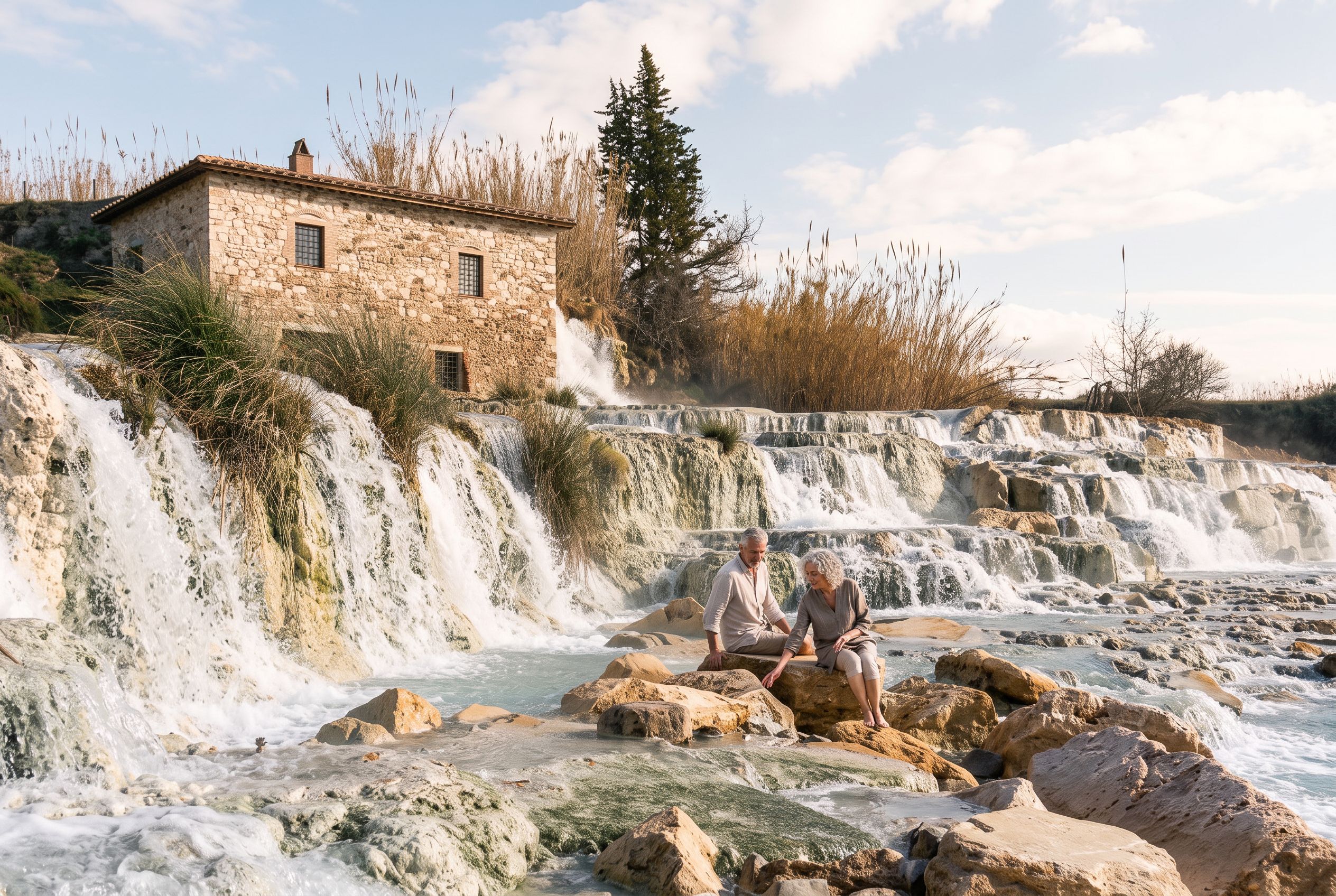
The free cascades at Saturnia are the most photographed and the most rustic. Water flows constantly over natural travertine terraces, leaving the spring at 37.5°C and filling a series of warm pools regardless of weather or season. There is no entrance gate, no fixed opening hours, and no admission fee. The site is open 24 hours a day, year-round.
About 60 kilometres north-east, Bagno Vignoni sits in the Val d'Orcia, a UNESCO World Heritage landscape; the drive takes roughly an hour and a quarter on rural roads. The village's centrepiece is a large rectangular pool in the piazza, filled with steaming thermal water. However, bathing has been prohibited since 2010, and the ban is wider than the basin itself: mayoral ordinance no. 22 of 31 March 2010 forbids bathing across the whole of the Parco dei Mulini below the village, with fines from €25 to €500. VisitTuscany, the regional tourist board, puts the practical upshot plainly: it is no longer possible to soak in the warm waters of the ancient pool, though bathing and spa treatments can still be enjoyed in the local accommodations.
For a structured wellness day with predictable facilities, the Terme di Saturnia resort offers day access to its thermal pools, changing rooms, and spa services. This is the option most suited to travellers who want comfort over adventure.
How do the free cascades compare to the ticketed spa at Saturnia?
The free Cascate del Mulino offer raw, natural beauty with minimal facilities and challenging terrain; the Terme di Saturnia day spa provides manicured pools, changing rooms, a hired towel-and-robe kit, and predictable access, at a significant price difference.
At the free cascades, you arrive at a parking area about 300 metres from the pools, five to ten minutes on foot. The walk is flat, and drivers can drop passengers closer before parking. The car park is run by the Comune di Manciano for cars and motorcycles only; campers are not admitted and use a dedicated camper area about a kilometre away. Parking costs €2.50 an hour and is charged between 8am and 8pm. It is also seasonal: the municipality keeps the area open about ten months of twelve and closes it in winter for maintenance, reopening on 27 March in 2026.
Once at the water, prepare for slippery, uneven rocks coated with a thin sulphur film. Local visitor guidance for the falls is blunt about it: the basins are shallow, but the rocks and the coated surface are dangerous, and walking barefoot on them is painful. Water shoes with grip are strongly recommended. The bar beside the falls runs the facilities: toilets and changing rooms are free, while the lockers need a €5 key deposit at the till and the showers are paid and take coins. Many visitors still arrive with swimwear already on.
The ticketed Terme di Saturnia, by contrast, provides clean, well-maintained pools set in landscaped gardens, with sunbeds and parasols available to rent. The wellness kit with bathrobe and towel is not part of the basic day ticket; some entry formulas include it and reception hires kits out. The scheduled rituals are free for thermal park guests, subject to the day's programme and availability: gentle movement in water, meditation, immersive sound sessions, thermal mud rituals and heat ceremonies. There is a bistro on site, and one entry formula bundles lunch there with the day ticket.
| Feature | Cascate del Mulino (free) | Terme di Saturnia (ticketed) |
|---|---|---|
| Cost | Free entry; car park €2.50/hour | Day pass; rates vary by season |
| Changing rooms | Free at the bar; paid showers, lockers €5 deposit | Full facilities; towel and robe kit extra |
| Terrain | Slippery natural rocks | Manicured paths, handrails |
| Opening hours | 24/7, year-round; car park 8am–8pm, seasonal | 9.30–19 Apr–Oct, 9.30–17 Nov–Mar |
| Crowds | Peak from mid-morning | Managed with booking |
As of August 2026, the Cascate del Mulino holds a Google rating of 4.6 out of 5 based on over 39,000 reviews. Guests consistently note the water's consistent warmth and the site's natural magic, with one writing on Google in May 2026: "Beautiful place, pet friendly. There is parking near by and great snack bar. People were very nice, water was fantastic."
What about Bagno Vignoni's historic pool?
The central pool in Bagno Vignoni's piazza is a protected historic monument and not open for bathing; visitors come for the atmosphere, the views, and a meal, with bathing banned throughout the Parco dei Mulini below the village and proper bathing available at the nearby spa hotels.
Bagno Vignoni is a small, quiet village that rewards a slow visit. The thermal water is part of the landscape, flowing through the streets and feeding the ancient pool. It surfaces at around 49°C, far hotter than the water at Saturnia, which is why the basin steams on cold mornings and why the village grew around it rather than in it.
The path below the village leads into the Parco dei Mulini, where the thermal stream runs past four medieval mills and the park itself is free to walk at any time of year. Bathing there is not an option, however tempting the water looks: the 2010 ordinance covers the whole park, and the municipality sets the fine at €25 to €500. Walk it for the mills, the travertine terraces and the view across the Val d'Orcia, and keep the soak for one of the village's spa hotels.
For proper bathing, the house long known as Hotel Posta Marcucci now trades as La Posta Hotel & Thermal Spa, a five-star hotel on Via Ara Urcea at the edge of the village. It opens its outdoor thermal pools to visitors who are not staying, from 9.30am to 6pm, and one of the three pools is closed each Thursday for cleaning. The basins run between 28°C and 38°C. This is the practical choice if you want to combine the village's charm with a proper soak.
"Great half day soak in hot natural springs. Beautiful location and views. A great relaxing day in between a lot of walking." — a review left on Google in May 2026 about the thermal pools at Bagno Vignoni
If you are planning a broader trip, our guide to Tuscany's highlights, chosen for the over-50s places Bagno Vignoni within a manageable Val d'Orcia itinerary.
How accessible are the changing rooms and pools?
Accessibility varies dramatically: Terme di Saturnia states that its thermal pools and some of its rooms are accessible to disabled guests and grants reduced or free entry on proof of disability, while nobody publishes an accessibility statement for the free cascades, where the bathing terraces are slippery travertine with unmarked depth changes, and Bagno Vignoni's medieval streets are best tackled with a powered chair or a companion.
Terme di Saturnia states on its own FAQ page that the resort is accessible to people with disabilities, and that it has rooms accessible to disabled guests, as are the thermal pools. The same page sets out the reduced rates: visitors with an officially recognised disability of 50 to 75 per cent pay a reduced day rate of €14 with a companion at the full rate, while those above 76 per cent enter free with a companion at the reduced €14. The operator publishes nothing about lifts, grab bars or pool hoists.
The free Cascate del Mulino are a different story. Neither the Comune di Manciano nor VisitTuscany publishes an accessibility statement for the site, and that silence is no assurance in either direction. What is not in doubt is the ground: the pools sit on terraced travertine, the surface is slippery, and the depth changes between basins are unmarked. If you have balance issues, knee problems, or limited confidence on wet rock, the free cascades are not advisable.
At Bagno Vignoni, no official body publishes an accessibility statement for the piazza or the Parco dei Mulini; the one survey that exists, by Handy Superabile in 2025, stops short of ruling the village out and instead recommends a powered chair or a companion, because medieval streets are bumpy. The nearby spa hotels, La Posta Hotel & Thermal Spa among them, offer purpose-built facilities, but none of them publishes an accessibility statement, so confirm specific features like lifts and step-free pool access directly before booking.
What are the therapeutic benefits of these waters?
The thermal waters at Saturnia are rich in hydrogen sulfide, calcium, and magnesium, with documented benefits for the skin, respiratory system, and muscular system; Tuscan thermal waters more broadly are used for bronchitis, dermatitis, sinusitis, arthrosis, rheumatism, and venous insufficiency.
VisitTuscany, the regional tourist board, describes the Bagno Vignoni water as treating osteoarthritis, extra-articular rheumatism, cellulitis, alterations in venous circulation and gynaecological and dermatological conditions, thanks to the heat and the combination of sulphur, bicarbonate and sulphates. The published analysis of the Saturnia spring gives the numbers behind the claim: sulphates at 1,480 mg/l, calcium at 561 mg/l, magnesium at 129.6 mg/l and total hydrogen sulphide at 14 mg/l. The sulphur content is what gives the water its distinctive "rotten egg" smell, which varies in intensity and dissipates quickly after you leave the water.
For travellers aged 50 to 70, the practical benefits are muscle relaxation, improved microcirculation, and skin oxygenation. Many visitors report relief from arthritic pain and improved sleep after a soak. The water leaves the spring at 37.5°C and cools a little on its way down the Gorello stream, so the basins at the cascades run below the source temperature — noticeably so on a cold day, and cooler again the further down the terraces you sit.
Be aware that sulphur water can tarnish silver jewellery black and leave a lingering smell on swimwear and towels if not washed promptly. Leave rings and chains in the car, and pack the swimsuit in a separate bag for the drive home.
When is the best time to visit for a calm experience?
For the free cascades, arrive before 10 AM or after 5 PM to avoid the worst crowds, with sunrise and late evening offering the most atmospheric and peaceful experience; for Bagno Vignoni, weekday daytime is calmest; for the day spa, weekday mornings outside holidays are quietest.
The free Cascate del Mulino are open 24 hours and draw crowds from mid-morning onward; Google reviewers writing in 2026 put the tipping point at about 10.30am, and several recommend arriving by 9am. Evenings thin out again, and the site is at its quietest around sunset. Night visits are magical — the site is not lit, so you soak under the stars, and parking is only charged between 8am and 8pm.
Season matters. Spring and autumn are the most comfortable periods, with late May and September to October ideal. Summer brings heat and crowds, and the water can feel less hot on a scorching June day. Winter makes the opposite case: VisitTuscany rates the free baths as open all year and especially worth it then, when stepping out of near-freezing air into warm water is the whole point. Bear in mind that the official car park is shut for maintenance in the depths of winter.
For Bagno Vignoni, weekday daytime is generally calmer than weekends, and visiting in daylight is recommended for safety and enjoyment. The village is a gentle stop rather than a full-day destination.
What should I bring, and how should I pace myself in hot mineral water?
Bring water shoes with grip, a towel, swimwear, and a change of clothes; avoid jewellery; and limit each soak to 15-20 minutes with breaks, staying hydrated and listening to your body.
For the free cascades, pack light but smart. Water shoes are non-negotiable — the gravel is less slippery than the big rocks, and the bottom can have unexpected holes or pebbly surfaces. Bring a towel and a robe, and carry coins for the showers and the locker deposit. The car park is not supervised, so take anything valuable with you rather than leaving it in the car.
For the thermal park, bring a water bottle. The wellness kit with bathrobe and towel is the one thing the basic ticket does not cover, and reception hires kits out if you arrive without one.
Pacing is crucial. Hot mineral water can lower blood pressure and cause dizziness, especially for older travellers. Limit each soak to 15-20 minutes, then rest, hydrate, and cool down before re-entering. If you feel light-headed, nauseous, or overly fatigued, get out immediately and sit in the shade with water.
What is the etiquette at these thermal sites?
Respect quiet hours, shower before entering, keep voices low, avoid splashing, and be mindful that these are shared therapeutic spaces, not swimming pools.
At the free cascades, the atmosphere is informal but should remain respectful. The pools are natural and shared; arriving at sunrise or late evening, you will find a quieter, more contemplative mood. Avoid playing music, shouting, or splashing. The sulphur smell is part of the experience — do not complain loudly about it, as locals and regular visitors are accustomed to it.
At the day spa, follow the posted rules: shower before entering pools, wear appropriate swimwear, and keep phone use to designated areas. The included wellness activities, such as sauna rituals and sound baths, require punctuality and a quiet, open attitude. Recent guests note that the staff are professional and the atmosphere is calm.
At Bagno Vignoni, remember that the central pool is a protected monument. Do not attempt to enter it. Respect the village's quiet character, and if you are staying at a nearby spa hotel, follow its specific etiquette guidelines.
For getting to these sites, our guide to getting to Tuscany by air, rail, and road covers the practicalities of reaching this rural region.
How do I book, and what is included in each option?
The free cascades require no booking and include nothing beyond the water itself; the Terme di Saturnia day spa requires online booking on busy days and includes pool access and the scheduled wellness rituals, but charges separately for the towel-and-robe kit; Bagno Vignoni's spa hotels offer day passes with varying inclusions.
For the free Cascate del Mulino, simply arrive. There is no gate, no ticket, and no reservation. You pay only for parking and optional lockers or showers. This is the most economical option but also the least predictable in terms of crowds and facilities.
For the Terme di Saturnia thermal park, the published hours are 9.30am to 7pm from 1 April to 31 October 2026 and 9.30am to 5pm from 1 November 2026 to 31 March 2027. It stays open all year, and the operator recommends booking online to guarantee entry at weekends, on long weekends and over holidays. The basic day pass covers the thermal park and its changing rooms; the bathrobe-and-towel kit is charged separately. Rates vary by season and booking channel.
At Bagno Vignoni, La Posta Hotel & Thermal Spa sells day access to its thermal pools, from 9.30am to 6pm for visitors who are not staying, with rates varying by season; the restaurant also takes outside bookings, serving lunch from 12.30 to 2pm and dinner from 7.30 to 9pm. One Google reviewer noted in April 2025: "Thermal pools were beautiful and set in a gorgeous and very relaxing garden. Views across the Tuscan hills were spectacular from pools and dining spaces." Day visitors have to leave the pools at 6pm, while residents keep them until 8pm, so an evening soak means staying the night.
For those combining a thermal visit with a broader Tuscan itinerary, the museums and gardens of Florence at an unrushed pace offer a complementary, low-impact cultural experience.
What are the main risks and caveats to keep in mind?
The main risks are slipping on wet rock, overheating in mineral water, and disappointment from mismatched expectations; plan around these with water shoes, short soaks, and honest research about each site's character.
Slipping is the most serious physical risk, particularly at the free cascades. The basins are shallow; the hazard is the rock and the film that coats it, and walking barefoot on the travertine is both painful and unsafe. Move slowly, and test each entry before committing — the pools vary in depth unexpectedly.
Overheating is a concern for older travellers. The water carries 14 mg of hydrogen sulphide per litre, which is what gives it both its smell and its effect on circulation; at close to body temperature, that combination builds dehydration faster than it feels. Keep soaks short, take breaks in the shade and drink steadily through the day.
Expectation management is the third risk. The free cascades are natural and rustic, not a spa: shared basins, a bar for the facilities, and nobody on duty at the water. If you arrive expecting a polished wellness experience at the free sites, you will be disappointed. If you want that polish, book the thermal park or a spa hotel.
Finally, consider the journey. Saturnia has no railway station, and the bus link is local rather than regional: Autolinee Toscane runs lines E02 and E04 between Manciano and Saturnia, so arriving by train means reaching Grosseto or Albinia first and changing at Manciano. Bagno Vignoni is similarly rural. Plan your transport carefully, and consider staying overnight if you want to enjoy the evening atmosphere without a long drive back.
For a more structured luxury option in the region, our dossier on Castello di Casole, a Belmond Hotel, looks at an alternative wellness base in the Tuscan hills.


