
Florence rewards the patient traveller. The city's great art collections and Renaissance gardens were designed for contemplation, not crowds, yet most visitors experience them in a blur of queues and hurried glances. For travellers aged 50 to 70, the secret lies not in seeing more, but in seeing better — with timed tickets, strategic pauses, and a willingness to let the city set its own gentle rhythm.
This guide focuses on the essential cultural core: the Uffizi Gallery, the Accademia, the Boboli and Bardini gardens, and the Duomo complex. It sets out how to reach each site with the least strain, where lifts and step-free entrances are, and how to shape a day around comfort rather than endurance. For the wider region, including hill towns and wine routes, see our complete guide to Tuscany for travellers over 50.
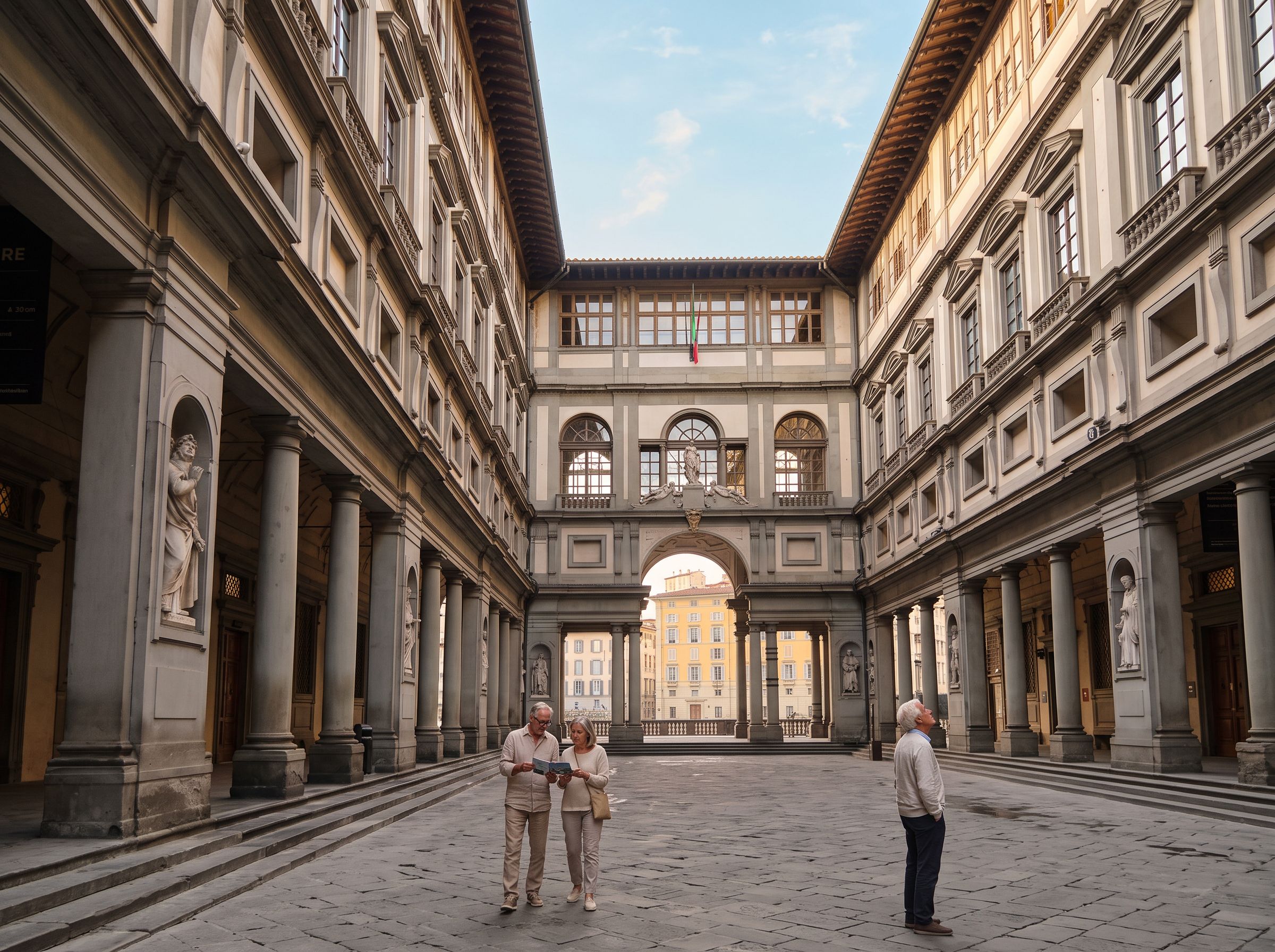 AI-edited
Why do timed tickets matter so much in Florence?
Timed entry tickets are the single most effective way to avoid the notorious Florence queues, allowing you to walk past the ticket-buying line and proceed directly to security screening. The visible queues outside the Uffizi and Accademia are almost always people who have not pre-booked. With a reserved slot, you bypass that entire process.
According to the Uffizi's official ticketing information, a visitor with a certified disability and one accompanying person receive free priority access, and the museum adds that the two of them do not need to book at all. Age alone earns nothing: Italian state museums charge the full fare from 26 upwards, with the reduced €2 ticket reserved for European Union citizens aged 18 to 25 and free entry for under-18s. The accessible entrance matters more than the discount here — it is the ramp in via della Ninna, which leads under the colonnade, and the museum's accessibility information states that accessible lifts are then available on the ground floor. The ordinary entrance is the Grand Ducal Staircase, four flights and 126 steps.
Booking through the museums' own websites is the most reliable route, and commercial skip-the-line vendors add markups for the same access. Know what the advance booking itself costs, though: the Uffizi charges €25 on the day of entry and €29 before it, and the Accademia €20 plus a €4 booking fee. The surcharge buys a guaranteed slot rather than a saving — worth paying in peak season from April to October, when three to four weeks' notice secures a morning time.
How should I plan my Uffizi visit?
Treat the Uffizi as a half-day experience, not a marathon. Arrive at your timed slot, focus on the rooms that genuinely interest you, and plan a long lunch break afterward to absorb what you have seen. Most visitors find that three hours is the comfortable maximum before fatigue sets in.
The Uffizi's collection is arranged chronologically, which makes self-guided navigation intuitive. The most famous rooms — Botticelli's Primavera and Birth of Venus, Leonardo's Annunciation, and the Tribuna octagonal room — are on the upper floor. If you have limited stamina, head directly there first, then work backward through earlier galleries if energy remains.
For accessibility, the entrance for visitors with mobility impairments is the accessible ramp in via della Ninna, leading under the colonnade, with accessible lifts on the ground floor; tickets for visitors with disabilities are collected at the ticket office under the Levante Loggia. Wheelchairs and walking frames are lent free of charge at the accessible entrance, with no booking and no deposit — an identity document is held for the duration of the visit. Accessible toilets are on the first and second floors and by the bookshop near the exit.
"Be sure to show up early as we booked the first entry at 8:15 am and there was already a considerable line at 8:00 am. Being among the first ones in was definitely worth it as we got to enjoy many galleries without the crowds." — a guest wrote on Google in June 2026
Consider the afternoon ticket. Since 1 January 2026 the Uffizi has charged €16 rather than the ordinary €25 for anyone entering from 4 p.m. onwards, or €20 if the ticket is bought before the day of the visit. The museum's own notice on the afternoon discount sets out the conditions. It is both the cheapest slot of the day and the calmest, once the day-trippers have gone.
Is the Accademia worth the visit just for David?
Yes, but keep expectations realistic. The Accademia is a compact museum built around Michelangelo's David, and most visitors spend 45 to 60 minutes total inside. The gallery is compact, with priority entry common, and guided visits can be paced with headsets and pauses for the major works.
Beyond David, the Accademia houses Michelangelo's unfinished Slaves — figures seemingly struggling to free themselves from raw marble — plus a collection of musical instruments and early paintings. The museum is considerably smaller than the Uffizi, making it an excellent choice for travellers who want a significant cultural experience without a full-day commitment.
Since 15 March 2026 the Accademia and the Museo Nazionale del Bargello have shared a combined ticket, announced by the museums themselves: €26 for 48 hours, or €38 for 72 hours covering all six museums of the group, with an optional €4 reservation fee. Both keep the same hours, 8.15 a.m. to 6.50 p.m., and both close on Mondays. The Bargello is the quieter of the two, and the 48-hour window means the pairing does not have to be squeezed into one morning. Its rooms sit at street level and are reached by ramps and a lift, with only the Chapel and the Sacristy out of reach.
How accessible are the Boboli Gardens really?
The Boboli Gardens are only partially accessible. The operator states plainly that the garden is accessible only with an accompanying person, because the ground is predominantly clay and gravel and almost entirely sloping, with climbs and descents. They suit travellers who come with company and keep to the lower route. The 20 percent gradient often quoted belongs to the uphill approach to the Pitti Palace entrance itself, which the Uffizi Galleries describe as quite steep and advise manual wheelchair users not to tackle alone.
Access for visitors with reduced mobility is from Piazza Pitti and from Piazzale di Porta Romana. The Porcelain Museum is not accessible and is in any case closed for refurbishment until further notice. The gardens close on the first and last Monday of each month and on 25 December. Opening is always at 8.15 a.m.; closing runs at 4.30 p.m. from November to February, 5.30 p.m. in March and October, 6.30 p.m. from April to May and in September, and 7.10 p.m. in June, July and August. Last admission is always an hour before closing. Two accessible toilets sit inside the gardens, one near the Chestnut Meadows and one by the Annalena gate on via Romana.
For a panoramic Florence view without the Boboli climb, a taxi to Piazzale Michelangelo is the easier option: cars reach the square from viale Galileo and viale Michelangiolo, and there are two parking bays reserved for vehicles carrying disabled passengers, so the walk from the car is short. Only the approach from Piazza Poggi involves the monumental staircases known as the Rampe del Poggi. Florence also has taxis equipped to carry passengers in wheelchairs, from So.Co.Ta. on +39 055 4242 and Co.Ta.Fi on +39 055 4390; the city's own visitor service notes a 15 percent reduction on the standard fare for disabled passengers and advises booking well ahead.
| Feature | Boboli Gardens | Bardini Garden |
|---|---|---|
| Terrain | Clay and gravel, almost entirely sloping | Stepped terraces, some gravel |
| Accessible entrance | Piazza Pitti, Porta Romana | Ramp at Costa San Giorgio 4, arranged in advance |
| Typical visit time | 1–2 hours | 45–60 minutes |
| Toilets and refreshment | Accessible toilets by the Amphitheatre, Chestnut Meadows and Annalena gate | Cafe bar and restaurant inside the garden |
| Best for | Contemplative strolling | Views over Oltrarno rooftops |
The adjacent Bardini Garden offers a shorter, quieter alternative with fewer visitors and a magnificent view over the Oltrarno. Its stepped terraces require some climbing, but the payoff is a serene perspective that most tourists miss entirely. From 3 March 2026 the Uffizi Galleries have sold a joint Boboli–Bardini ticket at €15, available only at their physical ticket offices on the day it is used, and not on days when Boboli is closed or admission is free.
What is the smartest way to see the Duomo complex?
The Duomo complex — cathedral, baptistery, Giotto's bell tower, and the Museo dell'Opera del Duomo — is best approached with one of the Opera del Duomo's passes, each valid for three calendar days, which lets you pace the elements separately instead of crowding them into one morning. The museum houses the original artworks removed from the cathedral facade, including Ghiberti's Gates of Paradise panels, and is far less crowded than the church itself.
Climbing Giotto's bell tower involves 414 steps and there is no lift; the Opera del Duomo advises against the ascent for anyone with heart problems, vertigo or claustrophobia, and the climb runs to a booked, non-transferable time slot. The cathedral itself needs no ticket and no reservation — admission is always free — but it is open to visitors only Monday to Saturday, 10.15 a.m. to 3.45 p.m., and closes to sightseeing on Sundays and during religious celebrations; the entrance for visitors with impaired mobility is on the right-hand side, at the Porta dei Canonici. The baptistery is small and the Opera suggests about 30 minutes for it, though the vault mosaics are currently under restoration.
The museum is the quietest part of the complex. Its airy galleries display Michelangelo's Pietà, the original cathedral facade sculptures, and a reconstruction of the medieval workshop across 28 rooms on three floors. The Opera del Duomo confirms that it is accessible to visitors with mobility difficulties, that it has a lift and restrooms, and that wheelchairs are available at the entrance — which makes it the most senior-friendly component of the complex. One date to note: it closes every first Tuesday of the month.
Where should I pause for coffee and lunch?
Florence's historic cafés and food markets offer the perfect antidote to museum fatigue, providing seated breaks with genuine local atmosphere. The city's culinary traditions — ribollita, pappa al pomodoro, bistecca alla Fiorentina, and crostini — are best experienced slowly, with a glass of Chianti and time to watch the city pass by.
Caffè Gilli has been trading since 1733 and sits on Via Roma at the corner of Piazza della Repubblica, a natural midpoint between the Uffizi and the Duomo complex; it publishes no accessibility details of its own. Inside the sites themselves the options are documented: the Uffizi cafeteria is on the second floor with a panoramic terrace, and the courtyard of the Pitti Palace, the starting point for Boboli, has a cafe, a bookshop and an accessible toilet, with no steps to enter it. The historic food markets — Sant'Ambrogio and San Lorenzo — offer short, seated lunches rather than lengthy restaurant meals, ideal for pacing a museum day.
For a lighter pause, the cafés along Via de' Neri and the Oltrarno side of the Arno provide quieter alternatives to the tourist-choked Piazza della Signoria. The Oltrarno, especially at sunset, offers a calmer, more local atmosphere than the historic center — a fact frequently noted by seasoned travellers.
How much walking is really involved?
The core museum district is compact — the Uffizi, Accademia, and Duomo complex all sit within a 20-minute walk of each other — but cobblestones, heat, and crowds make distances feel longer than they are. Plan for 10 to 20 minutes between sites at a steady pace, more if you stop, and factor in rest stops at cafés or church benches.
| Route | Distance | Walking Time |
|---|---|---|
| Uffizi to Accademia | 1.1 kilometers | 15 minutes |
| Uffizi to Duomo | 760 meters | 10 minutes |
| Duomo to Boboli (Piazza Pitti) | 1.3 kilometers | 18 minutes |
| Accademia to San Lorenzo market | 530 meters | 7 minutes |
Florence's city buses and trams are accessible: the Comune's own visitor service states that every Autolinee Toscane bus has a platform with a lowerable floor and that on the tram there is no height difference between the platform and the car. The tram operator adds four anchored wheelchair spaces on board every tram. Since January 2025 the T2 has run past Santa Maria Novella station on to Piazza San Marco, which brings a step-free tram from the airport to roughly 130 metres from the Accademia. For travellers who prefer to minimize walking, taxis are reasonably priced for short hops and are the practical choice for the Boboli approach or Piazzale Michelangelo.
For accommodation, choose a hotel near your primary museum interest. The comfort-first hotel guide offers specific recommendations with lift access and quiet rooms — essential for recovering from a day of galleries and gardens.
When is Florence quietest?
The quietest windows are weekday mornings before 10 a.m. and weekday late afternoons after 4 p.m., when day-trippers from Rome and Venice have departed. Avoid the first Sunday of the month, when state museums offer free entry but reservations are unavailable and crowds become extreme.
Regional tourism data from Regione Toscana's 2024 report shows 76 percent of overnight stays concentrated in the second and third quarters, confirming that spring and summer are the most crowded seasons. The months from April to October see the heaviest tourist inflows, with August peaking.
For a genuinely calm experience, consider the quieter museums that reward slow viewing: the Bargello and the Opera del Duomo museum both have that unhurried atmosphere. Casa Martelli, often named alongside them, is closed to the public for renovation from 10 March to 31 December 2026. A review left on Google in May 2026 says of the Bargello: "It isn't crowded; it's quiet."
What practical details should I confirm before visiting?
Confirm current opening hours and accessibility arrangements directly with each museum before your visit, as renovations and schedule changes are common. The Uffizi, the Accademia and the Bargello all close on Mondays, and the Uffizi also on 1 January and 25 December. Boboli closes on the first and last Monday of each month and on 25 December. The Opera del Duomo museum closes every first Tuesday. The cathedral is open to visitors Monday to Saturday only.
Arrive 15 minutes before your timed slot to clear security without rushing. Wear comfortable shoes — cobblestones are unforgiving — and carry water, especially in summer months when heat amplifies fatigue.
For travellers combining Florence with thermal relaxation, the thermal spa guide offers excellent post-museum recovery options. And for those visiting with grandchildren, the Lake Garda family guide provides a complementary slower-paced destination.
How do I structure the perfect unrushed day?
Begin with the Uffizi at opening time, break for a long lunch, visit the Accademia in the early afternoon, and finish with either the Boboli lower route or a taxi to Piazzale Michelangelo for sunset. This sequence spreads walking across the day and places the most demanding sites when energy is highest.
One planning note that catches many older travellers out: Italy's state museums give no discount for age. Free entry stops at 18 and the reduced €2 ticket runs only to the twenty-fifth birthday for European Union citizens, so a couple in their sixties pays the full fare at the Uffizi, the Accademia and Boboli alike. The concession that does exist is for certified disability — free priority admission for the visitor and one companion, with no booking needed.
The official Uffizi ticket page provides current pricing, free admission categories, and booking links. Book directly, choose your time slot, and arrive prepared. Florence's treasures have waited centuries for you — there is no need to rush now.


