
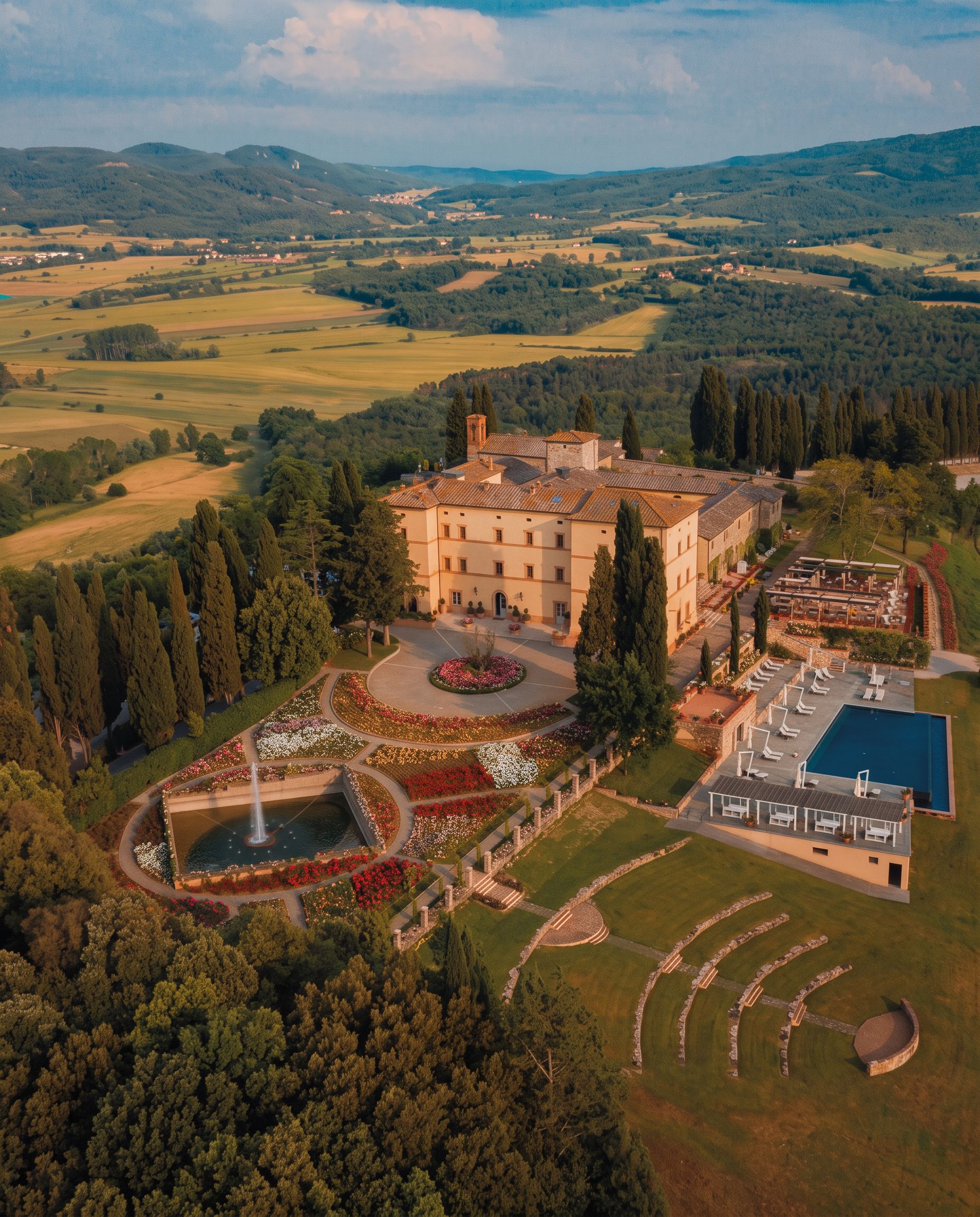
Castello di Casole is the rare Tuscan property that genuinely understands the art of stillness. Perched on a 3,200-acre estate in the Chianti hills, this restored 10th-century castle offers travellers aged 50 to 70 a chance to slow down without sacrificing comfort. The 39 suites and 2 villas are spread across what feels like a tiny medieval village, complete with a bakery, three restaurants, an infinity pool, and the Essere Spa tucked into a former wine cellar. It is luxurious, yes, but the real luxury here is the quiet.
For seniors who want a countryside retreat with on-site dining, spa access, and staff who anticipate needs before you voice them, Castello di Casole delivers. Guests consistently report that the team remembers names, preferences, and even specific pillows. The trade-off is location: this is not a walk-into-town property. You will need a car or private transfer to explore the wider region, and the hilly terrain means you should plan your mobility needs carefully before booking.
 AI-edited
Where is it, and how do you get there?
Castello di Casole sits in Località Querceto, Casole d'Elsa, about an hour's drive from Florence Airport and half an hour from Siena, so plan for a car or private transfer rather than public transport.
Belmond's own location page gives the drive times rather than distances: one hour from Florence Airport (FLR), an hour and a half from Pisa (PSA) and three hours from Rome Fiumicino (FCO). The closest rail option is Siena, which Belmond puts at thirty minutes by car, so you will need to arrange onward transport regardless of how you arrive.
Belmond states that access roads are suitable for standard coaches and minibuses, which is reassuring if you are considering a private transfer service. There is free on-site parking, and the hotel can arrange transfers from Florence or Siena. For travellers who prefer not to drive in Italy, booking a car with a driver through the hotel is the most straightforward option. As of August 2026, no public bus stop serves the hotel directly, so independent exploration without a vehicle is not practical.
If you are weighing this against a Siena-based stay, consider that Tuscany's accessibility for older travellers varies greatly by location, and Castello di Casole's remoteness is both its charm and its limitation.
What is the character and setting like?
The estate feels like a restored Tuscan hamlet rather than a conventional hotel, with stone buildings, vineyards, olive groves, and a nature reserve that rewards slow exploration, but the hillside layout means you will encounter steps and uneven ground.
This is not a purpose-built resort. The property evolved over centuries, and that history is visible in every corridor and courtyard. Guests repeatedly describe the atmosphere as peaceful and the grounds as beautiful, with walking paths and hiking trails winding through the estate. The estate's Bianchi bike hub keeps sixteen e-bikes for hire, and one hour of bike rental comes included once per stay, which is enough to see the vineyards, olive groves and protected woodland at an unhurried pace.
The property holds the "I Cieli più belli d'Italia" quality astrotourism certification, which speaks to the exceptional night skies. For couples or solo travellers who value scenery, long meals, and genuine quiet, this setting is hard to beat. The infinity pool overlooks the valley, and guests consistently note the serenity of the pool area.
One practical note on the layout: the estate spreads its cooking across three restaurants rather than one. Tosca sits inside the castle for dinner, Emporio del Castello serves lunch and dinner in a family-style room with a panoramic terrace, and Castello Grill cooks over charcoal beside the pool at lunchtime. Which of them is serving on a given evening is worth settling at check-in rather than discovering at seven o'clock.
What are the rooms like?
Rooms are spacious, tranquil, and designed for comfort, with very high sleep ratings from guests, but the spread-out layout means you should request a room with the easiest access for your mobility level.
The 39 suites and 2 villas are distributed across the historic buildings, each with its own character. A Google review from August 2022 calls the rooms "super comfortable, classicly Tuscan", and guests consistently describe them as quiet and well-appointed. Fireplaces feature in many suites, and garden seating areas are common. The villas offer more space and privacy, making them suitable for longer stays or families travelling together.
Because the property is built on a hillside, room locations vary significantly in terms of steps and walking distance from reception, the restaurant, and the pool. Steps and short slopes between the buildings are simply part of the place, and some corners of the estate stay out of reach even when your overall access is manageable. Belmond's own room list runs from Superior Junior Suites of 35 to 55 square metres up to the 99-square-metre Castello di Casole Suite, and several of the junior suites connect with a neighbour, which matters if you are travelling as a family.
For those planning to explore the wider region, Tuscany hotels worth booking for the food offers a broader perspective on dining-focused stays across the region.
How is the dining and service?
Breakfast is consistently praised as extensive and beautifully prepared, dinner at Tosca is excellent, and the staff are repeatedly described as exceptional, though some guests note occasional service inconsistencies at busy moments.
The main restaurant, Tosca, serves dinner with a focus on locally sourced ingredients, much of it from the estate itself. One guest wrote on Google in September 2025: "The food at every restaurant was amazing and all locally sourced, if not from their own property. The service was 11/10 and went above and beyond for anything we requested. They felt like our friends, everyone was so personable and friendly."
Breakfast includes fresh juices, fruit, cheese, pastries, and cooked-to-order egg dishes. The on-site bakery is a highlight, and the pizza comes out of the seventeenth-century wood-fired oven at Emporio del Castello, which serves lunch and dinner all week. For wine enthusiasts, the estate's position in the Chianti region makes it a natural base for wine tasting in Chianti, Montalcino and Montepulciano, though you will need transport to reach the vineyards.
Service is generally outstanding, with guests using words like "exceptional," "very attentive," and "most attentive." One guest wrote on Google in June 2026: "A beautiful establishment with possibly the best team of staff who are passionate about their work. From the rooms to the restaurant, the bakery to the garden, all the staff encountered were passionate and held themselves to an extremely high standard."
The one thing to settle when you book is which nights you will eat where. Tosca serves dinner only, from 7pm to 10pm, and Belmond's English listing gives its opening days as Tuesday to Saturday, while the Italian version of the same page runs to Sunday — so confirm your own dates. Emporio del Castello covers the rest of the week with lunch from 12pm to 3pm and dinner from 6.30pm to 10pm, and Castello Grill serves lunch by the pool every day.
What about the spa and pool?
The Essere Spa occupies a former wine cellar with restored stone walls and vaulted ceilings, open daily on request from 11:00 to 19:00, and the heated infinity pool offers valley views at a temperature Belmond puts at 28 to 30 degrees.
Belmond gives the spa's opening times as daily on request, 11am to 7pm, and lists three signature treatment rooms, an experience room, steam rooms and a private garden. There are two separate areas for women and men, each with its own jacuzzi and relaxation area, plus a small cold pool on the men's side — worth knowing if you were picturing an afternoon spent in the same room as your travelling companion. The entrance sits beside the church and leads down into the old cellar, so count on a flight of steps on the way in.
The infinity pool is heated and positioned to capture the valley views. Belmond gives the water temperature as typically 28 to 30 degrees and the main swimming area as about 1.4 metres deep, while noting that the exact temperature moves with the weather. The pool area is described as serene and peaceful, with attentive service. The 24-hour fitness centre is available for those who like to maintain their routine while travelling.
For health-related planning during your stay, our guide to health, pharmacies and peace of mind in Tuscany provides practical information about medical services in the region.
How accessible is it for travellers with mobility concerns?
Belmond's factsheet confirms wheelchair accessible rooms are available in the main hotel building, but the hillside estate includes steps, steep terrain, and gravel paths, so verify your specific route before booking.
This is the most important section for many senior travellers, so let us be precise. Belmond's official factsheet states that wheelchair accessible rooms are available in the hotel building, and staff can provide assistance and suitable accommodation. What Belmond does not publish is lift coverage or step-free routes between the buildings, and the booking portals contradict each other on the point, so treat vertical access as something to settle in writing rather than assume in either direction.
What this means in practice:
- Arriving: Parking is on the estate and comes with valet service, which keeps the walk from the car to reception short.
- Step-free access: Not published for the route from drop-off to the public areas. This is the one thing worth getting in writing for your own room.
- The spa: The entrance is beside the church and leads down into the former wine cellar, so expect steps on the way in.
- The pool: Heated to typically 28 to 30 degrees, with the main swimming area about 1.4 metres deep.
The property is spread across hillsides, and guests consistently note that there is a fair amount of walking between rooms, reception, the restaurant, the pool, and parking. The sensible request at booking is the room category with the easiest access and, just as important, the exact position of that room within the estate. For travellers using a walker or cane, this property can work well if you plan carefully. For wheelchair users, the main hotel building with accessible rooms is the safest choice, but you should confirm every step of your journey with the hotel before booking.
What is the price range?
Belmond does not publish nightly rates for Castello di Casole; the estate quotes per date through its own booking system and sits in the top luxury bracket for Tuscany. What is published is what surrounds the room rate — parking, an hour of bike hire and a run of estate activities are included, while spa treatments and experiences are priced separately.
As a Belmond property, Castello di Casole sits firmly in the luxury bracket, and the rate moves with the date rather than sitting in a published band. The season matters more than the room category: the Michelin Guide notes that the hotel is "open seasonally from mid-March through October", and Belmond's August 2026 announcement extended the 2026 season until 29 November, later than the usual pattern.
The published side of the bill is everything around the room. Parking comes with valet service, one hour of bike hire is included once per stay, and in-house activities such as wine tastings with the sommelier, a vegetable garden tour, estate hikes and yoga sessions are complimentary. Priced separately are the spa and the experiences: as of August 2026 a sixty-minute signature Essere massage is listed at €165 and the ninety-minute Dolcevita Ritual at €320, with facials and couples' rituals above that.
For autumn 2026 Belmond added a package on stays of two nights or more that includes private return transfers from the airport or railway station, a guaranteed room upgrade on arrival, early check-in and late check-out, and a €200 spa credit per stay. For a traveller who would rather not drive twice in one day, those transfers are worth more than the headline discount on any rate.
Who will love it, and who should look elsewhere?
Castello di Casole is ideal for travellers who want a stay-put luxury retreat with excellent dining, spa access, and attentive service, but it is not suited to those who need walkable town access, flat terrain, or a lively atmosphere.
This property rewards those who embrace its rhythm. If you enjoy long breakfasts, afternoon pool time, spa treatments, and unhurried dinners, you will find it difficult to leave. The staff's attentiveness is frequently described as the highlight of the stay, and the setting is genuinely beautiful.
However, if you prefer to base yourself in a town where you can step out for coffee or wander to a museum without a car, this is not the right choice. The remoteness is part of the appeal, but it also means planning every outing. Guests without a car will find the property isolating, and the hillside terrain requires a reasonable level of mobility.
For those who want easier access to Siena's attractions, Hotel Certosa Di Maggiano offers a more convenient location near the city. For a second Belmond property with the same service culture but a city on the doorstep, Villa San Michele above Florence sits an hour's drive north and stays open through the winter of 2026. Either way, confirm room-level accessibility directly with the property rather than through a booking portal.
What should you ask before booking?
Before reserving, confirm the exact room location, step-free routes from parking to your room, walk-in shower availability, bed height, and whether the elevator serves your floor.
These are practical questions that will determine whether your stay is effortless or challenging:
- Which room categories sit in the hotel building, and is there lift access to the floor you would be on?
- Are there step-free routes from the car park or drop-off point to the reception and restaurant?
- Do the accessible rooms have walk-in or roll-in showers?
- What is the bed height from floor to mattress top?
- Is the pool area accessible without steps?
- Can you arrange a golf cart or buggy transfer within the estate if walking is tiring?
Guests describe the staff as proactive about mobility. A review left on Google in September 2025 puts it plainly: "My mom has a bad back and each time we sat down to eat they would bring her a pillow and make sure she was very comfortable." This level of attentiveness suggests the team will accommodate reasonable requests, but it is always better to confirm specifics before you arrive.
The property's seasonal opening is also worth noting. The Michelin Guide describes the hotel as open mid-March through October, though the 2026 season extends to late November. If you are planning a winter visit, you will need to look elsewhere.
Castello di Casole is a property that rewards careful planning. For the right traveller, it offers an unforgettable stay in one of Tuscany's most beautiful settings. For those who need more accessibility or convenience, there are better options. The key is knowing which category you fall into before you book.


