
Tuscany rewards those who slow down. For travellers aged 50 to 70, the region's magic lies not in ticking off every sight but in savouring a handful of experiences properly — a Botticelli seen without a crowd, a glass of Chianti on a terrace, the evening light on Siena's brick expanse. This guide selects the finest experiences across the region, each rated for effort, seating, and crowd avoidance, so you can build a trip that matches your pace, whether you prefer active mornings or leisurely afternoons.
 AI-edited
Tuscany's visitor profile already skews toward your age group. According to regional research institute IRPET, the median tourist age in 2025 was about 45, with 52% of visitors over 45. You are in good company. The practical question is not whether Tuscany suits you, but how to choose among its riches without exhausting yourself. The answer lies in matching each destination's demands to your energy levels, booking smartly, and building rest into every day.
How do I see Florence's art without the crush?
Florence's Renaissance masterpieces are the region's crown jewels, but the crowds can drain the pleasure. The solution is timed tickets booked weeks ahead, early-morning entry, and focusing on a few works rather than everything. The Uffizi and Accademia reward patience; the Boboli Gardens offer outdoor respite.
Florence's historic centre is compact, which works in your favour. You can walk from the Duomo to the Ponte Vecchio in under fifteen minutes, though cobblestones demand sturdy shoes. The Uffizi Gallery houses Botticelli's Birth of Venus and works by Leonardo da Vinci, but the queues without pre-booked tickets can stretch for hours in peak season. Reserve timed entry directly through the official museum website, ideally for the first slot of the morning. The Accademia, home to Michelangelo's David, is smaller and quicker to absorb — many visitors spend under an hour there.
For a deeper dive at a gentler pace, our dedicated guide to Florence's museums and gardens at an unrushed pace offers a curated route that builds in café stops and bench time. The Boboli Gardens behind the Pitti Palace provide shaded paths and panoramic views with far fewer crowds than the indoor museums — a welcome reset for the senses.
Is Siena's Piazza del Campo worth the hills?
Yes, absolutely — but arrive prepared. Siena's famous shell-shaped square is traffic-free but gently sloping — its shell shape follows the old sloping ground — and the approach involves further slopes and uneven paving. The reward is one of Europe's most atmospheric public spaces, especially magical in the evening when day-trippers have departed.
Plan your route to minimise climbing. The walk from the car park or train station into the historic centre is uphill; consider a taxi for the final stretch if your stamina is limited. Once inside the walls, the city's main sights cluster around the Piazza del Campo and the adjacent Duomo. The square itself is a gentle bowl of red brick, ringed by cafés where you can sit with a coffee and watch the world pass. The Palazzo Pubblico's tower offers spectacular views, but the climb is about 400 steps with no lift, and the city's museums service strongly advises against it for anyone with a pacemaker, a heart or respiratory condition, vertigo, claustrophobia, diabetes or difficulty walking; ascents leave every 45 minutes for a maximum of 25 people. Enjoy the square from ground level instead, and consider the Civic Museum inside the Palazzo Pubblico, where a lift service for visitors with limited mobility can be requested at the ticket control point.
Siena's medieval civic culture is tangible here. The Palio horse race, held twice each summer, transforms the square into a racetrack; even outside race days, the sense of history is palpable. A Google review from July 2026 calls it "one of the prettiest squares to visit" but adds a warning worth heeding in summer: "It's a real sun trap, so be careful in the heat." The cafés around the rim are where the shade is. For a fuller exploration, consider a guided walking tour that paces itself with rest stops — many operators cater specifically to older travellers.
What is the easiest way to experience Chianti wine country?
A seated wine tasting at a single estate is the most comfortable way to experience Chianti. The Antinori nel Chianti Classico winery, with its striking modern architecture set into the hillside, runs guided tours of 90 minutes and longer, plus seated tastings of about 45 minutes in a room beside the wine shop for those who prefer less walking.
Chianti's appeal lies in its rolling vineyards, cypress-lined roads, and medieval villages. For the over-50s, the joy is in the journey rather than the exertion. Rent a car or book a private driver for a day; the roads are winding but well-maintained. Plan one estate visit per day, not three — the cumulative effect of walking through cellars and standing for tastings can tire you more than expected. Most wineries offer seated tastings with bread, olive oil, and cheese, making them natural lunch stops.
The Antinori estate, inaugurated on 25 October 2012, rewards an unhurried visit: its tasting room and restaurant look out over the vineyards, and the architecture itself is a modern landmark. As of August 2026, a seated tasting of four wines costs €30 per person and takes about 45 minutes, while the guided tours run from €50 for the 90-minute Tinaia tour to €75 for the two-and-a-half-hour Bottaia tour. For those who prefer not to drive, many tour operators offer small-group day trips from Florence or Siena that include hotel pickup, a guided tasting, and lunch. The Fodor's list of ultimate Tuscany experiences includes several such options worth reviewing.
How do I experience Val d'Orcia's famous cypress roads?
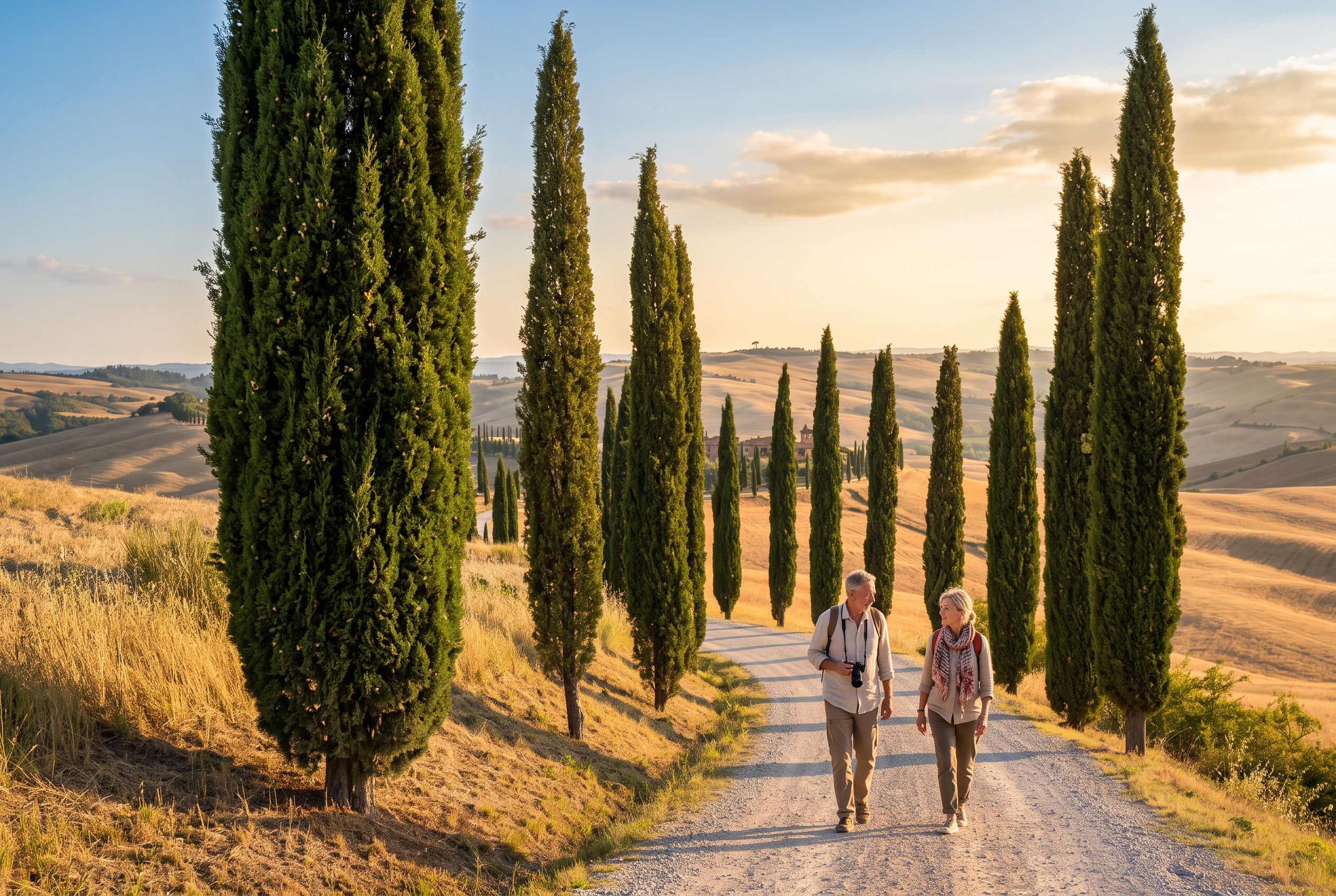
The Val d'Orcia is best experienced by car, with frequent stops at viewpoints and hill towns. The landscape — rolling wheat fields, lone cypress trees, and the UNESCO-listed countryside — is best appreciated slowly. Pienza is often singled out as the easiest of the hill towns, offering panoramic views with minimal climbing.
This southeastern corner of Tuscany is the region's most photographed landscape, and for good reason. The drive from San Quirico d'Orcia to Pienza takes barely fifteen minutes, but you will want to stop constantly. Pull over at designated viewpoints, breathe in the sage-scented air, and watch the light shift across the hills. The Val d'Orcia is not about attractions but about atmosphere — a slow, meditative experience that suits travellers who enjoy scenic drives.
Pienza, rebuilt as an "ideal city" between 1459 and 1462 for Pope Pius II, is often singled out as easier on the knees than steeper hill towns. Its main street, Corso Rossellino, is relatively flat and leads to a panoramic terrace overlooking the valley. Montalcino, home to Brunello wine, and Montepulciano, with its Renaissance palazzi, are both worth visiting but involve more slopes — pace yourself and use the cafés as rest stops. For a truly restful base, staying down in the valley rather than in the hill towns themselves lets the landscape be enjoyed without constant moving.
Where can I enjoy a thermal soak in Tuscany?
Tuscany's thermal baths are the ultimate low-effort luxury. Bagno Vignoni, a village built around a steaming natural pool, and Saturnia's cascading hot springs offer warm, mineral-rich waters in stunning settings. Neither is barrier-free: the operator of the Cascate del Mulino says the site has no walkways for people with disabilities, though its adjoining Il Molino del Bagno relaxation area is.
Bagno Vignoni, in the Val d'Orcia, is unique: the entire village square is a thermal pool, though swimming is not permitted in the historic centre. Bathing is in fact banned across the whole Parco dei Mulini by mayoral ordinance, with fines from €25 to €500, so the warm water is enjoyed in the spas of the village's own hotels: La Posta opens its thermal pools to non-residents from 9.30am to 6pm, with the pools cleaned on Thursdays. Saturnia, in the Maremma region, is more famous — its Cascate del Mulino are natural terraces of water that surfaces at 37.5°C and flows over limestone, free to enter and open around the clock in every season. The walk from the car park is short but uneven; sturdy shoes are essential, and a walking stick helps on the descent.
For a more structured experience, several spa towns offer day passes with pools, saunas, and treatment rooms. These are excellent choices for a recovery afternoon after several days of sightseeing. The thermal experience is deeply rooted in Tuscan culture — the Etruscans and Romans both valued these waters — and the warm, mineral-rich water is genuinely soothing for tired muscles and joints.
Why is Lucca recommended for older travellers?
Lucca's Renaissance city walls form a flat, tree-lined promenade that circles the entire historic centre — 4.2 kilometres of easy, even walking with benches and shade. The city's own accessibility project warns that the ramps up onto the walls always need assistance, so plan that part; once you are up, the going is easy.
The walls, begun in 1544 and finished only in 1650, were never used for defence — their one moment of service came in 1812, when the gates were closed against the flooding River Serchio — and they later became a public park. Today they are a beloved walking and cycling circuit, wide and level along the top, with benches, tables and drinking fountains on the bastions. Inside the walls, the streets are largely flat, and the city's main sights — the oval Piazza dell'Anfiteatro, the Duomo, and the Guinigi Tower with its rooftop trees — are all within easy walking distance. Lucca is also less crowded than Florence or Siena, offering a more authentic, unhurried Tuscan experience.
For travellers who want a base that allows easy day trips, Lucca's train station connects directly to Florence (about 1 hour 20 minutes) and Pisa (about 30 minutes). The city's many cafés and restaurants provide natural rest stops, and the evening passeggiata — the traditional stroll along the walls — is a delightful ritual. A review left on Google in July 2024 describes the path as "wide and predominantly shaded with large avenue trees" and suggests setting off early in high summer, before the sun gets too hot.
How do I sidestep the worst crowds?
Travel in spring (April–June) or autumn (September–October) for milder weather and thinner crowds. Start your days early, visit major sights at opening time, and retreat to cafés or gardens during peak hours (11am–3pm). Book everything in advance during high season.
Tuscany's popularity shows no sign of waning. According to IRPET, the region recorded about 55.5 million tourist presences in 2025, up 3.8% on the previous year. The same report puts the art and spa towns at 31% of all overnight stays, behind the coast on 38%, and describes Florence as the region's gateway with Siena, Pisa and Lucca as secondary hubs. The strategy is simple: go early, go late, or go elsewhere. The Uffizi at 8:15am is a different experience from the Uffizi at 11am. Siena's Piazza del Campo at 7pm, when tour buses have departed, is magical.
Consider spreading your time beyond the famous trio. IRPET concludes that the region needs to distribute its visitors more widely, and a Guardian round-up in April 2026 named Monteriggioni, Pienza, Arezzo and Volterra as the towns to head for instead — comparable beauty, a fraction of the crowds. For practical guidance on reaching these destinations, see our guide to getting to Tuscany by air, rail, and road. And for accommodation that prioritises comfort and accessibility, our roundup of where to stay in Tuscany when comfort comes first offers vetted options.
What practical steps make sightseeing easier?
Wear supportive, broken-in shoes; carry a lightweight scarf for church visits; use taxis for the final uphill stretch; and plan restroom stops carefully, as facilities often involve stairs. Ask hotels about lift access, step-free routes, and walk-in showers before booking.
Forum discussions among older travellers repeatedly emphasise the same lessons. Cobblestones, especially when wet, are a slipping hazard — take your time and use a cane if it helps your balance. Italian hotels may advertise elevators but still require stairs to reach them or to access rooms and terraces; verify this before booking. Public toilets are scarce in historic centres, and even restaurant facilities may be up or down a flight of stairs. Carry the business card of your hotel so a taxi driver can return you without confusion.
For those with limited mobility, private transfers or guided day tours reduce walking, navigation stress, and station demands. Several tour operators specifically cater to senior travellers, with guides used to a slower pace and staff who keep an eye on older guests through the day. Tuscany's official tourism board also publishes an overview of accessible museums and monuments in Siena, down to which entrance and which lift to ask for.
Since 1 August 2026, the single urban ticket in Tuscany's provincial capitals, Florence included, has cost €2.00 instead of €1.70, according to the regional operator Autolinee Toscane. This is a minor cost but worth knowing if you plan to use public transport in the city. For most sightseeing, however, walking and occasional taxis remain the most comfortable options.
When is the best time to visit?
Late spring (May–June) and early autumn (September–October) offer the ideal balance of pleasant temperatures, manageable crowds, and full operational schedules. Summer brings heat and congestion; winter offers quiet but some closures. For thermal baths and coastal areas, shoulder seasons are particularly rewarding.
Tuscany is a year-round destination, but your comfort depends on timing. July and August bring temperatures often exceeding 30°C in inland towns, making afternoon sightseeing exhausting. The crowds at major attractions reach their peak, and prices for accommodation and tours rise accordingly. Conversely, winter (November–February) offers cool, crisp days and dramatically fewer visitors, though some hill-town restaurants and smaller museums may close for the season.
Spring and autumn are the sweet spots. In May, the countryside is lush and the wildflowers are out; in October, the vineyards turn gold and the harvest season brings festive energy to wine regions. For thermal experiences, the cooler months are actually more pleasant — there is nothing quite like soaking in warm mineral water while the autumn air is crisp around you. Off-season visits are widely recommended for fewer crowds and cooler weather, which makes them a good fit for anyone sensitive to heat.
What should I budget for these experiences?
Expect about €29 for a pre-booked Uffizi ticket and €24 for the Accademia once its booking fee is added, €30 per person for a seated four-wine tasting at Antinori, and from €26 for a day pass at the Terme di Saturnia spa. Hotel rates vary widely, from €150–400 per night in high season for comfortable mid-range options.
These figures are the published rates as of August 2026 and vary by season and booking channel. The key is to book ahead: at the Uffizi the advance ticket costs €4 more than one bought at the door, a surcharge worth paying in high season, and winery tours at estates like Antinori fill up weeks ahead. For thermal baths, the free natural cascades at Saturnia cost nothing, while structured spa facilities charge for day access. Budget for taxis — a short ride from a hill-town car park to the centre can save significant energy for the price of a coffee.
Consider investing in a private guide for a half-day in Florence or Siena. A good guide not only enriches the experience but also knows the accessible routes, the quiet corners, and the best café stops. Many travellers over 50 report that this is money well spent, transforming a potentially exhausting day into a relaxed, informative experience.
"Incredible views, connected with nature, very peaceful. Rooms are comfortable and designed beautifully. Highly recommend visiting!" — guest review, Google, September 2025
This sentiment, from a guest at Tuscany Forever, captures what many travellers seek: peace, comfort, and beauty. The property sits at Saline di Volterra, about 12 kilometres from Volterra itself, and has earned a Google rating of 4.5/5 from 236 reviews as of August 2026. Guests consistently praise its panoramic views and comfortable rooms. The estate lists twelve villas holding twenty-nine apartments, three shared pools, a tennis court and an on-site restaurant, and — useful if stairs are a problem — nine of the apartments are let as ground-floor units in their own right. Such details matter when planning, which is why reading recent reviews and asking specific questions before booking is always wise.
For those considering a resort stay in the countryside, properties like Castelfalfi receive consistently warm reviews for their attentive staff and stunning settings. Recent guests note that the spa, with its indoor-outdoor pool overlooking the hills, is a standout feature. A Google review from April 2026 singles out "the beautiful spa and pool area" and "the Apéros at the outdoor lounge with spectacular view." The spa is open to guests aged 14 and over, and as of August 2026 the resort holds a Google rating of 4.7 out of 5 from 614 reviews.
Tuscany rewards the prepared traveller. With timed bookings, sensible pacing, and a willingness to sit and watch the world go by, the region offers some of Europe's most rewarding experiences for those aged 50 to 70. The art is extraordinary, the landscapes are iconic, and the pace can be exactly what you make it.


