
The first decision of any Tuscan journey sets the tone for everything that follows. Choose the right airport and the region unfolds with remarkable ease; choose poorly and you will spend your first precious afternoon wrestling with luggage and connections. For travellers aged 50 to 70, the difference between a seamless arrival and a stressful one often comes down to understanding how Tuscany's three main gateways actually work in practice.
Most seasoned travellers agree on a simple rule: Pisa (PSA) serves the wider region best, while Florence (FLR) wins when your trip centres on the city itself. Bologna (BLQ) works well for northern Tuscany, and Rome Fiumicino (FCO) remains a viable option if the flight prices are right, though it adds the longest onward journey. The good news is that all four airports connect to Florence's Santa Maria Novella station, the region's rail heart, through straightforward public transport links that require minimal physical effort.
 AI-edited
Which airport should I fly into?
Fly into Florence if your first stop is Florence, Fiesole, Chianti or Siena; choose Pisa for broader Tuscany itineraries that include Lucca, the coast or multiple hill towns; consider Bologna for northern Tuscany; and use Rome only when the fare difference justifies the extra travel time.
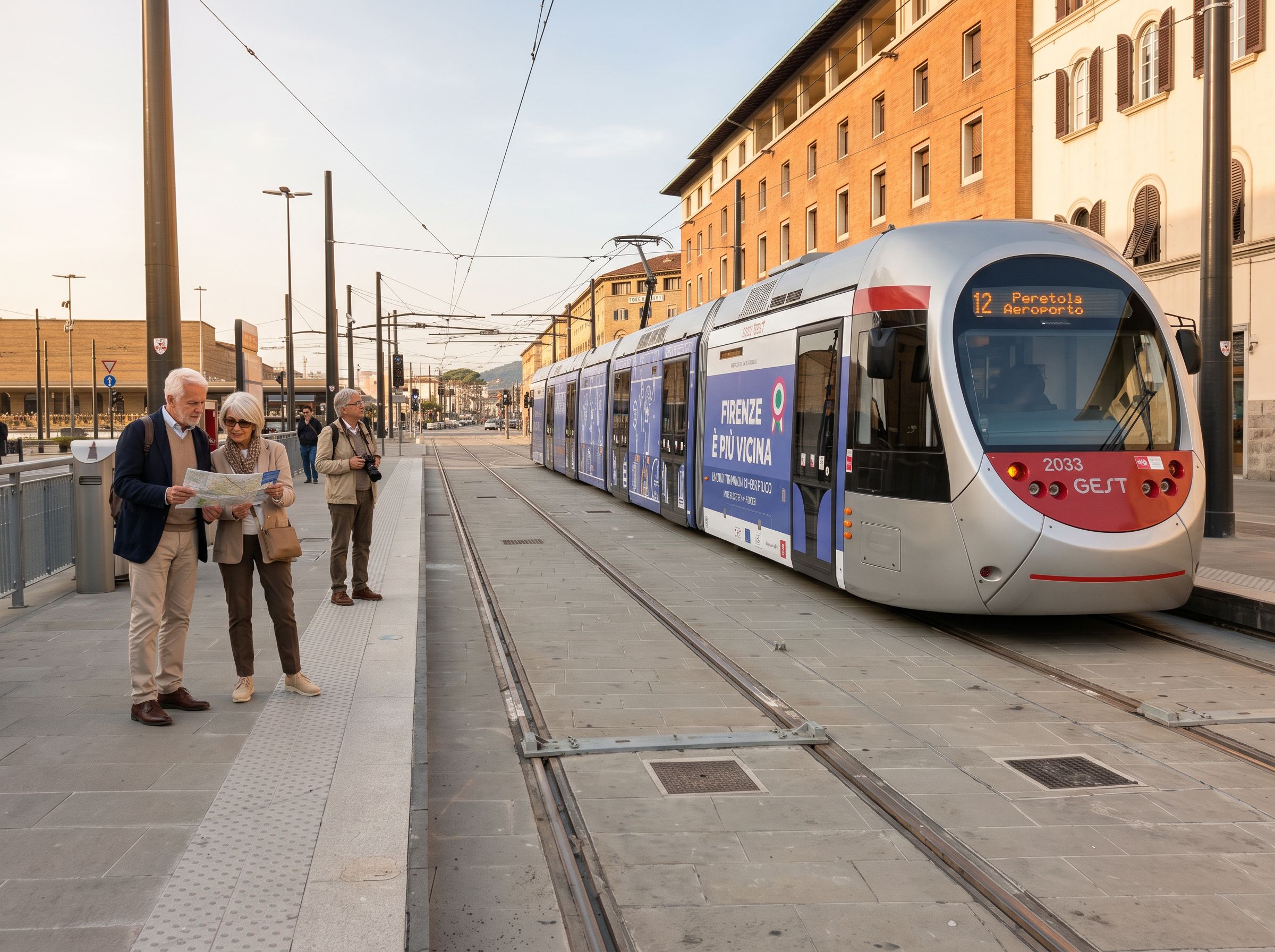
Florence Airport (Peretola, FLR) sits on the north-western edge of the city, making it the most convenient option for anyone whose trip begins in the regional capital. Its tram operator GEST states that the T2 line links the airport with Florence in 20 minutes, with services running frequently throughout the day. A single 90-minute urban ticket costs €2.00 as of August 2026.
Pisa Galileo Galilei (PSA) is repeatedly described in travel guidance as the most practical all-round airport for Tuscany holidays, particularly if you plan to visit multiple towns. The airport handles more flights than Florence, often at better prices, and its rail connection through Pisa Centrale opens up the entire regional network. The trade-off is one simple transfer: a five-minute ride on the PisaMover shuttle to the station, followed by a train to Florence taking 50 to 80 minutes depending on the service.
Bologna (BLQ) deserves consideration for northern Tuscany. Fast trains from Bologna Centrale reach Florence Santa Maria Novella in about 37–38 minutes on the quickest services. Rome Fiumicino (FCO) remains workable by rail, though Trenitalia's own timetable lists no through train from the airport to Florence, and the quickest routes run to around two and a half hours.
How do I get from Florence Airport to the city?
The T2 tram is the easiest and cheapest option, taking about 20 minutes to reach the station area on a €2.00 urban ticket valid for 90 minutes. The fixed airport taxi fare to central hotels is €28 on weekdays, €30 on Sundays and holidays and €32 between 22:00 and 06:00, plus €1.20 for each piece of luggage.
The tram platform is only about a two-minute walk from the terminal exit. One practical tip from experienced travellers: buy your ticket in the small shop inside the terminal before leaving, rather than fumbling with the machines at the platform. The tram avoids Florence's traffic entirely and runs frequently throughout the day, making it the sensible default choice for most visitors.
However, the tram can get busy, and you must validate paper tickets or tap correctly to avoid fines. If mobility or luggage weight is a concern, the taxi flat fare offers genuine value for two people sharing, especially after a long flight. One point worth planning around: the last tram from the airport leaves at 23:58 from Sunday to Thursday and at 01:15 on Friday and Saturday nights, with the first departure at 05:00 every day. A delayed evening flight can therefore leave the taxi rank as the only option.
What about Pisa Airport?
Take the PisaMover shuttle from the terminal to Pisa Centrale in about five minutes, then board a train to Florence Santa Maria Novella. The total journey typically takes around 1.5 hours, with the shuttle running every 5 or 15 minutes from 06:00 to midnight and two to four trains an hour on to Florence.
The PisaMover is a dedicated people-mover that connects the airport terminal directly to Pisa Centrale station. Trenitalia directs passengers to follow the "AEROPORTO / AIRPORT" signs to platform 14, so the route is simple and well signposted even with luggage. From there, regional trains run to Florence with journey times of roughly 50 minutes to 1 hour 20 minutes, depending on whether you catch a fast or stopping service. Booking through to "Pisa Aeroporto" covers both legs on one ticket, €16.30 per person as of August 2026, of which €6.50 is the shuttle.
Pisa Centrale itself has received a Google rating of 3.8 out of 5 based on 2,171 reviews as of August 2026. Recent guests describe the station as clean with helpful staff, and the walk from the station to the Leaning Tower takes about 25 to 30 minutes along well-paved roads suitable for rolling luggage. Rete Ferroviaria Italiana records step-free access by lift to platforms 1 to 13 and lists left luggage among the station's services.
One recurring piece of advice from travellers aged 50 and older concerns pickpocketing and scams targeting tourists in and around the station, particularly at ticket machines and on buses. Police and military are often present at the entrance, but it pays to remain vigilant with your belongings.
"We caught a train to Florence, easy to navigate and get tickets, helpful staff if needed." — a guest wrote on Google in May 2026
Are Bologna or Rome worth considering?
Bologna works well for northern Tuscany with fast trains to Florence in about 37–38 minutes; Rome is viable only when flight savings are substantial, as the rail journey from Fiumicino takes at least 2 hours 23 minutes and always requires a change in Rome.
Bologna's Guglielmo Marconi Airport (BLQ) has a dedicated monorail shuttle to Bologna Centrale station, one of Italy's busiest rail hubs. From there, high-speed Frecciarossa and Italo trains reach Florence Santa Maria Novella in under 40 minutes on the fastest services. This makes Bologna a genuinely practical alternative if you find significantly better flight prices or schedules, particularly for itineraries starting in northern Tuscany such as the Mugello valley or the Apuan Alps.
Rome Fiumicino (FCO) presents a different calculation. Trenitalia's booking system puts the fastest airport-to-Florence journey at 2 hours 23 minutes, always with one change. The Leonardo Express runs non-stop to Roma Termini in about 32 minutes for €14, where you connect to high-speed services north. For many arrivals, however, the simplest city-to-city transfer is still via Florence or Pisa rather than relying on FCO connections. As one traveller on the Fodor's forums advised, if you arrive in Rome, take the train to Florence immediately while jet-lagged, so you do not waste a full day dragging luggage back toward the airport at the end of your trip.
For the rules on combining the Pisa shuttle with a rail ticket, Trenitalia sets out the airport connection in detail, including the fare and where to find the people mover inside Pisa Centrale.
How accessible are the main stations?
Florence Santa Maria Novella is the region's most accessible hub: because it is a terminus, Rete Ferroviaria Italiana records a barrier-free route on the level or by ramp to every one of its 19 platforms. Pisa Centrale reaches platforms 1 to 13 step-free by lift, with the lifts running from 05:30 to 01:30.
Florence's Santa Maria Novella is a major rail hub with strong regional and high-speed connections, making it the most useful station for onward travel in Tuscany and beyond. Because the tracks end at the concourse rather than running through it, there are no stairs or lifts between the entrance and the platforms; the barrier-free route is simply the floor you arrive on. Allow time all the same, as the station is a large one and the walk to the far platforms is long.
Recent guests consistently report that Santa Maria Novella station is very walkable for many, with most major Florence sights reachable on foot within 10 to 15 minutes. The station area itself has been praised for its cleanliness and clear signage, with departure screens and announcements in both Italian and English.
For those planning to explore Florence's cultural treasures at a relaxed pace, our guide to the museums and gardens of Florence at an unrushed pace offers practical advice on avoiding crowds and fatigue.
What luggage strategy works best?
Pack light and use wheels wisely. Heavy luggage is the biggest practical hazard in Tuscany, and travellers repeatedly advise against renting a car in Florence itself due to restricted traffic zones (ZTLs) that make driving and parking a nightmare.
The ZTL system is a common source of confusion and fines. In Florence, Servizi alla Strada, the municipal company that runs the scheme, states that the camera gates are active Monday to Friday from 07:30 to 20:00 and on Saturday from 07:30 to 16:00, with an additional summer night ZTL from the first Thursday in April to the first Sunday in October. Public transport sidesteps the question entirely, which is why it remains the simplest way to reach sights inside the historic centre.
For the train journey itself, consider these practical points:
- Choose a backpack or wheeled bag that fits in overhead luggage racks on regional trains
- Book assistance at stations if you need help with steps or platforms — it is free and organised by Rete Ferroviaria Italiana through its Sala Blu network, whichever company you travel with
- Use luggage storage at stations rather than dragging bags through hill towns
- Consider shipping larger bags ahead to your accommodation if you are staying in one place for several nights
Several senior travellers recommend starting at the furthest point first, then working back toward your departure airport, so you do not waste a final day travelling with luggage. Others suggest choosing fewer bases with longer stays, as constant moves are tiring, especially for older adults. One Fodor's forum contributor noted that "most all towns are reachable by train or bus, but it takes longer to get around," reinforcing the wisdom of basing yourself in rail-linked towns such as Florence, Pisa, Lucca or Certaldo.
Are there senior discounts on trains?
Yes, but they are operator schemes rather than a single regional one. Trenitalia gives travellers over 60 twenty per cent off regional tickets and fares from €29 on the Frecce, and Italo cuts its Flex fare by 40 to 60 per cent for the same age group. Each needs free membership and advance purchase.
Trenitalia's Senior Regionale offer gives travellers of 60 and over 20 per cent off single regional tickets. It requires free membership of the X-GO programme, is sold only as a digital ticket, and must be bought by 23:59 on the day before you travel; the current round runs to 30 November 2026. On the Frecce, FrecciaSENIOR starts at €29 in standard class for CartaFreccia members over 60, but must be bought at least eleven days before departure. Italo's own senior fare cuts its Flex price by 40 to 60 per cent for the over-60s.
Two conditions are worth knowing before you count on a reduction. Trenitalia's Carta Argento, for years the standard senior card, has not been on sale since 1 April 2026, although cards issued before that date remain valid until they expire. And no discount of any kind applies to the PisaMover portion of an airport ticket, so the €6.50 shuttle fare is the same at every age.
What should I pack for a Tuscan trip?
Comfort and stability come first: strong-grip walking shoes, lightweight layers, sun protection and a refillable water bottle. Tuscany combines warm Mediterranean summers with historic centres of cobblestones and hills that demand careful footwear.
Tuscan historic centres are often pedestrian-friendly but can be tough on the feet because of cobblestones and uneven stone streets. Hill towns require frequent uphill walking, a major consideration for travellers with limited mobility. Even Florence itself includes slopes and bridges, so short distances may feel more strenuous than in modern cities.
Your packing list should include:
- Walking shoes with strong grip — non-negotiable for cobblestones
- Lightweight layers for changing temperatures
- Sun hat and sunglasses
- Sunscreen
- Refillable water bottle
- Small daypack for excursions
- Light rain jacket for shoulder-season showers
- Compression socks if you expect long train days or swelling
- Walking cane or trekking pole if you already use one for stability
- Portable phone charger
- Any prescription medication in original packaging
- Foldable seat pad if you need rest breaks while sightseeing
Summer heat increases the burden of walking with bags, especially in historic centres and around station areas. Travellers mention August as particularly challenging, when crowds and heat make the tram-versus-taxi choice more about comfort than savings.
What healthcare facilities are available?
Florence is the most practical base for higher-level medical care as the regional centre, directly connected to the airport by tram. For serious medical needs, larger cities like Florence and Pisa are the most reliable places to find hospitals and specialist care.
In Italy, the standard emergency number is 112 for urgent assistance, including medical emergencies. Pharmacies in Tuscany towns and cities are generally located near the centre, and Florence airport-area travellers can reach the city quickly by tram for better access to services.
Before arrival, save your hotel's address and the name of the nearest hospital. While the supplied research does not include specific clinic addresses, the practical advice is to check locally on arrival, especially if you are transferring through Florence or Pisa late in the day. For wellness-focused travellers, our guide to the best thermal spa towns and hotels in Tuscany may offer a restorative addition to your itinerary.
How are the pedestrian paths and streets?
Expect cobblestones, uneven paving and steep hills in historic centres. Benches are more common in larger piazzas, parks and transit hubs than on narrow historic lanes, so plan for fewer seating opportunities in older districts.
The quality of pedestrian infrastructure varies significantly across Tuscany. Modern districts and station areas generally offer smooth, well-maintained pavements, while historic centres retain their medieval character with all its physical challenges. Pisa Centrale's walk to the Leaning Tower, for example, follows well-paved roads suitable for rolling luggage, according to recent guest reviews.
For those planning to base themselves in Florence, the area around Santa Maria Novella station is notably walkable, with most major sights reachable on foot within 10 to 15 minutes. However, the historic centre's narrow streets and bridges can be strenuous, and the summer heat amplifies the effort required.
If comfort is your priority when choosing accommodation, our guide to where to stay in Tuscany when comfort comes first offers curated recommendations that consider accessibility and ease of movement.
How should I plan my arrival day?
Build in buffer time and avoid rushing. The most common mistake is underestimating how long transfers take, especially with luggage and in summer heat. A relaxed arrival sets the tone for the entire trip.
Experienced travellers offer consistent advice: spend more time in one place, have leisurely breakfasts, and use the day for short excursions rather than long transfers. Constant moves are tiring, especially for older adults, so consider a week in one base rather than hopping between three or four.
For your arrival day specifically:
- Book morning flights when possible, giving you daylight hours to navigate
- Arrange airport transfer in advance if you are not using public transport
- Have your hotel's address and phone number written down, not just stored on your phone
- Carry a small amount of euros for tram tickets, luggage storage and refreshments
- Know which station exit leads to your accommodation before you arrive
For those considering a splurge on arrival, the Castello di Casole, a Belmond Hotel: a senior traveller's dossier describes a property that handles transfers with particular grace.
How do the transfer costs compare?
Florence's tram costs €2.00; the fixed airport taxi fare is €28 to €32 depending on the day and the hour; the PisaMover plus train to Florence is sold as one €16.30 ticket; Bologna's Marconi Express costs €12.80, with the high-speed train on to Florence starting around €16.
Here is a practical comparison of the main transfer options:
| Route | Time | Cost Range | Transfers |
|---|---|---|---|
| Florence Airport tram to SMN | 20–30 min | €2.00 | None |
| Florence Airport taxi to city | 20–30 min | €28–€32 flat | None |
| Pisa Airport via PisaMover + train | 1.5 hours total | €16.30 | One (Pisa Centrale) |
| Bologna Airport shuttle + high-speed train | ~1.5 hours total | from €29 | One (Bologna Centrale) |
| Rome Fiumicino via Leonardo Express + high-speed train | 2 h 23–2 h 38 | €34–€57 | One (Roma Termini) |
All prices are indicative and vary by season and booking channel. High-speed train fares in particular fluctuate significantly based on how far in advance you book, with substantial savings available for early reservations.
For travellers weighing the Rome option, the Fodor's community discussion on the best airport for Tuscany offers extensive first-hand experience from travellers who have made the journey multiple times.
What is the easiest door-to-base route?
For Florence-based trips: fly into FLR, take the T2 tram to Santa Maria Novella, and walk or take a short taxi to your hotel. For wider Tuscany: fly into PSA, take the PisaMover and train to Florence, then connect to regional services. Bologna works for the north; Rome only for significant savings.
The simplest arrival experience combines Florence Airport with the T2 tram. The entire journey from terminal to station takes about 20 minutes with no transfers, no ticket complications beyond validation, and minimal walking. Between 06:30 and 20:30 on weekdays GEST runs the line every four to five minutes, so there is rarely a wait worth planning around.
Pisa's route requires one easy change but offers more flight options and often better prices. The PisaMover runs every 5 or 15 minutes between 06:00 and midnight, making the connection painless even with luggage. Trains from Pisa Centrale to Florence leave two to four times an hour through the day, so the wait at the station is usually short.
Whichever airport you choose, the golden rule remains the same: build in buffer time, pack light, and don't try to see everything in one trip. Tuscany rewards slow travel, and the journey itself is part of the pleasure.


