
Venice rewards a slower pace than most cities, and that suits grandparents travelling with grandchildren. The historic centre is compact, the waterbus network does the heavy lifting between sights, and the day can be built around short outings with proper rest stops. The city sits on 121 islets linked by 435 bridges, according to Venice tourism, and almost 70% of the historic centre is accessible to people with impaired mobility. That figure matters less than the shape of the day: a boat ride, one activity, a gelato in a campo, then home before tempers fray.
This guide covers the experiences that work across age groups, from toddlers to teenagers, and the honest practicalities of bridges, pushchairs and tired legs. It stays away from adult-only dining and long forced marches. For a broader look at getting around with minimal walking, see our companion guide to seeing Venice with little walking.
Is Venice worth visiting with grandchildren?
Yes, provided the trip is built around boats and single activities rather than a checklist. Venice tourism advises that a stroller is "absolutely not recommended" because of the stairs and bridges, so plan for a carrier with small children. The waterbus network turns the city into a series of short, scenic hops, which suits mixed-age groups well.
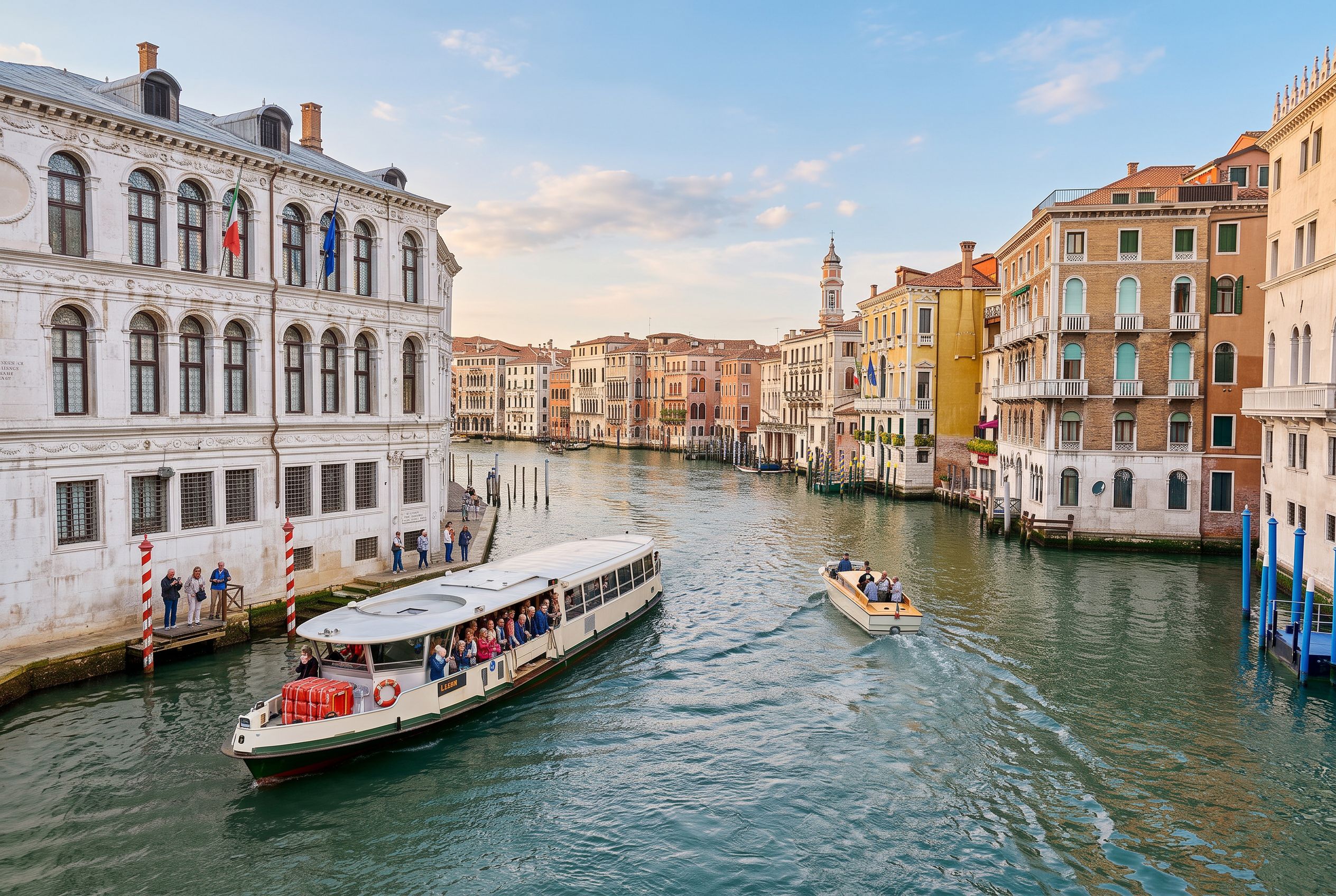
The strongest argument for Venice with grandchildren is that transport is itself the attraction. A vaporetto ride along the Grand Canal passes palace façades that children recognise from pictures before they can name them. One family guide specifically recommends Line 1 along the Grand Canal as a family-friendly ride, and it is the simplest way to give everyone a good first impression without a single bridge.
The second argument is scale. San Marco is a sensible base because many major sights cluster there, so less walking and fewer bridges are needed. A day can be one boat leg, one indoor stop, one outdoor break, and a return by water. That rhythm works for a seven-year-old and a seventy-year-old at the same time.
How do we get around without exhausting everyone?
The vaporetto is the backbone. ACTV's standard urban fare is €9.50 for 75 minutes, with children up to age 6 travelling free on urban services in the Municipality of Venice. Passes are €25 for 24 hours, €35 for 48 hours, €45 for 72 hours and €65 for seven days. Wheelchair users pay €1.50, with a companion travelling free on eligible waterbus services.
Lines 1 and 2 on the Grand Canal admit four wheelchairs at a time, according to the City of Venice, and the city says all vaporetto landing stages are accessible to disabled users. It adds one caveat: during particularly high tides, access ramps can become too steep.
Seats with a view on the Grand Canal or Giudecca Canal are hard to get unless it is early in the morning. For a family group, that argues for starting the first boat leg before 9am, or accepting an inside seat and saving the view for the return.
 AI-edited
For the Lido, the vaporetto drops visitors at Santa Maria Elisabetta, from where Gran Viale Santa Maria Elisabetta leads to the beach in about a 10-minute walk, according to Visit Venice. Line 1 runs from Piazzale Roma to Lido Santa Maria Elisabetta with 21 stops and a published 65-minute end-to-end run. Visit Venice's 2026 guide notes that the San Marco Vallaresso to Lido segment takes about 15 minutes, and that lines 5.1 and 5.2 also connect the Lido to Fondamente Nove.
Water taxis reduce walking but the cost is high. The City of Venice gives the Hello Venice service number as +39 041 2424 for timetable and route information.
What do grandchildren actually enjoy most?
Boats, glass, masks and gelato, in roughly that order. Murano glassblowing demonstrations are free to watch and reached by a short vaporetto journey, according to a family guide. Mask-making workshops run with the Mascareri, the master craftsmen, in all periods of the year, and children make a mask alongside them.
The Murano trip doubles as a boat outing. ACTV lines 4.1, 4.2 and 12 serve Murano, and the visit.venice.it guide says line 12 also reaches Mazzorbo, Burano and Torcello. The demonstrations are free to watch, but booking terms are not documented, so ask locally or through the workshop you plan to visit. Opening hours and demonstration prices for specific Murano venues are not documented in the material reviewed here.
Mask-making is the quieter counterpart and works well for children who need a seated activity after a morning on their feet. Venice tourism notes that workshops with the Mascareri run year-round, which makes them a reliable rainy-day or high-water fallback.
Gondola or traghetto: which water ride suits us?
The traghetto is the documented, low-cost canal crossing. For a short, memorable water moment with grandchildren, the traghetto does the job without a long sit.
Traghetti are the public gondola ferries that cross the Grand Canal at fixed points, and they are the only water ride the material supports with confidence. They are short, standing or seated for a couple of minutes, and they give children the gondola experience without the cost or the duration.
Ask at the landing stage, confirm the duration and route in advance, and agree the price before stepping aboard. The same applies to any private boat tour arranged through a hotel concierge.
Murano glass and mask-making: how do we book?
Glassblowing demonstrations on Murano are free to watch and reached by a short vaporetto journey, according to a family guide. Mask-making workshops with the Mascareri run in all periods of the year, per Venice tourism. Neither source documents booking terms, opening hours or prices for a specific venue, so arrange both directly.
Murano is served by ACTV lines 4.1, 4.2 and 12. The demonstration itself is the documented activity, and the craft tradition behind it is the reason the island exists as a visitor destination. For children, the appeal is the furnace, the molten glass and the speed of the work.
Mask-making is the better choice for a group that includes a child under five or a grandparent who wants to sit down. Venice tourism notes the workshops run year-round, which means they are not tied to Carnival.
Where do we stop for gelato and a sit-down?
The retrieved official sources do not publish a specific gelato venue in a named campo, so treat any recommendation as a local discovery rather than a documented one. use public gardens for breaks, and do not stand on bridges or in St Mark's Square to eat or drink outside the relevant bars and restaurants.
The city's responsible-visitor rules are worth reading before you go. They ask visitors to walk on the right, not to stand on bridges, and to use public gardens for breaks rather than bridge steps or square paving. For a grandparent managing a tired child, that is practical rather than pedantic: a campo bench or a garden is a better rest point than a bridge.
Venice has six public gardens in the historic centre, according to Venice tourism. The Papadopoli Gardens sit in Santa Croce, reachable on foot from Piazzale Roma. The Napoleonic Gardens of Castello, also called the Gardens of the Biennale, form part of the artistic event during Biennale periods, and from December to April other events may be held there. The Parco delle Rimembranze and Pineta di Sant'Elena mark the easternmost edge of the city and include football and volleyball fields.
For a flatter, gentler walk between stops, our piece on Venice's flattest strolls and loveliest corners maps out routes that avoid the worst of the bridge work.
Is the Lido beach worth a half day?
Yes, and it is the single best reset for children who have had enough of churches. A family guide identifies the Lido as a sandy Adriatic shore reached by vaporetto and suitable as a half-day break. Visit Venice describes it as a pleasant, low-key place outside festival season, with free public beaches at the northern and southern ends.
The Lido has three free zones where you can treat yourself to a beach day in privacy, according to Visit Lido. The seabed between the San Nicolò and Alberoni seawalls is never too deep, which Visit Lido notes makes it ideal for family holidays and holidays with children. Equipped beaches rent umbrellas and sunbeds and offer bars, restaurants, showers, toilets, beach volleyball and bowling courts, children's entertainment and pet-friendly areas.
One caution from Visit Lido: during the hatching period, Lipu volunteers protect nests on the dunes with nets, fences and notices along the beach. Keep children to the marked paths. The WWF Oasis Dune degli Alberoni sits at the Lido and is another reason to walk rather than dig.
For the 2026 season, the Venice Lido beaches page says Bluemoon opens on 18 April, Bluepool on 16 May, and the Lungomare and San Nicolò beach establishments from 22 May. Confirm current dates before travelling, as these are published season openings rather than fixed annual dates.
Bridges and pushchairs: what should we know?
Venice is not stroller-friendly. Venice tourism states plainly that a stroller is "absolutely not recommended" because of the stairs and bridges. A family guide notes the city is bumpy for pushchairs, with cobbled streets and stairs on all the bridges, while only the main tourist bridges have slides for pushchairs and wheelchairs. A carrier is the practical answer for small children.
The scale is worth holding in mind. Venice tourism counts 121 islets and 435 bridges, and notes the city is difficult to move around not only for people with reduced mobility but also for the elderly carrying shopping, parents pushing a pram and visitors with luggage. Venice's little canals usually mean at least eight steps up and eight down on each bridge, which becomes tiring fast with children, strollers or older adults.
Some major bridges now have ramps, especially near San Zaccaria and along the Zattere. The city's accessibility map covers the city centre and islands and was produced by the Città per tutti service with the EBA department for architectural barriers, and it distinguishes areas accessible by vaporetto, by motoscafo or facilitated bridge, and areas not accessible by public transport.
Exact step counts, lift counts and bridge-by-bridge difficulty ratings for Venice's main sights are not documented in the material reviewed here. Check routes on maps in advance, and ask your hotel which bridges lie between it and the sights you care about.
Where are the rest points and medical help?
The best-documented central medical service is the tourist first-aid point in Piazza San Marco near Caffè Florian, which one source gives as open 08:00 to 20:00 with a tourist-doctor number. The city emergency number is 118, with 112 for general emergency, 113 for police and 115 for fire fighters.
St Mark's Campanile has an elevator to the top, according to a family guide, which removes the stair fatigue from one of the city's best viewpoints. That makes it a strong choice for a grandparent who wants the panorama without the climb. Booking terms for the campanile are not documented in the material reviewed here.
For indoor rest, the Gallerie dell'Accademia is open Tuesday to Sunday 09:00 to 19:00 and closed Mondays, according to the source, and has a barrier-free entrance in Calle della Carità. The same source notes that parts of the route are interrupted by missing platforms, one elevator is temporarily out of service, and Halls XVIII to XXIII are currently closed because of an accessibility project. Confirm current conditions before relying on the gallery as a rest stop.
Family-friendly museums provide priority access for families and pregnant women, along with strollers for visiting and changing tables in the bathrooms, according to Venice tourism. That is useful for grandparents travelling with a baby or toddler.
Pharmacy proximity for each named attraction is not documented. Ask at your hotel for the nearest one to your day's route. Venice tourism publishes accessibility and information contacts at S. Marco 4136, including 041 2748050 and 041 2748149, plus 041 2748144 for public-relations information.
What does a day out cost?
The documented figures are the ACTV fares, the basilica ticket and the day-visitor access fee. The standard ACTV urban fare is €9.50 for 75 minutes, covering waterbus, bus, tram and People Mover within that window. The complete St Mark's Basilica ticket is €30 and includes the cathedral, Pala d'Oro, Museum and Loggia dei Cavalli.
Venice introduced a day-visitor access fee in 2026 on selected high-attendance dates. One source says it applied on 54 days in 2025, generally 8:30 to 16:00, with €5 if booked by the fourth-last day and €10 later. The exemption page cited in the material lists people with disabilities and their companions among those exempt.
| Item | Cost | Condition |
|---|---|---|
| ACTV urban ticket | €9.50 | 75 minutes, waterbus, bus, tram, People Mover |
| ACTV 24-hour pass | €25 | 24 hours from validation |
| ACTV 48-hour pass | €35 | 48 hours from validation |
| ACTV 72-hour pass | €45 | 72 hours from validation |
| ACTV 7-day pass | €65 | 7 days from validation |
| Wheelchair user fare | €1.50 | Eligible waterbus travel, companion free |
| Children up to age 6 | Free | Urban and suburban services, Municipality of Venice |
| St Mark's Basilica complete ticket | €30 | Cathedral, Pala d'Oro, Museum, Loggia dei Cavalli |
The material gathered does not document a general senior or over-65 tourist fare for Venice visitor transport, nor an over-65 museum tariff across the city. Over-65 reductions are resident-linked rather than visitor-linked. The Rolling Venice Card costs €6 and gives under-30 disabled visitors 72 hours of vaporetto access plus attraction discounts, with disability certification shown at HelloVenezia offices.
Rates are indicative and vary by season and booking channel. Confirm current prices when you book.
What should we book ahead, and what can wait?
Book St Mark's Basilica timed tickets online before travel, and carry identity documents for any free or reduced entry. The Doge's Palace is open daily, with summer hours 09:00 to 19:00 and winter hours 09:00 to 18:00, and Friday and Saturday evening openings until 23:00 from 1 May to 26 September 2026. It is closed on 25 December and 1 January.
The Doge's Palace regular visit is fully accessible, with fully accessible toilets on the ground floor, according to Palazzo Ducale. The same source states that the Secret Itineraries, Prisons and Armoury are not accessible. Suitcases, trolleys and bulky luggage are not permitted in museum areas, defined as any luggage whose three sides sum to more than one linear metre including handles, wheels and external pockets. The cloakroom service is free of charge.
Evening lit visits at St Mark's Basilica run 19:30 to 22:00 in one-hour slots.
Expect occasional vaporetto or landing-stage changes, especially around canal works and special events. The city began works on the banks of Rio di Cannaregio in May 2024, reducing the navigable section and introducing a temporary stop at San Giobbe. The Comune di Venezia said the works were completed and normal navigation resumed from 15 February 2025, with AVM/Actv restoring Line 3 and the circular lines 4.1, 4.2, 5.1 and 5.2. At the end of 2024, the mayor described works in Piazza San Marco and said 2025 would bring about 1.5 billion euros of public construction projects citywide.
If a trip overlaps with a major event such as the Venicemarathon, build in extra time and check waterbus stops in advance. For ideas beyond the city itself, see our guide to day trips worth making from Venice.
How many days do we need?
Three days covers the core without rushing. One day for San Marco and the Doge's Palace, one for Murano and mask-making, one for the Lido. Anything longer should be built around rest, not more sights. The recurring advice in family forums is to prioritise one or two experiences rather than treating Venice like a checklist city.
A Rick Steves forum post recommends taking a waterbus up the Grand Canal to the Rialto and back again as an efficient way to get a really good impression of Venice. The same forum advises booking St Mark's Basilica online in advance for a specific time to avoid the long queue, and recommends stopping for coffee or a meal instead of pushing on continuously.
For a group with a toddler, two half-days may be more realistic than one full day. The vaporetto pass makes that affordable: a 48-hour pass at €35 covers the comings and goings that a rest-heavy rhythm requires.
Accessibility details for specific sights should be checked directly. The material does not document step counts or lift details for St Mark's Basilica, and the city's accessibility pages do not publish them either. For a broader accessible overview, see Venice tourism's accessible Venice page.
For the Lido's beach season and facilities, Visit Lido's beach page carries the published 2026 opening dates.


