
Rome rewards timing more than almost any city in Europe. The difference between a comfortable morning on the Palatine and a punishing afternoon in the same spot is often a matter of weeks, not luck. April to May and late September to October. Get those months right and the city opens up. Get them wrong and you spend your holiday queueing in full sun.
The guidance below is drawn from published travel guides, official museum opening pages and traveller forums, and it is consistent across all of them. Shoulder seasons for comfort, winter for quiet, and a real warning about July and August. What follows is month-by-month, with the crowd peaks and closures that actually affect a trip.
What is the best month to visit Rome?
October is the most consistently praised single month for warm days and manageable crowds, with May the other month most often singled out as excellent. One Rome travel guide puts the best window at April to June and September to October, when average temperatures range from 15°C to 25°C.
That 15°C to 25°C band is the practical heart of the matter. It is warm enough for outdoor dining and long walks, cool enough that the Forum and the Colosseum do not become endurance tests. The same guide notes that hotel prices fall to around €100 per night in these months, against peak summer rates over €200, and that hotels can offer value around 30% below summer rates.
the Roman ottobrata, a settled warm spell that often runs into the middle of the month. May is arguably the better weather month, but it is also one of the busiest, and demand for the headline sights is sustained through June.
Which months should you avoid, and why?
July and August are the clearest months to avoid if your dates are flexible. The heat makes open-air ancient sites genuinely hard going, and August adds a second problem: many shops and restaurants close as Romans leave for the coast.
The heat warning is not a matter of preference. Traveller reports from the Rick Steves forum describe the Roman Forum as "so uncomfortably hot" that it was hard to enjoy, and summer afternoons, especially Friday or Saturday, as "hellish" for both crowding and heat.
August has a second layer. Mid-August brings Ferragosto on 15 August, when many Roman businesses close for one to two weeks as locals vacation. One guide notes average highs around 31°C in August and reports that the Colosseum, Vatican Museums, Trevi Fountain and Pantheon remain busy with foreign visitors even as local life thins out. Travellers describe August as a ghost town for residents and "hell" for heat.
What does each month actually feel like?
January and February are the quietest and cheapest months, spring builds gradually from March, summer peaks in July, and the year's best conditions arrive from mid-September through October before November turns cooler and wetter.
The pattern is unusually consistent. Here is how the year breaks down.
| Month | Weather character | Crowd level |
|---|---|---|
| January | Cold, typical highs around 12°C | Quietest month |
| February | Still cool, slightly better than January | Very quiet |
| March | Mild but changeable | Crowds begin building |
| April | Good spring weather | Holy Week and Easter spike |
| May | Warm days, long evenings | High demand |
| June | Warm to hot, heat building | Still busy |
| July | Very hot | Peak visitor numbers and prices |
| August | Extremely hot, around 31°C highs | Sites busy, locals away |
| September | Still warm, easing late in the month | Strong shoulder choice |
| October | Warm, settled ottobrata | Moderate |
| November | Cooler and wetter | Quieter, good value |
| December | Holiday atmosphere | Rises around Christmas week |
January deserves a closer look for anyone who prioritises empty streets over warm ones. One source calls it the calmest month, with a modelled crowd level near 40 out of 100 and typical highs of 12°C, and notes that crowds stay low after Epiphany. Travellers report walking through museums entirely alone in that period, and a Rome local in one discussion put the quietest stretch as roughly New Year's Day to just before the March school holidays.
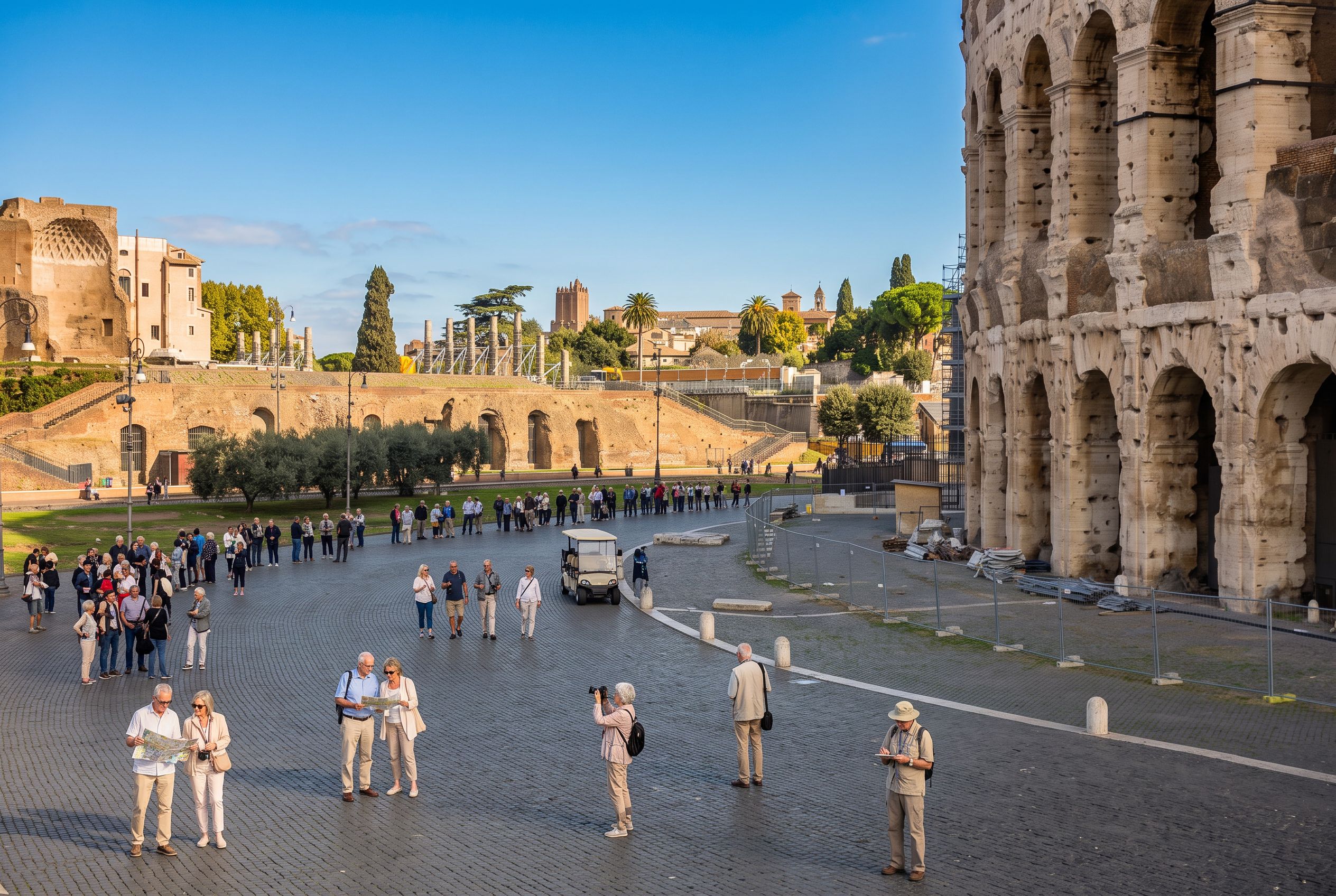 AI-edited
Why are April-May and October-November the calm shoulder windows?
These four months sit between the cold quiet of winter and the hot crush of summer.
April and May bring the city back to life without the summer volume, though April has one significant complication. Holy Week and Easter are repeatedly flagged as peak-crowd periods, when central Rome and the major sites get much busier than usual and prices rise. If crowd avoidance matters, the advice is to skip Holy Week dates and aim for later in April or May instead.
On the autumn side, the picture is cleaner. Mid-September onward is repeatedly described as one of the best times, once the worst summer heat has eased but before late-autumn weather arrives. Travellers on a Rick Steves forum reported late September as "significantly less crowded" and the weather as "warm, but tolerable." Late October into early November is described as slightly less crowded than summer while still good for long walking and outdoor café dining.
November is the trade-off month. It is quieter and often good value, but the weather is less reliable than October's, and one guide notes Rome can have rainy periods from November through March or April.
How do Holy Week and the holiday peaks affect a trip?
Easter and Holy Week are the single biggest spring crowd spike, and 20 December to 6 January is the winter equivalent. Both periods bring higher prices and much heavier demand at the Vatican and the Colosseum.
The Christmas period is described as a high-demand holiday peak, with crowds rising again around Christmas and New Year. December has its own appeal, and several travellers reported the first half of the month as "great," with no crowds or manageable crowds and cool weather, but the experience changes sharply once the holiday week begins.
Spring requires the most forward planning. One Rome guide advises that for spring visits, especially during Easter week and April, Vatican Museum and Colosseum tickets should be booked online at least three months in advance to secure preferred time slots, and that hotels should be booked four to six months ahead. That is the most concrete booking guidance, and it applies specifically to the Easter window.
Two other dates matter for planning. May 1st is Labor Day, when most attractions close. And the Vatican Museums publish a fixed closure pattern that includes most Sundays and selected feast days, with 1 May and 29 June among the annual closure dates.
When are the Vatican Museums and Colosseum least crowded?
January and February give the shortest queues, with possible waits of 10 to 15 minutes at the Vatican Museums in quieter weeks even without skip-the-line tickets. The Vatican Museums also open late on Friday evenings for most of the year and are far calmer then than at any morning slot.
The Vatican Museums are normally open Monday to Saturday from 8:00 AM to 8:00 PM, with last entry at 6:00 PM. They are usually closed on Sundays, with one important exception: they normally open on the last Sunday of each month from 9:00 AM to 2:00 PM, with final entry at 12:30 PM, and that opening is generally free of charge. The last Sunday opening does not apply when it coincides with certain dates, including Easter Sunday, 29 June, 25 and 26 December, and 31 December, so it is worth checking the official calendar before planning around it.
St Peter's Basilica is free and entirely separate from the museums, and the security queue there is shortest before 8am or after 4pm.
For the Colosseum, tickets go on sale on the official park site exactly 30 days ahead, and resellers clear the good slots within hours of release. In quieter periods, timed-entry slots can sometimes be available same-day. One guide recommends visiting major sites early morning (the Colosseum opens at 8:30 AM) or late afternoon. Several guides suggest weekday mornings, especially Tuesday to Thursday, for lighter pressure at major museums.
The Borghese Gallery is the other major booking to note. In quieter periods it can be booked a day or two ahead rather than much further in advance.
How do you handle the heat on Rome's shadeless ruins?
Go early.
Shade is the central problem. One traveller recommended 8:30 am for the Colosseum and Forum specifically because it is cooler and less crowded.
For travellers in their 50s and 60s, the practical advice that emerges is straightforward: start early, avoid August heat, and accept that the Forum and Colosseum are much harder to enjoy in hot weather. Multiple forum posters recommend early starts for general sightseeing because late afternoon is often the hottest and busiest part of the day.
Summer has one mitigation worth knowing. The Pantheon in Rome's city centre has published special evening openings throughout August in recent years, which can help manage daytime heat and crowd pressure. For general health planning, including where to find a pharmacy when you need one, our guide to health and pharmacies in Rome covers the practical side.
How many days do you need in Rome?
Three full days is the practical minimum to cover the Vatican, the Colosseum and the centre. Five days lets you slow down and add Ostia Antica or the Appian Way.
That guidance comes from a source that frames it in terms of pace rather than checklist. Three days is enough to see the headline sights without rushing, but it leaves little room for the unhurried mornings that make a shoulder-season trip worthwhile. Five days opens up day trips and gives you a buffer if one morning is rained out or one site is unexpectedly busy.
For a slower-paced visit, the shoulder seasons make the extra days pay off. Walking tours are explicitly described as particularly suitable in spring and autumn, and the hillside areas around the Palatine and the Aventine are noted as more pleasant to walk in May and late September through October.
They describe Rome as very walkable in the shoulder seasons, especially for walking tours in spring and fall, and they identify July and August as the most difficult months for sightseeing on foot because of heat. They do not document exact step counts, lift availability, pavement conditions or senior-specific terrain ratings for the Colosseum, Vatican Museums, Borghese Gallery, Palatine Hill or Aventine Hill. Those details are not documented and should be confirmed directly with each site. Our separate guide to Rome's accessibility for older travellers covers that subject in full.
Is Rome expensive, and when is it cheapest?
January is the most often cited cheapest month, with February and late November also described as low-cost periods. Hotels in the shoulder seasons run around €100 per night against peak summer rates over €200.
The savings are real but they come with conditions. One guide notes that in the quietest periods hotels have low rates (50% below summer), attractions have no queues, and restaurants welcome guests warmly. The same source notes that to save on entry fees averaging €12-18 for major sites, planning a winter trip can help, since many museums offer reduced or free admission days due to lower tourist demand.
Rates are indicative and vary by season and booking channel, so treat any figure as a starting point rather than a quote. The broader pattern is that winter and the shoulder months cost meaningfully less than July, when both visitor numbers and prices are at their highest.
Booking lead times shift with the season too. In the Easter window, the advice reverses: book Vatican and Colosseum tickets at least three months ahead and hotels four to six months ahead.
What else should shape your dates?
Two things beyond weather and crowds: what you want to eat and where you want to sleep. Both are affected by season, and both have their own considerations for travellers in their 50s and 60s.
August is the month to think hardest about food. Many shops and restaurants close, with restaurant closures often running from the second week of the month to the end. That is a real factor if dining is part of your trip rather than an afterthought. For a fuller picture of what to expect from Roman cooking across the year, our guide to what to eat in Rome covers the subject properly.
Sleep quality is the other seasonal consideration. Central Rome is a noisy city, and the gathered guest feedback points to street noise, thin walls and early breakfast-room noise as recurring themes across several central properties. If you are a light sleeper, the shoulder seasons do not solve that on their own; the room and the building matter more than the month. Our roundup of the quietest hotels in Rome for light sleepers goes into the detail.
One final planning note. Those details are not documented in the material and should be confirmed with the relevant authority or the site directly before you travel.


