
Rome rewards the traveller who arrives prepared. The city has a dense network of pharmacies, two public walk-in clinics aimed squarely at visitors, a single emergency number that works across Europe, and a fountain system that has kept people hydrated since the nineteenth century. None of it requires special knowledge in advance, but knowing where to look turns a minor ailment into a twenty-minute errand rather than a lost afternoon. This guide covers the practical health scaffolding of a Rome trip for travellers aged 50 to 70: where to find a pharmacy, how to reach an English-speaking doctor, what to do with your medication, and how to handle the heat on shadeless ruins.
What Rome does not do is publish a tidy, English-language map of all of this in one place. The information exists, scattered across municipal pages, national health portals and traveller guides, and it is worth assembling before you fly. The sections below do that work. Costs and packing are covered in their own dedicated guides, linked where relevant.
How do I find a pharmacy in Rome?
Pharmacies are widespread across Rome and are identified by a green cross, usually a illuminated one. Many are open 24 hours on a rotating duty schedule, and a closed pharmacy must post the address of the nearest open one on its door. Larger pharmacies in tourist areas are more likely to have English-speaking staff.
The green cross is the universal marker, and the UK government's travel advice for Italy confirms that pharmacies are widely available and usually identified this way. Most over-the-counter medicines are bought at a pharmacy rather than a supermarket, so the farmacia is your first stop for anything minor.
Standard opening hours are often Monday to Friday, 9am to 1pm and 4pm to 8pm, with on-duty pharmacies open around the clock on a rotating schedule for emergencies, according to a pharmacy guide for tourists. That split day is worth remembering: if you walk past a pharmacy at 2pm and find it shuttered, it is not closed for the day, only for the afternoon break.
In central Rome, several pharmacies keep extended hours. A pharmacy guide names Farmacia della Stazione near Termini, Farmacia Internazionale Capranica near the Pantheon, and Farmacia Cola di Rienzo in Prati near the Vatican as long-hours options. Traveller guides also point to Farmacia Piram on Via Nazionale, Farmacia Trastevere on Viale di Trastevere, Farmacia Igea San Gallicano on Via di San Gallicano, and Farmacia Senato Criserà Guglielmo on Corso del Rinascimento as central 24-hour or late-night choices.
 AI-edited
Late-night coverage clusters around major transport and shopping areas: Piazza dei Cinquecento, Piazza della Repubblica, Via Nazionale, Piazza Barberini and Viale Trastevere, according to a Rome pharmacy guide. If you are staying near any of those, you are within a short walk of after-hours help.
Can I find an English-speaking doctor in Rome?
Yes. Rome has two public walk-in clinics specifically for tourists, in Trastevere and near Piazza del Popolo, plus several private English-speaking practices. Emergency operators on 112 are described as English-speaking. Hotel front desks are a practical shortcut, and travellers report they will often call ahead on your behalf.
The two public options are Ospedale Nuovo Regina Margherita in Trastevere and Poliambulatorio Canova in the historic centre near Piazza del Popolo. A Rome medical guide for tourists describes both as walk-in services intended for visitors, with tourist medical lines operating 24 hours a day, seven days a week for urgent advice. One traveller account notes that the Via Antonio Canova location can look closed from the street until you ring the bell, and that the visit was free with English-speaking staff on hand.
Private practices listed in Rome medical guides include FirstMed on Via Morgagni 30, MedInAction on Viale delle Mura Gianicolensi 67, Aventino Medical Group on Via Sant'Alberto Magno 5, and Doctors in Italy on Via Frattina 48. These provide primary care, prescriptions and referrals, and all are described as English-speaking. Cancellation terms for these practices are not documented; ask when you call.
For non-urgent care when GP surgeries are closed, Italy operates a Continuity of Care Service, formerly the Medical Guard, reachable on 116117, according to ECC-Net Italia. The UK's Foreign, Commonwealth and Development Office maintains a list of medical providers in Italy where some staff will speak English.
Which hospitals in Rome have emergency departments?
Rome's major hospitals with emergency services include Policlinico Umberto I, Ospedale San Camillo-Forlanini, Azienda Ospedaliera San Giovanni-Addolorata, Ospedale Pediatrico Bambino Gesù and Ospedale CTO Andrea Alesini, according to ECC-Net Italia. Tourist-health sources also name Nuovo Regina Margherita in Trastevere and the hospital point at Isola Tiberina.
Dial 112 for any emergency in Rome. One source notes that 112 is the single European emergency number and that operators should speak English or be able to find someone who does. For an ambulance specifically, dial 118. The UK government's travel advice for Italy states plainly: dial 118 and ask for an ambulance.
Several traveller posts caution against using an emergency room for minor issues, since waits can be long and the setting is not intended as a substitute for a general doctor. That is practical guidance rather than a criticism of any named facility: the emergency department is built for emergencies.
If you are referred to a medical facility for treatment, contact your insurance company quickly, as the UK government advises. That call is often what triggers the paperwork for direct billing or later reimbursement.
What should I know about travelling with medication?
Keep medicines in their original packaging with the pharmacy label, and carry a doctor's letter in English listing medications, dosages and conditions. Italy's Ministry of Health allows foreigners to bring up to 30 days' worth of personal medication with a copy of the prescription, and forbids bringing prescription drugs for other people.
The original-packaging rule matters more than it might seem. A Rome medication guide states that this is essential for prescription medicines and critical for controlled substances. Travellers on forums echo the same advice, adding that a screenshot or paper copy of the prescription makes it easier to explain what you need at a farmacia.
UK prescriptions are not accepted in Italy, though you may be able to buy an equivalent medication from a pharmacy, according to the UK government. Alternatively, you can visit an Italian GP to obtain a local prescription. Prescription medicines are not free in Italy, but with a GHIC or EHIC and an Italian prescription, you will pay a reduced rate.
The legal status and regulation of some medicines prescribed or bought in the UK can be different in Italy. If you take a controlled substance, check the Italian Ministry of Health's guidance on travelling internationally with medicines containing controlled substances before you travel.
Do I need a GHIC and travel insurance?
To get medically necessary state healthcare in Italy, you need a Global Health Insurance Card (GHIC) or a European Health Insurance Card (EHIC). A GHIC or EHIC is not an alternative to travel insurance, and the UK government advises arranging cover at least eight weeks before your trip.
The GHIC covers state-provided treatment on the same terms as an Italian resident, which means reduced rates on prescription medicines with an Italian prescription. It does not cover private healthcare, private clinics, medical repatriation to the UK, additional standard costs for treatment, changes to travel and accommodation bookings, or treatment that is ruled non-urgent.
That list is worth reading twice. The gaps are exactly the situations where a Rome trip can become expensive: a private clinic visit, a changed flight, a taxi home from hospital. Travel insurance fills them.
If you hold a GHIC or EHIC, carry it with your passport. If you do not have one and are eligible, apply well before departure. The eight-week window the UK government recommends is not a processing deadline but a sensible buffer.
How do I cope with summer heat on Rome's ruins?
Rome's warmest period runs from June to August, and the archaeological sites offer almost no shade. Plan ruin visits for early morning or late afternoon, carry water, wear a hat, and use the city's free nasoni fountains to refill. Late spring and early autumn are generally more comfortable for walking.
Rome has a Mediterranean climate with hot, dry summers and milder, wetter winters. Rainfall is low from June to August and rises sharply in October and November, which are the wettest months. For a traveller aged 50 to 70 who wants to walk the Forum and the Palatine without wilting, the comfort window sits in spring and early autumn.
The terrain itself adds to the heat load. The historic centre is paved with sampietrini, the small basalt blocks set in sand that a mobility guide describes as uneven, dished and often loose. They radiate heat and demand attention with every step. That same guide recommends planning routes along asphalted stretches such as Via del Corso, the Tiber paths and the Villa Borghese avenues, which are smoother underfoot.
For a fuller picture of how the city's surfaces and transport affect older visitors, see our guide to how accessible Rome is for older travellers.
What are the nasoni fountains and can I drink from them?
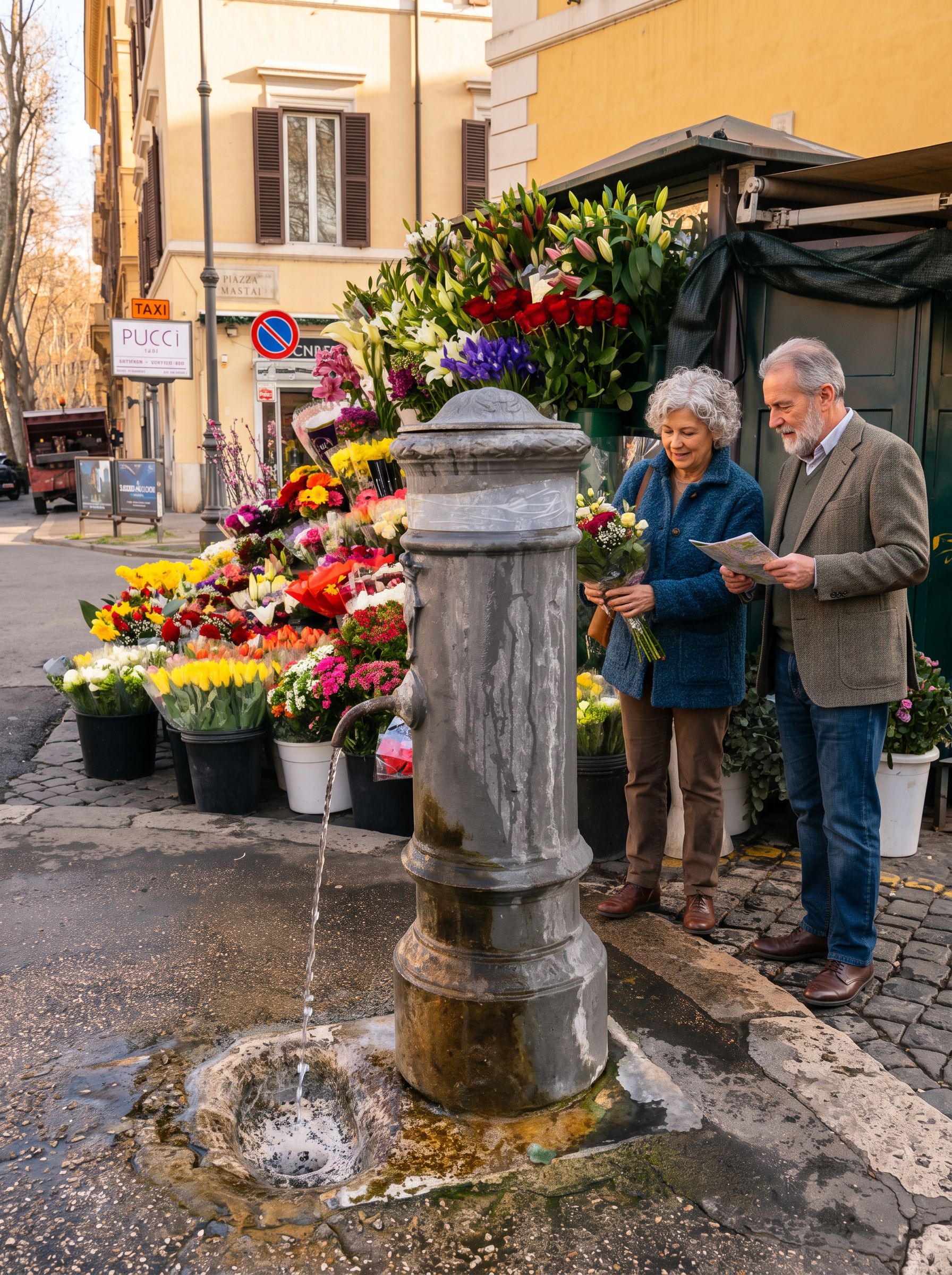
The nasoni are Rome's public drinking fountains, and their water is potable. They are free, scattered across the city, and a practical way to stay hydrated without buying bottles. Carry a refillable bottle and top up as you walk.
The fountains take their name from the curved spout that resembles a nose. They run continuously, which means cold water is available even in the hottest part of an August afternoon. For anyone managing hydration on medication, or simply trying to avoid heat exhaustion, they remove the excuse to go without.
A refillable bottle is the single most useful item in a Rome day bag between June and September. Fill it at the start of the morning, refill at every nasoni you pass, and you will drink far more than you would if each mouthful cost two euros from a kiosk.
How do I get around Rome with health and mobility in mind?
ATAC states that 100% of its bus fleet has boarding platforms and a wheelchair area, making buses the most consistently documented accessible public transport in Rome. Every metro station is accessible except Spagna, Barberini, Repubblica and Vittorio Emanuele on Line A, which have no lift or stair lift to the platform.
A Rome mobility guide adds that almost every ATAC bus has a ramp and wheelchair space, while about 70% of trams have a low floor. The same source notes that the line number matters less than the specific vehicle that arrives, which is useful to know if you are waiting at a stop and want to gauge what is coming.
Some Line A and B stations use stair lifts that ATAC books in advance rather than standard lifts. RFI's Sala Blu assistance service is free and covers Termini, Tiburtina, Ostiense and Fiumicino Aeroporto, according to the same mobility guide. If you need assistance at a station, book it rather than arriving and hoping.
one gives the BIT ticket at about €1.50 for 100 minutes, another says €1.50 for a standard single ticket, and a third says €2 for a single 100-minute ticket. Confirm the current fare at the machine. A Rome transport source states there are no senior discounted rates on tickets valid for less than one month.
Rome's transport network is also in a period of active change. Turismo Roma reported on 27 August 2024 that the city had invested 10 billion euros in transport and mobility systems for the decade, with the administration taking stock of its mid-term progress. If you are planning around a specific line, check the Turismo Roma transport update before you travel.
Is Rome safe for older travellers?
Rome is described as fairly safe for travellers, with pickpocketing and scams the main concerns, especially on public transport and around major attractions. Standard precautions apply: use well-lit ATMs, keep bags zipped and in front of you, and stay alert in crowded areas.
The practical health angle here is indirect but real. A stolen bag containing medication, a GHIC card or a phone with your prescription screenshots turns a manageable situation into a difficult one. Carry a paper copy of your medication list separately from your medicines.
For dining and food safety, our guide to eating in Rome covers what to expect from restaurants and markets. For a sense of what a comfortable trip costs, including the categories where insurance and health spending sit, see what a comfortable Rome trip costs.
How should I plan my health kit for Rome?
Assemble four things before you fly: a GHIC or EHIC, travel insurance arranged at least eight weeks ahead, medication in original packaging with a doctor's letter in English, and a written list of your medicines using generic names. Add a refillable water bottle and the address of the pharmacy nearest your hotel.
The generic-names point comes up repeatedly in traveller feedback. Italian pharmacists respond better when they can match the active ingredient rather than a brand name that may not exist in Italy.
Hotel front desks are worth using early rather than late. Travellers report that staff will call ahead to a doctor, provide a local list, or arrange a room visit. One forum account describes a hotel-arranged doctor visit at 120 euros, with the prescription filled at a pharmacy directly across the street. That figure comes from a traveller report, not a published rate, and no official price list exists for such visits.
If you are choosing accommodation with health and rest in mind, our guide to the quietest hotels in Rome covers what light sleepers should look for. A quiet room is not a medical matter, but on a hot Roman night it comes close.


