
Salzburg rewards the unhurried eater. While the crowds surge down Getreidegasse towards Mozart’s Birthplace, the city’s real culinary soul lives in wood-panelled Gasthäuser, marble-topped coffee houses, and a centuries-old monastery beer hall where locals still queue with their own steins. For the food-minded traveller aged 50 to 70, this is a city that rewards patience, a good appetite, and the willingness to share a dessert the size of a small mountain.
Forget the tourist-trap schnitzel palaces. The Salzburg worth tasting is found in the quiet corners of the Altstadt, across the river in less-polished neighbourhoods, and in institutions that have been serving the same dishes for generations. This guide focuses entirely on local specialities, where to find them, what they cost, and how to enjoy them without the stress of queues or overpriced menus. Fine dining has its own dedicated guide; here, we eat like Salzburgers do.
 AI-edited
What exactly is Salzburger Nockerl and where should I try it?
Salzburger Nockerl is a soufflé-like dessert whose three peaks are said to stand for Salzburg’s snow-covered hills, baked until golden and dusted with powdered sugar. It is Salzburg’s signature sweet. Café Mozart, Café Altstadt, Café Sacher, Herzl and Sternbräu all carry it on their published menus, and one portion is meant to be shared between two.
The Nockerl is a theatrical creation: a fluffy, egg-based soufflé that arrives puffed and golden, often with a berry compote underneath to cut through the richness. Which hills the three peaks stand for is not settled — the city tourism board names the Mönchsberg, Kapuzinerberg and Gaisberg, while Café Mozart and the Herzl both print the Rainberg in place of the Gaisberg. It takes time to prepare properly. Café Altstadt prints the waiting time on its own menu — at least 20 minutes for the Nockerl, and the same for the Kaiserschmarrn — so order it at the start of your meal rather than at the end. Café Mozart makes the same point in its menu text: because the dish is whipped up fresh from egg white and sugar, guests should bring time as well as appetite
Portions are genuinely enormous. St. Peter Stiftskulinarium sits in the rock cellars of the Benedictine archabbey of St. Peter and calls itself the oldest restaurant in Europe, dating its hospitality to the year 803. Its dining rooms feel more like a cathedral than a café. It is not cheap, but the atmosphere is unforgettable.
| Venue | Price Band | Wait Time | Notes |
|---|---|---|---|
| Café Mozart | €25.00 for two | Baked to order | On the bel étage above Getreidegasse; ask about step-free access before you set out |
| Café Sacher Salzburg | €€€ | Varies | Recommended by the city as a dish for two; listed as barrier-free, daily 8.30 a.m. to 10 p.m. |
| Café Altstadt | €22.00 | At least 20 minutes | Ground-floor café at the Radisson Blu Hotel Altstadt, entered from Judengasse |
| Sternbräu | €€ | Varies | Serves single portions for solo diners |
Where can I find an authentic Bosna sausage?
The Bosna is Salzburg’s answer to street food: two grilled sausages in a crisp white bread roll with onions, mustard and curry powder, finished with a spice mix the stand keeps to itself. The most famous version comes from Balkan Grill Walter, a tiny window at Getreidegasse 33a in the Stockhamer passage through to Universitätsplatz, open daily from 11 a.m. to 6.30 p.m.
This is not a sit-down meal. You order at the window, eat standing up or while walking, and the whole experience takes less than ten minutes. The city tourism board calls the Bosna a kind of hot dog and traces it to the Bulgarian Zanko Todoroff, who first grilled it to his own recipe at the Müllner Bräustübl in 1949 before opening his own stand. The spice level is noticeable but not overwhelming.
Getreidegasse is Salzburg’s most famous shopping street, so time your visit for mid-morning or mid-afternoon to avoid the worst crowds. The stand itself is easy to spot by the queue of locals and visitors alike. If you want to sit down with your Bosna, cross the river to the Linzergasse.
For a more substantial meal, the Gasthof Alter Fuchs at Linzergasse 47-49 across the river serves Austrian cooking to grandmother’s recipes in vaulted rooms and a shaded courtyard, daily from 11.45 a.m. with a hot kitchen until 9 p.m. Restaurant Herzl stands directly on Getreidegasse at number 37, holds one Gault Millau toque for 2026, and is reached step-free through the hotel entrance.
Which coffee houses are worth lingering in?
Café Tomaselli, which calls itself Austria’s oldest coffee house and dates its founding to 1700, is the essential stop for coffee culture in Salzburg. For a quieter room with a river terrace, Café Bazar has been serving since 1882 and is listed by the city as barrier-free. Both offer the classic marble tables, newspaper stands, and unhurried service that define the Austrian coffee house tradition.
Café Tomaselli sits on Alter Markt, directly across from Konditorei Fürst, where the original Mozartkugel was invented in 1890. The house dates its own founding to 1700, when the French-born Johann Fontaine was licensed to sell chocolate, tea and coffee in Salzburg, and the terrace in front of the café is coveted through spring and summer. The veranda on the floor above is reached by a small winding staircase, so keep to the ground floor if stairs are a problem. One thing to know before you order: what Tomaselli puts on the pastry tray is a Salzburger Nockerl slice from its own bakery, not the warm soufflé. It is touristy, yes, but it earns that status honestly.
Café Bazar, on the Salzach’s right bank at Schwarzstraße 3, is the choice for those who want fewer crowds: the city tourism board describes a picture-postcard view of the Old Town from its 100-seat terrace, and the café opens daily, from 7.30 a.m. on weekdays and Saturdays and from 9 a.m. on Sundays and public holidays. One Google reviewer called it in September 2025 “a great place for a coffee break or breakfast,” noting that “the outdoor patio has a very nice vibe as it’s by the river and you can watch the pedestrians and cyclists go by.” For modern specialty coffee, 220GRAD Rupertinum in the festival district roasts its own beans and bakes its own cakes; it opens Tuesday to Sunday from 9 a.m. to 6 p.m., closes on Mondays, and has a few steps at the entrance, though its WC is barrier-free.
“Superb setting with its magnificent wood panelling with inlays adorns the walls and takes guests back in time, as do the marble tables, silver trays, waiters in dinner jackets and the cake ladies… Still family-owned today, it is a stylish representation of more than 300 years of Austrian coffee house tradition.” — from a Google review of Café Tomaselli, February 2026
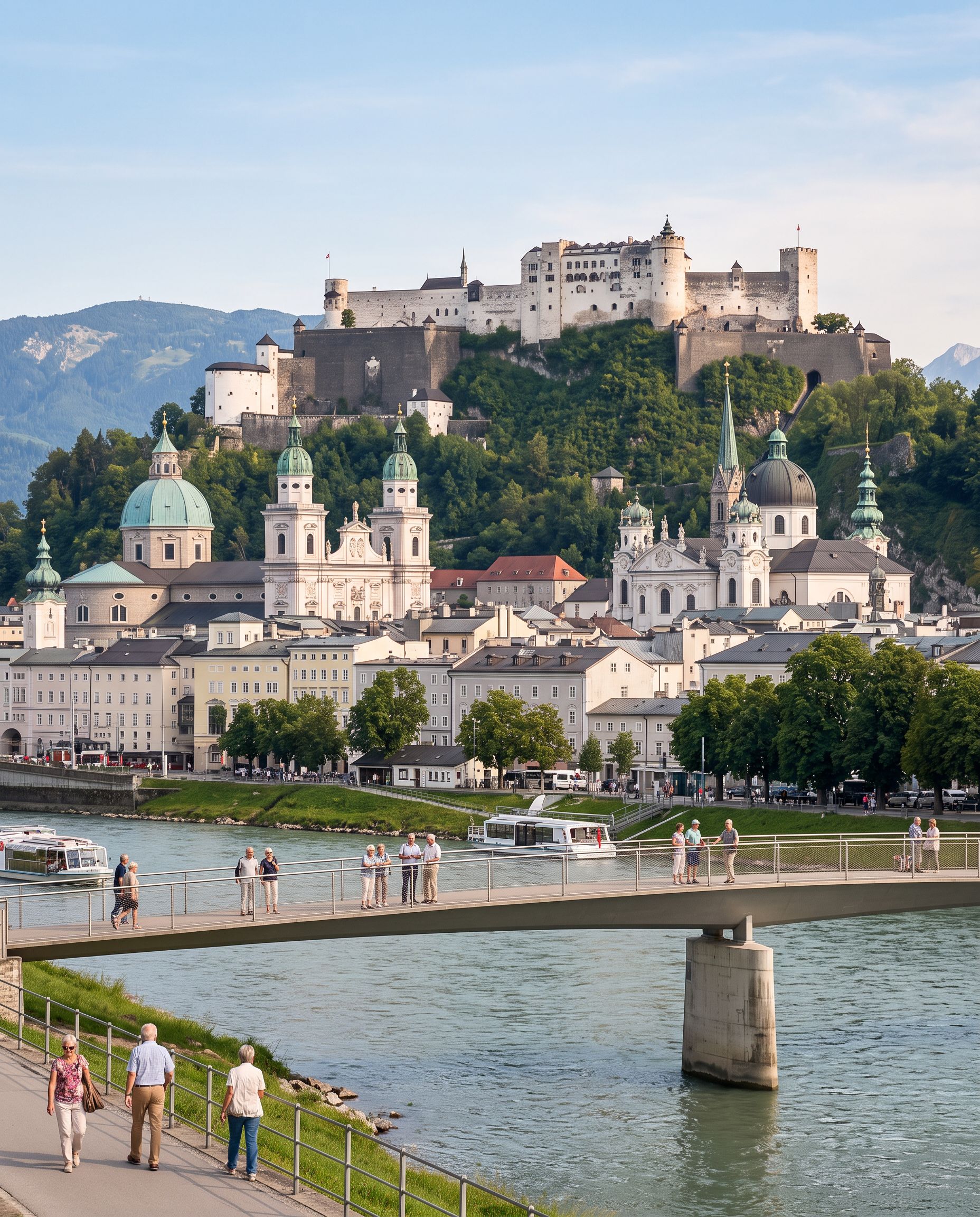
As of August 2026, Café Sacher Salzburg holds a Google rating of 4.1 out of 5 from 1,986 reviews. Its Original Sacher-Torte is still handcrafted in 34 steps to Franz Sacher’s 1832 recipe and comes traditionally with unsweetened whipped cream, and the 42-seat terrace on the Salzach’s right bank looks across to the Hohensalzburg Fortress. It opens daily from 8.30 a.m. to 10 p.m.
What are the best traditional Gasthäuser and beer gardens?
The Augustiner Bräustübl Mülln is the beer garden experience in Salzburg: a sprawling monastery brewery where you buy your own stein, rinse it at the fountain, and fill it from wooden barrels. It is authentic, atmospheric, and one Google reviewer wrote in June 2026 that the beer is “served like in the old days, straight from the barrel.”
This is not a polished experience. You queue, you carry your own beer, and you find a seat at long communal tables under chestnut trees. The food does not come from a kitchen at all: you pick it up along the Schmankerlgang, an arcade of small stalls and shops inside the building, where separate traders sell grilled meat, sausage, bread, cheese and the radishes that go with the beer, and you carry your plate to the table yourself. The atmosphere is convivial and relaxed, and it attracts a mix of locals and visitors who know where to go.
For a more traditional Gasthaus meal, Zwettler’s Wirtshaus at Kaigasse 3, a few steps from Mozartplatz, serves home-style Austrian cooking daily from 11 a.m. to midnight, with hot meals until 10 p.m. and gluten-free, lactose-free, vegan and vegetarian dishes on the same menu. Book ahead at busy times. Bärenwirt in Mülln has kept an inn since 1663, though the city tourism board notes plainly that it does not provide barrier-free access; Die Weisse in Schallmoos, Austria’s oldest wheat beer brewery, is listed as wheelchair accessible and opens Monday to Saturday from 10 a.m.
How do I avoid tourist traps and overpriced menus?
Step away from Getreidegasse, eat where locals eat, and read the posted menu before you sit down. Linzergasse across the river and Mülln on the Old Town’s own bank both hold long-established Gasthäuser — Alter Fuchs on the one, Bärenwirt on the other — each listed by the city tourism board with its address, its hours and its kitchen.
The tourist trap warning signs are familiar: laminated menus in five languages, staff standing outside with clipboards, and photographs of every dish. In Salzburg, these cluster around Getreidegasse, Mozart’s Birthplace, and the Residenzplatz. Size alone is not the signal, though: Sternbräu on Griesgasse is a designated traditional business and an awarded Salzburg Beer Culture establishment, and its own menu offers the Salzburger Nockerl as a portion for one.
The Johanneskeller in the Priesterhaus at Richard-Mayr-Gasse 1 serves Austrian home cooking in a vault and an arcade garden, but only Tuesday to Saturday from 5 p.m. to midnight — there is no lunch service, and it is closed on Sundays and Mondays. Worth the detour, as long as you go on the right evening. For a relaxed, traditional meal that will not break the bank, Alter Fuchs across the river is a consistent recommendation, and the walk there is pleasant, taking you through quieter streets with more character.
For a full guide to the city’s best sights, see our Salzburg’s Finest Sights, Chosen for the Over-50s.
Where do I find the original Mozartkugeln?
Konditorei Fürst makes the original Mozartkugel — a marzipan and pistachio centre with hazelnut nougat, dipped in dark chocolate — and sells it at five locations in the Old Town, at its manufactory in Elsbethen and in its own online shop. Paul Fürst created it in 1890, it is still made by hand to his recipe, and it comes in silver foil with a blue Mozart portrait.
The main house at Brodgasse 13 has stood there since 1884 and is a café as well as a shop, with a terrace looking onto the Alter Markt; it opens Monday to Saturday 9 a.m. to 7 p.m. and Sundays and holidays 10 a.m. to 5 p.m. Ten loose Mozartkugeln cost €22.00, about €2.20 each — more than the supermarket versions, but this is the original. It stands a few steps from Café Tomaselli, making it an easy stop on a coffee house tour.
The Alter Markt house is itself the place for a sit-down Mozartkugel and coffee; Fürst also keeps shops at Mirabellplatz, Ritzerbogen, Residenzplatz and the far end of Getreidegasse. The supermarket versions are made to a different recipe. If you want the original, spend the extra euro.
Salzburg’s broader culinary range is set out by the city tourism board itself in its guide to Salzburg’s culinary classics, which covers the Nockerl, the Bosna and the city’s beer culture in one place.
What should I expect to pay for a meal in Salzburg?
Published house menus are the reliable guide. A main course at the Gasthof Alter Fuchs runs from €15.90 for a Salzburger Bratwurst to €26.90 for Tafelspitz, a glass of wine there costs €5.20, and a Salzburger Nockerl for two is €25.00 at Café Mozart and €22.00 at Café Altstadt.
| Meal Type | Price Range | Examples |
|---|---|---|
| Gasthaus main course | €15.90–26.90 | Alter Fuchs, house menu 2025 |
| Salzburger Nockerl, shared | €22.00–25.00 | Café Altstadt €22.00; Café Mozart €25.00 for two |
| Slice of Original Sacher-Torte | €10.90 | Hotel Sacher Salzburg, August 2026 |
| Original Mozartkugel | €2.20 each | Konditorei Fürst, ten loose pieces €22.00 |
| Glass of wine, 1/8 litre | €5.20 | Alter Fuchs, house menu 2025 |
| Tap water, 0.5 litre | €2.20 | Café Mozart, house menu |
Drinks add up quickly, and tap water is not free: Café Mozart lists half a litre of Leitungswasser at €2.20 on its own menu. A slice of Original Sacher-Torte at the Hotel Sacher Salzburg is €10.90 as of August 2026. At Augustiner you take a 0.5-litre or 1-litre stoneware mug off the shelf, rinse it at the fountain by the cash desk, pay there and swap the voucher for a full stein at the beer counter — and only cash is accepted. Wine is easier to price in advance: the Alter Fuchs house menu lists an eighth of a litre of Grüner Veltliner or Riesling at €5.20.
For those planning their stay, our neighbourhood guide to Salzburg can help you choose accommodation near the best eating areas. And if you are arriving by train or plane, our practical transport guide covers the easiest ways into the city centre.
Are there seasonal dishes I should look out for?
Yes. In autumn, game dishes and wild mushroom specialities appear on menus across the city. In winter, hearty stews and roasted meats dominate. The Bauernherbst (farmers’ autumn) runs across the province from mid-August to the end of October and is the season for regional produce and traditional harvest dishes.
The Salzburger Christkindlmarkt on Domplatz and Residenzplatz runs from 19 November 2026 to 1 January 2027, and that is where you will find Glühwein, roasted chestnuts and gingerbread. It is crowded through the afternoon, so come early in the day or late in the evening.
For a traditional food-and-fair experience, the Rupertikirtag runs for several days around 24 September, with stalls, a beer tent and regional cooking on Domplatz, Kapitelplatz, Residenzplatz, Mozartplatz and the Alter Markt. Admission is free, and it is a genuine local event rather than a tourist attraction.
If you need a break from eating, our guide to quiet retreats and spas in Salzburg offers suggestions for a restful afternoon between meals.
Can I find vegetarian and lighter options?
Yes, though you may need to look beyond the traditional Gasthaus menu. Kasnocken (cheese spaetzle) is a vegetarian staple, and most restaurants offer at least one meat-free option. Afro Café on Bürgerspitalplatz serves African cooking with vegetarian and vegan dishes, Monday to Saturday from 9 a.m. to 8 p.m.
Salzburg’s traditional cuisine is meat-heavy, but the city has adapted, and the houses in this guide say so on their own menus: Zwettler’s lists gluten-free, lactose-free, vegan and vegetarian dishes, Alter Fuchs and Bärenwirt both flag vegetarian cooking, and 220GRAD adds gluten-free and vegan options to its breakfast and lunch.
For a quiet break away from the Old Town crowds, the Stadt:Bibliothek in Neue Mitte Lehen has a café in its Panoramabar, open with the library from Monday to Saturday and closed on Sundays. Trolleybus lines 8 and 11 stop directly outside, and the Open Library on the floor above the foyer is reachable without stairs.
As of August 2026, the city tourism board still lists Salzburg’s coffee houses as a category of their own, with opening times and an accessibility note for each house. For the Mozartkugel, the maker publishes its own history and shop list at Konditorei Fürst.
What practical tips should I know before dining out?
Book ahead for the popular houses, especially at weekends, and carry cash for the Augustiner Bräustübl. Check the hours before you set out: several of the best addresses open only in the evening. And ask for a terrace table in summer, since many rooms have no air conditioning.
The Nockerl is baked to order everywhere, so order it early and share it — that is how the dish is meant to be eaten. Two houses in this guide need planning of a different kind: the monastery beer hall in Mülln does not open before 3 p.m. on weekdays, and the Johanneskeller only serves from 5 p.m., Tuesday to Saturday.
Mobility varies from house to house, and the city tourism board publishes the detail for most of them. Café Bazar and Die Weisse are listed as barrier-free. St. Peter Stiftskulinarium, Café Tomaselli, Café Sacher, Herzl and Sternbräu are listed with a level entrance or a threshold of no more than three centimetres, and all five have accessible WCs. Bärenwirt is listed as not barrier-free. 220GRAD has a few steps at the door, and Café Mozart sits on the bel étage above Getreidegasse. The Old Town itself is walkable but involves cobblestones and some slopes. For a full overview of the city’s accessibility, our sights guide covers the most senior-friendly attractions.
Finally, remember that Salzburg’s dining scene rewards the unhurried. The best meals come to those who sit, order coffee, and watch the city go by. That is the Salzburg way.


