
Tuscany rewards those who time their visit around its calendar rather than against it. Beyond the famous Renaissance masterpieces and cypress-lined roads lies a rhythm of civic rituals, harvest celebrations, and quiet months that shape how you experience the region. For travellers aged 50 to 70, the question is not just when to go, but which Tuscany you want to meet—the shoulder-to-shoulder spectacle of Siena's Palio or the unhurried village sagre where chestnuts roast and new olive oil flows.
This guide walks you through the year, season by season, with honest notes on crowds, accessibility, and how to plan around your interests. We cover spring's bloom and Easter traditions, summer's iconic Palio, autumn's harvest festivals and truffle fairs, and winter's quieter Christmas markets. For detailed weather comparisons, see our companion guide on when to visit Tuscany for warm days and small crowds.
 AI-edited
What happens in Tuscany during spring?
Spring in Tuscany means Easter processions, blooming countryside, and the first outdoor markets of the year—crowds are moderate, temperatures are pleasant, and most sights remain comfortably navigable without summer's crush.
Easter week brings religious processions to Florence, Siena, and smaller hill towns. In Florence, the Scoppio del Carro (Explosion of the Cart) sees a fireworks-laden cart ignited outside the Duomo on Easter Sunday—a tradition dating back to the Crusades. The spectacle draws crowds, but the city remains far more manageable than in peak summer months.
Spring is also when many sagre begin their season, though autumn remains the heart of the food-festival calendar: Tuscany's official tourism board runs separate seasonal guides to the autumn and chestnut festivals and calls October the month of the chestnut harvest. April and May offer a gentler introduction: olive-oil tastings, asparagus festivals, and the first outdoor antiques markets in towns like Arezzo and Lucca.
For accessible sightseeing, spring's mild temperatures make the compact historic centers of Siena, Pienza, and Montepulciano more comfortable for walking. The Uffizi Galleries in Florence have accessible paths and elevators, making the museum workable for visitors with reduced mobility—and spring's shorter queues make it a practical choice.
How demanding is the Palio di Siena for older travellers?
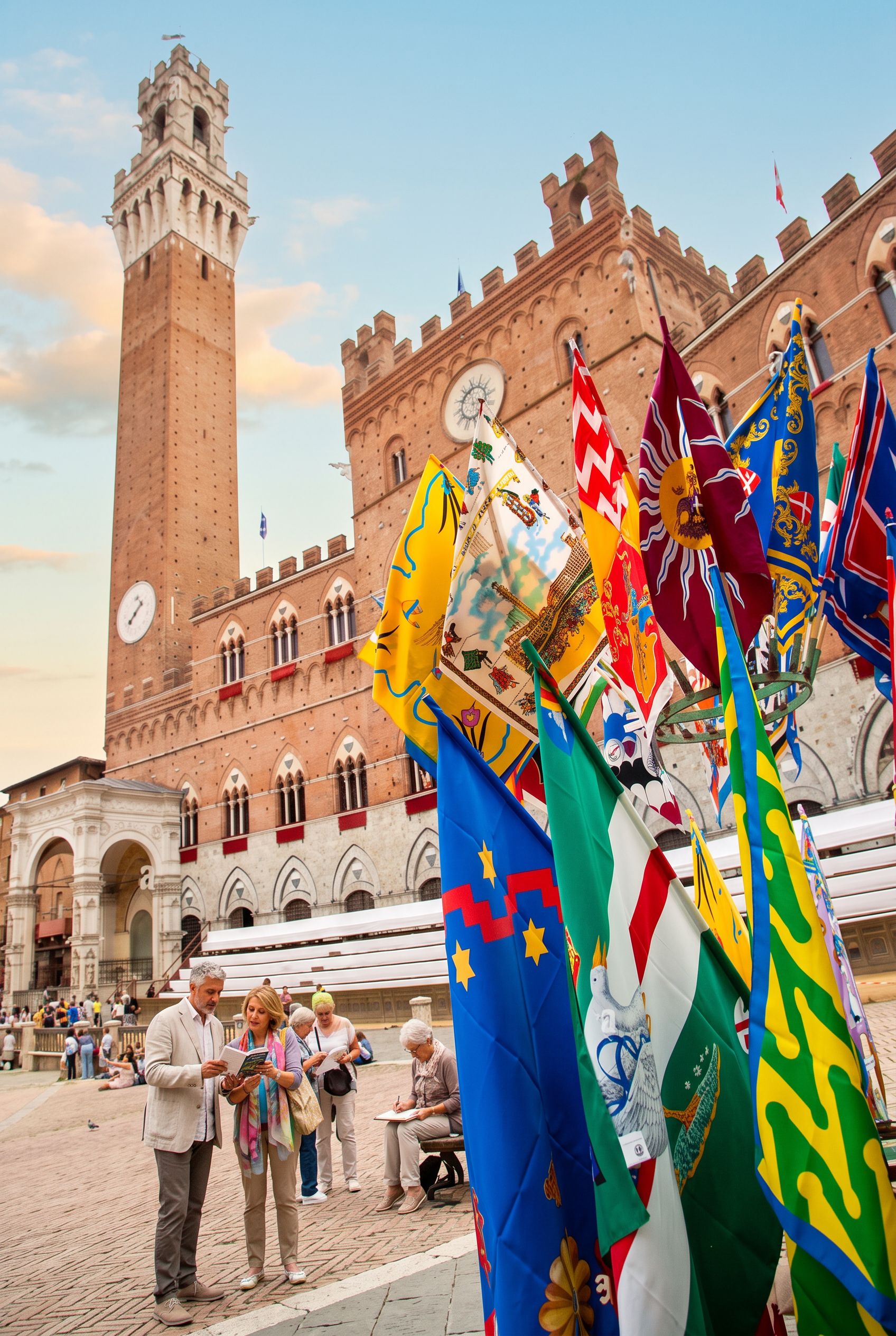
The Palio di Siena is Tuscany's most spectacular civic tradition—and its most physically demanding event. Held twice yearly on 2 July and 16 August in Piazza del Campo, it involves hours of standing in summer heat, crushing crowds, and limited visibility unless you book expensive seating in advance.
The Palio is a bareback horse race in which ten of Siena's seventeen contrade (neighbourhoods) take part, each with its own flag, emblem, and fierce loyalty; the ten are drawn by lot, and each is then assigned its horse the same way. The ceremony is extraordinary: a centuries-old pageant of drummers, flag-throwers, and medieval costumes parades through the square before the race itself, three laps of the piazza that are over almost as soon as they have begun. The build-up, however, takes hours.
For travellers aged 50 to 70, the practical realities matter. Free viewing from the centre of Piazza del Campo means standing for several hours in the sun, with no shade. The city publishes the access window: for the 16 August race the piazza may be entered only between 4pm and 6pm, from Via Duprè, and only up to maximum capacity, with the stands reachable until 4.30pm; for the 2 July race the window runs from 4.30pm to 6.30pm and the stands close at 5pm. The horses leave the Cortile del Podestà at 7pm in August and 7.30pm in July, so a free place commits you to roughly three hours on your feet before anything races.
Reserved seating in the wooden stands or on balconies is more comfortable but must be arranged well in advance. There is no central box office at all: the city states plainly that you have to approach the operators of the individual stands (palcaioli) or the owners of the apartments overlooking the square directly. Prices vary far more widely than a single range suggests. For the August 2024 race the stand operators declared seats of roughly €150 to €390 to the city; a year later the regional daily La Nazione put numbered stand seats sold to visitors at about €300 to €600, and places on private balconies from around €700 upwards. Some balcony-access products explicitly state they are not suitable for disabled people and not wheelchair accessible, so check carefully before booking.
What are the practical options for seeing the Palio?
You have three realistic choices: stand in the packed square for free, book a balcony or grandstand seat in advance, or watch from a nearby bar or restaurant—each with different costs, comfort levels, and visibility trade-offs.
During the race, Siena's historic centre is heavily restricted to traffic. Visitors are advised to arrive on foot or use train and bus connections rather than driving into the centre. Getting up into the old town is the hard part, and Siena has built for it: over the past fifteen years the city has installed a system of escalators on the northern, eastern and western approaches, linked to the multi-storey car parks that ring the historic centre, expressly to overcome the height differences that make reaching the heart of the city hard work. The cathedral has its own dedicated ramp on the left-hand side of the building, although its museum, crypt and baptistery have no equivalent provision. Holders of the European disabled badge can register a number plate online with the comune for a full day of access and parking inside the restricted zone, one registration per day.
Medical cover on race day is heavy and concentrated where the crowd is: the regional ambulance service places five medical posts inside Piazza del Campo itself, with around 100 rescuers, seven doctors, eight nurses and eighteen ambulances, plus an extra nursing vehicle for emergency calls in the rest of the city—reassuring for those worried about the heat.
| Option | Approximate Cost | Comfort Level | Booking Needed |
|---|---|---|---|
| Standing in Piazza del Campo | Free | Low—hours of standing, no shade, and no seat may be brought in | No, but arrive hours early |
| Grandstand or bleacher seat | Roughly €150–€600 | Moderate—seated but exposed to weather | Yes, well in advance |
| Balcony or terrace viewing | From around €700 | Higher—shade and facilities often included | Yes, months ahead |
Rates are indicative, reflect what was quoted for the 2024 and 2025 races, and vary by stand, viewpoint and seller.
Children under ten are not allowed inside the piazza on race day, even accompanied by an adult, and the city's rules also bar chairs, stools, benches, dogs, bottles, glass and metal containers and alcohol from the shell—so there is no bringing a folding seat to rest on. After the race, the outflow from the piazza is dense and slow, so plan to wait it out or move at the crowd's pace when leaving.
What makes autumn the best season for food festivals?
Autumn is Tuscany's true sagre season, when chestnuts, mushrooms, truffles, and new olive oil take centre stage in village squares across the region. The crowds are smaller, the weather is cooler, and the food is at its most seasonal and celebratory.
Visit Tuscany's official tourism site specifically highlights fall festivals, noting events such as chestnut festivals and other harvest-linked celebrations. The official fall festivals guide lists celebrations across the region, while a separate page details chestnut festivals in Tuscany—a staple of the October calendar.
The Marradi Chestnut Festival runs every Sunday in October, with stalls selling chestnut tortelli, castagnaccio, chestnut jam, marrons glacés and roasted chestnuts; the town sits on the Faentina railway from Florence, and a historic train runs up for the festival. Vivo d'Orcia holds its mushroom-and-chestnut weekends on the second and third weekends in October, and San Miniato's white truffle fair takes the last three weekends of November. VolterraGusto features a white truffle and local products market on the last two weekends of October.
For travellers aged 50 to 70, autumn sagre offer a more comfortable cultural experience than summer's headline events. The weather is mild, the crowds are local rather than international, and the pace is unhurried. September and early October bring the densest run of sagre and village festivals — the best stretch of the year for food-focused travel.
Which truffle fairs are worth planning around?
San Miniato's white truffle fair is the region's most famous, running on the last three weekends of November. VolterraGusto offers a smaller, more local alternative on the last two weekends of October, with truffles and products from the Alta Val di Cecina.
San Miniato sits on a hill roughly halfway between Florence and Pisa—46 kilometres from one, 47.5 from the other—and its claim to the white truffle rests on a real record: the largest white truffle ever recorded, 2.52 kilograms, was dug up here on 26 October 1954. The fair reached its 54th edition in 2025 and draws food lovers from across Italy and beyond, with truffle shavings sold by weight and local producers offering tastings. Its hilltop position matters for planning: on fair weekends the historic centre is closed to private traffic altogether and everyone comes up by shuttle bus from Via Guerrazzi to Piazza Dante Alighieri; train passengers ride the number 320 bus up free on production of a rail ticket.
VolterraGusto, held in Volterra, combines truffles with local cheeses, cured meats, and wines from the surrounding Val di Cecina. It is smaller and less commercial than San Miniato, making it a more relaxed experience for those who prefer browsing to battling crowds.
For those interested in the broader autumn food scene, Boccaccesca in Certaldo is a four-day food and wine festival held in October around the town's celebrated sweet onion, while Montisi marks the new season's oil at the turn of October and November with "Il Primo Olio e Altro Ancora", tastings and music included. The Festa dell'Uva in Impruneta, near Florence, celebrates the grape harvest with a parade of decorated floats from the town's four rioni—Sante Marie, Fornaci, Pallò and Sant'Antonio—and live music.
Where should you avoid crowds during festival season?
Piazza del Campo during the Palio is the single most crowded place in Tuscany—avoid it entirely if you dislike standing-room pressure and high noise levels. Large festival centres like Florence, Siena, Greve in Chianti, and San Miniato also become very busy during major event weekends.
Forum contributors consistently describe the Palio as packed to the gills, with crushing crowds and limited visibility without a reserved balcony or seat. The recurring disappointment in those threads is the same: the choice comes down to standing for hours or paying a good deal for a seat. Siena is also at its hottest in mid-August, which makes early morning and late evening the most comfortable times to explore. A Google review of the Palazzo Pubblico from March 2026 puts the gentler alternative plainly — you can enjoy the square "if you're sitting on the square itself or any restaurant & bar in the square."
Autumn sagre in small towns are often manageable earlier in the day, but the most popular food-festival weekends can still become crowded at peak meal times. If avoiding crowds is a priority, choose weekday museum visits, morning entries, and small hill towns outside the headline festival dates.
Many Tuscan old towns have restricted traffic zones (ZTL), and you can be fined if you drive where residents are the only permitted vehicles. The safe working assumption is that anything inside a town wall is restricted unless a sign says otherwise. This matters especially on festival days, when the restrictions tighten and the central car parks are often closed altogether.
What are Tuscany's Christmas markets like?
Tuscany's Christmas markets are smaller and more local than those in northern Italy or Germany, but they offer a charming, low-crowd way to experience the region in winter. Florence, Siena, and several hill towns host festive markets from the middle of November until shortly before Christmas.
Florence's main Christmas market, in Piazza Santa Croce, is run as a Weihnachtsmarkt in the German tradition, with more than fifty wooden chalets selling crafts, decorations and seasonal foods, and mulled wine and roasted chestnuts adding to the atmosphere. Recent editions opened in mid-November and closed just before Christmas: 19 November to 22 December in 2024, 15 November to 21 December in 2025. Everything sits in the one square, so the market can be covered without a long walk.
Siena's historic centre hosts a smaller market, and many hill towns—including Montepulciano, San Gimignano, and Cortona—arrange their own festive events. These tend to be quieter and more authentic, with local artisans rather than mass-produced imports.
Winter is Tuscany's quietest season for tourism. Museums are less crowded, hotels offer lower rates, and the region's famous landscapes take on a dramatic, misty quality. For travellers aged 50 to 70 who prefer a slower pace, December can be an ideal time to visit—provided you pack for cold weather and check opening hours, as some smaller venues close between Christmas and New Year.
How accessible are Tuscany's cultural events for older visitors?
Florence's major museums—including the Uffizi and Bargello—have accessible paths and elevators, while Siena's compact historic centre is more walkable than many hill towns. Smaller venues vary, so it is worth checking accessibility before booking.
At the Uffizi the accessible entrance is under the colonnade, with the ramp to it in Via della Ninna, and lifts run from the ground floor; wheelchairs and walkers can be borrowed free of charge, with no booking and no deposit, against an identity document. At the Bargello every room is accessible except the Chapel, the Sacristy and the Sala dei Bronzetti, with ramps and a lift covering the changes in level and staff on hand to help. In Siena, the Museo Civico inside the Palazzo Pubblico is fully accessible by lift, and at Santa Maria della Scala all rooms are reachable, the lower floors accompanied by museum custodians through external corridors.
Do not assume the Via Francigena near San Gimignano is an easy stroll. The official stage from San Gimignano to Monteriggioni is 30.9 kilometres with 607 metres of climb and 674 of descent, and the route association rates it demanding precisely because of its length and its constant up and down; two stream crossings on it turn awkward after heavy rain. Walk a short there-and-back stretch instead of a stage. Florence's Renaissance Ring is a 250-kilometre trekking route in eight sections plus ten variants of between five and twenty-five kilometres, rated medium difficulty across a mix of dirt and paved roads—better for active walkers than for mobility-limited travellers.
Tuscany also has programs for visitors with cognitive conditions, including the Musei Toscani per l'Alzheimer network, which offers specialised museum visits. For health-related planning, see our guide to health, pharmacies and peace of mind in Tuscany.
When is Tuscany at its quietest?
November (after the truffle fairs) and January through early March are Tuscany's quietest months, with minimal crowds, lower hotel rates, and a more local atmosphere—though some smaller venues and restaurants close for winter breaks.
For travellers who want to experience Tuscany without the crowds, these months offer a different kind of beauty. The light is softer, the streets are emptier, and you can often have major museums nearly to yourself. The trade-off is weather: expect cool temperatures, possible rain, and shorter daylight hours.
Late September to early October offers a middle ground: the harvest is underway, the weather is still warm, and the crowds have thinned from summer's peak. Panzano in Chianti holds Vino al Vino on the third weekend of every September, staged in Piazza Bucciarelli by the village's own growers' association and running since 1995, and Autumnia fills the historic centre of Figline Valdarno for three days in November with a fair devoted to farming, food and the environment. Both are worth checking against the regional events calendar before you build a trip around them.
For those planning around specific interests, the official Tuscan events calendar groups listings by season, making it easy to see what is happening when. As of August 2026, the calendar remains the most reliable source for current event dates and locations.
How should travellers 50–70 plan a festival-focused trip?
Base yourself in one or two central towns—Florence, Siena, or Pienza—and use trains and buses to reach festivals rather than driving into restricted historic centres. Book Palio seating months ahead, but leave autumn sagre flexible and ask locally what is happening nearby.
Older forum contributors repeatedly recommended longer stays in fewer places, afternoon rests, and using taxis so family members do not accumulate too many steps. A practical tip that comes up often is returning to your room several times a day to break up the schedule and rest. Many also conclude that Tuscany justifies a second, slower visit on your own schedule rather than one exhausting trip.
For food-focused travellers, the hotels worth booking for the food in Tuscany offer a way to combine comfortable lodging with exceptional dining. Guests at Agriturismo Villa Toscana in Campiglia Marittima consistently praise the spacious, clean rooms and the on-site restaurant, Opera, which attracts local diners as well as hotel guests. At Hotel Borgo San Felice in Castelnuovo Berardenga, guests highlight the Michelin-starred Poggio Rosso and the more casual Osteria Il Grigio, with one guest writing on Google in July 2026: "The truffle hunting and cooking class experience was incredible! By far, our favorite experience of the whole trip."
"This was the last stop on our two-week, adventure-filled trip through Italy, and it couldn't have been a more perfect ending. After constantly being on the go, it was the peaceful retreat we needed. Staying in a preserved medieval property felt magical." — Google, June 2026
For autumn sagre, flexibility is your friend. Ask hotel or apartment hosts, or the local tourism kiosk, what is happening nearby. Many small-town festivals appear on community noticeboards rather than international calendars, and locals are usually delighted to point visitors toward the best events.
Finally, remember that Tuscany rewards slowing down. The region's festivals are not just spectacles to tick off—they are invitations to participate in a way of life that has continued for centuries. Whether you stand in the Campo for the Palio or share a bench with strangers at a chestnut festival in Marradi, the memories you carry home will be about the people and the food as much as the events themselves.


