
Tuscany rewards slow travel, but the region's hills, cobblestones and summer heat demand a little forethought. For travellers aged 50–70, the real comfort comes from knowing exactly where to turn if a prescription runs short, a fever appears, or the afternoon sun becomes too much. This guide covers the practical health essentials: finding pharmacies and doctors in Florence and smaller towns, locating the nearest hospitals, travelling with medication, understanding the GHIC and insurance basics, and coping with intense summer heat in the countryside.
 AI-edited
What should I do in a medical emergency?
Call 112 immediately for any serious medical emergency in Tuscany. The number works across Italy and connects you to a single European emergency line that can dispatch an ambulance, police or fire services as needed.
According to the official tourism board of Tuscany, in a serious medical emergency, you should call 112 immediately. The single response centre has covered every telephone district in Tuscany since April 2021, and the Regione lists multilingual translation among the services it provides, so a lack of Italian is not a reason to hesitate. The same service offers an app, Where Are U, which places the emergency call and transmits your position at the same time — worth installing before a countryside trip, where describing where you are is the hard part. Major hospitals across the region provide 24-hour emergency room service, so you will never be far from urgent care in a city or large town.
For non-emergency medical concerns, Tuscany uses the 116117 number, which connects you to the guardia medica (on-call doctor service). This is the right option for issues that cannot wait for a regular appointment but are not life-threatening — a persistent fever, a bad cough, or a suspected infection. The call is free, callers are geolocated, and the Regione lists telephone interpreting in twenty different languages, which removes the usual reason for putting off the call. The on-call service itself runs from 8 pm to 8 am on weekdays, and continuously from 8 am on Saturday to 8 am on Monday. The separate tourist medical guard is a paid service for non-residents and runs only in high summer — on Elba, for instance, in July and August from a clinic in Portoferraio.
How do I find a pharmacy in Florence?
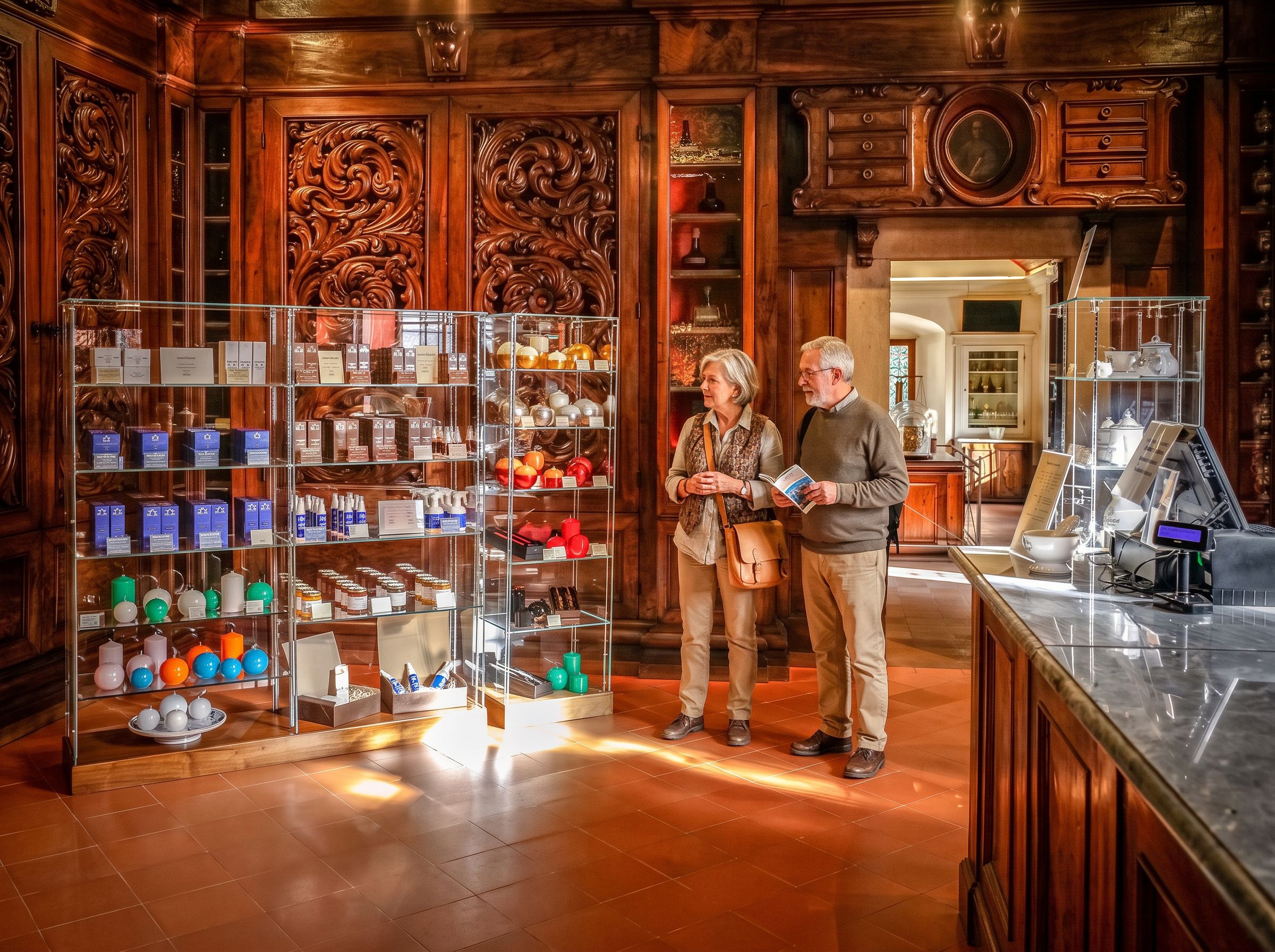
Florence has a dense network of pharmacies, but most close in the evening. Look for the duty roster posted in every pharmacy window — it lists which pharmacies stay open overnight and on Sundays.
Italian pharmacies follow a duty-roster system (farmacia di turno) that guarantees at least one open pharmacy in every district at all times. The roster is posted on the door of every pharmacy, so check it before you need it. For round-the-clock cover, the dependable address is the Farmacia Comunale Santa Maria Novella inside Firenze Santa Maria Novella station, which stays open continuously and suits travellers arriving late or departing early. Do not assume the other municipal pharmacies keep the same hours: the Farmacia Comunale San Niccolò in Via dei Renai states on its own site that it opens Monday to Friday from 9.00 to 13.30 and 15.30 to 20.00, and on Saturday mornings only.
Florentine pharmacists are used to visitors and will usually switch to English without being asked. What they cannot do is hand over a prescription-only medicine without a valid prescription, so treat the pharmacy as the place for advice, minor remedies and generic equivalents rather than as a short cut to a repeat prescription. One distinction is worth knowing before you walk into the wrong shop: the health ministry keeps separate registers for farmacie and parafarmacie, and a parafarmacia is a commercial outlet other than a pharmacy, licensed since a 2006 decree to sell medicines that do not require a prescription. If you need a prescription filled, the word to look for on the sign is farmacia.
For after-hours help in Florence, the pharmacists' association Federfarma Firenze runs a free telephone service for the city on 800 420 707, answered around the clock, which tells you which pharmacies are currently open. Note the boundary: it is a Florence service, not a Tuscany-wide one. Elsewhere in the region, use the roster posted in the window of any pharmacy, or call 116117, which covers the whole of Tuscany.
What about pharmacies in smaller towns?
Smaller Tuscan towns have at least one pharmacy, and the duty-roster system ensures one stays open after hours. Check the posted roster in any pharmacy window — outside Florence that is the reliable way to find the nearest open one, since the free pharmacy line covers the city only.
The Italian health ministry's own register listed 1,273 active pharmacies and 323 para-pharmacies in Tuscany in August 2026, spread across all ten of the region's provinces, so even villages with a few hundred residents typically have one. In towns like Siena, travellers can access care through pharmacies, public emergency services, private clinics, and private doctors who may do clinic or house calls. Outside Florence the roster in the pharmacy window is the dependable way to find whoever is on duty, and some municipalities also run late-night or rotating services.
In smaller towns, the pharmacy is often the fastest practical route for many non-emergency needs. Pharmacists can help you find the right generic equivalent of a medication you use at home and can point you toward a doctor or clinic if needed. Italian pharmacies stock a surprising range of items — braces, lemon drinks for colds, throat lozenges — and pharmacists will help you find what you need even if you do not speak Italian. Bring the generic name and dosage of any medication you take; brand names differ across countries, and the active ingredient is what matters for a pharmacist to help you.
How do I find a doctor as a tourist?
Tuscany's tourist medical service for non-residents is a summer service based in the holiday districts rather than in the cities, and it charges a fixed fee. In Florence itself there is no walk-in tourist doctor: call 116117 for an on-call doctor, or use the emergency department at Santa Maria Nuova.
The tourist medical guard service (guardia medica turistica) is the obvious resource for travellers who need a doctor without a life-threatening emergency — but it is worth knowing where it actually sits. The health authority for the Florence area, Azienda USL Toscana Centro, runs it in the holiday districts rather than in the city: in the summer of 2026 its clinics were at Bivigliano in the comune of Vaglia and at Saltino Vallombrosa in the comune of Reggello, alongside sites at Montepiano in the Prato district and in the Pistoia mountains, and the service ran only until 31 August. Inside Florence itself there is no walk-in tourist doctor. Call 116117 for advice or an on-call doctor, or go to the emergency department at Santa Maria Nuova on Piazza di Santa Maria Nuova, less than 500 metres east of the Duomo and the only emergency department in the historic centre.
Be prepared for a wait at a public emergency department. Patients are seen in order of clinical urgency rather than arrival, so a problem that is uncomfortable but not urgent can mean several hours; bring water, a book and patience. Where the tourist medical guard does operate, it is reserved for non-residents and charges a fixed fee: as of August 2026 the Tuscany North West health authority lists €20 for a clinic visit, €35 for a home visit and €10 for a short visit purely to repeat a prescription, and the Tuscany Centre authority publishes the same €20 and €35. Some areas also have English-speaking tourist medical services offering walk-in visits and home visits by appointment.
If you are staying in a rural area, ask your accommodation host for the nearest guardia medica and its hours before you need it. Agriturismo owners and hotel concierges are usually happy to help, and knowing the location in advance saves stress in a moment of need.
How do I travel with medication to Italy?
Carry all medication in its original labelled packaging, with a prescription stating the therapy and dosage. Keep everything in hand luggage, and for controlled medicines, carry stricter documentation from your doctor.
The Italian Ministry of Health advises travellers to carry their own medicines with a prescription and treatment documentation. For controlled medicines (narcotics, psychotropics), stricter documentation is required — a doctor's letter explaining the therapy, dosage and duration of treatment, ideally translated into Italian or English. The ministry provides specific rules for narcotic and psychotropic medicines, so check these before you travel if you take any controlled substance.
Travellers repeatedly advise keeping medicines in their original, labelled containers and carrying prescriptions or medical letters. Experienced travellers add a practical habit: carry a printout of your medications under their generic names, because medical staff may ask for them, and keep copies of prescriptions and ID both with you and with your travelling companion. That paperwork is what turns a lost tablet strip into a solved afternoon: an Italian pharmacy cannot hand over a prescription-only medicine without a valid prescription, and a doctor's letter naming the therapy and dosage is what lets an Italian doctor write one quickly.
Always keep medication in hand luggage, never in checked baggage. Properly labelled medication in original packaging rarely causes trouble at airport security or a border crossing. Several travellers say they would bring fewer clothes and more medical paperwork, including prescription printouts and generic drug names — the paperwork takes up no space and can save a great deal of trouble.
What about the GHIC and travel insurance?
The UK Global Health Insurance Card (GHIC) covers medically necessary treatment in Italy at the same cost as Italian residents, but it does not cover private treatment, repatriation or non-urgent care. Comprehensive travel insurance remains essential.
The GHIC replaced the EHIC after Brexit and remains valid for UK travellers visiting Italy. It entitles you to state-provided healthcare on the same terms as Italian residents, which means treatment at public hospitals and doctors is covered or at reduced cost. However, the GHIC does not cover private healthcare, medical repatriation, or non-urgent treatment, and it does not guarantee free treatment — you may still face co-payments or charges for certain services.
For travellers from other countries, check your home government's advice. The UK Foreign Office provides detailed guidance on Italy's healthcare system, and the US State Department offers guidance on travelling with medicine internationally. Both are worth reading before departure.
Comprehensive travel insurance is non-negotiable for travellers aged 50–70. Look for a policy that covers pre-existing conditions, emergency medical treatment, repatriation, and cancellation. Some policies exclude pre-existing conditions unless declared, so be honest on the application form — the cost of declaring is far lower than the cost of an uninsured emergency. Keep your insurance documents and emergency contact number accessible, ideally in your phone and on a printed card in your wallet.
For a deeper look at where to base yourself for maximum comfort and peace of mind, see our guide to where to stay in Tuscany when comfort comes first.
How do I cope with summer heat in the countryside?
Tuscan summers are hot, and the countryside offers little shade. Plan outdoor activity for early morning or late afternoon, carry water at all times, and choose accommodation with air conditioning in the bedroom.
Older travellers who have spent a Tuscan summer in the countryside make two points repeatedly: hydration is vital, and air conditioning belongs in the bedroom, not only in the common areas. When booking rural accommodation, confirm that air conditioning is available in the bedroom — not just in common areas. Many farmhouses and agriturismi rely on thick stone walls for natural cooling, which works well at night but can leave rooms stuffy during heatwaves.
The heat in the countryside is different from city heat: there is less shade, more exposed walking, and distances between villages can be deceptive. Plan your outings for the cooler hours — before 11 am and after 4 pm — and use the middle of the day for lunch, a siesta, or a visit to a cool church or museum. Carry a refillable water bottle and refill it at every opportunity; many Tuscan towns have public fountains with drinkable water.
If you plan to walk in hill towns, be realistic about your pace. The region is notably hilly, and some routes rise sharply; hill-town approaches can be strenuous. Travellers recommend comfortable shoes, and if there are balance issues, walking poles or a cane. Older travellers advise choosing places that minimise strain from hills, stairs, and long transfers, and avoiding overambitious daily movement when temperatures are high.
For a relaxed approach to the region's famous wines without the heat, see our guide to wine tasting in Chianti, Montalcino and Montepulciano.
Which Tuscan towns are easiest on the knees?
There is no official ranking of Tuscan towns by gradient, so check each one before you go. Florence is the best documented: its tourist board publishes four itineraries through the historic centre that are accessible to wheelchair users. Arezzo is the caution — its comune routes visitors up to the Duomo by escalator. Hill towns such as San Gimignano and Volterra sit on ridges.
Many Tuscan historic centres have cobblestone streets that can be difficult for mobility-limited travellers. The region is notably hilly, and some routes rise sharply; hill-town approaches can be strenuous. Florence is the one town with published detail: the city's tourist board offers Passepartour, four itineraries through the historic centre that are accessible to wheelchair users, and points visitors to the Kimap app, which plots routes around architectural barriers. Arezzo is the useful counter-example: the comune's own visitor guidance has people reach the upper part of the historic centre at Piazza Duomo by the escalators from the Via Pietri car park. For the other towns no official source ranks gradients, so check the contour of your route on a map before you book.
Formal rest infrastructure is inconsistent: some accessible nature routes include rest points, but historic-town walking routes may not provide frequent benches. A portable seat or a clear rest plan is wise if mobility is limited, because benches are not guaranteed along every historic route. Some accessible paths and parks exist, including routes with compacted surfaces, reduced gradients, and rest points, but these are the exception rather than the rule in older urban areas.
When choosing a base, consider the walking distance from your accommodation to the town centre, the gradient of the approach, and whether there are steps between the car park and your room. For a detailed look at a senior-friendly luxury option, read our review of Castello di Casole, A Belmond Hotel.
What should I pack for health and comfort?
Pack supportive walking shoes with grip, light layers, sun protection, a refillable water bottle, and a small day pack for medications and documents. Bring your full medication supply in original containers with prescriptions.
Supportive walking shoes with grip are essential for cobblestones and uneven pavement. Light layers handle changeable weather, especially for spring and autumn and cooler evenings in hill towns. Sun protection — hat, sunglasses, sunscreen — is vital for open squares, coastal areas and exposed hill walks. A refillable water bottle matters more than almost anything else you will carry on a warm day of uphill walking.
Bring your medication supply for the full trip, in original containers, with prescriptions and any doctor's letter. Compression socks or trekking poles are worth considering if long standing or hill walking is likely; Tuscany's terrain can be demanding. Travellers recommend travelling lightly and not overpacking, because every extra kilogram becomes noticeable on hills and stairs.
For those planning a food-focused trip, our guide to Tuscany hotels worth booking for the food pairs well with health-conscious travel planning.
What should I know about transport and accessibility?
Regional trains connect most Tuscan cities and are the most comfortable option for moving between main towns. Buses fill the gaps to smaller villages; buy tickets beforehand at a tabacchi or a machine, because buying from the driver costs more and is not guaranteed on every service.
Regional trains connect many Tuscan cities and are usually the most comfortable option for moving between main towns; in many places the station is centrally located, which reduces walking after arrival. Buses fill in the gaps where trains do not reach, and they are often the only public transport to smaller villages. Tuscany's public transport network is described as offering options even for people with reduced mobility, but practical accessibility varies by route and stop, so station-to-destination walking conditions matter.
Buy bus tickets before boarding where you can — at tobacco shops (tabacchi), newsstands or ticket machines — because fares are distance-based and buying from the driver costs more. Autolinee Toscane does sell an on-board ticket, from €3.00 under the tariff introduced in August 2026, but it cautions that on-board sales are only guaranteed on regular services, that drivers are not required to give change, and that being unable to buy a ticket on board does not exempt you from the penalty for travelling without one. On the railways there is a discount worth knowing about: Trenitalia's Promo Senior gives travellers over 60 who have joined its X-GO programme 20 per cent off selected regional services, for journeys until 30 November 2026. Trains remain the better choice for intercity travel, with buses for smaller places, and a plan that assumes hills, cobblestones and limited bench seating in historic towns.
For a comfortable stay that minimises mobility challenges, consider the properties featured in our comfort-first Tuscany guide, which focuses on accessible layouts and convenient locations.
What are the key numbers to save?
Save 112 for emergencies and 116117 for non-emergency medical care; both are free and cover the whole of Tuscany. In the city of Florence, 800 420 707 tells you which pharmacies are open at any hour. Everywhere else, the duty roster in the window of any pharmacy is the reliable answer.
Keep these numbers in your phone and on a printed card in your wallet:
| Number | Purpose | Availability |
|---|---|---|
| 112 | Serious medical emergency | 24/7 |
| 116117 | Non-emergency medical care (guardia medica) | Nights, weekends and holidays |
| 800 420 707 | Open pharmacies — city of Florence only | 24/7 |
| Roster in the window | Open pharmacies — anywhere in Tuscany | Posted at every pharmacy |
According to the official tourism board of Tuscany, in a serious medical emergency, you should call 112 immediately. The UK Foreign Office also provides detailed health guidance for Italy, including information on the GHIC and reciprocal healthcare arrangements.
Write these numbers down as well as saving them in your phone — a dead battery or a lost phone is exactly when you will need them most. Share them with your travelling companion and your accommodation host, so someone else knows how to help you if needed.


