
Tuscany rewards travellers who time their visit with intention. The region's famous hill towns, Renaissance cities, and vineyard-draped valleys shift character dramatically between seasons, and the difference between a July afternoon in Florence and a May morning in the Val d'Orcia is almost like visiting two different places. For travellers aged 50 to 70 who want genuine warmth without the crush of peak season, the sweet spot is narrower than you might think—and it is not in summer.
The central question is not simply "when is it warm" but "when is it warm enough to enjoy without queuing for an hour in the sun." The answer, supported by the regional climate record and by the tourist board's own season calendar, points to May and September as the prime months, with late April and early October as worthy extensions of that window. This guide walks you through each month so you can match your priorities—gardens in bloom, harvest atmosphere, or empty piazzas—to the right calendar slot.
 AI-edited
What is the best month for warm days and fewer crowds?
May and September are the strongest single-month picks for travellers 50-70 who want mild temperatures and manageable crowds. In Florence, May averages daytime highs close to 25°C and September 27°C, both well below the 32°C that July and August reach. VisitTuscany identifies mid-June through mid-September as peak season, so these shoulder months avoid the worst of it.
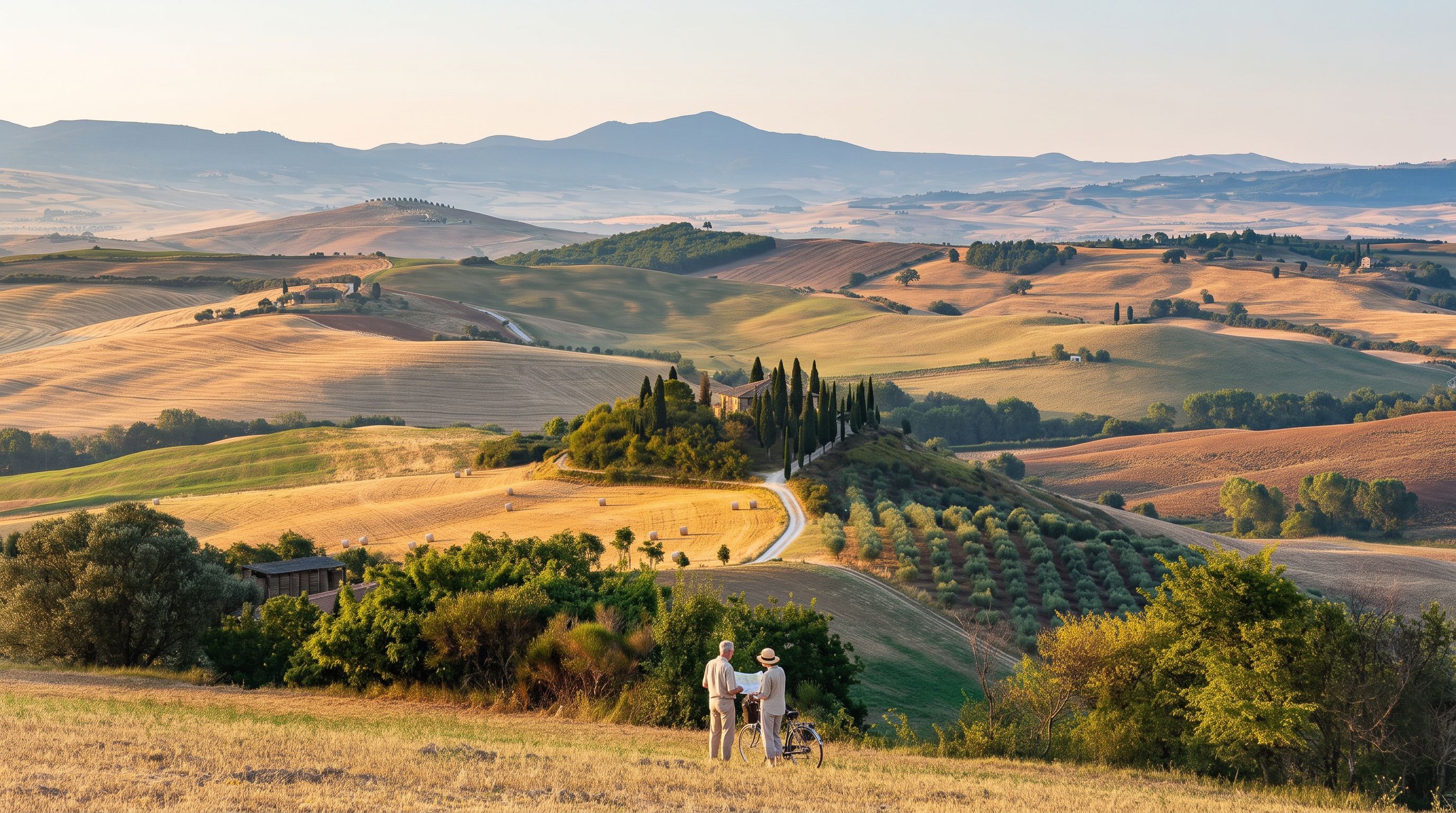
May brings spring's full expression: the winter wheat in the Val d'Orcia stands tall and green, gardens are at their most exuberant, and the light has a clarity that photographers chase. Nights are mild rather than cold: the average May low in Florence is 12.1°C, warm enough to eat outdoors without a coat. September offers the reverse pleasure—the landscape is golden, the grape harvest begins in the Chianti hills, and the intense heat of July and August has broken.
Both months share a critical advantage: the big crowds have not yet arrived (in May) or have begun to thin (in September). Florence's Uffizi and Accademia still reward booking ahead — the Accademia states that "reservations are highly recommended, if you do not have a reservation, the wait for access may be long" — but you will not be shuffling shoulder-to-shoulder across the Ponte Vecchio. In the hill towns, you can linger in a piazza without feeling rushed.
How hot does Tuscan summer really get?
July and August are the hottest months in Florence, averaging daytime highs of 32.2°C and 32.5°C, and the regional tourist board puts summer temperatures across Tuscany between 27°C and 40°C. Mid-June to mid-September is peak season as well, so the heat and the queues arrive together.
Florence's stone-paved streets absorb and radiate heat, turning the historic centre into an oven by mid-afternoon. The hill towns, while slightly cooler due to elevation, still demand uphill walking in full sun. Siena's shell-shaped Piazza del Campo offers little shade. A Google review left in July 2026 calls it "one of the prettiest squares to visit" and then warns that "it's a real sun trap", with the Torre del Mangia and the ring of cafés supplying what shade there is. San Gimignano's tower-lined streets can feel relentless by 2 p.m.
There is a nuance worth knowing: August is when many Italians take their own holidays, so some cities actually thin out around Ferragosto (mid-August). But this is small consolation when the average August high sits above 32°C. If summer is your only option, plan sightseeing for early mornings and late afternoons, and build your days around air-conditioned museums during peak heat.
Between 50 and 70, the physical toll of summer heat is not just discomfort—it is a safety consideration. Dehydration, heat exhaustion, and fatigue can turn a dream trip into a struggle. The shoulder seasons eliminate this concern almost entirely.
What are the quietest months in Tuscany?
November through March is the quietest period overall. VisitTuscany counts late autumn, winter and early spring as low season and names lower accommodation prices as one of the benefits. You will have Florence's museums and Siena's cathedral nearly to yourself, but you must accept cooler temperatures, shorter daylight hours, and some rural closures.
Winter in Tuscany is a trade-off. The crowds vanish, and with them most of the planning: the long museum queues and restaurant waiting lists that VisitTuscany warns about for mid-June to mid-September simply are not there. Daytime highs range from 11.2°C in January to 15.7°C in November, and January nights average 2.1°C.
The catch is that many countryside hotels, agriturismi, and smaller restaurants close or reduce hours between November and March. The region's showpiece gardens close outright: La Foce near Chianciano Terme is open to the public only from 1 April to 28 October in 2026, and the park at Villa Reale di Marlia shuts from 1 January to 13 February for maintenance. You will need to base yourself in larger centres like Florence, Siena, or Lucca, where year-round services remain available.
Rain is also more frequent, with November the wettest month in Florence at 118 mm on average. Snow is rare except at higher elevations, but the damp cold can seep into stone buildings. Pack layers, a good raincoat, and sturdy waterproof shoes—the cobblestones become slippery when wet.
When do the gardens and estates open?
Most villa gardens and estate grounds open for the season between late March and early April: La Foce opens on 1 April in 2026, the park at Villa Reale di Marlia from 1 March. The Boboli Gardens in Florence are open all year, while the garden at Villa Medici in Fiesole can be seen by appointment only.
Spring is when Tuscany's cultivated landscape puts on its most theatrical display. The Val d'Orcia's rolling hills turn emerald, dotted with yellow broom and red poppies. The cypress-lined roads that define the region's iconic views are at their most photogenic in the soft spring light.
By September, the gardens take on a different character—more golden than green, with late-flowering perennials and the first autumn colour. Many estates shift their focus from ornamental gardens to the working landscape: the vineyards and olive groves that produce the region's celebrated wines and oils. September is when the harvest begins and the cellars are at their most active.
October brings the olive harvest, which typically runs from late October through November. Some estates offer visitors the chance to observe or participate in the pressing, though this is more common at working agriturismi than at grand historic villas.
How do crowds build through the year?
VisitTuscany officially identifies mid-June, July, August, and mid-September as peak season, with big crowds, longer museum queues, and longer restaurant waits. The shoulder windows of April-May and late September-October offer the same sights with a fraction of the pressure.
The crowd curve in Tuscany is not a gentle slope—it is a cliff. April still feels relatively calm, but by the first week of June, the tour buses arrive. Florence's historic centre becomes a river of people, and the hill towns of San Gimignano and Montepulciano can feel like open-air shopping malls.
September is more complex. VisitTuscany counts mid-September as part of peak season, so the first half of the month still carries summer crowds, especially in Florence and Siena. From late September onward the numbers drop noticeably, and the tourist board's own autumn advice is plain: there are fewer tourists crowding the main attractions, and the waits for a table and for museum entry are shorter.
The practical implication for travellers 50-70 is clear: if you want to move at your own pace, linger in museums, and eat without reservations, target late April, May, late September, or early October. These windows give you the experience Tuscany is famous for—without the sensory overload of peak season.
| Month | Avg High | Crowd Level | Character |
|---|---|---|---|
| January | 11.2°C | Very low | Cold, quiet, some closures |
| February | 12.7°C | Very low | Still quiet, warming slightly |
| March | 16.3°C | Low | Gardens begin, changeable weather |
| April | 19.9°C | Moderate | Spring bloom, pleasant days |
| May | 24.5°C | Moderate | Best balance of warmth and crowds |
| June | 29.1°C | High | Peak season begins |
| July | 32.2°C | Very high | Peak heat and peak crowds |
| August | 32.5°C | High | Hottest month, some Italian closures |
| September | 27.1°C | High to moderate | Harvest begins, crowds thin late month |
| October | 21.6°C | Moderate to low | Golden light, olive harvest |
| November | 15.7°C | Low | Wettest month, quiet |
| December | 11.4°C | Low | Festive, cold, quiet |
What about spring versus autumn?
Spring (April-May) offers greener landscapes, blooming gardens, and the freshest light, while autumn (September-October) brings golden hills, harvest activity, and slightly warmer sea temperatures if you plan to visit the coast. Both are excellent; your choice depends on whether you prefer renewal or ripeness.
Spring is the season of optimism. The Val d'Orcia's winter wheat is at its most vivid green, the gardens are in full flower, and there is a sense of the landscape waking up. May is not a bone-dry month — Florence averages 66 mm of rain, next to April's 67 mm — but both stay far short of October's 104 mm. The downside is that April can still be changeable, with rain a real possibility.
Autumn has a different poetry. The light turns golden, the vineyards prepare for harvest, and the crowds thin progressively through October. Florence averages 27.1°C by day in September and 21.6°C in October, with nights at 14.7°C and 11.0°C—cool enough for sleeping in old stone buildings without air conditioning.
October is wetter than September — 104 mm against 74 mm in Florence — and November is wetter still at 118 mm. But the rain tends to come in bursts rather than all-day drizzle, and the cleared skies afterward are spectacular.
How should I plan for Florence specifically?
Florence is the region's art capital and its busiest city, but it rewards strategic timing. The historic centre is compact and relatively flat, making it one of the more senior-friendly bases in Tuscany, though pavements are uneven and summer crowds can be intense.
Florence works best as a base for anyone over 50 when you stay central and use taxis for longer hops. The tram network has grown: line T2 has run from the airport to Piazza San Marco, a few streets from the Accademia, since 25 January 2025. Work on line T3.1 from Piazza della Libertà to Bagno a Ripoli started in January 2025 and is due to finish by the end of 2026, so check current routes and diversions before relying on trams for your daily movements.
The museums and gardens of Florence deserve at least two full days, and the shoulder seasons make them far more enjoyable. In May or late September, you can visit the Uffizi without the oppressive crush of July, and the Boboli Gardens become a genuine retreat rather than a crowded thoroughfare. Two things to diary: Boboli closes on the first and last Monday of every month, and it climbs a hillside, so allow time for the slope. A Google review from June 2026 catches the seasonal trade-off — the greenery was not fully out at the end of March, "but it was still absolutely worth spending 2–3 hours wandering through the elegant alleys, admiring the statues, and enjoying the beautiful views of Florence from the hills".
One practical move: stay in or wander through Oltrarno, the neighbourhood south of the Arno and away from the Duomo-Uffizi-Ponte Vecchio corridor where the crowds concentrate. Even in central Florence, moving a few streets away from the main drag makes places significantly quieter.
Which hill towns are easiest for seniors?
Of the towns in this guide, Lucca asks least of your legs: it sits on the Lucca plain rather than on a hilltop, and the centre inside its intact Renaissance walls is comparatively flat and walkable. Siena and San Gimignano are more demanding, with uphill walking and steps, while the Val d'Orcia is best experienced by car with scenic stops rather than extensive walking.
Lucca's tree-lined walls form a flat, shaded promenade 4.2 km around, perfect for a morning walk or bicycle ride. Getting up onto them is the one caveat: the city's own accessibility project notes that the ramps to the walls always require assistance. A Google review from January 2026 makes the seasonal case well — it is delightful at any time to walk the circuit, but autumn is special, with the chestnuts falling and the leaves changing colour. The historic centre within is largely level, making it one of the better choices for travellers who want a gentler pace. Cafés and restaurants are plentiful, and the town rewards leisurely exploration.
Siena is more challenging. The medieval centre is built on hills, and the walk from the car park or train station to the Piazza del Campo involves slopes and steps; Radiotaxi Siena runs that trip from the station rank to Piazza del Campo at a fixed 10.00 euros, a published tariff as of August 2026. That said, the reward is one of Italy's most atmospheric urban spaces, and a few streets off the Campo the pressure drops away even in the busier months.
San Gimignano, with its famous towers, is visually outstanding but hilly and pedestrianised. Its four car parks are linked to the town by citybus line 1 all year at 1.20 euros a ride, but from June to September that line stops short of the centre, at Porta San Giovanni and Porta San Matteo — one more argument for the shoulder season. Montepulciano and many smaller medieval centres have steep streets, steps, and cobblestones that can be tiring. For the Val d'Orcia, plan short drives with scenic stops rather than full-day town-to-town hikes.
Uneven paving and cobblestones are common across Tuscany, and wet surfaces can be slippery. Sturdy shoes with good grip are essential, and for travellers with limited mobility, basing in one or two towns rather than changing hotels frequently is usually the better strategy.
What should I know about harvest season?
September marks the beginning of the grape harvest in Chianti, Montalcino, and Montepulciano, while October brings the olive harvest. These are working seasons, not just scenic ones, and they add a layer of authenticity to any visit.
The white grapes come in first, from early August, and Sangiovese — the variety behind the region's defining reds — follows through September and October. In Montalcino the Brunello consorzio put the start of the 2025 vendemmia at Monday 15 September. Wineries are busy, and some offer special harvest-time tours and tastings. For a relaxed introduction, our guide to wine tasting in Chianti, Montalcino and Montepulciano offers practical advice for travellers 50-70.
The olive harvest follows in late October and November. Many estates press their own oil, and the fresh, peppery flavour of nuovo olio is a seasonal delicacy. Some agriturismi invite guests to observe the process, though this is more common at working farms than at grand villas.
For food-focused travellers, the autumn months are unmatched. The Tuscany hotels worth booking for the food are particularly appealing in September and October, when menus feature porcini mushrooms, truffles, and the first game of the season.
How do I handle the practicalities?
Book accommodation close to historic centres, request ground-floor or elevator access when possible, and plan frequent rest stops—restrooms in older buildings may involve stairs. Shoulder-season travel means easier booking and fewer lines, but summer requires advance reservations for major sights.
For travellers 50-70, the practical details matter as much as the itinerary. In Florence, staying within walking distance of the Duomo or Santa Croce eliminates daily transport hassles. In hill towns, choose hotels near the main square or with shuttle services from the car park.
Public transport between cities is excellent, with Trenitalia's regional trains connecting Florence, Siena, Lucca, and Pisa. Within cities, buses and taxis fill the gaps. The Florence tram network runs on two lines, T1 and T2, while line T3.1 to Bagno a Ripoli remains under construction until the end of 2026.
Museum bookings: in May and September, you can often book a day or two ahead rather than weeks in advance. In July and August, book as early as possible. The Uffizi and Accademia have timed entry slots, and arriving early or late in the day reduces queue times.
Finally, consider travel insurance that covers medical care and trip interruption. The health and peace of mind guide covers pharmacies, hospitals, and what to do in an emergency.
What is the bottom line?
For warm days and small crowds, target May or the period from mid-September through mid-October. Accept that July and August will be hot and busy, and that winter offers quiet at the cost of closures and cooler weather. The shoulder seasons give you the best of both worlds.
Tuscany is not a destination you visit once and tick off a list. It is a region that rewards return visits, each season revealing a different character. For your first visit, or for a trip where comfort matters, the shoulder seasons are the clear choice.
May gives you spring's freshness, gardens in bloom, and the sense of the landscape waking up. September and October give you golden light, harvest activity, and progressively thinning crowds. Both avoid the fierce heat that defines July and August, and both keep the essential services—hotels, restaurants, museums—fully operational.
The quiet winter months remain an option for travellers who prioritise solitude over warmth and who are willing to base themselves in the larger cities. But for most travellers aged 50-70, the balance of factors points decisively to May and September-October.
Plan ahead, book your key museums, and leave room in your itinerary for spontaneity. Tuscany's greatest pleasures are often the unplanned ones—a café in a quiet piazza, a view that stops you mid-stride, a conversation with a winemaker during the harvest. The right timing makes these moments possible.


