
Lake Garda has a way of making cyclists feel either heroic or humbled, and for travellers aged 50 to 70, the difference often comes down to route choice and battery power. The good news: you can ride the lake's most spectacular stretches without grinding up alpine passes, provided you pick the right segments and hire an e-bike that does the heavy lifting. This guide focuses on three distinctly different rides—the suspended cliffside path at Limone, the flat southern greenway toward Mantua, and the vineyard lanes around Bardolino—with honest notes on gradients, traffic, and where to hire your bike.
 AI-edited
Each of the three routes serves a different mood. The Limone path is the postcard moment, a narrow ribbon of steel and wood bolted to a cliff face, hovering metres above turquoise water. The Peschiera-to-Mantua greenway is the endurance-free zone, a dead-flat former railway line that lets you cover serious distance without breaking a sweat. And the Bardolino lanes are the connoisseur's choice, rolling gently through vineyards where the only traffic is the occasional tractor. None of them require mountain-biking skills or hiking boots.
What makes the Limone cliffside path so special?
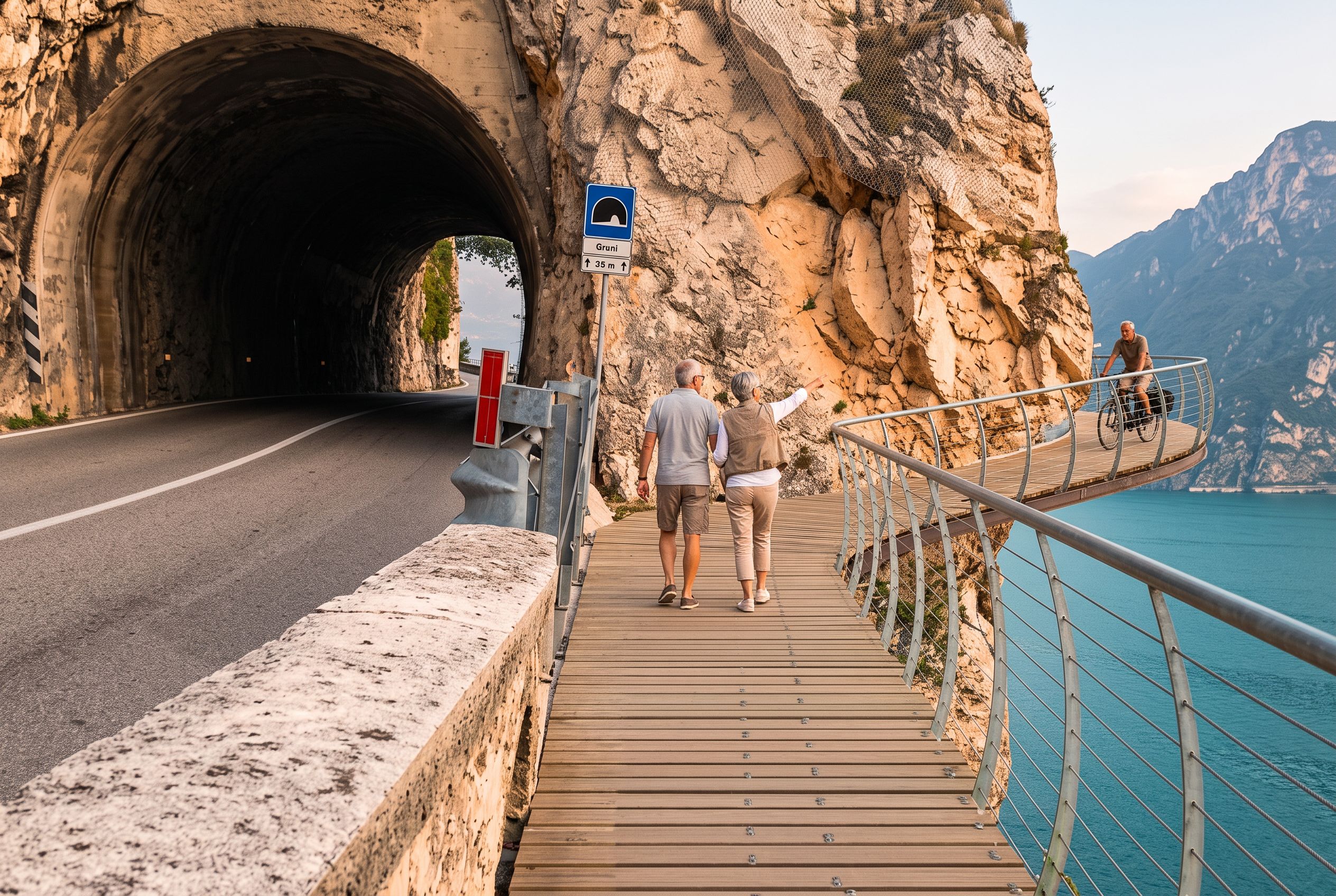
The Limone cycle path is a 2.5-kilometre cycle-and-pedestrian route inaugurated on 14 July 2018, lit at night by LED pace markers and free of steep climbs or steps—and it begins in the historic centre of Limone itself, so there is no approach to negotiate before you start.
This is the ride everyone photographs, and for good reason. The path cantilevers out from the cliff between Limone and Capo Reamol, supported by steel beams driven into the rock face. You ride with the lake directly beneath you, the water lapping against the supports, and the sheer limestone wall rising above. It's flat, smooth, and wide enough for comfortable two-way cycling, though you'll share it with pedestrians, so a gentle bell and patient pace are essential.
As of August 2026, the walkway carries a Google rating of 4.6 out of 5 from 1,921 reviews. The route runs from the lakefront at Lungolago Marconi to Capo Reamol on the Trentino border and takes about 30 minutes on foot or 10 to 15 minutes by bike. Anyone who wants only the final two kilometres, where the path hangs furthest out over the water, can take a taxi from the multi-storey car park on the lakefront and ride or walk back.
“An amazing experience bike riding along this ciclopista that is expertly built high up along the amazing town of Limone sul Garda, allowing one to take in the incredible beauty of Lake Garda. A serene atmosphere… take it slow and soak it all in. It can be enjoyed by both cyclists and pedestrians alike.” — a rider wrote on Google in October 2025
One practical note in your favour: benches are set along the walkway itself, and Limone's tourist office lists public toilets and drinking fountains along the route, so a pause is easy to plan. The route is free, open year-round, and illuminated at night with LED step-marker lights, though daylight is when the views come into their own.
Is the Peschiera-to-Mantua greenway really flat?
Yes—the Parco del Mincio describes its 37-kilometre Mantova–Peschiera itinerary as having negligible height gain, and the first 15 kilometres out of Peschiera follow the trackbed of the old Mantova–Peschiera railway, which closed in 1967. It is the most forgiving long ride here.
This route suits anyone who wants to feel the wind in their hair without worrying about the next hill. The greenway starts at Peschiera del Garda, follows the trackbed of the old Mantova–Peschiera railway, which ran from 1934 to 1967, and cuts inland through farmland, reed beds, and small villages. The surface is predominantly asphalt, with gravel towpath sections along the Mincio, well-maintained and almost entirely traffic-free.
The Parco del Mincio signposts the full Mantova–Peschiera itinerary at 37 kilometres, but you don't need to commit to the whole thing. Borghetto, the medieval mill village at the Mincio crossing, lies 15 kilometres out of Peschiera, so an out-and-back makes a 30-kilometre round trip at a relaxed e-bike pace. The gradient is so gentle you could almost ride it on a conventional bike, but the e-bike makes headwinds—which Garda's climate can deliver, according to VisitGarda's wind notes—a non-issue.
Battery management deserves a thought. The hire fleets carry sizeable packs—Limone Bike Rental lists Bosch PowerTube batteries of 625 and 750 watt-hours on its e-trekking and e-mountain bikes, and a 560-watt-hour pack on its e-city bike—but riding to Mantua and back doubles those 37 kilometres, which is a great deal to ask of a single charge. The 30-kilometre Borghetto out-and-back is the safer plan, and the longer version works better as a one-way ride with the train home from Mantua.
How challenging are the Bardolino vineyard lanes?
The Bardolino lanes are gently rolling rather than flat: the asphalt ciclostrada up to Cavaion Veronese gains 123 metres over 4.8 kilometres, an average gradient of 2.2 percent—perfect for an e-bike, which smooths out the undulations and lets you focus on the scenery.
Bardolino sits on the eastern shore, and its hinterland is a patchwork of vineyards producing the region's namesake red wine. The cycling here is less about dramatic lake views and more about immersion: narrow lanes lined with cypress trees, farmhouses with faded shutters, and the occasional cantina where you can stop for a tasting. Traffic is light on the back roads, though you'll need to watch for tractors during harvest season in September and October.
A classic loop starts in Bardolino, heads east toward Cavaion Veronese, then loops back through the hills above the lake. The signposted connection to Cavaion is 4.8 kilometres of asphalt with 123 metres of climbing, an average of 2.2 percent—modest next to the 165-kilometre Ciclovia del Garda that will one day ring the whole lake, but enough to make you grateful for the motor. The e-bike turns what would be a moderate workout into a pleasant afternoon, and the vineyard scenery rewards every pedal stroke.
For a shorter option, the lakeside promenade between Bardolino and Garda town is flat and easy, though it gets busy with walkers in summer. The vineyard lanes are the better choice for a proper ride, and several rental shops in Bardolino offer route maps with recommended stops.
Where can I hire an e-bike, and what should I pay?
E-bike hire is available in nearly every lake town. Published 2026 day rates run from €35 for a city e-bike at Bike Center Limone to €45 and €55 for front- and full-suspension e-bikes at E-Bike Rent in Riva del Garda; booking 1 to 2 weeks ahead in high season is wise.
The rental market around Lake Garda is mature and competitive. In Limone, Riva del Garda, Malcesine, Garda, Lazise, Peschiera, and Salò, you'll find multiple shops within walking distance of the lakefront. Most offer half-day and full-day rentals. E-Bike Rent in Riva lists the helmet, lock, backpack and phone mount as included in the day rate, and Bike Center Limone prices its bikes by the hour as well as by the day, from two hours upward—useful if you only want the Limone path and lunch.
One caveat: bike quality varies between providers, and the hire conditions put the check on you. Bike Center Limone states it plainly—every customer must inspect the condition of the bike before setting off—so take the two minutes it asks for. Ask about the battery range, test the brakes, and make sure the saddle is adjusted for your height. A good shop will happily make adjustments.
| Bike type | Half-day | Full day | Notes |
|---|---|---|---|
| City e-bike | €25 (5 hrs) | €35 | Bike Center Limone, Via IV Novembre 29, Limone |
| E-mountain bike | €35 (5 hrs) | €45 | Bike Center Limone; €30 for each extra day |
| Front-suspension e-bike | — | €45 | E-Bike Rent, Via Giovanni Prati 11, Riva del Garda |
| Full-suspension e-bike | — | €55 | E-Bike Rent, Riva; helmet, lock and backpack included |
If you're staying at a bike-friendly hotel, ask whether they offer rental partnerships or delivery to the property. Some hotels include e-bikes in their packages, which can simplify logistics. For the Limone path specifically, the town-centre rental shops are well-positioned—Bike Center Limone at Via IV Novembre 29 and Limone Bike Rental at Via IV Novembre 20 both sit a few minutes from where the route begins on the lakefront.
Which roads should I avoid on an e-bike?
Avoid the SS45bis Gardesana Occidentale between Limone and Riva del Garda, where the incomplete cycle path forces riders onto a two-lane highway with no shoulders and narrow tunnels; use the ferry instead.
The biggest disappointment for many cyclists is discovering that the Garda cycle path is not a continuous ring. Despite decades of planning and construction, significant gaps remain, particularly on the north-west shore between Limone and Riva. The Trentino stretch between the Lombardy border and the mouth of the Ponale is split into several separate construction units, and the province's own schedule ran to December 2026 for the last of them. In the meantime, riders face a choice: share the road with cars through tunnels, or take the ferry.
The tunnels are the heart of the problem: article 182 of the Codice della Strada obliges cyclists to wear a high-visibility reflective jacket or braces inside them, which tells you what sort of company you would be keeping. This is not a road for leisure cycling, regardless of your fitness level or e-bike power.
Similarly, the eastern shore between Torbole and Malcesine has unfinished stretches that put riders on busy roads. The safest approach is to plan your rides around the completed segments and use the ferry network to bridge the gaps. Navigazione Laghi carries bicycles between Limone, Riva and Malcesine, and its 2026 tariff gives travellers over 65 a reduced fare on ordinary services—Monday to Friday only, not at weekends or on public holidays.
When is the best time for e-bike cycling?
Spring (April to June) and early autumn (September to October) offer the most comfortable cycling conditions. At Salò on the south-west shore the long-run averages are 13.5°C in April, 18.7°C in May and 14.7°C in October—warm enough for short sleeves but cool enough for steady pedalling.
Summer brings the hottest temperatures and the busiest conditions. July averages 24.6°C and August 24.5°C, which sounds pleasant but feels hotter when you're climbing or riding in direct sun. The lake's climate also includes winds that can affect exposed lakeside sections, so check the forecast before setting out on longer rides.
According to Climate to Travel's Lake Garda data, spring and autumn also tend to have fewer crowds, which matters on popular routes like the Limone path. Late September is the pick of the year for the Bardolino lanes: the vineyards are turning gold, the harvest is underway, and the summer crowds have thinned.
Winter cycling is possible but not recommended for most visitors—January averages just 4.8°C, and some higher routes can be chilly even in good weather. Stick to the April-to-October window and you'll have the best of the lake.
How do ferries fit into a cycling itinerary?
Ferries are an essential part of any Garda cycling plan, letting you combine rideable segments with boat transfers to avoid busy roads and unfinished paths.
Think of the lake as a series of rideable islands connected by water. You can ride the Limone path, take the ferry to Riva del Garda, ride the kilometre-long section to Spiaggia dello Sperone that opened on 21 March 2025, then ferry back. Or ride the Bardolino lanes, ferry to Malcesine, and explore the northern shore without ever touching the dangerous roads.
For a comprehensive look at boat-based exploration, see our guide to seeing Lake Garda mostly by boat, with little walking. The ferry network is reliable and carries bicycles, and the operator's tariff sheet lists a separate bicycle charge alongside the passenger fare. It's the smart traveller's way to see more of the lake without riding more of the road.
Riva del Garda works well as a base: the Torbole–Riva section of the Ciclovia del Garda was under construction with completion scheduled for June 2026, and boat services connect to Limone and Malcesine. The lakefront path to Torbole is flat and easy, making it a good warm-up or recovery ride.
What safety and comfort considerations matter for riders over 50?
Comfort and handling matter more than fitness: choose an upright riding position, practice starts and stops before setting out, and consider a mirror because looking over your shoulder can affect balance.
An upright position reduces strain on your back and neck, and a mirror lets you check traffic without twisting around. If you're new to e-bikes, spend ten minutes in the rental shop's parking lot getting comfortable with the throttle and brakes before hitting the road.
Reflective gear and front and rear lights are non-negotiable, especially on sections where the cycle path runs close to traffic. On the Limone path this matters less—much of it hangs out over the water on brackets fixed to the rock face—but Italian law is strict about it elsewhere: article 182 of the Codice della Strada makes a high-visibility reflective jacket or braces compulsory for cyclists in tunnels, and outside built-up areas from half an hour after sunset to half an hour before sunrise.
For health emergencies, the nearest hospital with an emergency room is the Ospedale P. Pederzoli in Peschiera del Garda, Via Monte Baldo 24—about 18 kilometres from Garda town by road, and roughly 15 from Bardolino. Pharmacies on the eastern shore include Farmacia Alla Madonna at Via Croce 35 in Bardolino and Farmacia Benati at Via A. Della Scala 56 in Lazise. Carry water and snacks, especially on the vineyard lanes where facilities can be sparse.
What does a realistic three-day e-bike itinerary look like?
A well-paced three-day plan covers the Limone path, the southern greenway, and the Bardolino lanes without repeating routes or facing dangerous roads, using ferries to bridge gaps.
Day one: Base yourself in Limone or Riva del Garda. Ride the Limone path in the morning when it's quietest, then take the ferry to Malcesine for lunch and a stroll through the old town. Return by ferry in the afternoon. Distance: 5–10 kilometres of riding, plus ferry time.
Day two: Move to Peschiera del Garda or Desenzano. Ride the greenway toward Mantua, stopping at Borghetto for lunch. Return the same way or continue to Mantua if you're feeling ambitious. Distance: 30–45 kilometres, flat.
Day three: Base in Bardolino or Garda town. Ride the vineyard loop through Cavaion Veronese, stopping at a cantina for a tasting. Add the lakeside promenade if you want more distance. Distance: 25–35 kilometres, gently rolling.
This itinerary keeps daily riding manageable, avoids the dangerous northern roads, and gives you time to enjoy the lake's other pleasures—swimming, dining, and simply watching the light change over the water. For more ideas on combining cycling with other activities, see our guide to day trips worth making from Lake Garda.
What practical logistics should I plan in advance?
Book e-bikes 1 to 2 weeks ahead in high season, confirm battery range and brake condition at pickup, and plan ferry times around your rides, especially on the northern shore where gaps in the cycle path remain.
The Garda cycle path is a work in progress, and published maps don't always match reality on the ground. The first stretch of the Ciclovia del Garda at Torri del Benaco opened on 22 May 2026: about two kilometres of cantilevered corten-steel walkway between Brancolino and the edge of the town, on the Gardesana Orientale. A further 1.7-kilometre lot toward Brenzone is already funded. Don't assume you can ride the full loop—treat it as a collection of excellent segments connected by ferries.
Parking is another consideration, particularly at Limone where spaces near the cycle path entrance are scarce. Verona's tourist office points visitors to the multi-storey car park at Lungolago Marconi 50, which sits at the start of the route. In Bardolino and Peschiera, parking is easier, and several rental shops offer secure bike storage if you're staying nearby.
Finally, consider travel insurance that covers cycling activities. Most standard policies include cycling, but it's worth confirming that e-bike riding is covered, as some providers exclude motor-assisted bikes. A few minutes of checking now can save significant stress later.
For those who prefer walking to cycling, our guide to easy lakeside walks and the best views on Lake Garda covers the lake's most accessible promenades. And if you're tempted by the mountains above the lake, our Monte Baldo hiking guide offers a different perspective—though that's a subject for another day.


