
Lake Garda rewards the unhurried traveller. For those of us who prefer a gentle stroll over a demanding hike, the southern shore offers some of Italy's most rewarding walking — level promenades, shaded paths, and benches placed precisely where the view opens up. This guide focuses entirely on flat, accessible routes where the only effort required is deciding where to stop for coffee.
Every route below is described with the length, surface and gradient that the official sources give for it, together with the accessibility information published by the municipalities and the ferry operator. The result is a practical companion for travellers aged 50–70 who want the lake's beauty without the strain. For the more ambitious climbs, including the famous Monte Baldo trails, we have a separate guide — this one keeps your feet firmly on level ground.
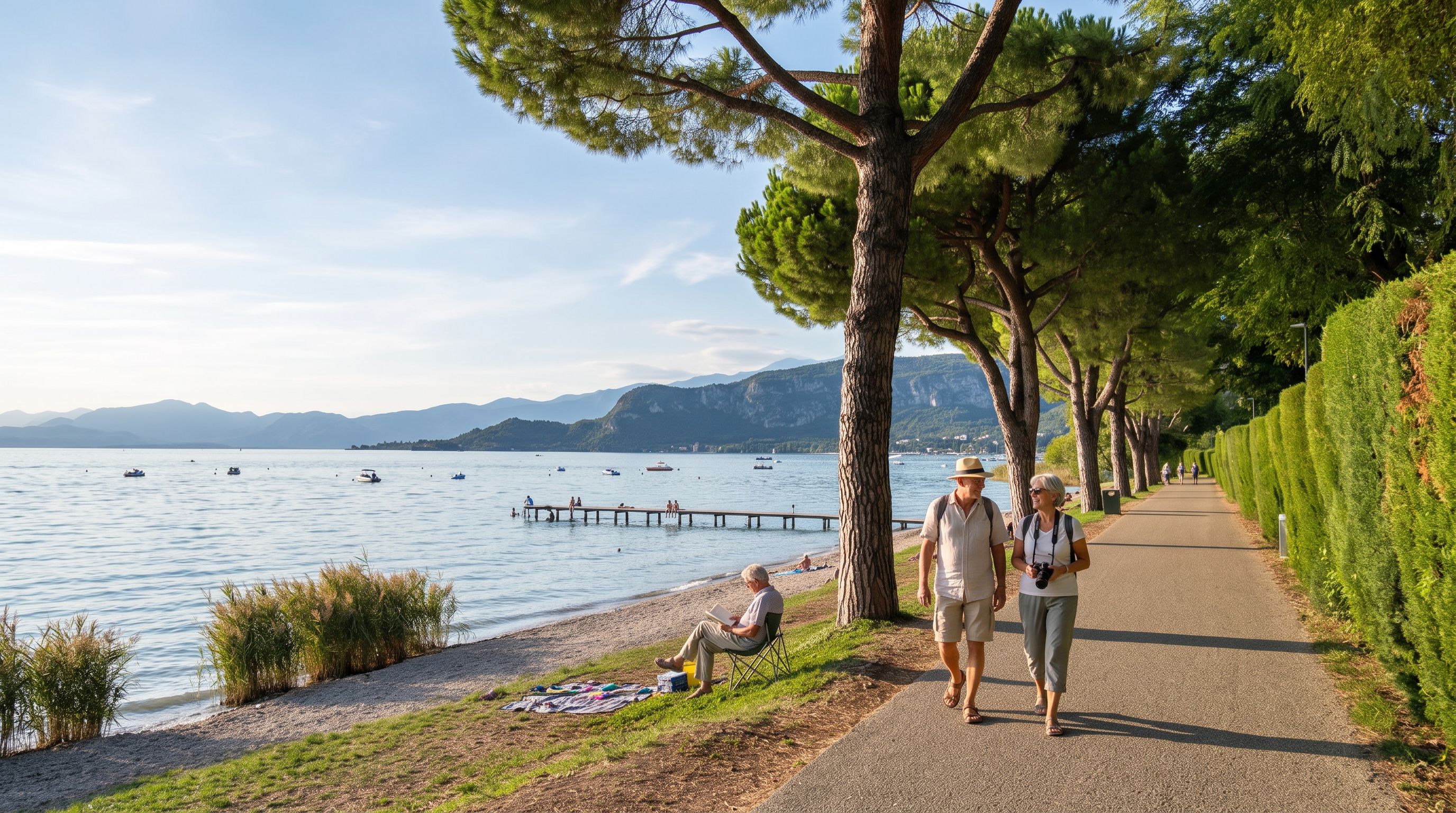 AI-edited
Which promenades are genuinely flat?
The flattest, most comfortable walking on Lake Garda is concentrated in the southern towns: Garda, Bardolino, Lazise, Peschiera, Sirmione, and Salò. Each offers level, paved lakeside paths with regular seating and easy turn-back points, making them ideal for unhurried exploration.
The distinction between a true promenade and a scenic path matters. A promenade is purpose-built for walking: even surfaces, no steps, benches every few hundred metres, and cafés exactly where you need them. The southern shore excels here. In the northern towns the streets behind the waterfront do climb steeply, but the shorelines themselves are not the problem: Malcesine's lakeside path crosses the whole municipality without architectural barriers, and Limone has its own ciclopedonale. For a relaxed day out, the south still offers the longest level stretches.
One of the best-documented accessible routes is the new lakeside promenade at Desenzano, mapped by the Lombardy S.T.A.I. accessible-tourism project, which calls it "completely on the level with no barriers or obstacles, no climbs or descents." It runs on to Rivoltella del Garda "while enjoying the panorama with views of the Sirmione peninsula overlooked by the grandeur of Mount Baldo, the Brescian shore and the Veronese shore." This is the gold standard for easy walking on the lake.
The Garda to Bardolino walk: the classic no-climb route
This four-kilometre lakeside path is the finest easy walk on Lake Garda. It connects two charming towns along a level, mostly shaded esplanade with excellent views, benches to sit on, and a surface that suits both walking shoes and walking sticks.
The route, known locally as the Rivalunga, begins in Garda's old harbour and follows the shoreline south to Bardolino. The surface is paved throughout, and the regional tourist board describes the whole Lazise–Bardolino–Garda lakeside route as completely level and suitable for everyone. Olive trees provide shade for much of the route, which reviewers regularly mention as a blessing on warm afternoons.
On Tripadvisor the stretch is listed as "Walk Rivalunga Garda Bardolino" and rated 4.5 out of 5 from 11 reviews as of August 2026; reviewers call it an easy walk and mention the bars and restaurants along the way. It is a public lakeside route rather than a ticketed attraction, and it is protected from traffic for its whole length, so early morning or late afternoon simply offers the most peaceful experience.
Sirmione's peninsula path: history without the climb
The level path from Sirmione's castle to the Roman ruins at Grotte di Catullo is one of the lake's great flat walks. Regione Lombardia puts it at about a kilometre, running through the historic centre and along the last stretch of the peninsula, ending at some of Italy's most atmospheric ancient remains.
This walk offers something rare: a genuinely flat route to a major historical site. The Grotte di Catullo, a sprawling Roman villa complex, sits at the peninsula's tip, and the approach path involves no significant climbing. Sirmione's town council states that all pedestrian routes in the town are suitable for wheelchairs, and that the Grotte di Catullo, including the museum, are accessible — while the inside of the Scaligero Castle is not. Within the site the shortest visiting route takes about 40 minutes and is described as suitable for people with mobility difficulties. The views across to the mainland are superb.
The Scaliger Castle at the town entrance is worth a pause before you set out; its medieval towers frame the start of the walk beautifully, though the interior is not accessible to wheelchair users. As of August 2026, the Grotte di Catullo e Museo Archeologico di Sirmione at the far end rates 4.5 out of 5 from more than 17,700 Google reviews. Do note that the peninsula can become busy in high season, so an early start rewards you with quieter paths and softer light.
"We chose to walk to the ruins, although there was also a golf cart-style transportation option available for purchase. The walk was easy and only took about 8 minutes." — a guest wrote on Google in June 2026
Limone's lakeside boardwalk: the northern exception
Despite the northern shore's reputation for steep terrain, Limone sul Garda offers a delightful flat boardwalk along its waterfront. It is shorter than the southern promenades but rewards walkers with dramatic mountain views and a genuine sense of the lake's scale.
Limone's promenade runs along the town's harbour and extends northward, with level paving throughout. The town itself climbs steeply behind the waterfront, so stay on the lakeside path and you will be fine. The views across the lake toward Monte Baldo are spectacular, and the lemon groves that give the town its name add a fragrant backdrop.
The official Verona tourism portal puts the ciclopedonale at 2.5 kilometres, on a way 2.5 metres wide, running from Lungolago Marconi in the old centre to Capo Reamol on the Trentino border — about 30 minutes on foot each way. It forms part of the wider Ciclopista del Garda. One caveat: the route stops at the provincial boundary, and on the Trentino side the path has so far been built only as far as the Spiaggia dello Sperone outside Riva, so do not assume you can walk the entire northern shoreline without interruption. For a full guide to getting around by ferry and bus, see our transport guide for Lake Garda.
Cisano to Lazise: a calm 3-kilometre stretch
This quiet lakeside path between Cisano and Lazise is part of the protected Lazise–Bardolino–Garda route, which the regional tourist board describes as flat throughout and open to everyone. It is less famous than the Garda–Bardolino stretch but just as flat and often far less crowded.
The walk begins in the small hamlet of Cisano, just south of Bardolino, and follows the shoreline to the medieval town of Lazise; the full Lazise–Bardolino leg is six kilometres, so this is roughly half of it. The route is protected from traffic along its whole length, and benches appear at intervals, many positioned to catch the afternoon shade.
Lazise itself rewards the effort with a beautifully preserved harbour and castle walls. The town's waterfront cafés are perfect for a mid-walk rest, and the atmosphere is noticeably calmer than the busier promenades to the north. This is the walk to choose when you want solitude with your scenery.
Peschiera del Garda: flat, functional, and friendly
Peschiera works well as a base for travellers without a car. Its ferry pier is one of only six on Lake Garda certified under the Bandiera Lilla Approved scheme, and RFI lists its railway station as one with an assistance service for passengers with disabilities and reduced mobility, plus accessible toilets.
The town sits at the lake's southern tip, where the Mincio River flows out toward the Veneto plain. The historic centre, enclosed by Venetian walls, is compact and easily explored on foot, and the waterfront runs along its edge. No municipal survey of the promenade's surfaces has been published, so the two points with documented step-free access are the ferry pier and the railway station.
What makes Peschiera particularly valuable is its practicality. The station is served by trains from Verona and Milan, and the ferry pier sits inside the town. One Google reviewer noted in July 2025 that the fortification area is "filled with canals and restaurants" and "an amazing part of Lake Garda to relax and enjoy". For those who prefer to see the lake from the water, our guide to seeing Lake Garda mostly by boat complements this walking guide perfectly.
Where will I find benches and rest stops?
Every promenade described in this guide has benches along it, and none of them makes you climb to reach the next one. The Lazise–Bardolino–Garda lakeside route runs level from end to end, so a rest stop never costs you any height.
Beyond benches, the southern promenades are lined with cafés and bars that welcome walkers for a coffee or a longer rest. Tripadvisor reviewers of the Garda–Bardolino stretch mention the bars and restaurants along it, so a table by the water is never far away.
For a detailed breakdown of distances and facilities, here is a practical comparison:
| Route | Distance | Surface | Benches | Difficulty |
|---|---|---|---|---|
| Garda–Bardolino | about 4 km | Paved, level | Yes | Very easy |
| Sirmione peninsula | about 1 km | Paved, wheelchair-suitable | Yes | Very easy |
| Cisano–Lazise | 3 km | Paved, wide | Regular | Very easy |
| Limone boardwalk | 2.5 km | Paved | Occasional | Easy |
| Peschiera waterfront | Not specified | Paved | Regular | Very easy |
| Salò lungolago | 3 km | Paved, elegant | Yes | Very easy |
What are the best views without any climbing?
The lakeside promenades themselves offer the finest easy views, particularly from the Sirmione peninsula and the Garda–Bardolino path. For elevated perspectives without hiking, take the ferry or, at Riva del Garda, use the panoramic elevator to the Bastione.
Many travellers assume that good views require climbing. On Lake Garda, this is not true. The flat promenades offer open vistas across the water, with the Sirmione peninsula and Monte Baldo visible from multiple points. The Desenzano lakeside promenade takes in the Sirmione peninsula, Monte Baldo and both shores of the lake — all without a single step.
For a different perspective, consider the ferries. Navigazione Laghi runs boats that provide superb views from the water, and since 2016 its ships and main landing stages have had stepless ramps for easy boarding. The 25-minute boat tour from Sirmione, run by the Consorzio Motoscafisti at the harbour and rated 4.7 out of 5 from 765 Google reviews as of August 2026, passes the Scaligero Castle and the lakeside villa where Maria Callas lived. Tickets were published at around €12 per adult for the 2026 season.
At Riva del Garda, an inclined panoramic lift climbs 208 metres of track and 130 metres of height in about three minutes, from Via Monte Oro up to the Venetian Bastione; each trip takes one wheelchair or pushchair. It runs from mid-May to early November, and a single ride costs €6, a return €10 in high season and €9 outside it. For more ideas on seeing the lake comfortably, our guide to senior-friendly day trips from Lake Garda offers additional suggestions.
When should I walk to avoid crowds and heat?
Walk in the early morning, before 9:30, or after 17:00 in summer. These windows offer cooler temperatures, softer light, and noticeably fewer people on the promenades. Spring and autumn are ideal seasons for extended walking days.
Plan around the heat as carefully as around the distance. Midsummer walking can feel much harder than expected, even on flat ground, so build in rest stops and carry water. The shaded sections of the Garda–Bardolino path are particularly valuable on hot afternoons.
As of August 2026, the most comfortable months for extended walking are May, June, September, and early October. July and August bring both heat and peak crowds, though early mornings remain pleasant. Winter walks are possible but can be chilly, especially in the northern towns where mountain shadows fall early.
What about the northern shore?
In the northern towns the streets behind the waterfront climb quickly, but the shorelines themselves are level. Malcesine holds the Bandiera Lilla accessibility award and its lakeside path crosses the whole municipality without architectural barriers; in Garda Trentino, public transport is entirely barrier-free, including the lift to the Bastione above Riva.
If you are based in the north, you can still enjoy easy walking by staying on the immediate waterfront. The first Trentino section of the Ciclovia del Garda, linking Riva del Garda to the Spiaggia dello Sperone, was inaugurated on 21 March 2025 and adds about a kilometre of flat, traffic-free walking. Beyond it the route towards Limone is still unbuilt as of 2026, so do not plan a long coastal walk in this direction.
The dramatic viewpoint trails of the north — including the Busatte–Tempesta path and the Ponale route — involve stairs and elevation gain. These are wonderful walks for those who want exertion, but they fall outside the scope of this guide. For a comfortable northern experience, combine the Limone boardwalk with a ferry ride to see the dramatic scenery from the water.
What practical details should I know?
All the promenades described here are public lakeside routes rather than ticketed attractions. Comfortable walking shoes are sufficient; Sirmione's council states that all its pedestrian routes are wheelchair-suitable, so no special footwear is needed there either. Parking is available near most start points, but arrive early in high season.
Desenzano's lakefront is the best-documented stretch on the lake for accessibility. The Giovanni Rambotti Civic Archaeological Museum has a step at its main door but a fully accessible side entrance with ramp and handrail on Via Anelli, and a lift beside the ticket desk reaches the second floor. The Granelli pharmacy on Piazza Cappelletti, further along the same lakefront, likewise has a step at its main entrance and a fully accessible rear entrance with a ramp and a sliding door.
For those with mobility concerns, the ferry system is genuinely helpful. Navigazione Laghi's stepless ramps, installed since 2016, make boarding straightforward; boarding is always assisted by staff over a gangway at least 80 centimetres wide, and crews have been trained since the 2017 season by an association specialising in accessible tourism. This opens up the possibility of combining easy walks in different towns without the stress of driving and parking.
One practical note: a level town does not guarantee a level building. If you are staying in a hotel, check whether there are stairs between the entrance, the restaurant and your room, and ask before you book rather than on arrival.
How do I plan a perfect walking day?
Choose one town as your base, walk its promenade in the morning, take a ferry to a second town for lunch, and walk that town's waterfront in the afternoon. This gives you two easy walks, two different atmospheres, and no repeated stretches.
A typical day might look like this: start in Garda, walk to Bardolino along the Rivalunga (about an hour at a gentle pace), stop for coffee and a pastry in Bardolino, then take the ferry to Sirmione for lunch. After lunch, walk the peninsula path to the Roman ruins and back. The ferry connections between these towns run frequently in season.
For those who prefer to stay in one place, a full day in Sirmione offers the castle, the peninsula walk, the ruins, and the lakeside cafés — all without any significant climbing. Alternatively, base yourself in Peschiera for its flat terrain and excellent transport links, then use ferries to explore other towns. Our guide to small-group tours of Lake Garda offers another comfortable way to see the lake without worrying about logistics.
Is Lake Garda accessible for travellers with limited mobility?
Yes, with planning. The Desenzano and Lazise–Garda lakeside routes are officially described as level and free of obstacles, six ferry piers are certified accessible, and several museums and services document step-free entrances. What needs more care are the old town centres behind the waterfronts.
The key is choosing your locations carefully. The S.T.A.I. project promenade near Desenzano is explicitly designed for accessibility, with parking for disabled users, a bus stop 100 metres away, and access to taxis, buses, and boats. The Garda–Bardolino path is similarly accommodating, with even surfaces and regular seating.
For those using wheelchairs or with significant mobility limitations, the ferry-based approach works best. You can see multiple towns and enjoy lakeside views without walking more than a few hundred metres at a time. Six Lake Garda piers — Desenzano, Sirmione, Peschiera, Garda, Malcesine and Riva — and nine ships carry the Bandiera Lilla Approved certificate; for the remaining landing stages the operator says plainly that not all of them are easy to reach, and its survey is still under way.
One caution: the moment you leave the immediate waterfront, surfaces can become uneven. Stay on the promenades and you will find Lake Garda remarkably accommodating.
What should I pack for a walking day?
Comfortable, supportive shoes are essential. Bring a light jacket for ferry rides, sunscreen for exposed sections, and a water bottle. A folding walking stick is useful for the Sirmione gravel sections but unnecessary on the paved promenades.
Good footwear matters more than anything else you carry. Even flat Italian promenades can be tiring if your shoes lack support. Consider shoes with good grip for the occasional smooth stone surface, and break them in before your trip.
For summer walking, start early and finish by midday. The afternoon heat on exposed sections can be intense, even on flat ground. Carry more water than you think you need, and do not hesitate to use the benches — they are placed for a reason.
Finally, remember that the journey is the destination. Lake Garda's southern promenades are not about reaching a viewpoint or completing a distance. They are about the pleasure of walking beside clear water, watching the light change on the mountains, and stopping whenever the mood takes you. That is the essence of easy travel at any age.
"An amazing experience … allowing one to take in the incredible beauty of Lake Garda. A serene atmosphere… take it slow and soak it all in. It can be enjoyed by both cyclists and pedestrians alike." — from a review left on Google in October 2025


