
Lake Garda rewards the traveller who resists the urge to see everything. The lake itself—Italy's largest—sprawls across three provinces, and its shoreline towns each carry a distinct personality: the Roman-flavoured south, the wine-growing east, and the dramatic alpine north. But the real genius of basing yourself here is what lies beyond the water's edge. Within a two-hour radius sit some of northern Italy's most compelling destinations, each reachable by train, ferry, or organised coach with surprisingly little fuss.
For travellers aged 50 to 70, the key is choosing day trips that reward the effort without exhausting you. Verona offers opera and Roman stones a short train ride away. Venice, though longer, remains achievable with the right planning. Mantua delivers Renaissance art on flat, walkable streets. The Valpolicella hills roll with vineyards and quiet trattorias. And the Sigurtà Garden Park offers one of Europe's most delightful slow-afternoon experiences. This guide covers each in practical detail—travel times, walking demands, and the little logistics that make or break a day out.
 AI-edited
Which base makes day-tripping easiest?
Peschiera del Garda and Desenzano del Garda are the two most practical bases for day trips, each with a train station on the Verona–Milan line and direct ferry access. Sirmione, beautiful as it is, has no station of its own, so it works better as a destination than as a hub.
Peschiera wins for sheer convenience. Trains to Verona run frequently and take 14 to 19 minutes, and the station is about ten minutes on foot from the Porto dei Battelli, where the lake boats leave; a town bus links the two in around five. Desenzano offers similar rail access with a slightly larger station and more services. RFI lists both stations as offering assistance for passengers with disabilities and reduced mobility, each with a barrier-free, lift-served route down to the platforms; the reference Sala Blu is Verona, and assistance can be requested in person or by telephone up to an hour before the train, between 7.45 a.m. and 10.30 p.m. Regione Lombardia's accessible-tourism pages describe Desenzano's lakeside walk as wide, level and well paved, and say the same of the old-town streets beside it.
Sirmione, by contrast, is a destination rather than a base for most travellers. Its medieval streets and hillier approaches make it more demanding underfoot. If you're set on Sirmione as your home base, plan for slower mornings and consider taxis for the station-to-hotel leg. For most readers, however, choosing Peschiera or Desenzano keeps your options open and your energy reserves high. The ferry and bus network around the lake works well from either town, and you can always visit Sirmione as a day trip in its own right.
Verona: the classic short day trip
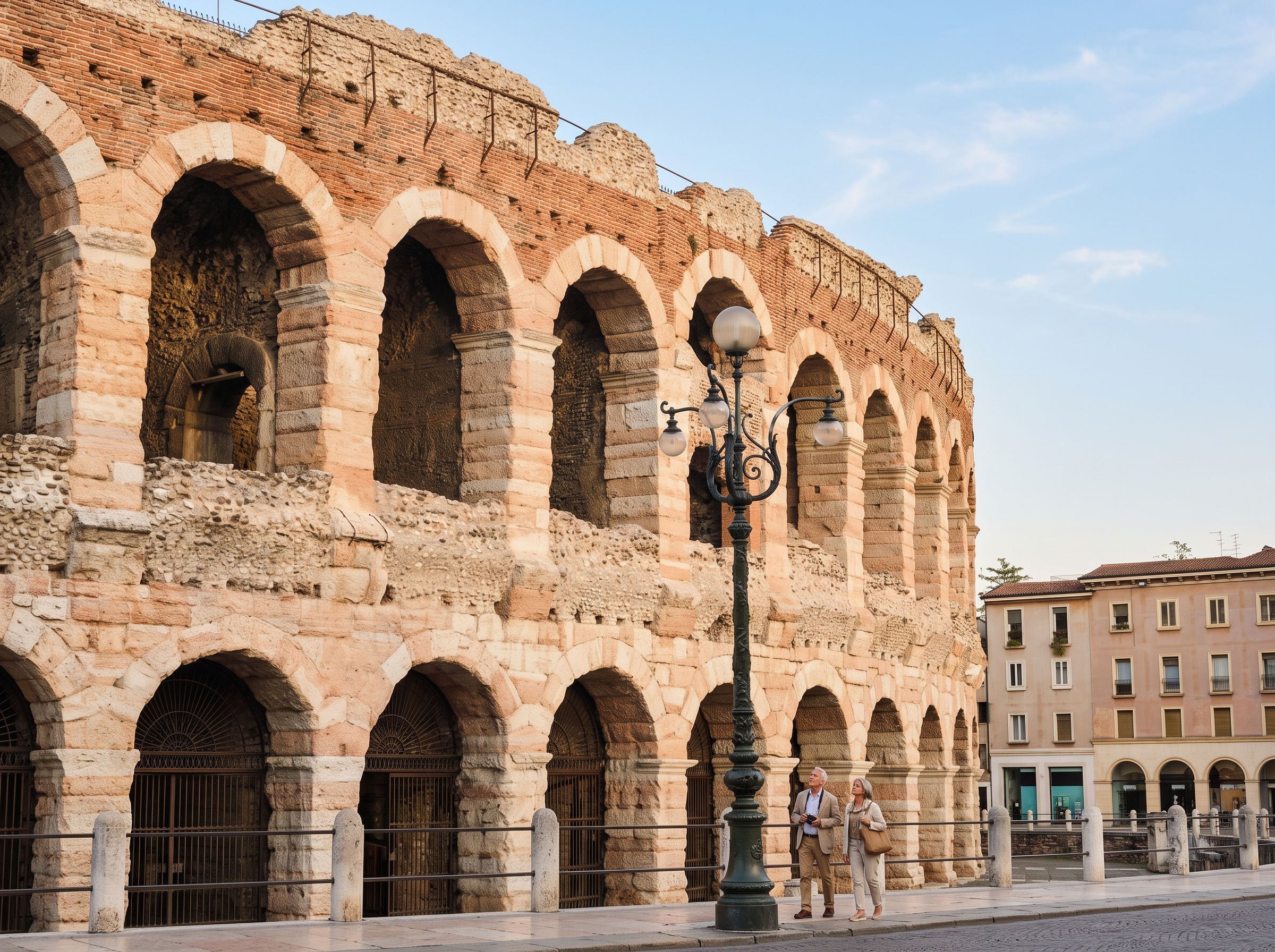
Verona is the most rewarding day trip from Lake Garda for travellers 50–70: roughly 15–25 minutes by train from Peschiera or Desenzano, flat and walkable in the centre, and packed with Roman and medieval layers that reward a slow pace.
Step out of Verona Porta Nuova station and the city unfolds gently. Piazza Brà, home of the famous Arena, is an easy walk from the station, or a short bus ride: the bus station sits in the forecourt of Porta Nuova, and city lines 11, 12, 13, 51 and 52 stop in the square, opposite the Arena. ATV, which runs them, states that 98% of its Verona city fleet is fitted with a ramp — accessible vehicles carry a blue sticker beside the door — while on the country routes around the lake the share is 60% and those journeys have to be booked 48 hours ahead. The Arena itself, a first-century Roman amphitheatre still used for opera performances, is the headline act. Even if you're not attending a performance, the exterior alone justifies the trip.
From Piazza Brà, the old centre spreads out in a manageable loop. Juliet's balcony draws crowds, but the real treasures are quieter: the Roman theatre across the river, the maze of medieval lanes around Piazza delle Erbe, and the Castelvecchio museum with its superb art collection. As of August 2026, Verona's civic museums and churches offer free admission for people with disabilities and their companions—worth knowing if it applies to your party. Read the city's own accessibility list first, though: it rates the Arena, Castelvecchio, the Roman theatre and the Basilica di San Zeno as only partly accessible, and the Archaeological Museum at the Roman theatre as not accessible at all.
Recent guests consistently praise Verona's walkability. A Google reviewer writing in July 2026 stressed that the Arena "is not a ruin" but a working venue, with "modern lighting and sound systems", "modern bathrooms" and "stadium seating". The city's accessibility infrastructure is genuinely thoughtful: two public toilets reached by an outside lift, in Piazza Brà and Piazza San Zeno; the Castel San Pietro funicular, which the city lists among its fully accessible sites; and RFI's Sala Blu assistance service at Porta Nuova. For a full-day outing that doesn't feel like a marathon, Verona is hard to beat.
"I loved the architecture of this castle. The walls are amazing. Take the walk over the old bridge leading up to it. Absolutely incredible art collection if you love renaissance paintings." — a guest wrote on Google in May 2026
Venice by train: worth it or too much?
Venice is feasible as a day trip from Lake Garda, and quicker than its reputation suggests: direct trains reach Venezia Santa Lucia in about an hour and a half from Peschiera or Desenzano, while ATV's direct coach takes three and a half hours from Riva. Either way it is a long day and an early start.
Let's be honest about the numbers. A timetable check in August 2026 puts direct trains from Peschiera into Venezia Santa Lucia in 1 hour 28 minutes and from Desenzano in 1 hour 34 minutes; go via a change at Verona Porta Nuova and it is closer to two hours. From Santa Lucia you need not cross a single bridge on foot: ACTV waterbus lines 1 and 2 leave from the Ferrovia landing stage outside the station and run down the Grand Canal to San Marco. As of August 2026, ATV Verona also operates a direct coach from the lake, and its calendar is narrower than the word "seasonal" suggests: the service runs from 2 June to 13 October 2026, on Tuesdays in June and October and on Tuesdays and Thursdays in July, August and September. It leaves Riva del Garda at 7 a.m., calls at Malcesine, Torri del Benaco, Garda, Bardolino, Lazise and Peschiera among others, reaches Venice at the Tronchetto terminal at 10.30 and starts back at 5.15 p.m. A single fare is €25 and a return €45.
The choice, then, is between train and coach. The train is faster, runs all year and leaves you free to pick your own hours; the coach removes every change but ties you to one or two departure days a week and a fixed 5.15 p.m. return. Whichever you take, the day is long — and Venice is crossed on foot and by water, which tires people in a way no timetable shows. Optional extras such as a shared gondola ride or a lagoon boat tour are sold separately from any tour price and are added on the day.
If you would rather not plan the day yourself, book a tour that includes hotel pickup and a guided walking segment; going independently means working out waterbus routes and reckoning with the sheer scale of the city, which adds mental load to an already long day. And one thing has become simpler: the Comune di Venezia states that the 2026 trial of the day-tripper access fee has ended and that, since 27 July, Venice can be visited with no payment and no exemption request — whether the fee returns after 2026 is a decision for the city council. For a deeper look at the city, consider an overnight stay instead; squeezing Venice into a single day from Garda is possible, but it's the most demanding outing on this list.
Mantua: Renaissance art without the crowds
Mantua is the quiet achiever of this list: a flat, walkable Renaissance city with world-class art and almost none of Verona's crowds. It is 46 minutes by direct train from Verona Porta Nuova, which means about an hour and a quarter from Peschiera with one change. Ideal for culture without the crush.
Getting there means one change. A timetable check in August 2026 gives Peschiera to Mantova in 1 hour 8 minutes and Desenzano in 1 hour 28 minutes, both changing at Verona Porta Nuova, from where the regional train runs to Mantova in 46 minutes. At the far end the Comune di Mantova puts Piazza Sordello about fifteen minutes' walk from the station, with APAM's city buses stopping in the square itself; the station has three lifts to the platforms with braille buttons and an audible signal, an access ramp on the right-hand side of the façade, and automatic doors. The city's crown jewel is the Palazzo Ducale, a sprawling complex of courtyards, frescoed rooms, and the famous Camera degli Sposi by Andrea Mantegna. Allow at least two hours here; the palace is vast and rewards slow exploration.
From the palace, the city unfolds in a series of level squares. The Basilica of Sant'Andrea, designed by Leon Battista Alberti, is a masterpiece of Renaissance architecture. The Rotonda di San Lorenzo, a tiny Romanesque church, hides in the market square. And the waterfront along the three lakes the Mincio forms around the old city offers a pleasant, flat stroll for a post-lunch digestif.
Mantua's flatness is its greatest gift to older travellers. Unlike Verona's gentle hills or Venice's bridges, Mantua's centre is almost entirely level. It carries far fewer tour groups than Verona and gives you more breathing room; Palazzo Ducale itself averages 4.6 from more than 18,000 Google reviews as of August 2026. The local cuisine—pumpkin tortelli, sbrisolona cake, and Lambrusco wine—is worth planning lunch around. For a day trip that feels like a discovery rather than a checklist, Mantua delivers.
Valpolicella: wine country at a gentle pace
The Valpolicella hills north-west of Verona offer a day of vineyard visits, olive groves, and hilltop villages with minimal walking and maximum reward. It's best done by car or small-group tour, with tastings at two or three estates.
Valpolicella produces some of Italy's most celebrated red wines—Amarone, Ripasso, and Valpolicella Classico—and the landscape is as intoxicating as the product. The hills roll gently, dotted with cypress trees, stone farmhouses, and vineyards that have been cultivated for centuries. The consortium that protects the wines divides the area into three zones, and the Classica zone alone is made up of five: Sant'Ambrogio di Valpolicella, San Pietro in Cariano, and the valleys of Fumane, Marano di Valpolicella and Negrar di Valpolicella. Each clusters around a medieval church and a handful of trattorias.
For travellers 50–70, the key is choosing how to explore. Driving yourself through the narrow, winding roads can be stressful, especially after a tasting. A small-group tour solves this: most operators offer half-day or full-day itineraries that visit two or three estates, include lunch, and handle all transport. The small-group tour option is particularly well suited to this region, where the real pleasure is lingering over a glass of Amarone while watching the light shift across the hills.
If you prefer independent exploration, base yourself in the town of Negrar or San Pietro in Cariano and walk between nearby estates. Many wineries welcome walk-ins for tastings, though booking ahead is wise in peak season. The walking is moderate—gentle slopes rather than steep climbs—and the rewards are sensory: the smell of fermenting grapes, the texture of ancient stone, the taste of wine aged in cherrywood casks. Prices vary more than a single band suggests. Tommasi, at Pedemonte di San Pietro in Cariano, lists its entry-level cellar visit and tasting at €25 a head as of August 2026, with longer tastings at €45, €50 and €75; ask what is poured, and how much of it, before you book.
Sigurtà Garden Park: a slow afternoon among a million tulips
The Sigurtà Garden Park at Valeggio sul Mincio is one of Europe's great garden experiences—more than a million tulips from March into April, ancient trees and 40,000 clipped box shrubs across 60 hectares—with an accessible panoramic train for anyone who cannot walk far.
Located about 12 kilometres from Peschiera — some twenty minutes by car — the park spans 60 hectares of manicured lawns, ornamental lakes, and centuries-old trees. The signature moment is Tulipanomania, and its timing is easy to get wrong: the park says the tulips open from the second half of March to mid-April, with the last varieties holding on, weather permitting, into the first days of May. But the park rewards visits right through its season: summer brings roses, water lilies and lotus flowers, and autumn the reds of the Japanese maples and ginkgos before it closes in mid-November.
The genius of Sigurtà for older travellers is the choice of transport. The park's recommended circuit runs to about 10 kilometres of porphyry avenues with, in its own words, gentle ups and downs; most of the main paths are level and firm-surfaced, and shaded benches, picnic areas and lawns are spread along the route. An electric golf cart costs €20 an hour per vehicle and seats up to four — but the park is explicit that the carts are not built for people with impaired mobility and are hired at the visitor's own risk. For that, the panoramic train is the better answer: it has reserved spaces and an electric ramp, the circuit takes about 35 minutes, and it costs €5 a head, free for visitors holding a Law 104/1992 or Disability Card certificate. Allow half a day, which is the park's own average visit.
Sigurtà holds a 4.6 average from more than 32,000 Google reviews as of August 2026. Its cafés serve coffee and light lunches, and the park sits inside Valeggio sul Mincio itself, whose centre is an easy walk and whose tortellini are famous; the medieval mill village of Borghetto sul Mincio is 2.5 kilometres away. For the 2026 season the park opens daily from 7 March to 15 November, 9 a.m. to 7 p.m. with last entry at 6 — and 9 a.m. to 6 p.m. with last entry at 5 during March, October and November. Admission is €18 for adults and €14 for over-65s; visitors with a Law 104 certificate or a Disability Card enter free and their companion pays €14. The nearest free car park is about 600 metres from the main entrance, which is worth knowing before you plan the walk in.
How accessible are these day trips for travellers with limited mobility?
Verona and Mantua are the most accessible day trips: both stations offer RFI assistance and step-free access to the platforms, and both cities run ramp-equipped buses. Venice is the most demanding — 435 bridges. Valpolicella and Sigurtà are manageable with planning; at Sigurtà, take the panoramic train.
Verona's official tourism site lists the accessible public toilets in Piazza Brà and Piazza San Zeno and the Castel San Pietro funicular; ATV, the bus operator, puts the share of ramp-equipped vehicles at 98% on the Verona city network and 60% on the country routes, where a booking 48 hours ahead is required. RFI's Sala Blu at Porta Nuova provides assistance for boarding and alighting, bookable in person or by phone up to an hour before the train, between 7.45 a.m. and 10.30 p.m. Mantova station is well equipped too, with three lifts to the platforms, braille buttons and an audible signal, an access ramp beside the entrance and automatic doors.
Venice is the outlier. The Comune di Venezia counts a historic centre of 121 islands linked by 435 bridges, and states plainly that where a bridge is not equipped you have to use public transport to cross. The city publishes a Venezia Accessibile map marking the ones that are — some with a removable ramp, others with lowered steps. If you have significant mobility concerns, plan the day around the waterbus rather than on foot, consider a water taxi, or keep Venice for another trip and give the day to Verona instead. If you do book a guided walk, it is worth asking for a slower-paced group.
For Valpolicella, choose a tour operator that offers door-to-door transport and minimal walking between tastings. For Sigurtà, take the accessible panoramic train rather than a golf cart. And for all day trips, the low-walking boat-based approach to the lake itself remains the gentlest way to see the region.
Practical planning: tickets, timing, and comfort
Book train tickets in advance for Venice, validate them before boarding, and always confirm ferry and coach schedules seasonally. Pack layers, comfortable shoes, and a water bottle—Italian summer heat is real, and winter days are short.
A few practical notes from seasoned travellers:
- Validate train tickets — or skip the problem. Paper regional tickets must be stamped in the yellow machines before boarding; Trenitalia lists a missing or incorrect validation among the irregularities sanctioned on board, at the rate in force in the region where you are checked. Its Biglietto Digitale Regionale removes the step altogether: it is tied to one train, activates itself at departure, and can be bought up to five minutes before.
- Check ferry schedules. Lake Garda ferries run seasonally: for 2026 Navigazione Laghi published two timetables, 1 April to 15 May and 16 May to 4 October. Dates change every year, so check the operator's site before your trip.
- Book the Venice coach early. ATV's Lake Garda–Venice line runs on only one or two days a week and sells out in peak season; book well ahead for the Tuesday and Thursday departures between June and mid-October.
- Pack for temperature swings. Even in summer, evenings on the lake can be cool. A light jacket or pashmina is essential.
- Carry cash for extras. On organised Venice tours, optional gondola rides and lagoon tours are paid to the guide on the day rather than booked with the tour, so they are not covered by what you paid in advance.
| Destination | Travel Time (each way) | Effort Level | Best For |
|---|---|---|---|
| Verona | 15–25 min by train | Low–Moderate | Culture, opera, easy walking |
| Venice | 1 hr 30 min by direct train | High | Iconic sights, once-in-a-lifetime |
| Mantua | 1 hr 10 min by train, change at Verona | Low | Renaissance art, quiet streets |
| Valpolicella | 30–45 min by car/tour | Moderate | Wine tasting, hilltop villages |
| Sigurtà Park | 20 min by car (12 km) | Low (with the panoramic train) | Gardens, slow afternoons |
One final thought on pacing: the greatest risk for travellers 50–70 is trying to do too much. A day trip from Lake Garda should feel like a highlight, not a hurdle. Choose one destination, allow time for coffee and lingering, and return to the lake for a slow evening by the water. The quieter seasons—May, September, and early October—offer the best balance of pleasant weather and manageable crowds. That's the Garda way: not a checklist, but a rhythm.


