
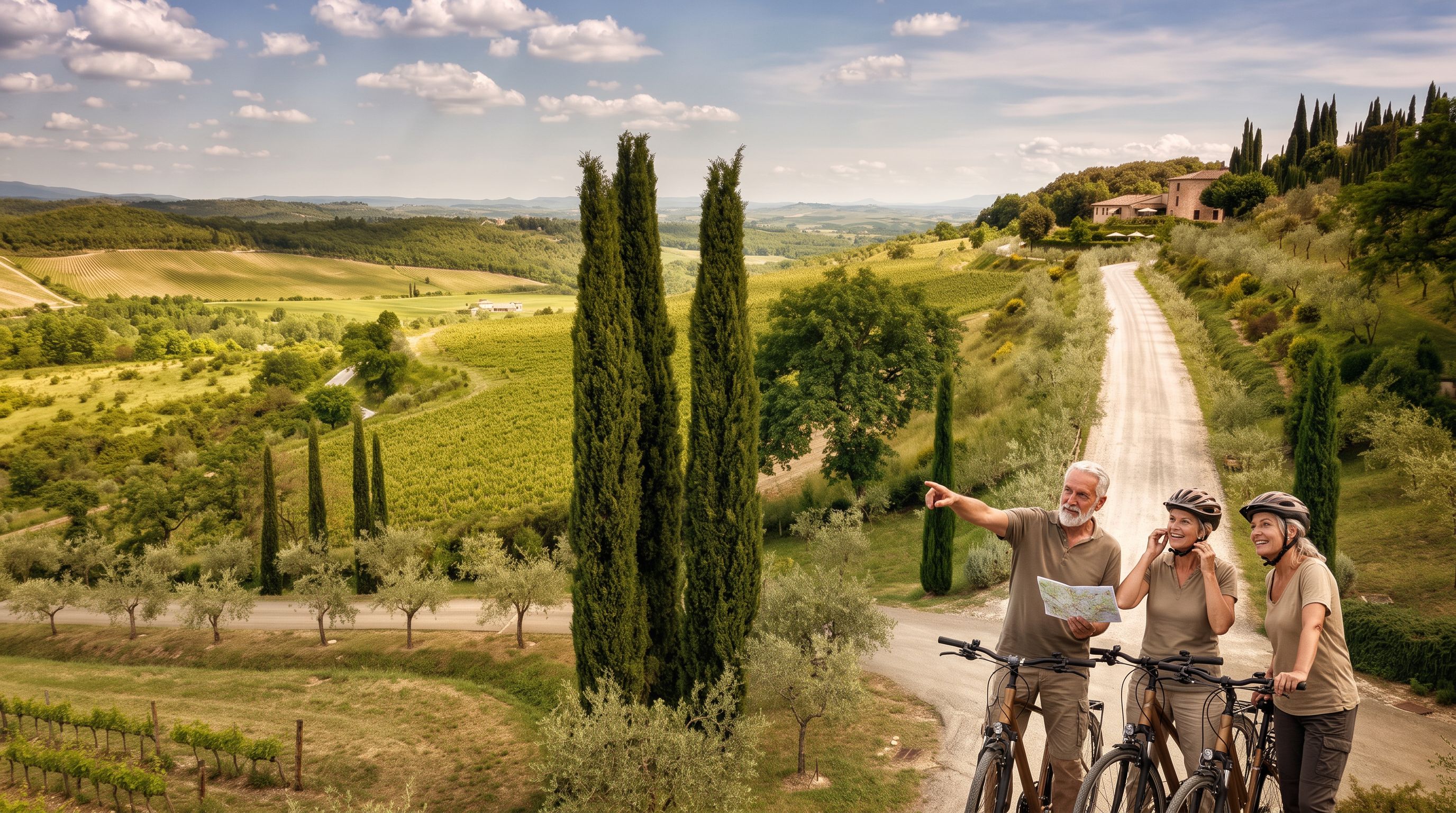
Tuscany's wine country rewards the traveller who slows down, and an e-bike is the tool that makes slowing down possible without surrendering the hills. For active travellers aged 50 to 70 who cycle, the region's Chianti heartland and the white gravel roads of the Val d'Orcia offer a way to see vineyards, medieval villages and open hillscapes at a pace that leaves room for lunch, a tasting and a second espresso. The key is choosing routes by elevation gain rather than distance alone, because a short day in this hill country can still demand real climbing.
The good news is that e-bike rental and guided options have multiplied across the region, with several operators now building routes specifically for riders who want assistance on the climbs and unhurried days among the vines. This guide covers where to hire an e-bike with support, which routes suit a relaxed pace, and how the Val d'Orcia's famous white roads fit into a week of gentle riding. For travellers who prefer to keep both feet on the ground, our guide to half-day walks in the Tuscan hills for active over-50s covers that option separately.
 AI-edited
Which routes suit a relaxed pace?
The gentlest documented e-bike riding sits near Siena and Montespertoli, where operators describe easy loops on quiet secondary roads and well-maintained gravel tracks that suit non-technical riders who want scenery without constant effort.
Visit Tuscany, the regional tourism authority, publishes a self-guided e-bike tour through the Sienese countryside that follows easy routes on quiet secondary roads, white gravel tracks and short stretches of cycle path, describing it as ideal even for non-technical riders. The loop covers the countryside around Montaperti, Pianella, Pievasciata and Pieve a Bozzone, with the Chianti Sculpture Park in Pievasciata as a cultural pause along the way. The tour meets in Siena at Via Girolamo Gigli 54, and runs daily from 1 January 2026 to 31 December 2026, starting at 9:30 and ending at 15:30, with a helmet and phone mount included in the rental package.
North-west of Florence's orbit, the operator Toscana e-Bike describes an 18 km route near Montespertoli as nice and easy, running on small roads with asphalt and dirt surfaces that are always wide and in good condition. Taken slowly, the operator suggests it suits a two- to three-hour trip, and the route is free to download on a mobile phone. For a longer day, the same operator describes a full-day cycle from Montespertoli to San Gimignano, with lunch and e-bike battery charging possible in the hilltop town, making it a practical long-but-doable outing rather than a punishing one.
Where can you hire an e-bike with support?
Several Chianti operators offer rental with delivery to your accommodation, certified guides on request, and roadside assistance, making it straightforward to base yourself in one village and ride out each day without owning a single piece of cycling kit.
Chianti Bicycles, based at Via del Chianti 10 in Castelnuovo Berardenga, rents hybrid and electric bikes with pickup from the office or home delivery to your accommodation. The fleet includes 15 e-bikes alongside other well-maintained models, with sizes from XS to XL, and each e-bike's 400 Wh battery supports roughly 70 km of travel. The operator offers certified guides for organised tours, GPS devices for self-guided riding, and a repair and assistance service. Riders can also arrange full board, combining lunches or dinners with bike rental, and the team can organise wine tastings at local cellars on request. Contact details are published on the operator's site, with phone +39 331 578 4929 and email chiantibicycles@gmail.com.
Tuscany e-Bike Rental, based at Via Roma 82 in Gaiole in Chianti, delivers e-bikes to locations within reasonable distance of the town, including Greve, Panzano, Radda, Volpaia and Castellina. The operator's published price list shows €19 for one hour, €29 for a half-day, €39 for a full day, and €17 per day for a guide or trainer. Bikes can be delivered directly to hotels and agriturismi, which removes the logistics of collecting and returning equipment. Yep Bike also states it rents e-bikes in the heart of Chianti, with pickup in Cerbaia or home delivery available.
How does the Val d'Orcia compare?
The Val d'Orcia's white gravel roads offer some of Tuscany's most memorable riding, but the terrain climbs more than Chianti's gentlest loops, so e-bike assistance becomes less a luxury and more a practical necessity for most riders over 50.
The Val d'Orcia, a UNESCO landscape, is presented by Visit Tuscany as a destination for bike touring along white roads and climbs toward the slopes of Mount Amiata. The regional tourism board describes the routes as white roads and climbs, which signals a landscape of open hilltops rather than shaded valley floors. Florence Trip describes a route from Pienza to Montalcino as 35 km one way with 600 m of climbing, following classic Val d'Orcia views across open hilltops. That distance and elevation profile makes it a substantial half-day or full-day outing, best attempted with a charged battery and a planned lunch stop.
The Eroica organisation, famous for its vintage-bike events, maintains permanent routes that let cyclists ride the white roads of Terra Eroica in the Chianti and Val d'Orcia areas every day of the year. These routes are published as usable throughout the year and on any type of bike, and travellers can organise trips with official Terra Eroica tour operators. For riders who want the Val d'Orcia experience without committing to a full day, basing yourself in Pienza and riding shorter loops toward San Quirico d'Orcia, about 10 km away by road, offers flexibility.
What does a guided vineyard ride include?
Guided e-bike tours through Chianti typically combine a private guide, quality e-bikes, vineyard visits and tastings, with operators capping group sizes and pacing rides to suit mixed fitness levels.
The Podere Resort in Chianti offers e-bike rides it describes as on Tuscan Time, meaning unhurried, with a private guide, top-quality e-bikes and private pickup from the estate. Published options include a Chianti Superiore e-bike-and-wine ride through vineyards and cellars, listed at 18 km one way with 2/5 difficulty, plus other rides of 16 to 24 km with private guided pacing. Guided tours take up to eight riders, run every day from 9 am, and require at least 24 hours' notice. The resort also offers half-day, full-day or hourly rental for those who prefer to ride independently.
GetYourGuide lists a Chianti countryside e-bike tour from Siena that uses secondary roads with limited traffic, covers about 20 km, and includes frequent stops, a farm lunch and wine. Tuscany Private Tour's e-bike adventure lets riders explore Chianti or the Val d'Orcia at their own pace, with a guided ride, orientation on how to use the e-bike, and assistance throughout for all fitness levels. For self-guided travellers, E-bikes Florence specialises in self-guided Tuscany e-bike tours with a GPS map, includes roadside support for flat tyres, and can help book vineyard wine and olive oil tastings.
How demanding are the hills really?
Chianti's gradients commonly run between 8 and 15 percent, which is demanding on a conventional bike but manageable on an e-bike, provided you choose your route and charge your battery before setting out.
A 2026 cycling guide notes that 8 to 15 percent gradients are common in the Chianti zone, which is a clear warning that ordinary road cycling can be demanding. The same guide recommends April to June or September to October for the best experience, and notes that spring is best for the Crete Senesi because the landscape is green and the light is soft.
The operator Luxor Chianti Glamping rates its routes on a difficulty scale, with a simple route to Monteriggioni rated 1/4 and described as suitable for the whole family, while a medium-long route to Castellina in Chianti is rated 3/4 with a warning that climbs and gradients make it better for users with good preparation. This distinction matters for planning: a route that one operator calls easy may still involve steady climbing, and the difference between a 1/4 and a 3/4 rating is not trivial. Forum contributors echo this, advising riders to pick routes by elevation gain rather than distance alone, because a short day can still be demanding in hill country.
How do you plan a day ride?
Start with a base town, choose a loop that matches your fitness and interest, confirm the rental operator can deliver or meet you there, and build in a lunch or tasting stop that also allows for battery charging where needed.
Forum contributors and operators commonly organise rides from base towns including Florence, Pienza, Siena, Castellina in Chianti and San Quirico d'Orcia. A published Chianti e-bike tour starting in Gaiole in Chianti uses Scott e-mountain bikes, covers 38 km with 690 m of ascent, and runs roughly half paved, half unpaved surfaces, with the area described as low traffic. A Reddit post from someone who biked around Gaiole in Chianti said the roads were great and drivers considerate, which matches the low-traffic description.
For a shorter day, the Visit Tuscany Siena countryside tour covers about 20 km on easy terrain, while the Podere Resort's Chianti Superiore ride runs 18 km one way. E-bikes Florence publishes a Tuscany Ride with Vineyard Visit of around 38 km from Florence, mixing cycle path, countryside roads and vineyards, with lunch, wine and olive oil tasting, and the Arno bike path back into Florence. The key planning principle across all these options is to match the day's elevation gain to your energy and interest, not just the distance.
What should you book in advance?
Most operators require at least 24 hours' notice for guided tours, and some ask you to book through an online form, so plan your riding days before you arrive rather than deciding on the morning.
The Podere Resort asks guests to contact reception for pricing and availability, with at least 24 hours' notice for its guided tours. Yep Bike's reservation process involves selecting the bike, date, duration and accessories, then confirming the reservation. One rental company says booking is done by online form and offers Small, Medium and Large frame sizes, with instant rental-rate display after form submission. Luxor Chianti Glamping says users can rent directly at the village and choose routes by interests and abilities, with rides available every day from 9 am.
For travellers who prefer a package, a Rick Steves forum contributor mentioned that Tuscany Bike Tours offered one-day rides through Chianti, just outside Florence, with winery stops and lunch included, at about €60. Another forum thread noted that a Tuscany bike tour from Florence met in the city centre but shuttled riders to the actual starting point outside the centre. Holidoit publishes a general Tuscany e-bike rental range of €40 to €100 per person, depending on duration and services such as a guide or tasting and lunch. None of the operators in the gathered material publish senior or over-65 fares, reduced tariffs or seasonal closure calendars, so confirm current pricing and availability directly when booking.
How do you get to the start?
Driving distances between the main bases are manageable, with Siena to Castellina in Chianti about 20 km and Pienza to Montalcino about 24 km, making it feasible to base yourself centrally and reach different riding areas on different days.
Measured on the road network, Florence's main railway station to Gaiole in Chianti is 71 km, about 60 minutes with clear roads and no stops. Florence station to Greve in Chianti is 33 km, about 45 minutes with clear roads. Siena station to Castellina in Chianti is 20 km, about 25 minutes with clear roads. Siena station to Pienza is 69 km, about 60 minutes with clear roads. Pienza to San Quirico d'Orcia is 10 km, about 10 minutes with clear roads, and Pienza to Montalcino is 24 km, about 30 minutes with clear roads.
These distances suggest a practical structure: base yourself in or near Siena for the Sienese Chianti loops, in Gaiole or Castellina for the Chianti Classico heartland, and in Pienza or San Quirico d'Orcia for the Val d'Orcia. Each base puts several riding areas within a short drive, and most operators will deliver e-bikes to your accommodation, removing the need to transport bikes yourself. For travellers combining cycling with other interests, the region also offers gentle countryside walks and the best views in Tuscany for rest days.
What about traffic and safety?
The documented routes favour quiet secondary roads and white gravel tracks over main roads, and riders report considerate drivers in the Gaiole area, but you should still ride defensively and confirm current conditions with your operator.
The Visit Tuscany Siena countryside tour explicitly uses quiet secondary roads and short cycle-path stretches. The Gaiole e-bike tour is described as low traffic, and a Reddit post from someone who biked around Gaiole said drivers were considerate. GetYourGuide's Chianti tour from Siena uses secondary roads with limited traffic. These descriptions suggest that the documented routes avoid the busiest arteries, but road conditions change, and a route that was quiet in one season may carry more traffic during harvest or holiday periods.
Italy's emergency number is 112, which works across the country for police, medical and fire services. None of the operators in the gathered material document specific health provisions, reduced-mobility assistance or maintenance closures, so ask when booking if you have particular needs. For riders who find even e-bike days too demanding, a Rick Steves forum post suggested that car or van-based wine tours may be a better choice in Chianti, which is a sensible fallback for a rest day. Travellers who prefer to explore on foot rather than wheels can consult our guide to the hill towns of Tuscany and which are easiest underfoot.
When is the best season to ride?
April to June and September to October offer the best combination of comfortable temperatures, green or golden landscapes and lighter traffic, with spring particularly recommended for the Crete Senesi.
A 2026 cycling guide recommends April to June or September to October for the best experience in Tuscany. The same guide says spring is best for the Crete Senesi because the landscape is green and the light is soft. Summer months bring heat, which makes midday riding less comfortable, while winter days are short and some operators reduce hours. The Freedome Chianti e-bike rental with digital itinerary runs every day from March to November, which gives a practical sense of the operating season for rental services.
For the Val d'Orcia, the open hilltops offer little shade, so spring and autumn are particularly sensible choices. The Eroica permanent routes are usable throughout the year, but the white roads can become muddy after rain, so check conditions with your operator before setting out on gravel sections. Autumn brings the grape harvest, which adds atmosphere to vineyard rides but also means more traffic on farm roads during picking hours.


