
Tuscany's hill country rewards walkers who still enjoy a climb. The region's most documented half-day routes for fit travellers aged 50 to 70 run through the Chianti Classico vineyards and the Unesco-listed Val d'Orcia, where official trail networks publish distances, ascent and timings. These are working landscapes of farm tracks and gravel lanes, not groomed footpaths, so the walking feels like genuine exercise. The routes below are graded for difficulty, with trailhead access and the seasons that suit them best, so you can plan around the midday heat.
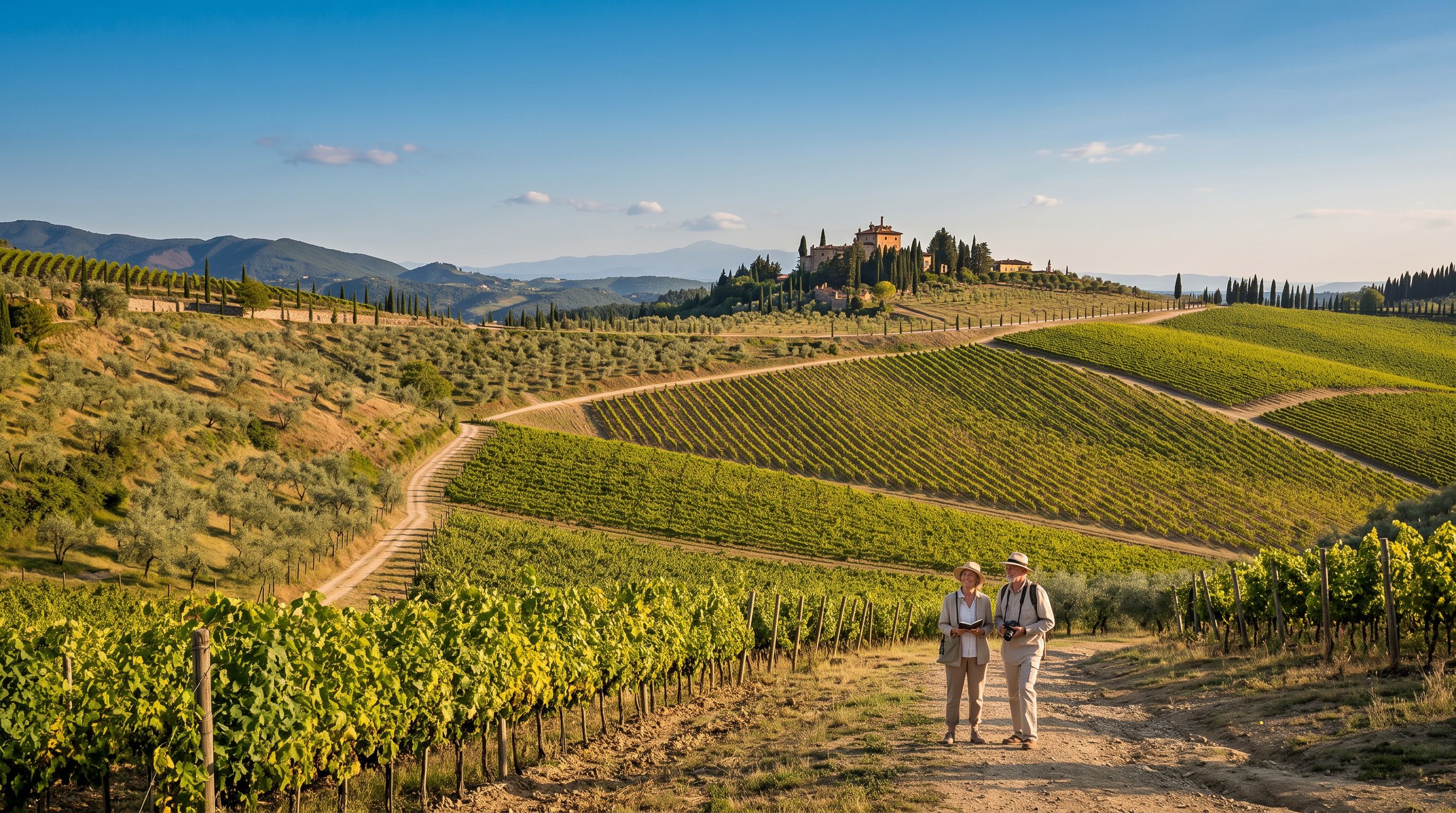 AI-edited
Which walks suit fit travellers over 50?
The clearest match for active over-50s who enjoy a climb is the Chianti Vineyards and Woods route, an official 14 km circuit with 535 m of ascent, graded E for hiking with no particular difficulties and medium experience required.
Visit Chianti, the area's official tourism body, publishes the route's full specifications: 14 km in length, 535 m of total ascent and the same in descent, with a maximum height of 575 m above sea level and a minimum of 270 m. The official page states the best time to tackle the route is all year round and that the necessary equipment is walking shoes. The route starts at Quercegrossa and Vagliagli, and the official page says access is by car.
In the Val d'Orcia, the municipality of San Quirico d'Orcia publishes a network of 17 trails totalling 185 km, suitable for trekking in all seasons. For a half-day with modest ascent, the official choices include the 7.3 km San Quirico d'Orcia to Pienza walk at about 2.5 hours, or the 9.9 km route to the Chapel of Vitaleta at about 3 hours. Walkers who want a more athletic outing can take the 13.5 km route to the Abbazia di Sant'Antimo at about 4.2 hours, which sits at the longer end of a half-day.
How do I reach the trailheads?
Reach the Chianti routes by car from Florence, with Greve in Chianti about 33 km from Florence's Santa Maria Novella station, roughly 45 minutes with clear roads and no stops. The Val d'Orcia trails start from the hill towns of San Quirico d'Orcia and Bagno Vignoni.
The measured road distances give a clear picture for planning. From Florence's Firenze SMN railway station to Greve in Chianti is 33 km by road, about 45 minutes with clear roads. Montefioralle, the hilltop village above Greve, is 36 km from Florence, also about 45 minutes with clear roads. Siena, which makes a good base for the Val d'Orcia, sits 69 km from Florence, about 65 minutes with clear roads.
For the Val d'Orcia trails, the municipality of San Quirico d'Orcia publishes its network with official signposting and a dedicated app. The official page says the app helps hikers follow directions on the official signage "easily and safely." Public transport connections to the smaller Val d'Orcia villages are limited, so most walkers arrive by car and park at the trailhead.
| Destination | Distance from Florence | Driving time (clear roads) |
|---|---|---|
| Greve in Chianti | 33 km | About 45 minutes |
| Montefioralle | 36 km | About 45 minutes |
| Siena | 69 km | About 65 minutes |
What is the Chianti Vineyards and Woods route like?
The Chianti Vineyards and Woods route is a 14 km circuit with 535 m of ascent and descent, graded E for hiking. The official page says it has no particular difficulties, requires medium experience and is best tackled all year round.
This is the strongest official match for fit over-50s who want a half-day walk with a proper climb. The route runs through the Chianti Classico vineyards that give the region its name, passing working farms and woodland. Visit Tuscany, the region's official tourism website, says Chianti has a dense network of trails and that many itineraries suit "expert walkers or simple enthusiasts," which this route reflects.
The 535 m of ascent spread over 14 km gives a steady, sustained climb rather than a punishing gradient. The official page lists walking shoes as the necessary equipment, which reflects the terrain: much of Tuscany's walking is on working rural roads and farm tracks rather than groomed footpaths, so shoes with good grip matter. The route's maximum height of 575 m above sea level keeps it below the level where heat and altitude become concerns for most walkers.
Which Val d'Orcia routes suit half-day walkers?
The Val d'Orcia's official network offers several half-day options with published distances and times: San Quirico d'Orcia to Pienza at 7.3 km and about 2.5 hours, the Chapel of Vitaleta at 9.9 km and about 3 hours, and the Abbazia di Sant'Antimo at 13.5 km and about 4.2 hours for a more athletic outing.
The municipality of San Quirico d'Orcia publishes its trail network of 17 trails totalling 185 km, describing the landscape as Oscar-worthy and surrounded by icons symbolic of Tuscany and Unesco heritage. The trails suit trekking in all seasons and can be followed with the Valdorcia app and official signposting.
For a gentler half-day, the San Quirico d'Orcia to Pienza route at 7.3 km connects two of the Val d'Orcia's most famous hill towns, both Unesco-listed. The Chapel of Vitaleta route at 9.9 km leads to the iconic Renaissance chapel that appears in countless photographs of the Val d'Orcia landscape. Walkers who still enjoy a climb and want more time on their feet can take the 13.5 km route to the Abbazia di Sant'Antimo, a Romanesque abbey that sits in a valley below Montalcino.
A recorded Val d'Orcia route suitable for fit half-day walkers runs from Bagno Vignoni at 18 km in 4 hours, one of the longer options for strong walkers. The route passes the thermal village of Bagno Vignoni, whose central square is a pool of hot spring water rather than a piazza.
What about walks near Greve and Panzano?
Travellers consistently recommend the hill country around Greve in Chianti, Panzano and Montefioralle for half-day walks, describing routes that feel like real exercise while passing vineyards and hilltop villages. These are documented in traveller reports rather than on a single official trail page.
Forum reports describe starting in Greve, taking the bus from Florence, then hiking toward Panzano, with Montefioralle on the downhill return. The same reports say the roads from Greve in Chianti toward Poggibonsi each take about 4 hours of walking, with wineries along the way for breaks and tasting.
Practical advice from these reports includes checking local market days: Saturday morning in Greve and Sunday in Panzano, which can be combined with a walk. The walking here is mostly on gravel roads through olive groves and vineyards, and travellers note that the routes feel scenic but still like genuine exercise rather than a casual stroll.
For travellers who want less climbing, the gentler countryside options are covered in our separate guide to gentle countryside walks and the best views in Tuscany.
When is the best season to walk?
The official pages for both the Chianti Vineyards and Woods route and the Val d'Orcia network say the trails can be walked all year round. No official source gives a precise timetable for avoiding midday heat, so the practical guidance is to start early in summer.
The Chianti Vineyards and Woods official page states the best time to tackle the route is all year round. The San Quirico d'Orcia municipal page says its trail network is suitable for trekking in all seasons. Neither source names a best month, and no gathered source gives an official timetable for avoiding the heat of the day.
The practical implication for walkers aged 50 to 70 is to plan around the sun rather than the calendar. In the cooler months of October through April, a mid-morning start works well. From May through September, starting at first light and finishing by early afternoon avoids the worst of the heat. The Val d'Orcia's clay tracks can turn muddy after rain from November to March, so waterproof boots are worth packing in those months.
How hard are these walks really?
The Chianti Vineyards and Woods route is graded E for hiking with no particular difficulties and medium experience required, while the Val d'Orcia network is described as suitable for trekking in all seasons. Traveller reports consistently say the walking feels like real exercise on working farm tracks.
The official gradings give a clear picture. The Chianti route's 535 m of ascent over 14 km is a sustained but manageable climb for fit walkers. The Val d'Orcia routes are shorter and gentler, with the exception of the 13.5 km Abbazia di Sant'Antimo walk. A Fodors forum post described the Montalcino to Abbey Sant'Antimo route as about 10 km, downhill and "easy," passing fields, vineyards and olive groves.
Traveller reports add useful texture. Several forum contributors say these routes are scenic but still feel like real exercise rather than a casual stroll. What surprised travellers most was how much of Tuscany's walking is on working rural roads and farm tracks, not groomed footpaths, so the walking can feel longer than the map suggests. Shoes with good grip matter, and the social side is part of the appeal: winery stops, market-town pauses and agriturismo bases made the walks feel easier and more rewarding for active visitors in their 50s and 60s.
What should I pack and wear?
The official Chianti route page lists walking shoes as the necessary equipment. Traveller reports add that good grip matters because much of the walking is on gravel farm tracks, and waterproof boots are recommended in the Val d'Orcia from November to March.
The terrain dictates the kit. Tuscany's hill walks run on working rural roads and farm tracks, which can be loose underfoot after dry weather and muddy on clay soils after rain. Walking shoes with a decent tread are the minimum, and boots give better ankle support on the descents, which can feel harder than the climbs on a 535 m route.
For the warmer months, carry water even on shorter routes; the Val d'Orcia in particular has long stretches without shade. A sun hat and sunscreen are essential from late spring through early autumn. In the cooler months, layers work well because the walking generates heat quickly, but the pace of a half-day route means you will stop periodically, and the temperature drops fast in the shade.
For those who prefer not to carry everything, the hill towns along the routes have cafes and restaurants where you can pause. The wineries along the Chianti routes also offer natural break points, and several operators run wine-tasting walks that combine short hikes with cellar visits.
Can I join a guided walk?
Several operators run guided and self-guided walking experiences in Chianti, including wine-tasting walks with short hikes between wineries. The Chianti Classico wine hiking adventure covers 8 km with 150 m of elevation gain and includes van transport.
For walkers who prefer company or local knowledge, guided options are documented. The Chianti Classico wine hiking adventure is an 8 km wine trek with 150 m of elevation gain among Chianti Classico vineyards, with transportation included by van. This is the easiest of the documented wine-walk options because the distance and ascent are modest and the effort is spread across the day.
A private walking winery tour of the Chianti Classico offers a full-day experience with short hikes between stops totalling 7 km through rolling hills, vineyards and castles, visiting three organic wineries. The effort is spread across the day rather than concentrated, making it more of a day out than a focused walk.
One operator states that its Chianti wine trekking tour is customizable, available also by MTB or e-bike, with bike rental offered through partners. The same operator advises boots and water. For those who want a guided half-day without the wine focus, Toscana Hiking Experience says it offers themed excursions on foot or by bicycle, with members that include certified hiking guides and instructors.
Walkers who prefer to go independently can use the official resources. Visit Tuscany publishes an "Atlas of Tuscan Walks" and a tourist-office page with contacts, addresses and opening hours for information points across the region. The Val d'Orcia's official app provides route directions that follow the official signposting.
What should I know before setting out?
No ticket, pass or entrance fee is documented for the walking routes in Chianti or the Val d'Orcia, and no senior fares or reduced tariffs are published for these trails. The routes are open access, and the main planning considerations are transport, weather and the midday heat.
The practical details are straightforward. Trail fares or prices for these walking routes are not documented on the official pages gathered. No gathered source documents a ticket, pass or entrance fee for the walking routes in Chianti or the Val d'Orcia. No senior or over-65 fares are documented for these trails either.
Access to the Chianti Vineyards and Woods route is by car, according to the official page. The Val d'Orcia trails start from the hill towns, which have limited public transport, so most walkers drive. For those basing themselves in Florence, the measured road distance to Greve in Chianti is 33 km, about 45 minutes with clear roads.
For walkers who want to combine their half-day with a visit to the region's hill towns, our guide to the hill towns of Tuscany and which are easiest underfoot covers the practicalities of exploring these villages. Those who prefer to see the countryside with minimal walking can consult seeing Tuscany with little walking.
One planning note for the Val d'Orcia: the clay tracks can become muddy after rain from November to March, and waterproof boots are recommended in those months. The official pages do not document step-free access, assistance services or seating for the exact walking routes in Chianti or the Val d'Orcia, so walkers with specific mobility needs should confirm details with local tourist offices before setting out.
How do I stay safe in the heat?
No official source gives a precise timetable for avoiding midday heat in these areas. The practical approach is to start early in the warmer months, carry water, and plan routes that finish by early afternoon.
The official pages confirm all-season walking but do not address heat specifically. The Chianti route's maximum height of 575 m above sea level keeps it relatively cool compared with lower-lying areas, but the 535 m of ascent will still generate heat. The Val d'Orcia's open landscape offers little shade on many stretches.
For fit walkers aged 50 to 70, the sensible pattern is to start at first light from late spring through early autumn, take the main climb in the cooler morning hours, and plan lunch and wine-tasting stops for the afternoon. Carry more water than you think you need, particularly on the longer Val d'Orcia routes such as the 13.5 km walk to the Abbazia di Sant'Antimo. The hill towns along the routes have public fountains in their squares where you can refill bottles.
The Val d'Orcia's official page says the area can be walked in all seasons, and the winter months offer crisp, clear days with few other walkers. The trade-off is the mud on clay tracks after rain, so check the forecast and pack accordingly.
What about the longer options?
For strong walkers who want a fuller half-day, the Val d'Orcia network offers the 13.5 km route to the Abbazia di Sant'Antimo at about 4.2 hours, and a published walk from Bagno Vignoni runs 18 km in 4 hours.
The Abbazia di Sant'Antimo route sits at the longer end of a half-day and suits walkers who still enjoy a climb. The Romanesque abbey, set in a valley below Montalcino, is one of Tuscany's most atmospheric religious sites, and the walk approaches it through fields, vineyards and olive groves. A Fodors forum post described the Montalcino to Abbey route as about 10 km, downhill and "easy."
The 18 km walk from Bagno Vignoni in 4 hours is one of the longer half-day options for strong walkers. It starts from the thermal village whose central square is a pool of hot spring water, a memorable departure point for a day on the trails. The route connects to the broader network that Italy's official tourism site describes as experienced "step by step" through the Val d'Orcia landscape.
For those who want to extend their walking into a multi-day stay, the Via Francigena, the historic pilgrim route from Canterbury to Rome, passes through Tuscany with sections from Siena past Monteriggioni and San Gimignano described as suitable for day hikes. The Via Francigena is described as accessible in parts and suitable for walking or cycling, with services in population centres along the way.
Walkers who prefer a luxury base for their explorations might consider the estate hotels of the Val d'Orcia, such as those featured in our closer look at Rosewood Castiglion del Bosco, which sits within walking distance of the region's trails.


