
Tuscany's hill towns draw travellers with their medieval towers, Renaissance piazzas and sweeping countryside views. For those aged 50 to 70, the question is rarely whether to visit, but how much climbing the knees can take. The classic six, Siena, San Gimignano, Montepulciano, Pienza, Cortona and Volterra, differ enormously in gradient, paving and the distance from car park to summit. This guide compares them on what matters most: how steep, how cobbled, and where a car can drop you near the top.
The good news is that the easiest town underfoot is also one of the most rewarding. Pienza, a compact Renaissance gem, is documented as relatively flat and pedestrian friendly, while Montepulciano, just 14 kilometres away, is repeatedly described as steep and demanding. Siena, though larger, has solved much of its climb with escalators. The others sit somewhere in between, each with its own workarounds.
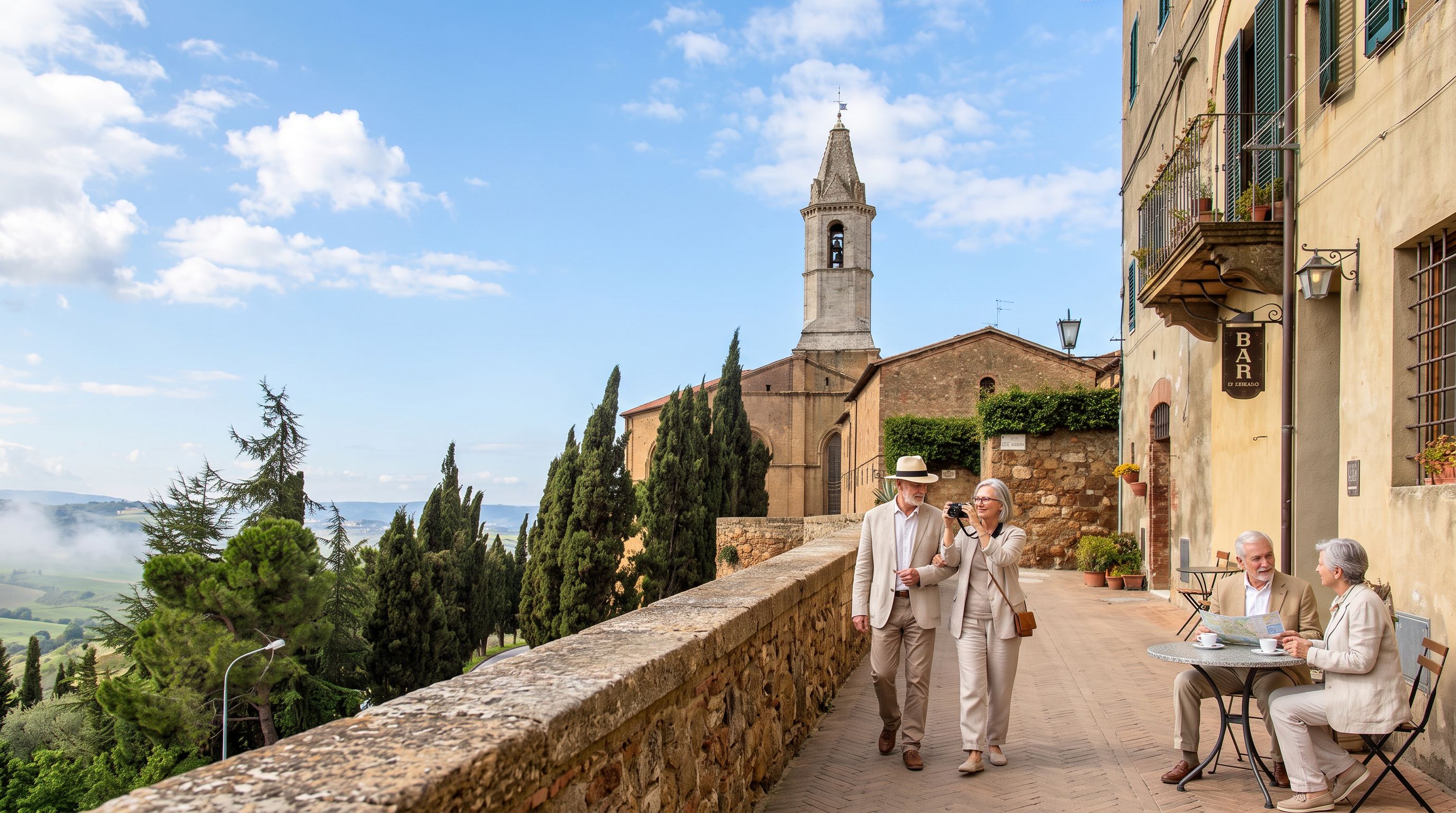 AI-edited
Which Tuscan hill town is easiest underfoot?
Pienza is the clearest documented answer for travellers 50 to 70 who want minimal climbing. Multiple traveller sources describe it as flat or mostly flat, pedestrian friendly, and easier than Montepulciano, with short inclines only toward viewpoints at the town's edge.
Pienza's historic centre sits on a gentle ridge, and its main street, Corso il Rossellino, runs nearly level between the two gates. Traveller reports on Rick Steves forums describe it as "flat all around" and "an extremely pleasant village," while a Fodor's discussion calls it "quite pedestrian friendly, even for poor walkers."
The town is compact and best navigated on foot, which works in its favour. You can see the cathedral, the papal palace and the panoramic viewpoints along the perimeter without sustained effort. The only documented inclines come at the belvederes looking out over the Val d'Orcia, and these are short. For a traveller who wants the hill-town experience without the hill, Pienza delivers.
How steep is Montepulciano, really?
Montepulciano is the most demanding of the six on foot. Travellers call its main street "a killer" and "pretty steep," and the town sits high on a 605-metre limestone ridge with Piazza Grande at the summit, so the entire visit is an uphill effort unless you use parking near the top.
BBC Travel describes Montepulciano as "perched on a narrow ridge" and notes that the climb along Il Corso to Piazza Grande can be demanding. Even fit travellers report not enjoying the climb, which suggests the gradient defeats more than just weak knees. The main approach rises steadily from Porta al Prato at the lower gate to the summit, and the cobblestones underfoot add to the effort.
The practical workaround is parking strategy. Montepulciano's parking is outside the historic centre, with lots such as P1 Porta al Prato at the lower gate and P6 and P8 near the summit. According to a town guide, P8 is the closest to the top, and some larger lots, including P8, provide shuttle bus services to the main square. Travellers advise using parking near the top or the Fortezza when available to reduce climbing. The public vehicle "Pollicino," documented in the Handy Superabile guide, reaches Piazza Grande and has a ramp for wheelchair users; the service number given in that guide is 0575/398843.
Does Siena have escalators to avoid the climb?
Yes. Siena is the easiest of the classic hill towns if the goal is to minimise steep climbing, because several central car parks sit below the historic core and some have escalators or moving walkways that carry visitors up into the centre.
Siena's historic centre is a limited traffic zone, so private vehicles cannot drive in without authorisation. Visitors park in paid lots outside the core, and the city has engineered the last stretch. According to a siena-cathedral.com page, the closest practical options for the Duomo are Parcheggio Il Campo, about a 5-minute walk, Parcheggio Santa Caterina, about 8 minutes, and Parcheggio il Duomo, about 10 minutes via escalator. Another page on the same site says the San Francesco, Santa Caterina, Il Campo and Duomo garages are linked by escalators or moving walkways that lift you the steep last stretch into town.
The upper city can be reached via three free, 24-hour escalator systems from parking areas and the station. A traveller discussion on Tripadvisor notes that San Francesco is convenient because the escalators avoid "a very steep climb" into the city centre. For those who need more help, the municipality provides a free substitute taxi for disabled users between the ends of the ascent systems, requestable by calling Siena Parcheggi at +39 0577 228799, according to the Visitsiena accessibility page. Siena also has a Disability Advocate, a position it was among the first Italian cities to establish, offering free support to residents with disabilities.
What about San Gimignano and its towers?
San Gimignano is manageable if you use the official edge-of-town parking, but its old town still involves a noticeable uphill approach from the car parks. The closest lot, Parcheggio Porta San Giovanni, sits about 5 to 10 minutes' walk below Piazza della Cisterna and Piazza del Duomo.
The historic centre of San Gimignano is a limited traffic zone, and official edge-of-town parking is recommended. The source identifies Parcheggio Porta San Giovanni as the closest lot for a quick walk, accessible 24/7, with the walk rising gently to the twin piazzas. Larger official alternatives include Parcheggio Montemaggio and Parcheggio Filippo di Lotto, also with 24/7 access, though these sit further out.
Once inside the walls, the main street, Via San Giovanni, runs uphill from the gate toward the towers. The gradient is steady rather than punishing, and the reward, the famous medieval skyline of 14 surviving towers, appears gradually as you climb. No exact step-free town-centre access detail was documented in the retrieved sources for San Gimignano itself, so travellers with limited mobility should plan for the uphill approach and consider a taxi from the lower lots if needed.
How do Cortona and Volterra compare?
Cortona is grouped among the towns that are especially steep and stair-heavy, while Volterra has paid parking at Parcheggio di Porta Fiorentina but little documented town-wide mobility relief. Both reward visitors who plan their approach carefully.
Cortona, perched above the Val di Chiana, is documented in traveller discussions as one of the more demanding hill towns, with steep lanes and stairs connecting its lower and upper sections. The town's Etruscan museum and its views over Lake Trasimeno are the draws, but the walking is sustained. One source gives Cortona museum opening and admission details but no stronger town-wide mobility relief than that, so the terrain itself is the limiting factor.
Volterra, set dramatically on a volcanic outcrop, has paid parking at Parcheggio di Porta Fiorentina, which places visitors at a reasonable entry point. The most concrete fact available is that the centre is a hill-town visit with seasonal museum hours rather than an easy walking environment. Some museum and parking timings vary seasonally, especially in Volterra, so check current hours before setting out. Neither town is documented as having the escalator systems of Siena or the flat centre of Pienza.
| Town | Documented terrain | Best parking strategy |
|---|---|---|
| Pienza | Flat or mostly flat; short inclines at viewpoints | Paid lots outside walls, including Via degli Archi with about 200 spaces |
| Siena | Steep core, but escalators from several car parks | Parcheggio Il Campo, Santa Caterina or il Duomo, linked by escalators |
| San Gimignano | Noticeable uphill approach from car parks | Parcheggio Porta San Giovanni, 5 to 10 minutes below the piazzas |
| Montepulciano | Very steep; summit at Piazza Grande | Upper lots P6 or P8, with shuttle service from P8 |
| Cortona | Steep and stair-heavy | Not documented in retrieved sources |
| Volterra | Hill-town visit; seasonal museum hours | Parcheggio di Porta Fiorentina |
Where can a car drop you near the top?
In Montepulciano, the upper lots P6 and P8 sit near the summit, and P8 offers a shuttle to Piazza Grande. In Pienza, drop-off is at Via Enzo Mangiavacchi 5 for tourist buses, with paid lots outside the walls. Siena's escalator car parks solve the problem entirely.
The question of where the car stops matters as much as the gradient itself. In Montepulciano, the published guide says P1 is the lower lot and P8 is the closest to the top of the town, while an elevator or ascensore can help from P5 or the bus station up to Giardini di Poggiofanti. A gotravelitalynow.com page says visitors must park outside the walls and use designated lots, with some higher lots reducing the uphill effort.
In Pienza, the official town portal states that the ZTL is active 24/7 inside the historic walls, tourist buses must pay a transit fee, and drop-off is at Via Enzo Mangiavacchi 5. A senior-travel guide says resident street spaces are reserved in the historic centre, so visitors generally use paid lots outside town, including the large lot in Via degli Archi with about 200 spaces. The walk from these lots into the centre is short and level.
For Siena, the escalator system means you can park below and rise into the heart of the city without climbing. This makes Siena arguably the most practical of the six for a full day of sightseeing, even though its streets are steep once you leave the escalator routes.
What should you see in each town?
Each town has a defining sight: Pienza's Renaissance piazza and cathedral, Montepulciano's Piazza Grande and San Biagio church, Siena's Duomo and Piazza del Campo, San Gimignano's towers, Cortona's Etruscan museum, and Volterra's Roman theatre and alabaster workshops.
Pienza is the model Renaissance town, rebuilt by Pope Pius II in the 15th century around a single harmonious piazza. The cathedral and the Palazzo Piccolomini, with its famous hanging gardens, sit at the centre, and the views from the belvederes over the Val d'Orcia are the payoff. The town is small enough to absorb in a morning, leaving time for lunch and a slow wander.
Montepulciano's Piazza Grande is documented as cobblestoned but fairly flat, and it remains the town's summit destination. The Montepulciano Cathedral has documented access details in the Handy Superabile guide, including a ramp added to overcome three entrance steps, about 5 metres long at roughly 9 percent incline. The town's Museo is documented as visitable across all four floors by wheelchair users through ramps and an elevator with a 75 cm doorway. The San Biagio church, just below the town, has a small entrance lip and other access constraints, according to an accessible-tour operator.
For a broader look at the region, Florence deserves its own visit, and it has its own dedicated guide elsewhere in this magazine. The hill towns stand apart from the city experience, each offering a distinct slice of Tuscan history without the urban crowds.
How should you plan a route between towns?
Base yourself in one or two towns and make day trips. Montepulciano and Pienza sit just 14 kilometres apart, about 15 minutes by car with clear roads, making them a natural pairing. Siena works as a separate base, with San Gimignano 40 kilometres away.
The road distances between the towns are modest, which makes a multi-town itinerary feasible without constant packing and unpacking. From Siena's railway station, San Gimignano is 40 kilometres by road, about 40 minutes with clear roads. Montepulciano is 64 kilometres from Siena, about 55 minutes with clear roads, and Pienza is 69 kilometres, about 60 minutes. Cortona, measured from the Camucia-Cortona railway station, is 67 kilometres from Siena, about 55 minutes, and Volterra is 49 kilometres, about 55 minutes.
For travellers who prefer not to drive, the practicalities of getting around Tuscany by train, bus or car are covered in a separate guide. The hill towns themselves reward a slow pace, and the week-long itinerary for the over-50s suggests a sensible rhythm of big sights and quiet afternoons.
A circular walking route from Pienza into the countryside is described as "very nice" in one traveller thread, though the same discussion warns of "some steep slope" and "quite steep hills" on the walk toward La Foce and La Vitaleta. In 2024, a new pathway was inaugurated in Pienza linking the main piazza to the surrounding countryside, with 28 travertine-marble benches along the route, making it a more comfortable option for slower walkers. The route runs for just under two miles and offers a gentle way to experience the Val d'Orcia landscape.
When is the best time to visit?
Early mornings before 10 AM and late afternoons after 4 PM generally see fewer people, especially during peak season, according to a Montepulciano transport guide. Avoid Friday in Pienza, when the market fills the streets and complicates parking.
The hill towns draw their largest crowds in the middle of the day, when tour buses arrive and the main streets fill. A Rick Steves forum post advises avoiding Friday in Pienza because it is market day, which affects parking. The same logic applies across the towns: visit early or late, and you will find quieter streets and easier movement.
For walking routes between towns, one hiking source says the Pienza-to-Montepulciano route is best from April to October, which reflects the conditions on the trails rather than the towns themselves. The towns are open year-round, and the shoulder seasons of spring and autumn offer mild temperatures and softer light on the stone facades.
What should you confirm before you go?
Several practical details are not documented in the available sources for these towns. No over-65 fares or senior passes were found for the hill towns themselves, no town-specific emergency numbers were documented, and no exact closure schedules were confirmed.
Travellers aged 50 to 70 often plan around four things: mobility, health, safety and ease of booking. On mobility, the terrain facts above are well documented. On health, no nearest pharmacy or medical help details were found for the exact towns in the gathered sources, so ask at your accommodation when you arrive. On safety, the towns are generally quiet at night, with one Tripadvisor review noting that "Pienza old town has zero noise at night," though this is a traveller account rather than a townwide guarantee.
On booking, the Pienza town portal says access and permit requests for ZTL access, paid parking permits and tourist bus entry fees are handled through a digital platform or by QR code. No senior or over-65 tariff is documented on the Pienza portal page. For Montepulciano, the accessible-tour operator Accessible Tuscany offers a guided tour of Montepulciano and Pienza designed for disabled participants, with step-free routes and short walking or rolling distances; the operator notes that including only Pienza improves the accessibility rating. Users provide their own transport between the towns.
For those who want to see more of the region with minimal walking, the guide to seeing Tuscany with little walking offers a broader perspective on accessible itineraries.
The bottom line for travellers 50 to 70
Choose Pienza for the gentlest walking, Siena for the best mobility infrastructure, and Montepulciano only if you use the upper parking or shuttle. San Gimignano, Cortona and Volterra reward the effort but demand more from the knees.
The hill towns of Tuscany are among the most beautiful places in Italy, and none should be ruled out entirely. The key is matching the town to your walking ability and planning the approach. Pienza offers the classic Tuscan experience, Renaissance architecture, sweeping valley views, excellent local cheese, on nearly level ground. Siena delivers grandeur with the help of its escalators. Montepulciano, for all its steepness, rewards those who arrive at the top by shuttle with one of the most atmospheric piazzas in the region.
For a fuller picture of the region's accessibility, the official Tuscany accessibility overview from Visittuscany includes municipality-level notes for Siena and Pienza. And for the wider context of the Valdichiana Senese, where Montepulciano was the 2024 Tuscan Capital of Culture, the Visittuscany list of villages not to be missed places the town within its regional setting.
The hills will always be there. The art of visiting them well, at any age, is knowing which ones to climb and which to let the shuttle climb for you.


